The BIP-110 split: Bitcoin forked on Saturday night, and nobody followed
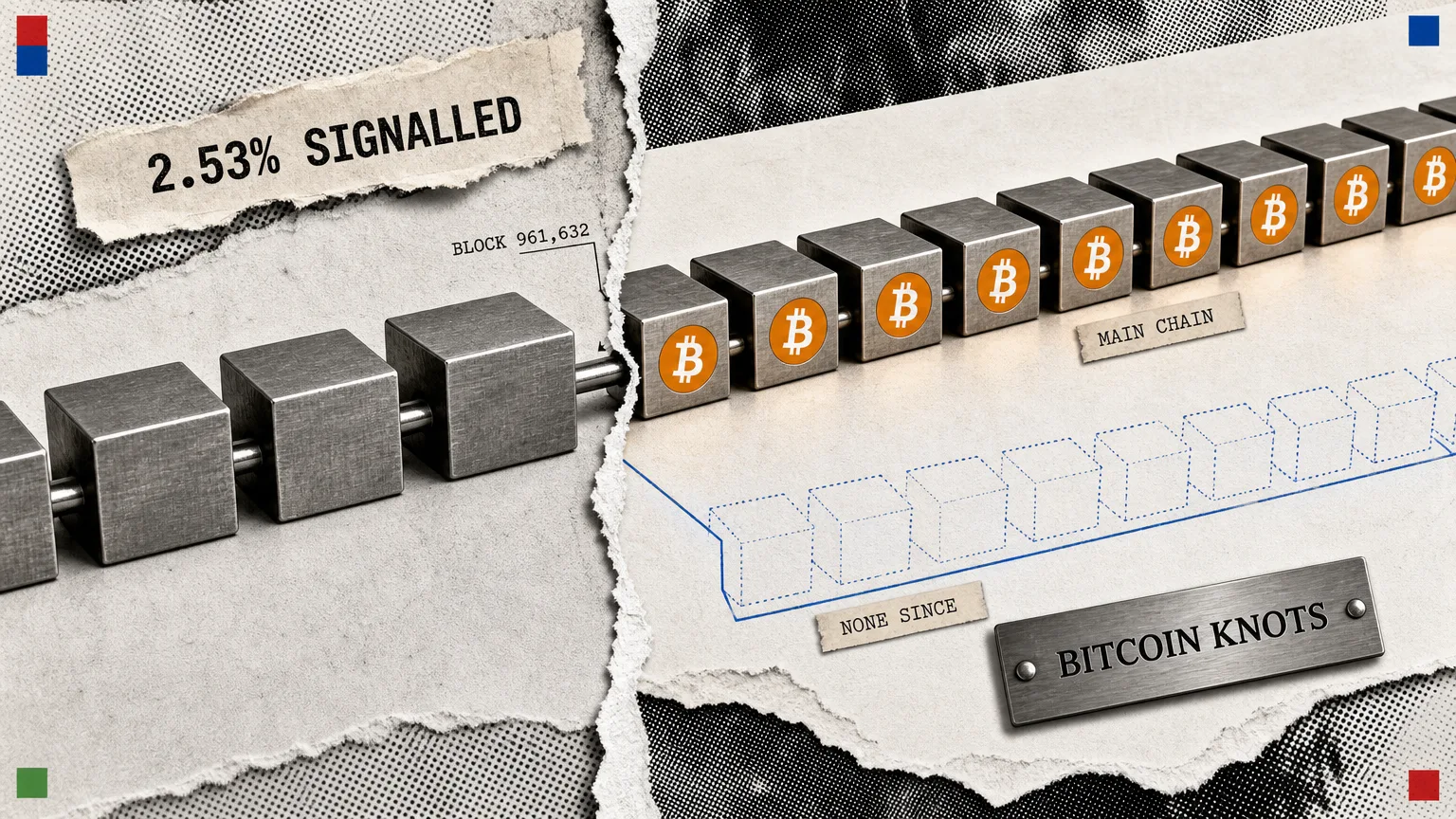
Mandatory signalling for BIP-110 opened at block 961,632 on Saturday evening. That block did not signal, so nodes enforcing the rule rejected it. Our own count of the chain puts miner support at 51 blocks in 2,016.
Listen to this podcastListen
Bitcoin block 961,632 was mined at 19:35:55 UTC on Saturday evening. Its version field reads 0x20006000, which has bit 4 unset, and bit 4 is the one BIP-110 asks miners to raise. Under the rules the proposal itself sets out, 961,632 opened a mandatory signalling period, and a node enforcing those rules had no choice but to reject the first block that arrived without the flag. That is what a chain split is: not a dramatic event, just software following the rule it was given.
What BIP-110 asks for
The Reduced Data Temporary Softfork imposes seven consensus limits on how much arbitrary data a transaction may carry. Output scripts above 34 bytes become invalid unless they start with OP_RETURN, which gets 83; pushes and witness elements are capped at 256 bytes; undefined witness versions, the Taproot annex and several Tapscript behaviours are restricted. The target is the technique that writes images and tokens into a chain designed to move money.
It was created on 3 December 2025 under the pseudonym Dathon Ohm, reached Complete status, and it expires: 52,416 blocks, about a year, after any activation. The parameters are unusually specific. Signalling runs from block 961,632 to 963,647, lock-in needs 1,109 of 2,016 blocks, or 55 per cent, and the last possible activation height is 965,664, around 1 September.
Fifty-five is itself the argument in miniature. BIP-9 uses 95 per cent for permanent changes; the authors chose a lower bar on the grounds that this one is temporary and urgent.
The number, counted rather than quoted
We read the signalling period off the chain instead of taking it from anyone’s summary. Across blocks 959,616 to 961,631, all 2,016 of them, 51 carried bit 4. That is 2.53 per cent, against the 1,109 blocks the specification requires. Lock-in was arithmetically impossible long before the deadline arrived.
Since the split we counted again: of the 98 blocks the main chain has added, not one has signalled.
Who was for, and who was against
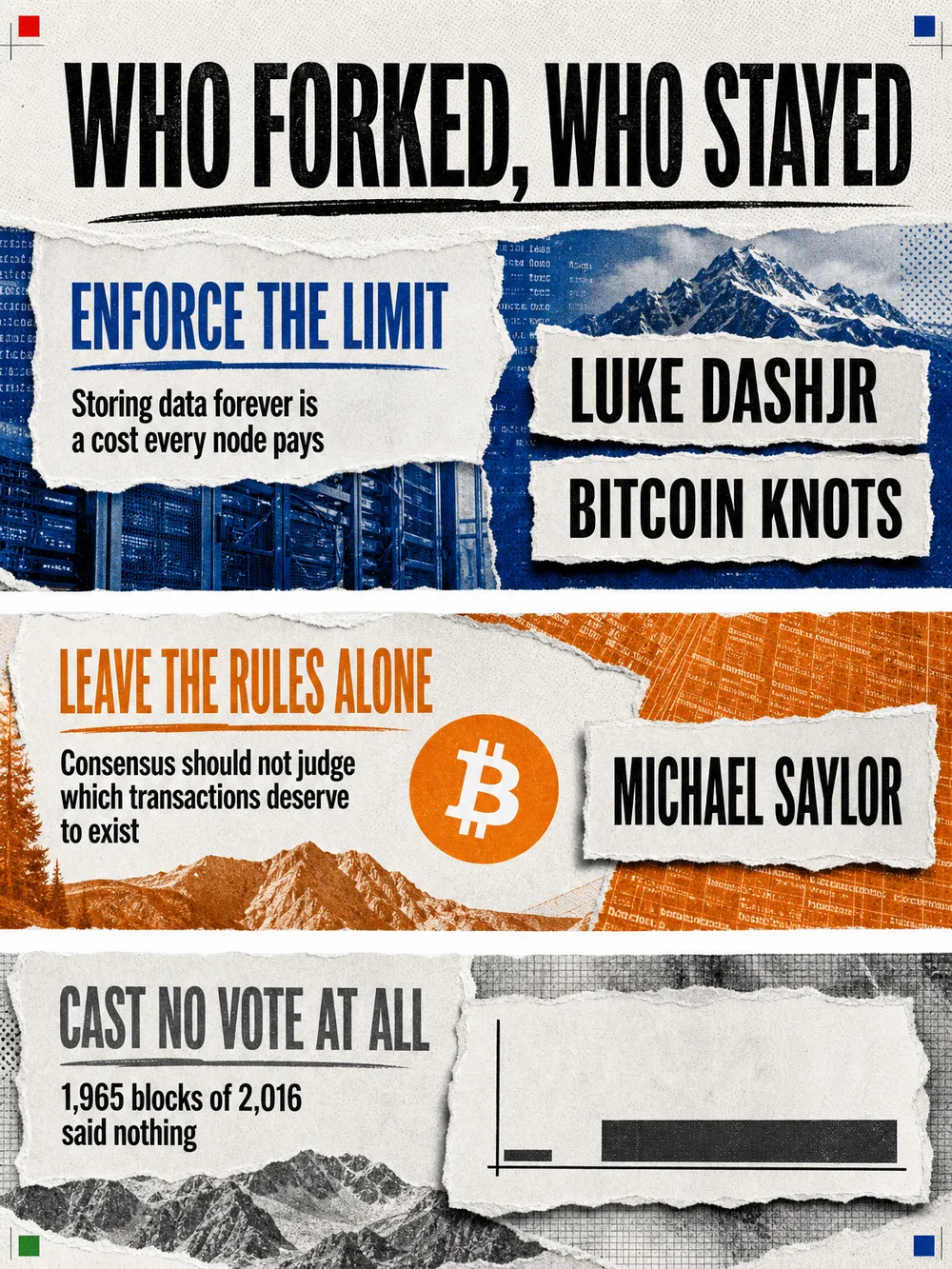
| Position | Who | The argument |
|---|---|---|
| Enforce the limit | Luke Dashjr and the Bitcoin Knots project, which shipped the implementation, and the node operators running it | Permanent storage of non-monetary data is a cost every node pays forever |
| Leave the rules alone | Michael Saylor, Adam Back, and the reviewers on the BIP itself | Consensus rules should not judge which fee-paying transactions deserve to exist |
| Cast no vote at all | The mining industry | Silence, in 1,965 blocks out of 2,016 |
Saylor made the fullest case against, on X on 19 July: “Many Bitcoiners I respect support BIP 110. I understand and share their desire to protect Bitcoin, but believe the proposed cure is more dangerous than the condition. Here are 110 reasons why Bitcoin needs guardians of neutrality.”
The review thread on the proposal was no gentler. Mark Erhardt, working through the text, called it “an unusually rushed and careless approach to Bitcoin protocol development”. Jameson Lopp pressed on denial-of-service vectors and the scope of legacy script. Peter Todd defended the applications the limits would break, pointing out that timestamped signatures stay verifiable even after a key is later compromised.
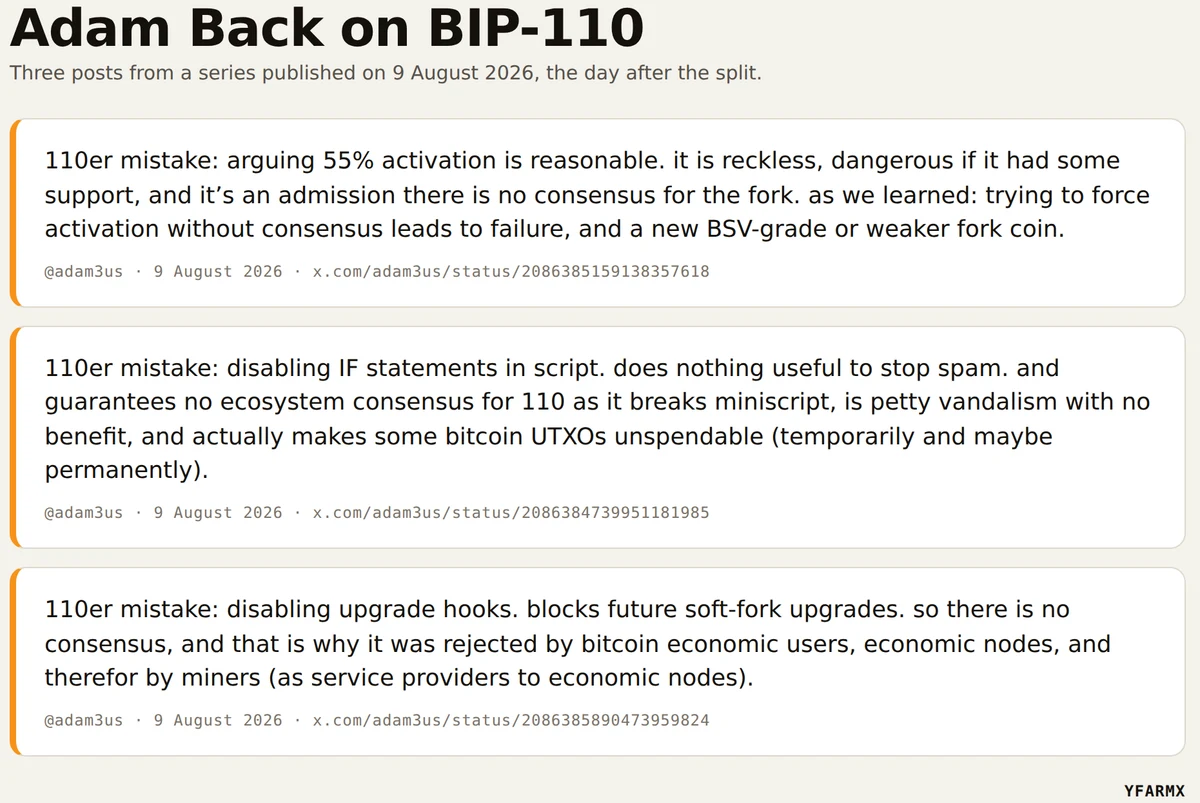
Adam Back spent Sunday posting a numbered series of what he calls the 110ers’ mistakes. On the activation bar: “arguing 55% activation is reasonable. it is reckless, dangerous if it had some support, and it’s an admission there is no consensus for the fork.” On the script changes: disabling IF statements “does nothing useful to stop spam”, “breaks miniscript”, and “actually makes some bitcoin UTXOs unspendable (temporarily and maybe permanently)”.
His governance argument compresses the whole disagreement into three sentences: “the economic users control the protocol, via the market. they transmit their views by transacting with their economic nodes. 1000s of nodes with no economic use have no influence.” A node that nobody sends money through, on this account, is not a vote.
He also supplied the detail we could not otherwise stand up. Asked what became of the forked chain, Back’s answer was flat: “no blocks after the first 2.”
And the ending has an author. On 3 July, five weeks before any of it, Michael Rozman wrote: “I look forward to witnessing the BIP110 chain freeze in time like Pompeii. Its last block will serve as a historical monument, standing for future generations as a stark symbol of hubris and stupidity.” Back reposted it on Sunday with four words: “and behold, it happened as foretold.”
The line that did not survive contact
Luke Dashjr, before the deadline, on X: “1) I’m not the leader. There is no leader. 2) BIP110 cannot cause a chain split. 3) If miners attack the network and cause a chain split, they will be only hurting themselves.”
The chain split on Saturday night, and it was not miners who changed the rules they were validating against.
The contingency being discussed on the same side is a change to Bitcoin’s proof-of-work algorithm, which would make every mining chip on the network worthless on whichever chain adopted it. Chris Guida, who prepared the code, has been explicit that it is not primed: “People seem to think that the intention is for this pow change to activate immediately. That’s not the case. This is just some code to have in our back pocket in case miners betray bitcoin, to activate at some point later. No deadline for activation has been set.”
Sources
- BIP-110, Reduced Data Temporary Softfork, the specification text (status Complete, created 3 December 2025)bips.dev
- BIP 110 pull request and review discussion, bitcoin/bips #2017github.com
- Reduced Data Temporary Softfork implementation, bitcoinknots/bitcoin #238github.com
- ReducedData Temporary Softfork (BIP-110/RDTS), bitcoin/bitcoin #34930github.com
- Block 961,632, timestamp and version, mempool.space (read 9 August 2026)mempool.space
- Michael Saylor on X, '110 reasons why Bitcoin needs guardians of neutrality' (19 July 2026)x.com
- Luke Dashjr on X, 'BIP110 cannot cause a chain split'x.com
- Chris Guida on X, on the proof-of-work contingency codex.com
- Adam Back on X, on the 55 per cent activation bar (9 August 2026)x.com
- Adam Back on X, on disabling IF statements and miniscript (9 August 2026)x.com
- Adam Back on X, on upgrade hooks and consensus (9 August 2026)x.com
- Adam Back on X, 'no blocks after the first 2' (9 August 2026)x.com
- Adam Back on X, 'and behold, it happened as foretold' (9 August 2026)x.com
- Michael Rozman on X, the Pompeii prediction (3 July 2026)x.com