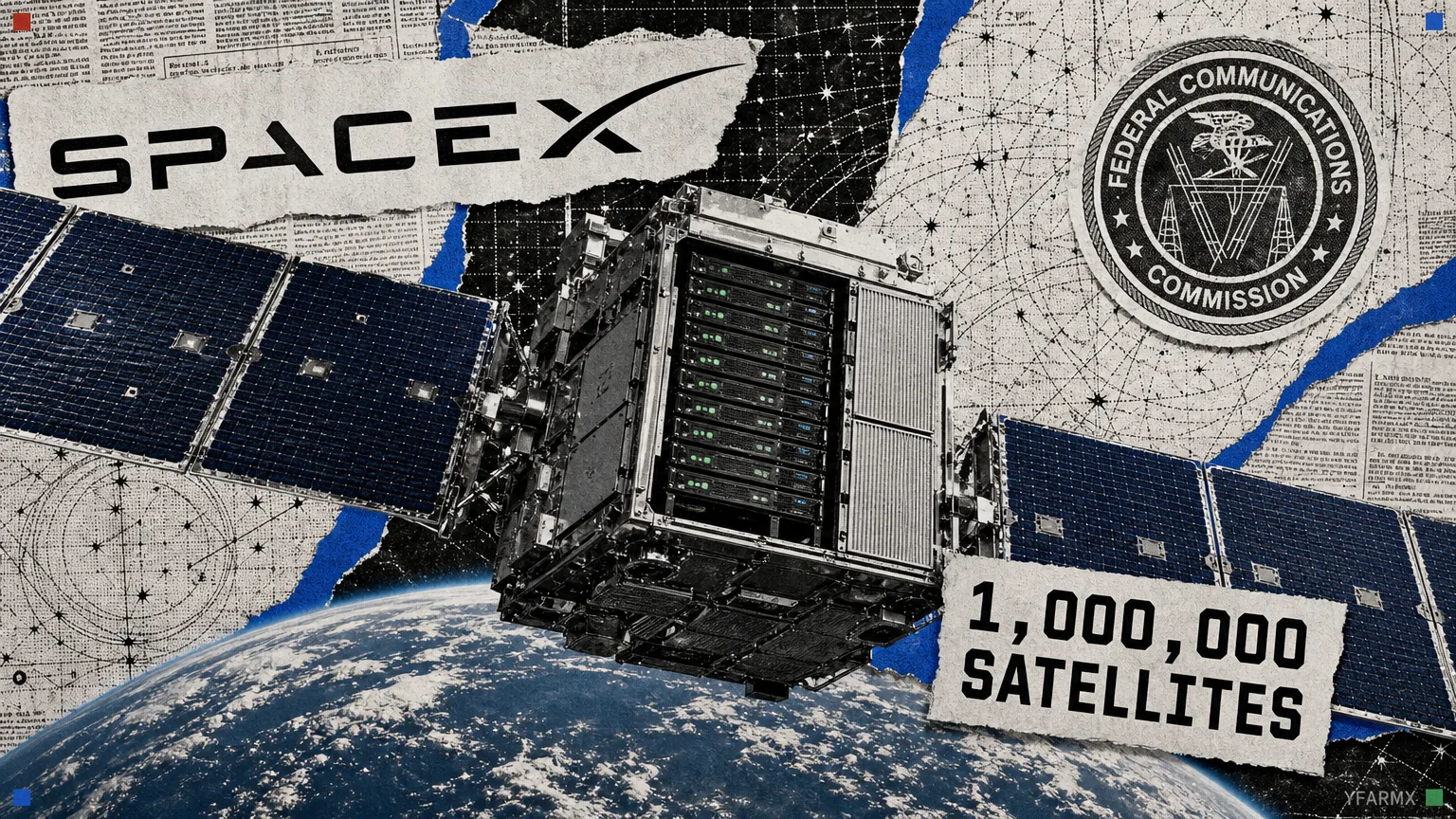
FCC clears SpaceX for up to one million data-centre satellites
The US Federal Communications Commission authorised SpaceX on 25 November 2026 to launch up to one million Starmind satellites, each a small AI data centre in orbit. The grant is conditional: the first must fly by November 2033 and the higher orbits need a further filing.
Listen to this articleListen
The US Federal Communications Commission authorised SpaceX on 25 November 2026 to launch and operate up to one million satellites that work as AI data centres in orbit, a system SpaceX calls Starmind. The FCC called it the first authorisation in US history for a constellation of data centres in space. Its chairman, Brendan Carr, said: “This action opens a bold new frontier for the computing infrastructure needed to power America’s leadership and growth.”
The approval is conditional. SpaceX has to meet four deployment deadlines between 2033 and 2040, and the FCC’s Space Bureau held back its decision on how satellites in the higher orbits will be disposed of. Elon Musk wrote on X that “this will be a great asset to America and the world.”
What did the FCC approve?
The FCC’s Space Bureau granted SpaceX authority for up to one million satellites in six altitude bands between 500km and 1,002km above the Earth, on a 15-year licence. SpaceX applied on 30 January 2026 and the bureau issued its order ten months later.
| Term of the grant | Detail |
|---|---|
| Satellites | Up to 1,000,000 |
| Altitude | 500km to 1,002km, in six altitude bands |
| Data links | Mainly optical, by laser |
| Radio spectrum | Two Ka-band ranges, for backup and emergency control only |
| Licence term | 15 years from the first working satellite |
The satellites talk mainly by laser. The grant covers two slices of Ka-band radio spectrum, 18.8 to 19.3GHz down and 28.6 to 29.1GHz up, and limits them to backup and emergency tracking and control. Those radio links get no protection from interference, and SpaceX has to stop any transmission that causes documented harmful interference to another operator.
Each Starmind satellite is a computer with solar panels. SpaceX’s first design, Starmind AI1, draws about 250 kilowatts at full power and carries a full Nvidia server rack. SpaceX’s application argued that the satellites would run on “near-constant solar power”.

What deadlines does SpaceX have to meet?
SpaceX must have its first Starmind satellite working by 25 November 2033, 100,000 by 2035, 500,000 by 2038 and the full million by 2040. Missing a deadline voids the authorisation.
| Deadline | Satellites in orbit and working |
|---|---|
| 25 November 2033 | The first |
| 25 November 2035 | 100,000 |
| 25 November 2038 | 500,000 |
| 25 November 2040 | 1,000,000 |
The later steps are steep. Going from 100,000 satellites to 500,000 in three years means launching more than 130,000 a year, about 365 a day, on our arithmetic. Twice a year, on 1 January and 1 July, it has to report to the FCC on launches, close approaches with other objects, avoidance manoeuvres and re-entries.
What did the FCC hold back?
The bureau accepted SpaceX’s plan for dealing with space debris only for satellites that fly below 600km, which covers two of the six altitude bands. The other four bands sit between 686km and 1,002km. Before SpaceX puts a satellite in any of them it has to file a modification with a fuller debris plan and have it approved.
The bureau also deferred one SpaceX request. Satellites in low orbits are normally disposed of by letting them burn up in the atmosphere, and the higher a satellite flies the longer that takes. SpaceX asked for permission to retire satellites above 600km in other ways, such as moving them to a disposal orbit around the Earth or the Sun. The bureau said it needed more information before deciding.

How does one million compare with what is in orbit now?
About 16,700 working satellites are in orbit today, so the full Starmind constellation would be about 60 times everything flying now. CNN reported the count from the tracker Orbital Radar, alongside a European Space Agency figure of 15,800 functioning satellites.
The hardware is unproven at this scale, and SpaceX has said so itself. In a regulatory filing before its stock market listing it told investors that data centres in space rely on “unproven” technologies and “may not achieve commercial viability”, CNN reported. The main engineering problem is heat. A computer on the ground is cooled by air or water, and a computer in orbit can shed heat only by radiating it from large panels.
Who objected?
Amazon, Viasat and the American Astronomical Society each asked the FCC to deny the application, and the bureau turned all three down. Amazon, which is building its own Leo satellite network, called the plan “a lofty ambition rather than a real plan” in its petition of March 2026.
The astronomers’ objection is about the sky itself. The American Astronomical Society said it was “dismayed” by the decision and warned that the satellites would be “extremely bright objects for longer periods in the night sky”. The bureau accepted SpaceX’s commitment to coordinate with the US National Science Foundation on protecting astronomy and added no further conditions.
On the question many commenters raised, whether a million orbiting computers can work or pay for themselves, the bureau left the judgment to SpaceX. Asked to weigh the plan’s technical and economic chances, its order answered: “We decline to do so.”

Why does SpaceX want computers in orbit?
SpaceX’s case is that orbit has unlimited sunlight and room, at a time when AI data centres on the ground are running short of electricity. Its application, as CNN reported it, said the satellites would run “with little operating or maintenance costs”. The FCC’s own statement cited “rapidly growing demand” for computing and satellites able to “process massive amounts of data to be used back here on Earth”.
The plan depends on Starship, SpaceX’s fully reusable rocket, bringing the cost of launch down far enough to make a million satellites affordable. On the ground, the strain AI data centres put on the power grid is already slowing new sites, and SpaceX is working both ends of that problem: it proposed a supercomputer campus with its own gas power plant in Texas earlier in November, with about $24bn of investment in its first phases.
The licence is granted and the clock starts in 2033
The grant stands unless SpaceX declines it within 30 days, and after that the dates in the order are the test. The company has to put one working data-centre satellite in orbit by November 2033 and half a million five years later. Carr set out what he believes is at stake when he announced the decision: “America is leading the world into the era of super intelligence.”
Sources
- Federal Communications Commission: Order and Authorization, SpaceX orbital data center system (DA 26-1273, 25 November 2026)docs.fcc.gov
- Federal Communications Commission: FCC authorizes 1 million satellites for data centers in spacefcc.gov
- CNN: US authorizes SpaceX to deploy 1 million satellites for AI data centers in space (26 November 2026)cnn.com
- Amazon Leo: Petition to deny SpaceX's orbital data center application (6 March 2026)aas.org