SpaceX will fly an NVIDIA NVL72 rack in orbit
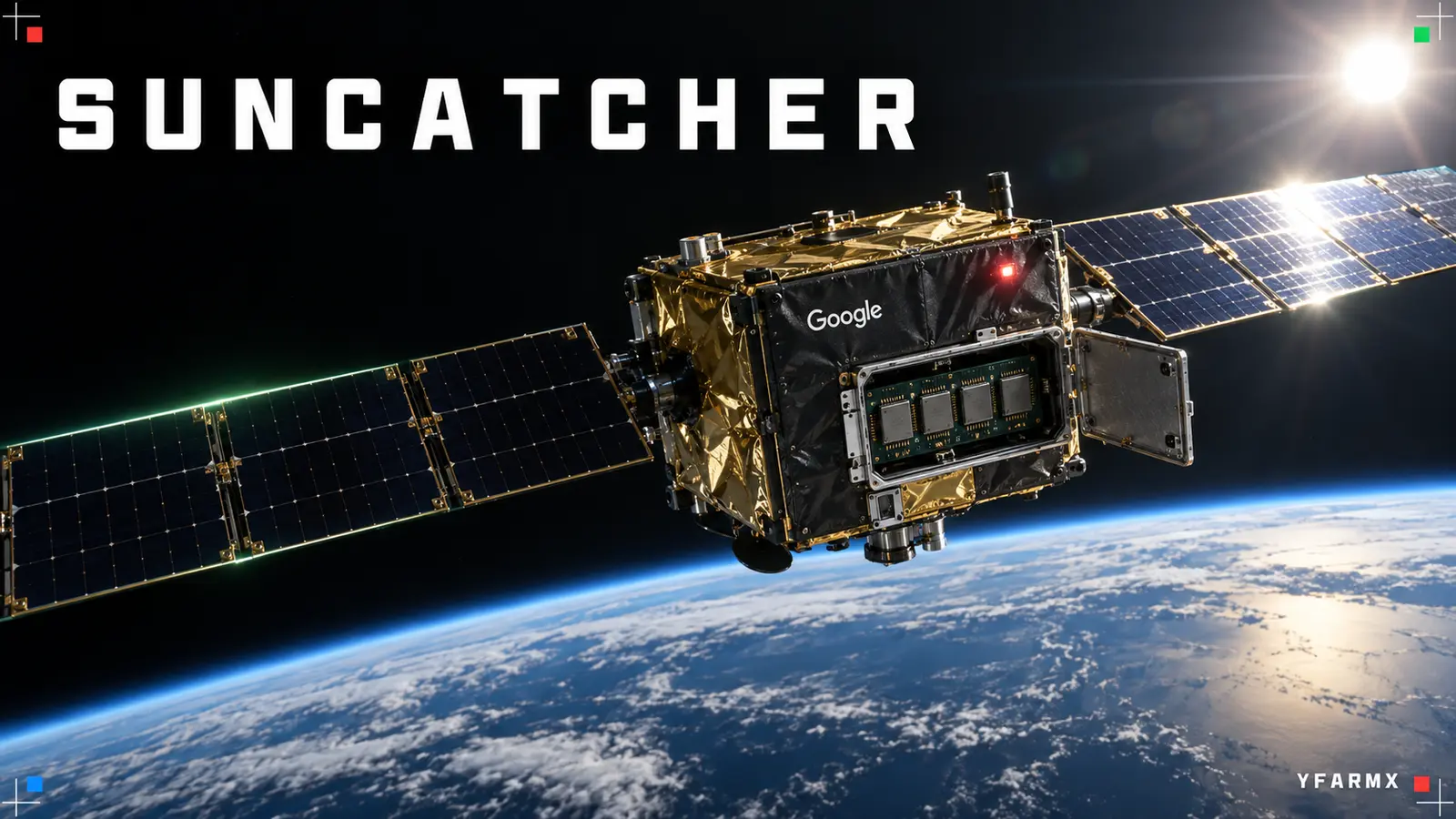
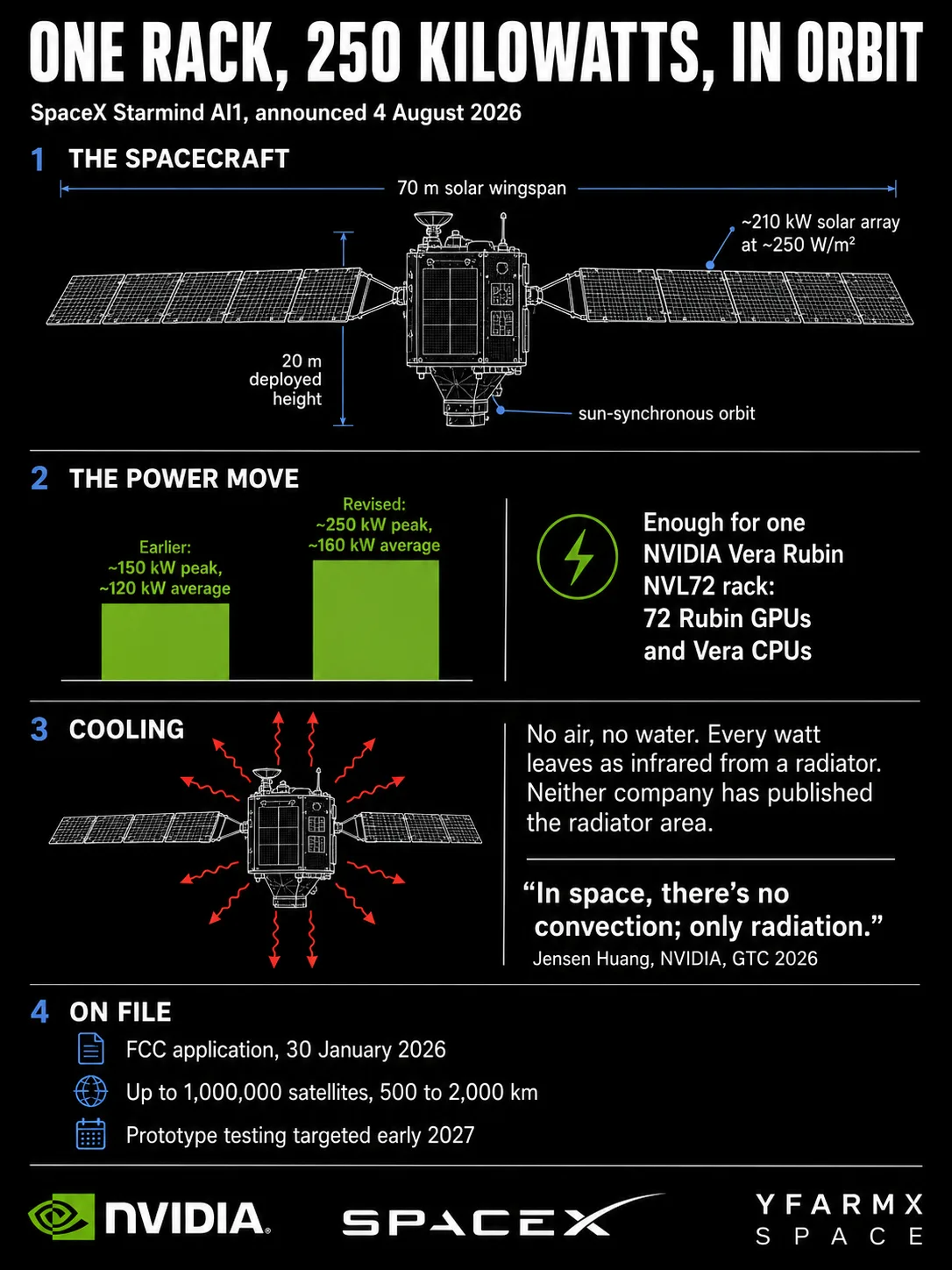
SpaceX says its Starmind AI1 satellite will carry NVIDIA Rubin GPUs and Vera CPUs, and NVIDIA says the payload is a Vera Rubin NVL72. The satellite was made two thirds more powerful to carry it.
Listen to this articleListen
SpaceX said on 4 August 2026 that it is working with NVIDIA on the compute payload for Starmind AI1, its first orbital data-centre satellite. In SpaceX’s words, “each of the Starmind satellites will include NVIDIA Rubin GPUs and Vera CPUs for datacenter class space compute.”
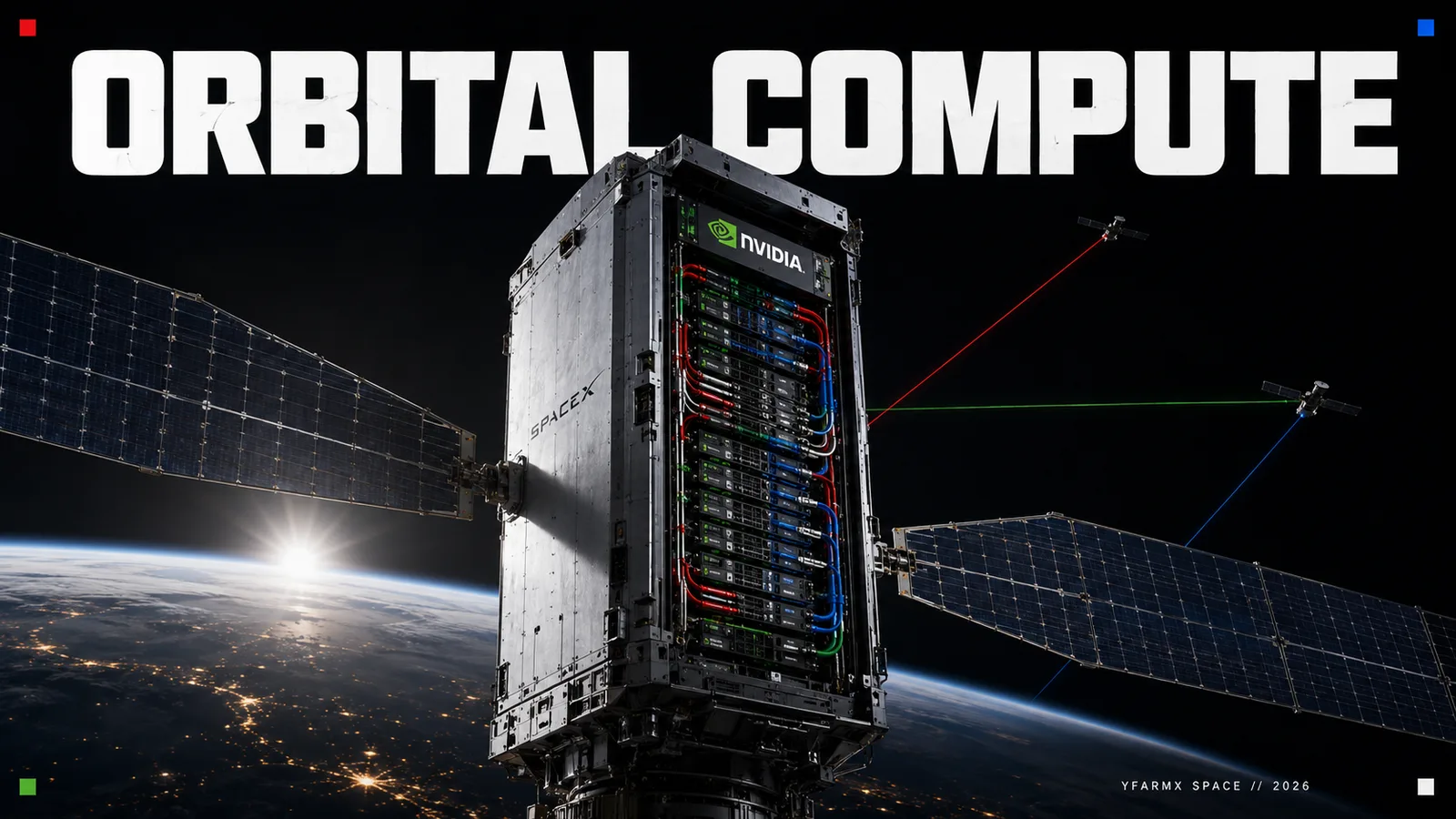
NVIDIA named the part. Its own post says the Starmind AI1 payload is powered by NVIDIA Vera Rubin NVL72, the rack-scale system it sells for ground data centres, holding 72 Rubin GPUs alongside Vera CPUs.
They made the satellite bigger to fit the rack
The giveaway is that SpaceX changed the satellite before it announced the partnership. It now draws about two thirds more power at full tilt than the version described a few weeks earlier.
| Before | Now | |
|---|---|---|
| Full power | ~150 kW | ~250 kW |
| Typical running power | ~120 kW | ~160 kW |
That is roughly what one of NVIDIA’s racks eats. Not a scaled-down version of one, not a single card: the whole cabinet, seventy-two graphics chips, the thing NVIDIA sells to companies building data centres on the ground.
Mostly solar panel, with a computer in the middle
The satellite is enormous. Unfolded it stands about as tall as a six-storey building, and its two solar wings span 70 metres, wider than a Boeing 737. Almost all of that is there to make electricity. The computer is the small part in the middle.
It flies in a sun-synchronous orbit, which means it crosses the daylight side of the planet at the same local time on every lap and stays in sunlight almost permanently. No sunset, no long stretch running off batteries, no bill.
That is the pitch. A data centre on the ground has to buy power from a grid, wait years for permission to connect to it, and pay again to get rid of the heat. This one makes its own power the moment it unfolds, and nobody has to approve it.
The rack in orbit is not the space-rated part
NVIDIA has a purpose-built orbital product: at GTC 2026 it announced the NVIDIA Space-1 Vera Rubin Module, which it says delivers up to 25 times more AI compute for space-based inferencing than an H100. That launch named six partners, and SpaceX was not among them: Aetherflux, Axiom Space, Kepler Communications, Planet Labs, Sophia Space and Starcloud.
What NVIDIA’s Starmind post names is Vera Rubin NVL72, the terrestrial rack. Neither company has published how the rack is qualified for launch loads, vacuum or the radiation environment, or how much of the NVL72 architecture survives into flight hardware. SpaceX has previously described AI1’s compute payload as interchangeable, which reads as a design that expects its silicon to be swapped.
The hard part is getting rid of the heat
Jensen Huang summed the problem up in one line at GTC 2026: “In space, there’s no convection; only radiation.”
A rack of chips that powerful runs hot enough to need serious cooling, and on the ground that is a solved problem. You blow air across it, or you pump water through it. In space there is no air and no water to carry the heat anywhere. The only way out is to let it glow away from a big enough surface, slowly.
So the real limit on a satellite like this is not how many chips you can afford to launch. It is how large a radiator you can unfold to keep them from cooking. Neither company has said how big that radiator is.
One million satellites, on file
None of this is a sketch on a whiteboard. SpaceX applied to the American regulator on 30 January 2026 for permission to fly up to a million of these satellites, and the FCC accepted the application a week later. The plan is for them to pass work between each other by laser and hand it to the existing Starlink network, so most of the traffic never touches a ground station until the end.
A million is the ceiling written into the paperwork rather than a build order. The first AI1 is due to be tested in early 2027, with production later that year if it goes well.
The commercial half
The announcement arrived hours before SpaceX’s first earnings call as a public company. On that call Elon Musk said NVIDIA would be the exclusive supplier for SpaceX’s AI chip needs, which converts a payload partnership into a standing procurement commitment across both the orbital and ground build-out.
The easy parts are done, the hard part is unproven
Two thirds of this already works. SpaceX builds big solar arrays and launches them by the hundred. NVIDIA builds the rack. Putting the whole thing somewhere the sun never sets is a genuinely good answer to the power problem, and no site on Earth can match it.
What nobody has shown is the rest: keeping that much computing cool in a vacuum, and getting hardware built for an air-conditioned building to survive a rocket launch and then work. On both, the two companies have given a name and a wattage and left it there. Early 2027 is when we find out.
Sources
- SpaceX announcement post on X (4 August 2026)x.com
- NVIDIA announcement post on X (4 August 2026)x.com
- NVIDIA Newsroom, NVIDIA Launches Space Computing, Rocketing AI Into Orbit (GTC 2026)nvidianews.nvidia.com
- FCC Public Notice DA-26-113A1, Space Exploration Holdings application, ICFS File No. SAT-LOA-20260108-00016docs.fcc.gov