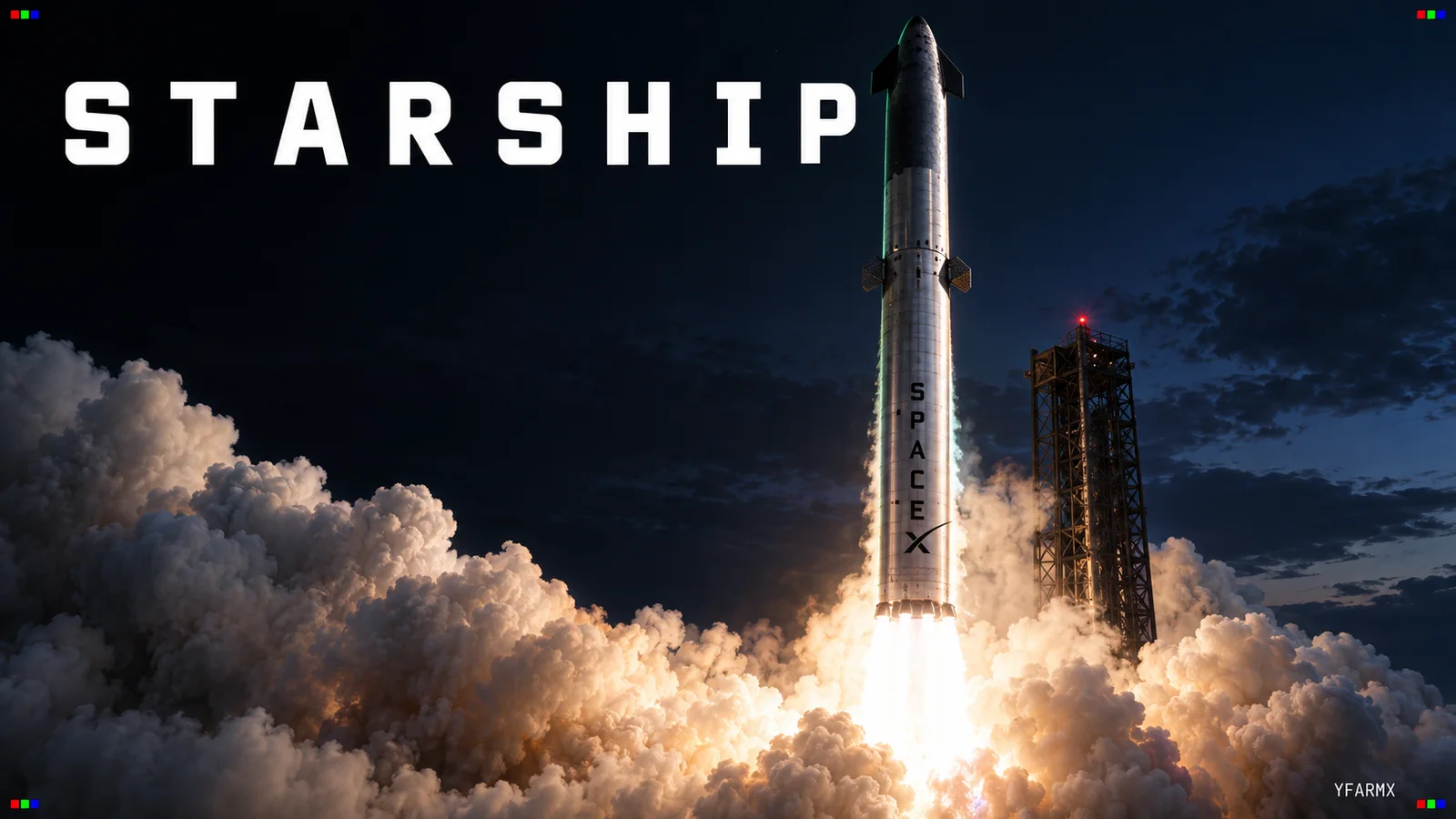
SpaceX targets Starship’s first double catch
Starship Flight 15 targets a 4:45 p.m. Texas launch on 13 November, pending approval, followed by booster recovery and a Ship catch the next day.

Listen to this articleListen
SpaceX is targeting 13 November for a Starship flight designed to bring both rocket stages back to Starbase’s catching towers. Its Flight 15 mission plan gives a 75-minute launch window opening at 4:45 p.m. Texas time, subject to regulatory approval.
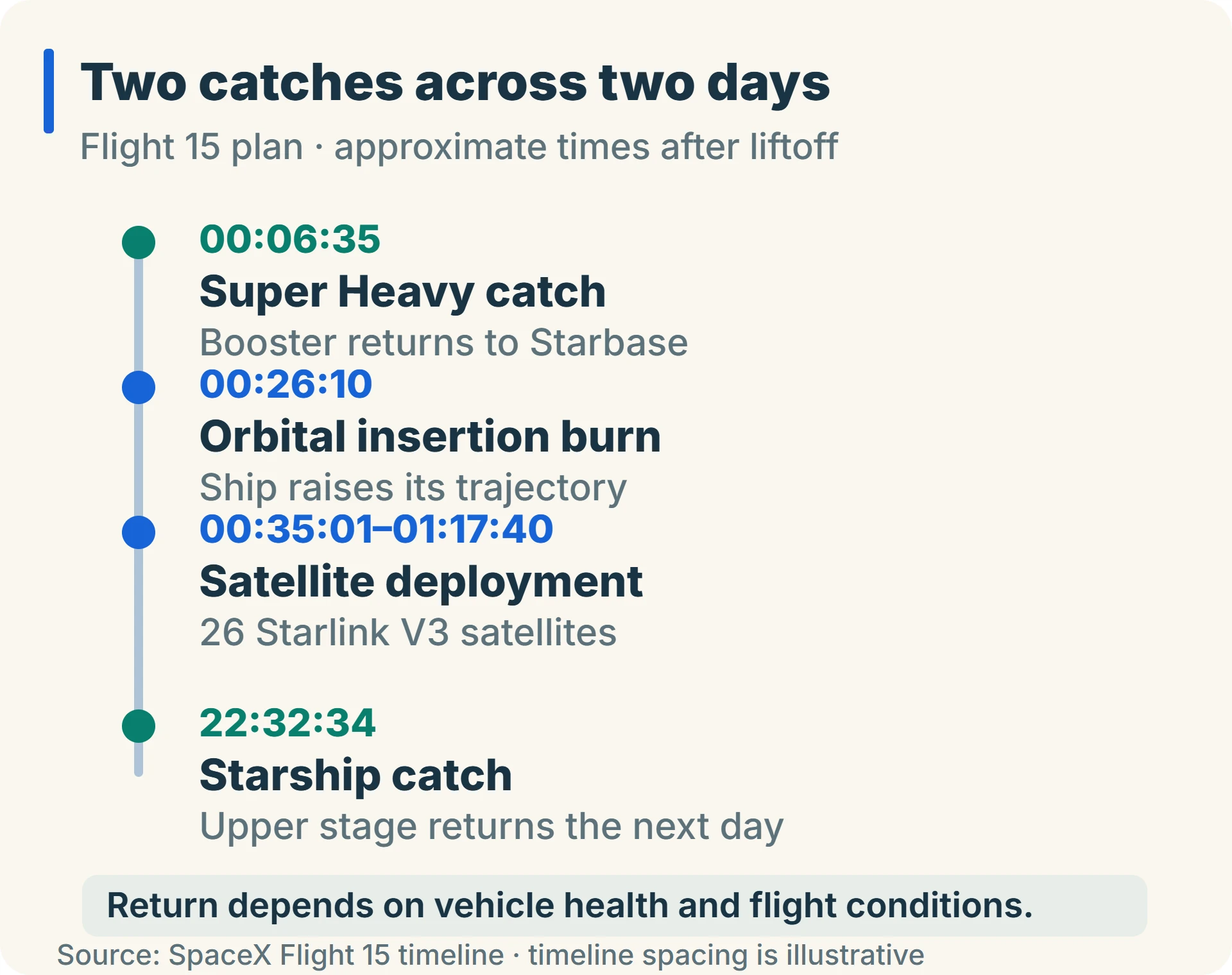
The two catches would happen on different days. Super Heavy is scheduled to return about six and a half minutes after launch. The Starship upper stage would deploy 26 Starlink V3 satellites, circle Earth roughly 14 times and return about 22½ hours after liftoff. A successful pair of recoveries would advance SpaceX’s goal of reusing the complete launch system.
The booster comes back first
Super Heavy’s planned catch is 6 minutes 35 seconds after liftoff, according to SpaceX’s approximate flight timeline. The booster first pushes Starship through the lower atmosphere, separates and fires its engines to reverse course towards Starbase.
SpaceX describes Flight 15 as the first return-and-catch attempt for a V3 Super Heavy booster. Earlier-generation boosters have already demonstrated tower catches and reflights. This mission applies that recovery method to the newer version while adding the upper stage’s much longer journey home.
Starship’s orbital insertion burn is scheduled about 26 minutes after launch. Satellite deployment would begin around 35 minutes and finish roughly 1 hour 18 minutes into the flight. These are planned milestones, with vehicle health and flight conditions determining the actual sequence.
The Ship has a full day of work
Starship is expected to fly at approximately 275 kilometres altitude for around 14 orbits before its return. SpaceX’s published sequence places the deorbit burn about 21 hours 36 minutes after liftoff and the catch at approximately 22 hours 33 minutes.
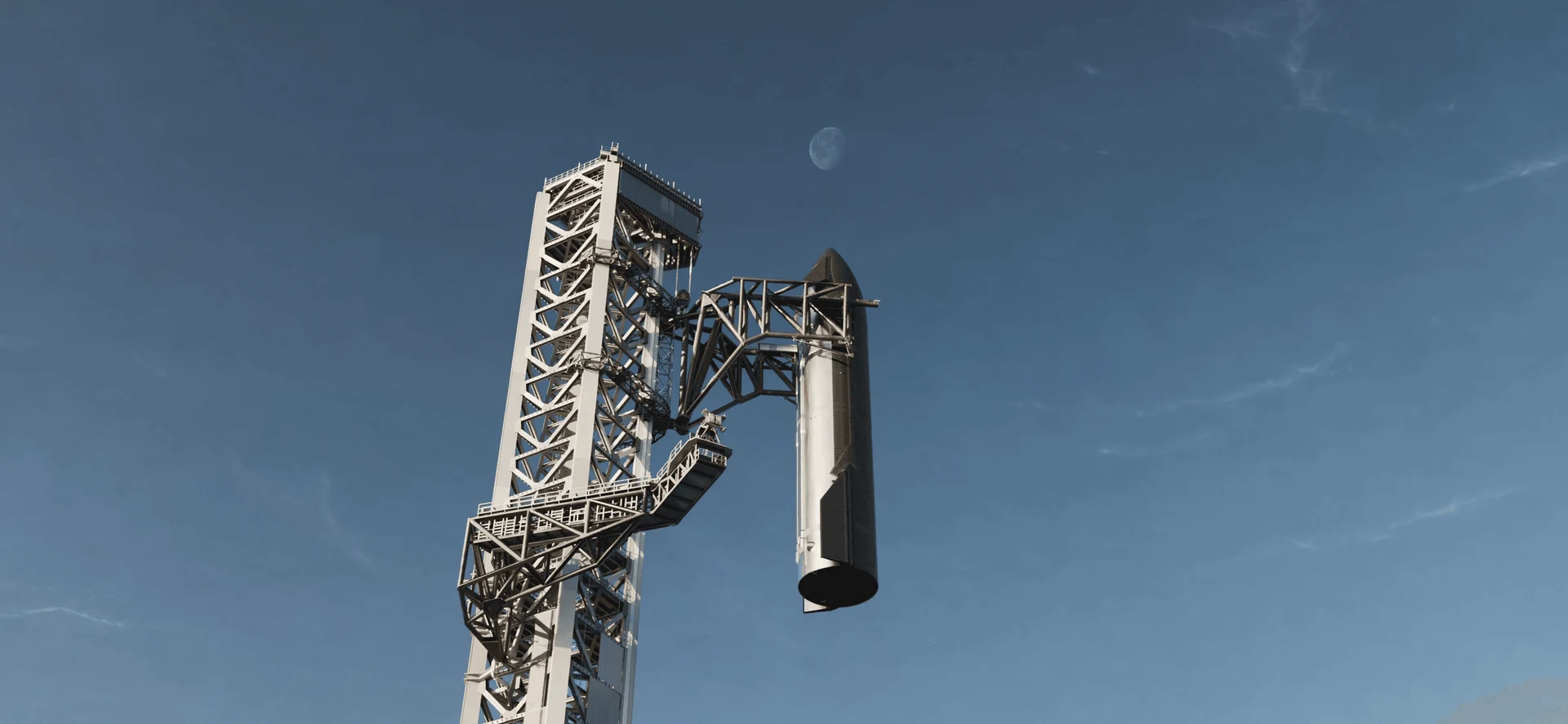
The recovery decision depends on the condition of systems needed for re-entry, the landing burn and the final tower approach. Flight controllers will assess those systems before allowing a return to Starbase. SpaceX has also designed opportunities for an earlier ocean return at predetermined checkpoints.
That makes the extended flight a test of several systems working together: orbital manoeuvring, communications, heatshield performance, re-entry control and the final powered landing. The upper stage must complete the spaceflight and reach the tower in a condition suitable for recovery.
Three satellites will inspect the heatshield
Three of the 26 Starlink satellites carry cameras intended to inspect Starship’s heatshield and transmit pictures to operators. SpaceX says those images are one of several sources used to judge whether the vehicle is ready to return to the launch site.
The heatshield incorporates changes made for Flight 14, including extra tile-retention mechanisms in higher-risk areas and work on paths that allow hot plasma behind the tiles. A large portion also uses a curved tile design intended to reduce heating in the gaps.
The inspection task connects the payload operation to the recovery decision. After deployment, operators can combine external views with the vehicle’s other flight data to assess how well it survived ascent and orbital operations before committing to the journey back.
The payload is also a commercial mission
SpaceX plans to deliver 26 Starlink V3 satellites, each designed to add one terabit per second of capacity to the network. The company compares the batch’s added capacity with roughly ten Falcon 9 launches carrying V2 Mini satellites. That comparison concerns network capacity per mission.
After release, the satellites are expected to unfold antennas and solar arrays, establish radio and laser communications and raise their orbits using onboard thrusters. SpaceX says customer service could begin within weeks, following orbital checks.
The flight therefore has two substantial jobs: delivering a new generation of communications hardware and advancing recovery of the vehicle that carries it. Payload delivery and tower catches are separate milestones, each with its own sequence and conditions.
How to follow the attempt
The planned opening time is 10:45 p.m. in the UK on 13 November, with SpaceX’s webcast expected to start about half an hour before liftoff. The company plans coverage through the upper-stage catch, with the possibility of extended live views from orbit.
The FAA’s 13 November operations plan lists a Flight 15 launch that evening and re-entry the following day. Airspace planning supports preparations for the mission; SpaceX continues to describe its launch target as pending regulatory approval. Schedules can move as those preparations and flight-readiness decisions progress.
For viewers, the key sequence is straightforward: launch, booster return, satellite deployment, then the Ship’s return the next day. Successful recovery of both stages would give SpaceX two pieces of flight-tested hardware to inspect as it works towards repeated use of the complete rocket.