IBM quantum credits programme produces results beyond classical reach
IBM published results on 3 July from its Quantum Credits programme, which provides free access to its most capable hardware for university faculty and research scientists.
Listen to this articleListen
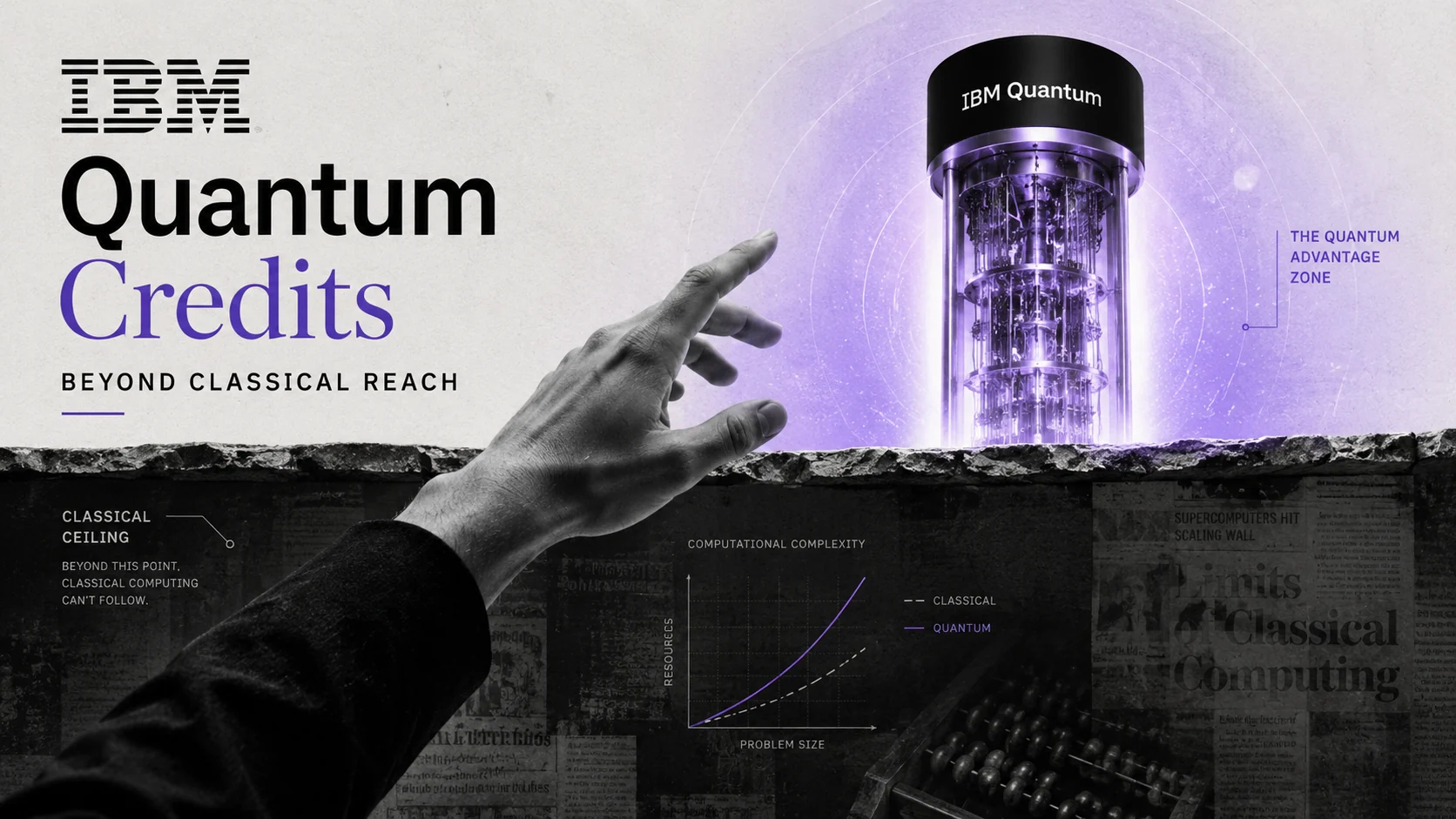
IBM published results on 3 July from its Quantum Credits programme, which provides free access to its most capable hardware for university faculty and research scientists. The IBM Quantum Credits programme, led by Jay Gambetta, has produced a set of early results in areas where the company argues classical simulation is reaching its limits, including high energy physics, quantum state reconstruction, materials science and lattice gauge theory.
The specific outputs are worth listing because they show what the current hardware generation can actually do. Researchers simulated the emergence of new particles in high energy physics settings. A separate group demonstrated efficient reconstruction of mixed quantum states on up to 96 qubits, which is a measurement and characterisation problem that becomes exponentially expensive classically. Materials science work covered a 103 qubit kagome lattice, a frustrated magnetic geometry that is genuinely difficult to simulate by conventional means. And Hamiltonian formulations were developed for lattice gauge theories aimed at the sign problem in quantum chromodynamics, a well known obstacle that has resisted classical approaches for decades.
The sign problem deserves a note, because it is the strongest available example of a workload where quantum computation has a principled advantage. Monte Carlo methods, the workhorse of lattice quantum chromodynamics, break down when the quantity being sampled takes negative or complex values, because the statistical errors overwhelm the signal. Insufficient classical computing power is not the cause. It is a structural limitation of the method. A quantum simulator that represents the system directly avoids the problem entirely.
The commercial logic behind the IBM Quantum Credits programme is straightforward. IBM has committed publicly to demonstrating verified quantum advantage by the end of 2026, meaning proof that a combined quantum and classical workflow outperforms all classical methods on a real problem. Establishing that requires a body of independent work from researchers who are not employed by IBM, published in venues that are not IBM’s marketing channels, on problems the community accepts as meaningful. Free hardware access to academic groups is the most efficient way to generate that evidence, and it also builds the Qiskit user base that any advantage claim will need to be reproduced in.
The hardware behind the IBM Quantum Credits programme is the Nighthawk generation, a 120 qubit processor with 218 tunable couplers supporting circuits of up to 5,000 two qubit gates. IBM’s roadmap raises that to 7,500 gates by the end of 2026 and 10,000 in 2027, with the experimental Loon processor demonstrating the components required for fault tolerance and the Starling system targeted for 2029 with 200 logical qubits and more than 100 million operations per job.
The appropriate scepticism concerns the phrase beyond classical limits, which does more work in the announcement than the results strictly support. Classical algorithms improve continuously, often in response to quantum claims, and several results previously described as beyond classical reach were subsequently matched by better classical methods on conventional hardware. A 103 qubit kagome lattice simulation is a serious piece of work. Whether it survives a determined classical challenge is a separate question, and IBM’s open community advantage tracker exists precisely to let that argument happen in public.
For enterprises the practical takeaway is about where to look. Simulation of quantum systems, which means chemistry, materials and fundamental physics, remains the application area with the clearest theoretical case. Optimisation and machine learning, which attract the majority of commercial interest, have a considerably weaker one. An organisation whose competitive position depends on materials discovery or molecular simulation has a reason to build capability now. An organisation hoping quantum computing will improve its logistics scheduling should read the evidence carefully.
IBM remains Bank of America’s preferred exposure to the sector, on the basis that investors get the research programme attached to a company with revenue and a balance sheet. In a month when pure play quantum equities fell between 17 and 20 per cent in a week, that argument gained supporters.