SpaceX wants to be your phone company, and it has the spectrum to try
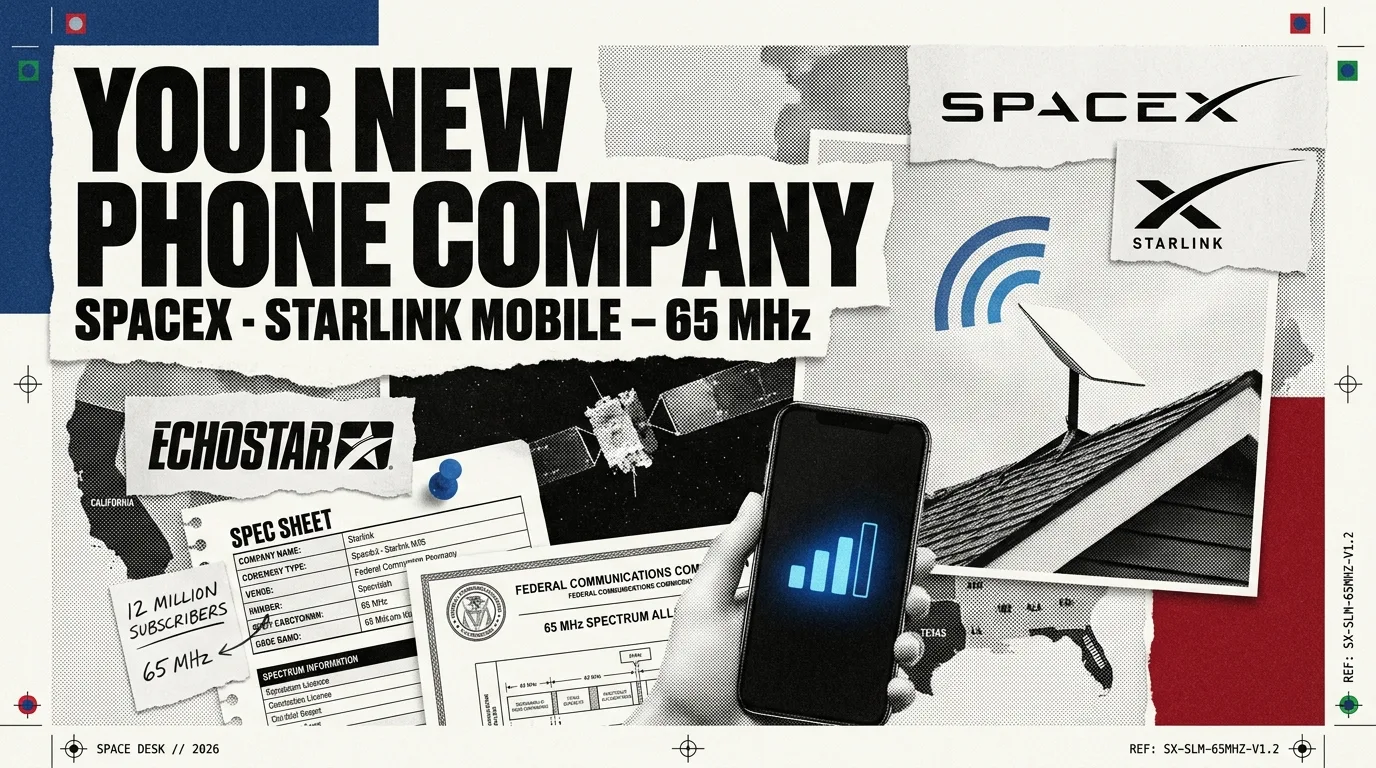
On its first earnings call as a public company, SpaceX said it intends to sell mobile service directly to consumers and take customers from Verizon, AT&T and T-Mobile. It has 65 MHz of American spectrum, 12 million Starlink subscribers and a plan to turn rooftop dishes into cell sites.
Listen to this podcastListen
SpaceX held its first earnings call as a public company on 4 August. The numbers were the expected part. What came out of the questions afterwards was the company saying it intends to become a mobile network operator and take customers from Verizon, AT&T and T-Mobile.
Satellite companies have said versions of this before and it has usually meant a niche: a messaging fallback for hikers, a service you buy for the fortnight you are somewhere without coverage. This is not that, and the reason is on the balance sheet.
What is already built
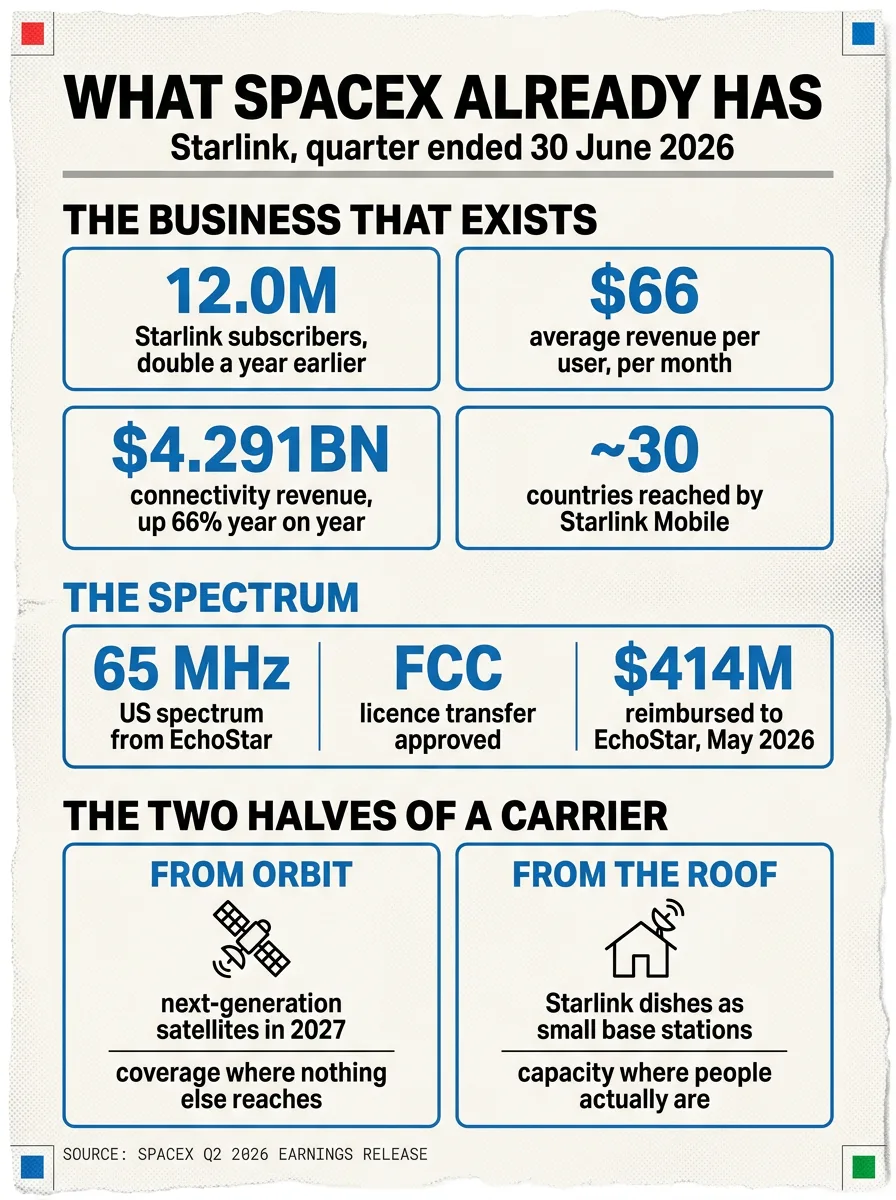
Starlink’s direct-to-cell business exists and is not small. SpaceX describes Starlink Mobile as connectivity delivered through a dedicated satellite-to-mobile constellation covering roughly 30 countries, and the quarter’s release records new carrier partnerships with SoftBank, NTT Docomo and Spark NZ.
The core numbers behind it, from the same release:
| Q2 2026 | Figure |
|---|---|
| Starlink subscribers | 12.0 million, double a year earlier |
| Added in the quarter | 1.7 million |
| ARPU | $66 a month, unchanged from Q1 |
| Connectivity revenue | $4.291bn, up 66% year on year |
| of which consumer | $2.485bn |
| of which enterprise and government | $1.806bn |
Twelve million subscribers paying $66 a month is a real consumer business with a billing relationship already in place. That is the asset a carrier is built on, and SpaceX has it before selling a single phone plan.
The part that is new is on the ground
Every satellite direct-to-cell service has the same ceiling. A satellite is far away and shared, so the physics allow messaging and thin data across a wide area, never the capacity of a mast down the road. Which is why the plan described on the call is not really about satellites.
SpaceX said it is developing a distributed network of smaller base stations, integrated with the Starlink installations already on homes and businesses. The rooftop dishes become cell sites. Where a conventional carrier spends a decade and tens of billions acquiring sites, negotiating leases and running backhaul to each one, SpaceX would be adding a radio to hardware it has already installed, with the backhaul solved by definition: the dish is the backhaul.
That is the argument in one sentence. Whether it survives contact with radio planning, local permitting and the power budget of a domestic installation is the question the call did not answer.
The spectrum is the reason to take it seriously
Intent is cheap. Spectrum is not, and SpaceX has it.
The quarter’s release records FCC approval of the EchoStar licence transfer: 65 MHz of spectrum in the United States, plus certain global Mobile Satellite Service licences. EchoStar’s own filings put the reported price at $19.6bn and record that SpaceX reimbursed EchoStar $414m in May for cash interest previously paid on the seller notes. The agreement also runs the other way: EchoStar’s wireless subscribers get access to SpaceX’s next-generation direct-to-cell service on spectrum EchoStar is handing over.
Sixty-five megahertz is a serious national holding, and unlike a satellite constellation it cannot be built by anyone with a rocket. It is the piece that turns this from an ambition into a plan.
The timeline, as stated
President Gwynne Shotwell put the next-generation Starlink Mobile satellites in 2027, with the upgraded service starting by the end of that year. SpaceX’s public material describes those V2 satellites as carrying custom SpaceX silicon and phased-array antennas supporting thousands of spatial beams, at around twenty times the throughput of the first generation, and says that in most environments they will enable full 5G cellular connectivity comparable to terrestrial service.
Read that claim against the ground plan and the shape becomes clear: satellites for coverage where nothing else reaches, base stations for capacity where people actually are. Neither half is a carrier on its own.
What is not settled
No site count, no launch market, no date, no price, no plan structure.
There is also a relationship to unwind. T-Mobile is SpaceX’s American direct-to-cell partner, selling T-Satellite at $10 a month. A supplier that announces it will compete for its partner’s subscribers has changed what that partnership is, whatever the contract says.
Nobody has ever started a phone company from the top down
New entrants normally arrive at the cheap end: an MVNO renting somebody else’s network, competing on price, hoping to graduate. SpaceX would arrive owning national spectrum, a satellite constellation reaching 30 countries, twelve million paying subscribers and a hardware footprint on rooftops that a traditional operator would need a decade to match.
What it lacks is the boring middle: the density of masts that makes a phone work in a city centre at 6pm, and the retail machinery of handsets, contracts and support. Those are solved problems, which is not the same as easy ones, and they are where the money and the years go.
The satellites are the part everyone will write about. The base stations are the part that decides it.
Sources
- SpaceX, Q2 2026 earnings release (SEC, 4 August 2026)sec.gov
- SpaceX Investor Relations, Q2 2026 Earningsir.spacex.com
- SpaceX, Q2 2026 Earnings Q&Aquestiontime.ir.spacex.com
- EchoStar, Spectrum sale and commercial agreement with SpaceXir.echostar.com
- EchoStar Corporation, Form 10-Q for the quarter ended 30 June 2026sec.gov