The US says it has weapons in orbit, and the treaty it signed allows it
Air Force Secretary Troy Meink told the AFA conference on 14 September 2026 that the United States has on-orbit space control weapons. Outer Space Treaty Article IV bars nuclear weapons and other weapons of mass destruction from orbit, and reaches no further.
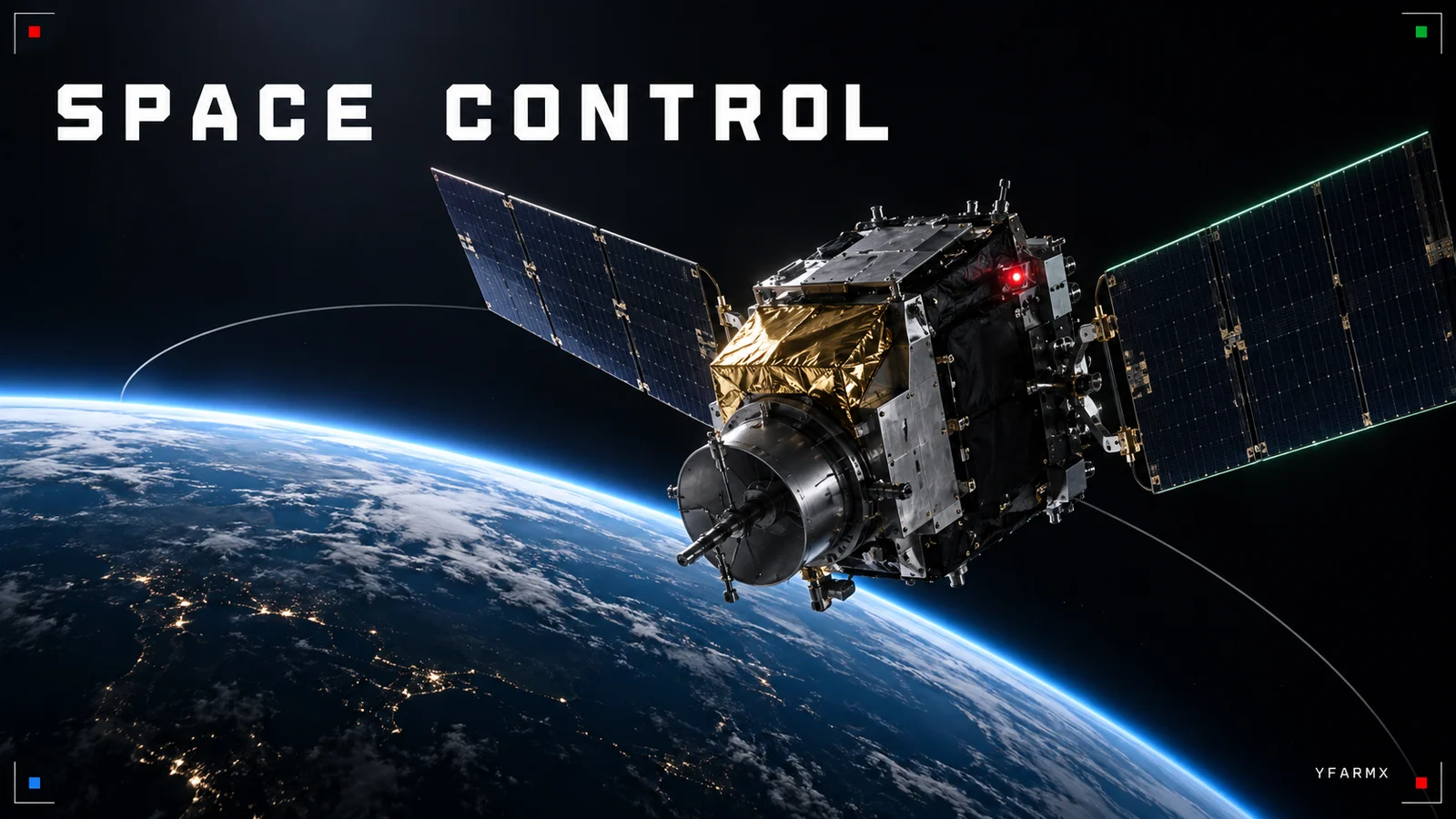
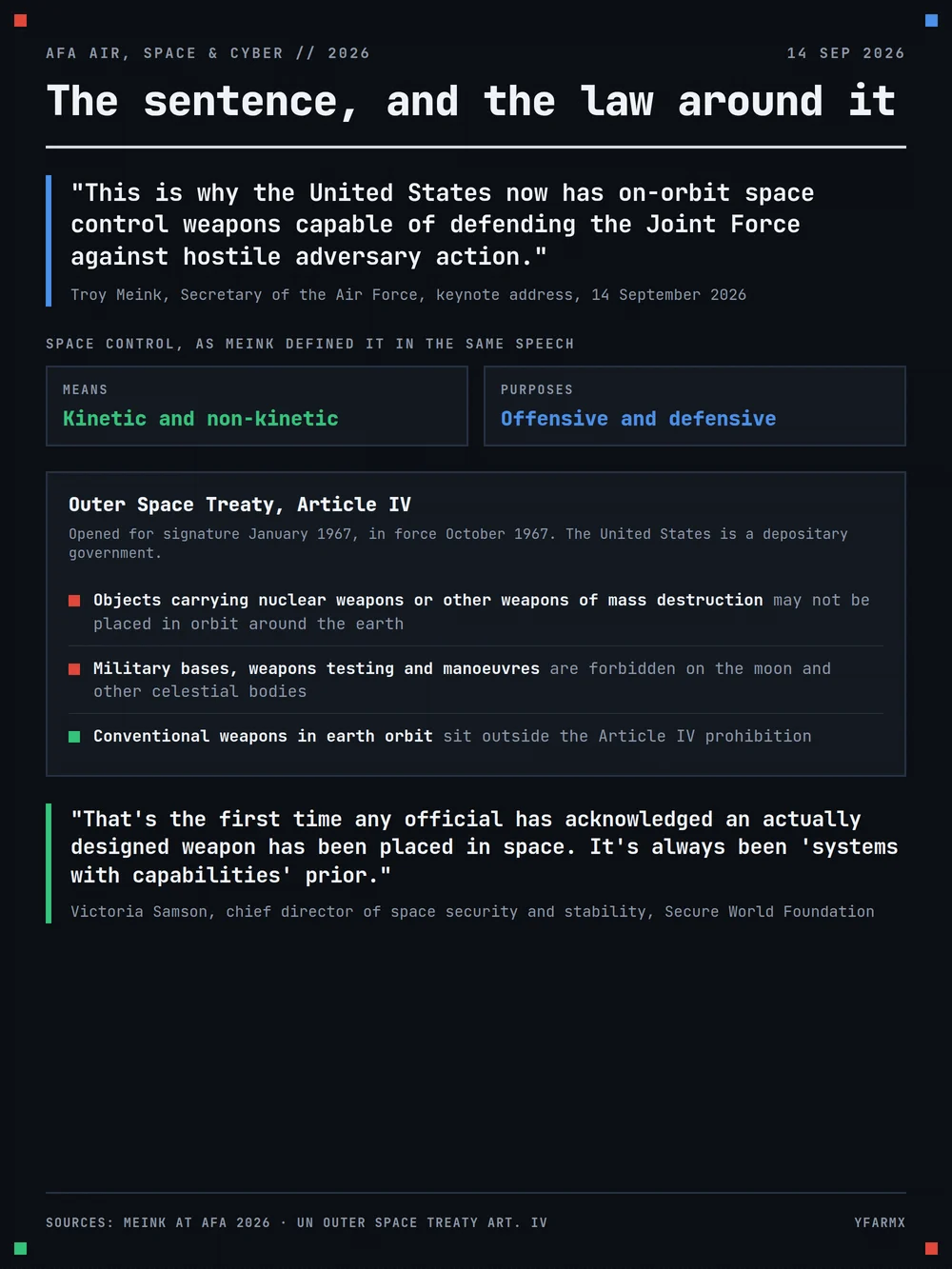
The Secretary of the Air Force told a conference hall in Maryland on 14 September that the United States keeps weapons in orbit. His words were: “This is why the United States now has on-orbit space control weapons capable of defending the Joint Force against hostile adversary action.” Troy Meink said it in a scheduled keynote, in public, on a stage his own service had booked, and it is the first time an American official has acknowledged a designed weapon in earth orbit on the record.
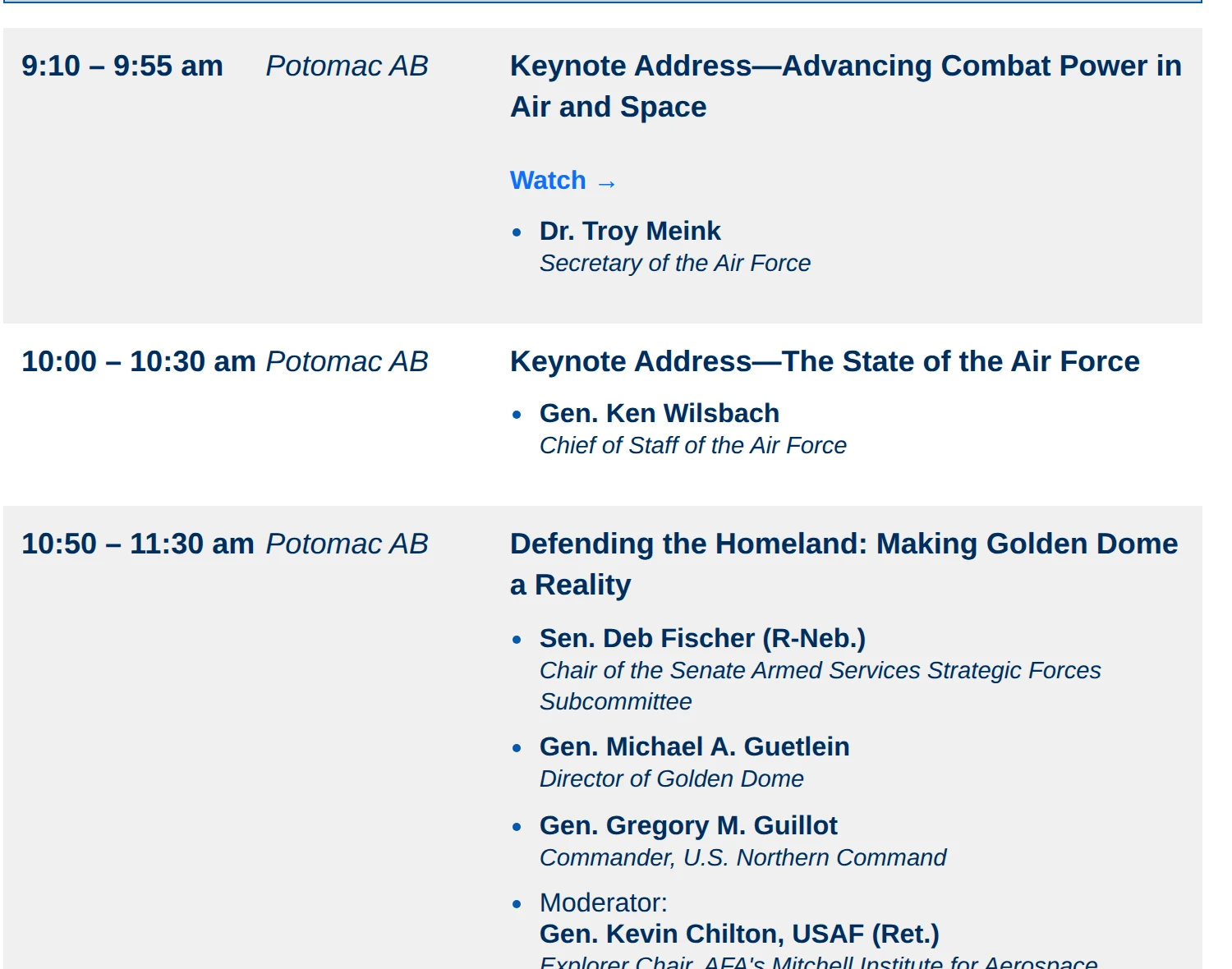
The setting was a scheduled keynote
The conference programme puts Meink in Potomac AB from 9.10 to 9.55am on Monday 14 September, under the title “Advancing Combat Power in Air and Space”. The Chief of Staff of the Air Force followed him at 10.00, and a panel on the Golden Dome missile defence programme came after that. The Association published the video of the address on its own channel.
So the disclosure arrived inside a prepared speech at the service’s largest annual gathering, in the same hour as the rest of the Air Force’s public messaging for the year. Meink placed it after a line about readiness: “to ensure we remain ready to meet the challenges of evolving threats wherever they exist,” he said, and then the sentence about weapons.
Space control, in his own definition

Meink defined the term in the same address rather than leaving it to interpretation. “Space control encapsulates the mission areas required to contest and control the space domain,” he said, “employing kinetic and non-kinetic means to affect adversary capabilities,” adding that “these capabilities can be employed for offensive and defensive purposes”.
Those two sentences do a lot of work. Kinetic covers systems that strike or collide. Non-kinetic covers jamming, spoofing, dazzling and cyber effects. Offensive and defensive covers both sides of the mission. The definition is wide enough to hold almost any counterspace system, which is why the word doing the real work in the announcement is the plain one.
Victoria Samson, chief director of space security and stability at the Secure World Foundation, told Al Jazeera that the key word in the announcement is “weapons”, sitting inside the phrase “space control”. Her reason: “That’s the first time any official has acknowledged an actually designed weapon has been placed in space. It’s always been ‘systems with capabilities’ prior.”
Where the treaty draws its line
The legal position is the part most of the coverage skipped, and it is the reason this confirmation could be made at a podium rather than leaked.
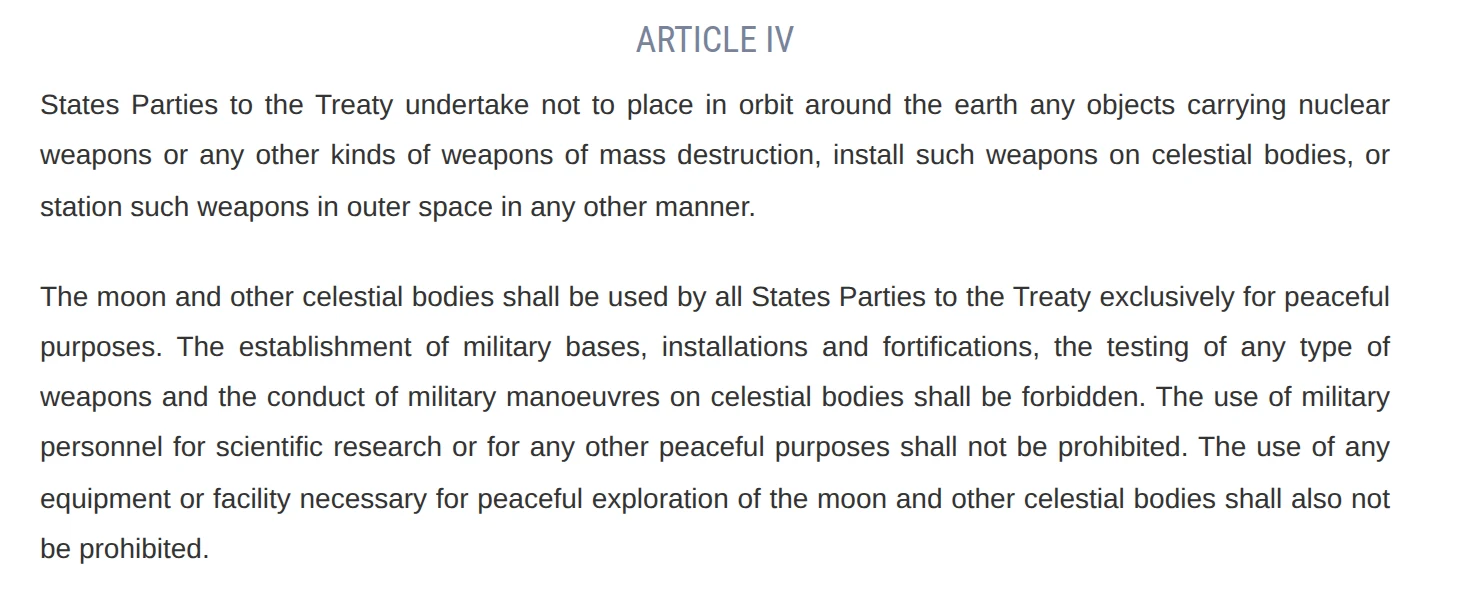
The Outer Space Treaty was opened for signature in January 1967 and entered into force that October, with the United States as one of three depositary governments. Its Article IV reads: “States Parties to the Treaty undertake not to place in orbit around the earth any objects carrying nuclear weapons or any other kinds of weapons of mass destruction, install such weapons on celestial bodies, or station such weapons in outer space in any other manner.”
The second paragraph goes further, but only about celestial bodies: on the moon and elsewhere, “the establishment of military bases, installations and fortifications, the testing of any type of weapons and the conduct of military manoeuvres” are forbidden.
Read the two paragraphs together and the boundary is sharp. Earth orbit is closed to nuclear weapons and other weapons of mass destruction. The moon is closed to weapons of every type. Conventional weapons in earth orbit sit in neither prohibition, which is the space Meink’s sentence occupies.
What the systems are likely to be
Meink described a capability. The type, the number and the launch dates stay classified, so the reading of what is actually up there comes from people who track the hardware.
Bleddyn Bowen, an associate professor in astropolitics at Durham University, told BBC Radio 4’s Today programme: “We don’t know exactly what the mechanism of the weapon is. I would expect there to be some kind of electronic warfare or radio-jamming platform. This would be a non-destructive kind of anti-satellite weapon, and these variants already exist on Earth.” He put a kinetic kill vehicle lower down the list.
The physics supports that reading. A weapon that destroys a satellite by hitting it produces a debris field at orbital velocity, and the debris stays in the same neighbourhood as everything else the operator owns. A jammer produces an effect that stops when it is switched off.
Samson’s own expectation ran the same way, on the grounds of what the other side already fields. Her team, she said, has highlighted in its reports that “China and Russia have space-based jammers”, and so “I always thought it would be strange that the US didn’t have them too”. The Secure World Foundation’s 2026 Global Counterspace Capabilities Report, published on 8 April and edited by Samson and Kathleen Brett, is the annual open-source survey of exactly those systems.
The Space Force case for saying it aloud
A Space Force spokesperson framed the disclosure as deterrence rather than revelation, noting that Washington “has warned about Russian and Chinese weapons testing and operationalisation since 2007”.
“Due to their actions, it is no longer a question that space is a warfighting domain,” the spokesperson said. “Open communication strengthens deterrence, prevents adversary miscalculation, and normalises space operations alongside the other services.”
That is a coherent argument: a capability nobody knows about deters nobody, and ambiguity invites the miscalculation it is meant to prevent. Bowen’s account of the past decade gives it substance. Russia and China have been “flying up really close to Western satellites, inspecting them, taking pictures”, he said, and China has demonstrated a “space tug” capability, “a vehicle that goes up to a satellite can grapple it and then move it into a different” orbit.
The reading that runs the other way
Samson put the counter-argument in one word. Meink’s statement “crosses a line”, she said, and would “either encourage China and Russia to also declare weapons in space, or will make US allies and partners want to also place weapons in space”.
She added that “Counterspace capabilities have been proliferating already – this speeds up that trend”, and that this “is incredibly destabilising and will work against US national security goals”.
Both readings accept the same facts. They differ on what an acknowledgement does to everyone else’s programme, and that is a question the next twelve months of Chinese and Russian announcements will answer rather than any analysis now.
Where this leaves the record
As of 16 September 2026 the public record holds a sentence from a serving Secretary of the Air Force, a definition of space control that covers kinetic and non-kinetic systems for offensive and defensive use, and a treaty whose orbital prohibition names nuclear weapons and weapons of mass destruction alone. Everything beyond that, including which orbits and how many, remains inside the classification.
Whether Beijing or Moscow answers in the same register decides what this costs. An acknowledgement is cheap to make and hard to withdraw, and the value of American ambiguity in orbit was spent on 14 September in a 45-minute slot before the Chief of Staff took the stage.
Sources
- AFA Air, Space & Cyber Conference 2026 agenda, listing Meink's keynoteafa.org
- AFA, full keynote video: 'Advancing Combat Power in Air and Space'youtube.com
- United Nations, Treaty on Principles Governing the Activities of States in the Exploration and Use of Outer Space (full text)unoosa.org
- UNOOSA, introduction to the Outer Space Treaty and its statusunoosa.org
- Al Jazeera, 'What are space weapons, which US says it has deployed into orbit?'aljazeera.com
- NBC News, 'U.S. acknowledges for the first time that it has deployed weapons in space'nbcnews.com
- Secure World Foundation, 2026 Global Counterspace Capabilities Reportswfound.org