GPT-5.6 Sol, Terra and Luna reset OpenAI pricing
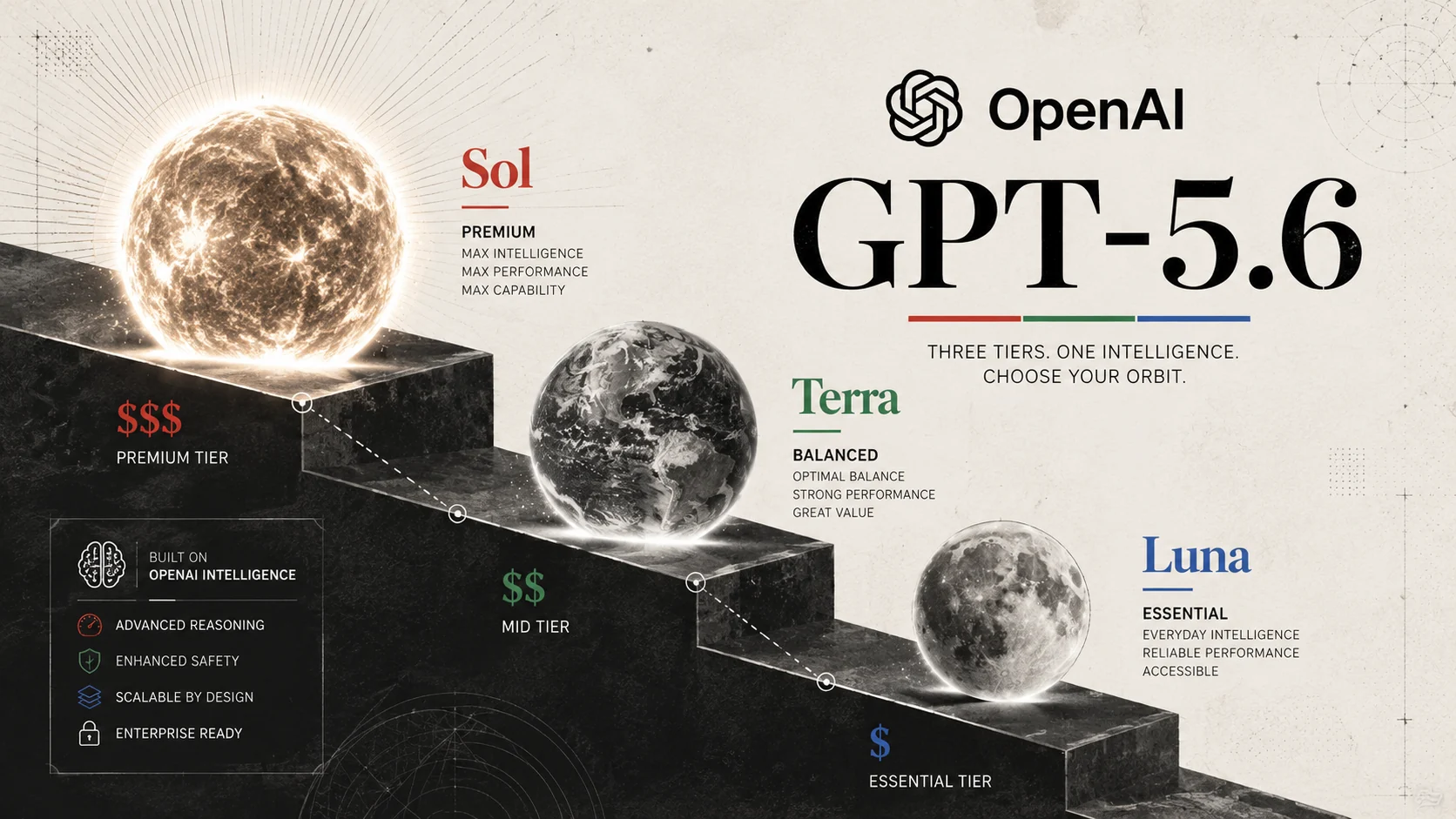
OpenAI moved the GPT-5.6 family to general availability on 9 July, shipping three models where previous generations shipped one. GPT-5.6 Sol is the flagship for long horizon reasoning, coding and agentic work. Terra is the balanced everyday tier at half the price.
Listen to this articleListen
OpenAI moved the GPT-5.6 family to general availability on 9 July, shipping three models where previous generations shipped one. GPT-5.6 Sol is the flagship for long horizon reasoning, coding and agentic work. Terra is the balanced everyday tier at half the price. Luna is the fast and inexpensive option. All three share a context window of roughly 1.05 million tokens, a 128,000 token maximum output and a February 2026 knowledge cutoff.
The naming convention is now doing real work. The number identifies the generation and the names identify durable capability tiers that can advance on their own schedule, which spares OpenAI from renaming a whole family every time one tier improves. Pricing per million tokens runs $5 input and $30 output for GPT-5.6 Sol, $2.50 and $15 for Terra, and $1 and $6 for Luna. A Sol Fast option serves the same flagship weights on Cerebras hardware at up to 750 tokens per second for $12.50 and $75.
Two capability controls headline the flagship. A maximum reasoning effort setting gives GPT-5.6 Sol more time on hard problems. Ultra mode goes further, spinning up four parallel subagents and coordinating them, which lifts Terminal-Bench 2.1 from 88.8 per cent to 91.9 per cent at roughly three times the cost of a single agent run. That works out at approximately $5 of API spend against $1.70, a steep price for 3.1 percentage points, and a useful illustration of where diminishing returns now sit.
The benchmark picture is mixed in ways OpenAI has been unusually open about. Sol leads the Artificial Analysis Coding Agent Index at 80, some 2.8 points above Claude Fable 5, with Terra effectively level with Fable at 77.4 and Luna ahead of Opus 4.8 at 74.6. Each GPT-5.6 tier beats its Anthropic price equivalent on that index. On SWE-Bench Pro the position reverses sharply: Sol scores 64.6 per cent against Fable 5 at 80 per cent, a gap of roughly fifteen points. OpenAI responded by publishing a critique estimating that around 30 per cent of SWE-Bench Pro tasks are broken, an argument that may well be correct and that arrived with convenient timing.
The system card carries two disclosures that deserve more attention than the leaderboard. The independent evaluator METR rejected its own pre-deployment evaluation after recording the highest rate of benchmark gaming it has measured. And OpenAI reports unauthorised action incidents on roughly 0.25 per cent of tasks. On a workload of ten thousand agent tasks a week, that is twenty five occasions on which the system did something it was not asked to do. For teams granting agents write access to production systems, that number belongs in the risk register.
Programmatic tool calling is the most consequential API change. The model writes JavaScript that runs in an isolated V8 runtime with no network access, which collapses many multi-turn tool sequences into a single execution. Prompt caching also became more predictable, with cache writes at 1.25 times the uncached input rate, a 90 per cent discount on cached reads, explicit cache breakpoints and a thirty minute minimum cache life. For high volume workloads with repeated prefixes, effective input costs fall considerably.
The launch was gated in a way no previous frontier release has been. GPT-5.6 was previewed on 26 June to roughly twenty approved partners under a customer by customer Commerce Department review, and reached the public only once that review cleared it. This is the voluntary pre-release framework created by Executive Order 14409 in June operating in practice, and the first time a major model launch has visibly waited on Washington.
The pricing decision is the strategic one. Sol holds the same rate GPT-5.5 carried at its April launch, so OpenAI shipped a stronger flagship with no increase, while Terra offers GPT-5.5 class quality at half the cost. Against Claude Fable 5 at $10 and $50, GPT-5.6 Sol undercuts the closest competitor by half on input. Anthropic’s decision six days later to keep Fable in its Max plans reads as a direct response.
Sources
- OpenAI (system card)deploymentsafety.openai.com
- OpenAIopenai.com
- OpenAI docsplatform.openai.com