Nvidia H200 China shipments restart in token volumes
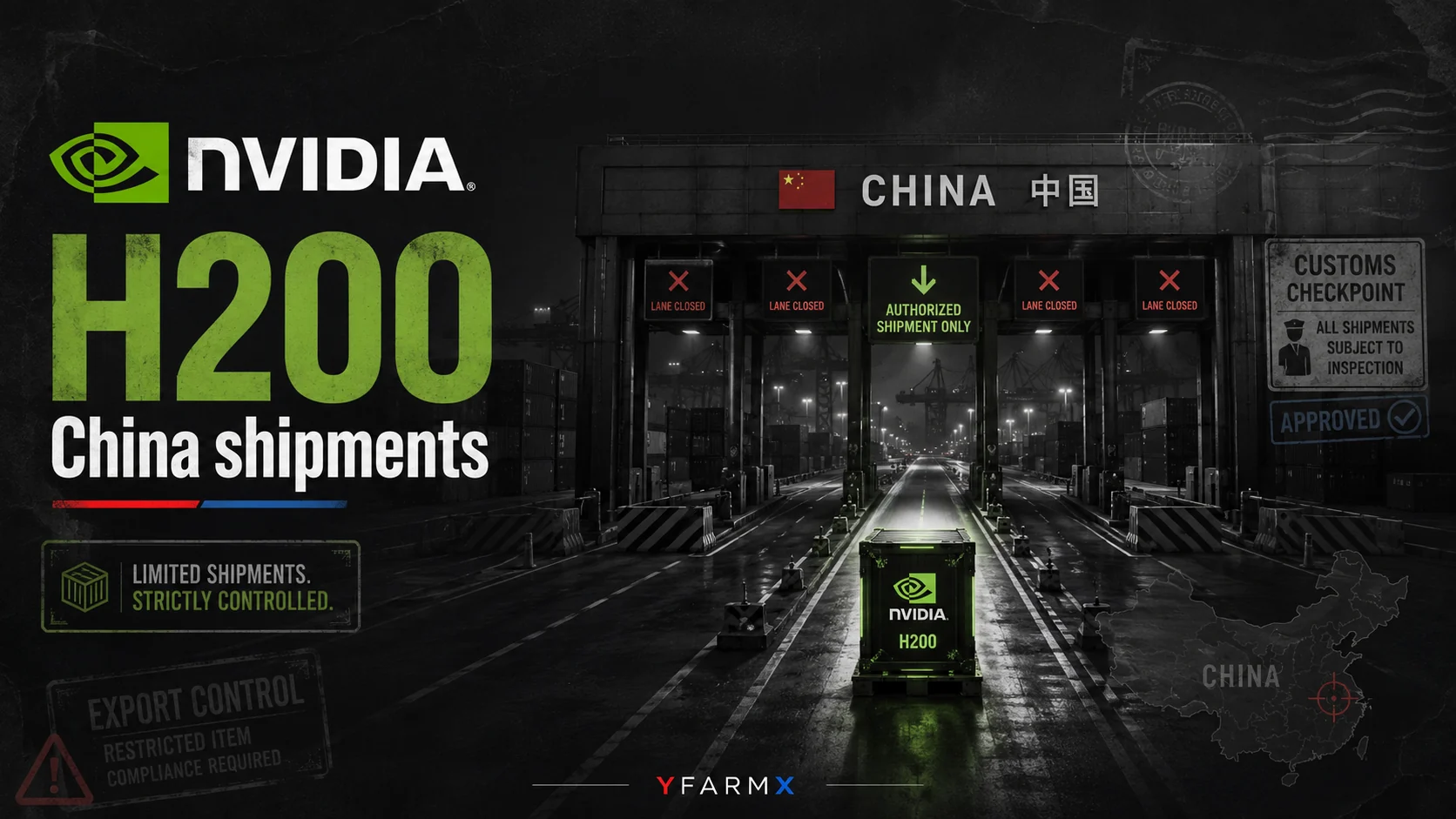
The most senior US official responsible for export controls confirmed on Tuesday that Nvidia H200 China shipments have begun, while taking care to describe the quantity as trivial.
Listen to this articleListen
The most senior US official responsible for export controls confirmed on Tuesday that Nvidia H200 China shipments have begun, while taking care to describe the quantity as trivial. Jeffrey Kessler, under secretary of commerce for industry and security, told lawmakers that very few shipments had taken place against approved H200 licences, and declined to identify volumes or buyers. Nvidia shares rose about 4 per cent on the confirmation.
The disclosure is a small fact with a long shadow. Nvidia H200 China shipments were authorised earlier this year as part of a licensing arrangement that allows a specific, previous generation accelerator to reach approved Chinese customers while the current Blackwell line remains restricted. Guidance issued in late May tightened requirements further, obliging licences for transfers to any entity headquartered in China or Macau. The practical effect has been that permission exists on paper while very little product moves.
Two obstacles explain the gap. The first is Beijing. Chinese authorities have discouraged domestic purchases of American accelerators as part of a push toward domestic silicon, and Reuters reported in early July that regulators were only then considering allowing a limited number of firms including Alibaba and ByteDance to buy. A licence from Washington is of no use if Beijing declines the import. The second is commercial. Chinese buyers have spent two years designing around export controls, and models such as Meituan’s LongCat-2.0 were trained end to end on domestic accelerators with no Nvidia hardware involved at all.
The politics in Washington are unusually cross cutting. Representative Gregory Meeks, the senior Democrat on the House Foreign Affairs Committee, accused the administration of weakening safeguards and treating export controls as a bargaining chip in wider negotiations with Beijing. Representative Bill Huizenga, a Republican, attacked the Commerce Department from the opposite direction, over loopholes that may allow Chinese subsidiaries registered overseas to retain access to Blackwell parts. Criticism from both benches on the same day is a reasonable indicator that the policy is unresolved.
Nvidia’s own case, set out in a report submitted to the US government and reviewed by The Wire China, rests on Huawei. The company argues that Huawei’s stockpile of accelerators, combined with expanding capacity at its manufacturing partner SMIC, positions the Chinese firm to dominate the global market if American vendors are locked out of the world’s second largest computing market. A company spokesperson pointed to the evidence that China’s domestic ecosystem is already yielding competitive systems, noting that leading Chinese models are optimised for domestic hardware.
That argument has an uncomfortable corollary. If Chinese laboratories are already producing frontier class models on domestic silicon, the marginal security value of restricting H200 sales falls, and so does the commercial argument for permitting them. Bernstein analysts have projected Nvidia’s share of the Chinese AI accelerator market falling from 66 per cent in 2024 to 54 per cent in 2025, with further erosion expected.
For investors, the practical significance of Nvidia H200 China shipments is narrow. KeyBanc raised its price target to $330 on the news, but the volumes acknowledged by Commerce would not register in a quarter that saw the company report record results. The signal is directional. It suggests the administration is prepared to convert restrictions into negotiable instruments, and that Chinese demand for American accelerators is now a policy choice on both sides of the Pacific.
The wider context is a compute market being reshaped by state action. Anthropic lost access to its own frontier models for nineteen days in June under an export control directive. OpenAI’s GPT-5.6 reached general availability only after a customer by customer Commerce Department review. Nvidia now ships accelerators to China in quantities that a senior official describes as trivial. In each case the constraint is not engineering. Frontier computing has become an instrument of trade policy, and companies are learning to plan their roadmaps around review periods they cannot control.
Nvidia has separately tightened its own approved buyer list across Asia, narrowing the customer screening process to reduce the risk of diversion. That is a rational response to an environment in which a single smuggling investigation can jeopardise a licence.
Sources
- NVIDIAnvidianews.nvidia.com
- Bureau of Industry and Securitybis.doc.gov