Together AI Series C raises 800 million dollars for open model compute
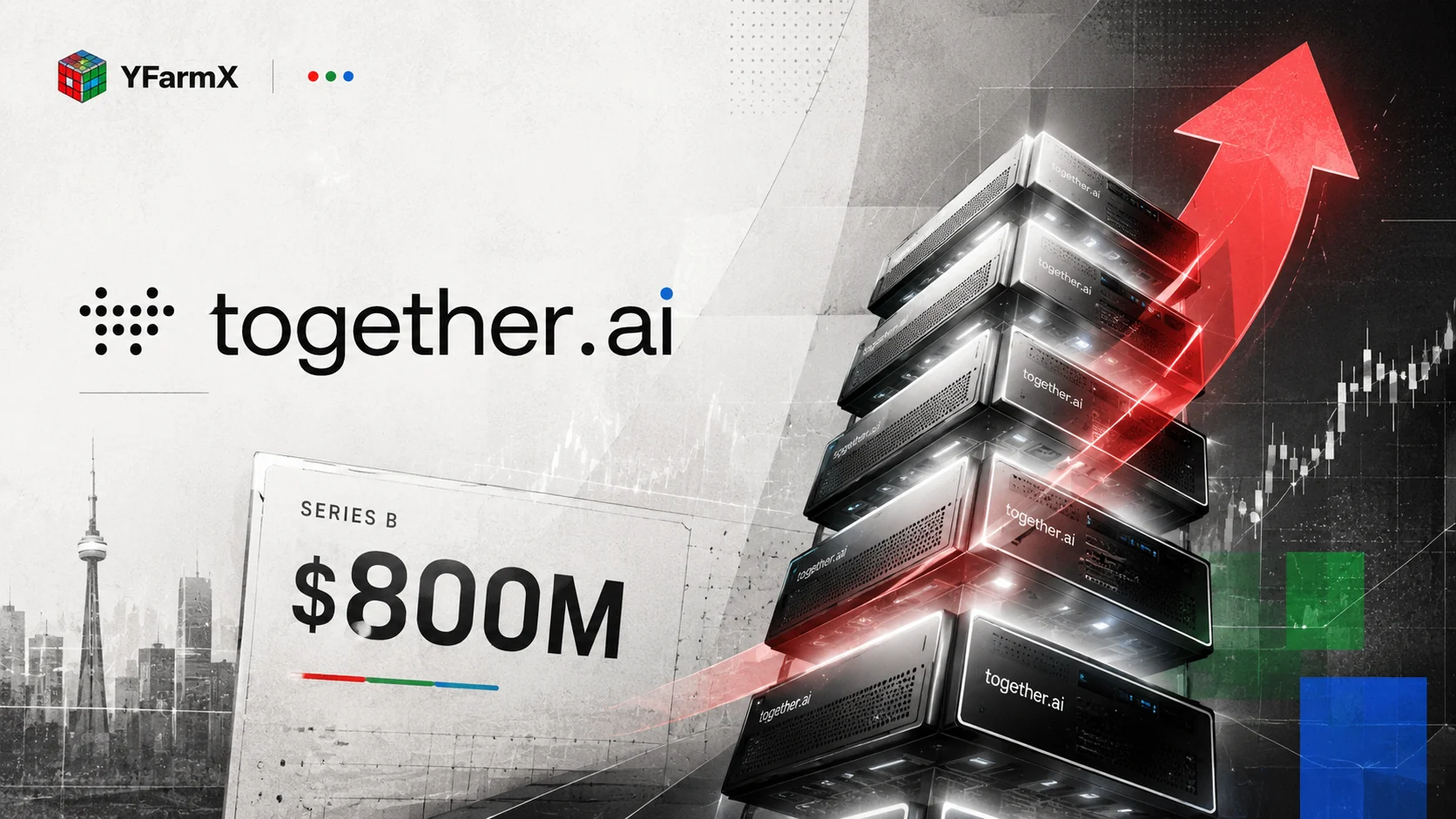
Together AI closed an $800 million Series C on 1 July at a valuation of $8.3 billion, led by Aramco Ventures with participation from NVIDIA, Vista Equity Partners and General Catalyst.
Listen to this articleListen
Together AI closed an $800 million Series C on 1 July at a valuation of $8.3 billion, led by Aramco Ventures with participation from NVIDIA, Vista Equity Partners and General Catalyst. The Together AI Series C funds an infrastructure expansion the company describes as roughly fiftyfold over five years, on the back of more than $1 billion in annual bookings and open model usage on its platform tripling year on year.
The investor list is the most informative part of the Together AI Series C announcement. Aramco Ventures leading an AI cloud round places Saudi energy capital directly into the compute layer, which is consistent with a wider pattern of sovereign and energy linked money moving into infrastructure where the binding constraint is power. NVIDIA’s participation is strategic in the plainest sense, since Together buys its accelerators and its growth expands the market for them.
Together AI occupies a specific position in the market. It serves open weight models at scale, which places it downstream of exactly the trend documented across this month’s releases: Kimi K3 at 2.8 trillion parameters, GLM-5.2 at 753 billion under an MIT licence, LongCat-2.0 at 1.6 trillion, Nemotron 3 Ultra at 550 billion with weights, data and recipes published. Every one of those models needs somewhere to run, and most organisations that want to use them have neither the hardware nor the inclination to operate a multi-node inference cluster.
The tripling of open model usage on the platform is the number to watch. It measures the practical adoption of open weights by companies making cost decisions, and it corroborates the routing data showing Chinese open weight models at roughly 30 per cent of OpenRouter volume against 1.2 per cent eleven months ago. Two independent measurements pointing the same way is a trend and not an artefact.
The financing environment gives the round context. Hyperscalers are committing something approaching $700 billion to data centre capital expenditure in 2026 alone, with Amazon around $200 billion, Alphabet between $175 billion and $185 billion, and Meta between $115 billion and $135 billion. BloombergNEF puts the combined capital expenditure of the fourteen largest listed data centre operators near $750 billion this year against a little under $450 billion last year. Against those figures $800 million is a rounding error, which is precisely why the specialist providers exist. They compete on serving efficiency and model coverage in segments the hyperscalers treat as marginal.
The competitive risk is straightforward and well understood by everyone involved. Amazon Bedrock, Google Vertex AI and Microsoft Foundry all serve open models, and all three can subsidise inference from other revenue. Together’s defence is that it is faster to onboard new models, cheaper per token and neutral between vendors, which appeals to teams building routing layers across many models. That is a real advantage while the model release cadence stays at one notable launch every few days. It becomes a thinner advantage if the field consolidates.
Aramco’s involvement points at the constraint that will define the next phase. Compute is increasingly limited by electricity and by the time required to connect it, not by chip supply. SoftBank committed up to 75 billion euros for five gigawatts of capacity in France. Brookfield and Bloom Energy expanded their AI infrastructure partnership to $25 billion. South Korea announced an $880 billion technology investment plan. Capital with access to power is the scarce input, and energy companies are the natural holders of it.
For the open model ecosystem the Together AI Series C is a useful signal. Serving free weights has become a business with a billion dollars of bookings and institutional backing, which suggests the open weight wave has become a durable part of the market.
Sources
- Togethertogether.ai