
xAI
Grok Imagine
the fast and permissive one
Key facts
- Image + videogeneration
- Modalities
- Grok + Xin-app
- Access
- 100M+X app users
- Reach
- Permissivecontent filter
- Policy
The fast and permissive one. xAI's image and video generation surface, available inside Grok and the X app.
What it is
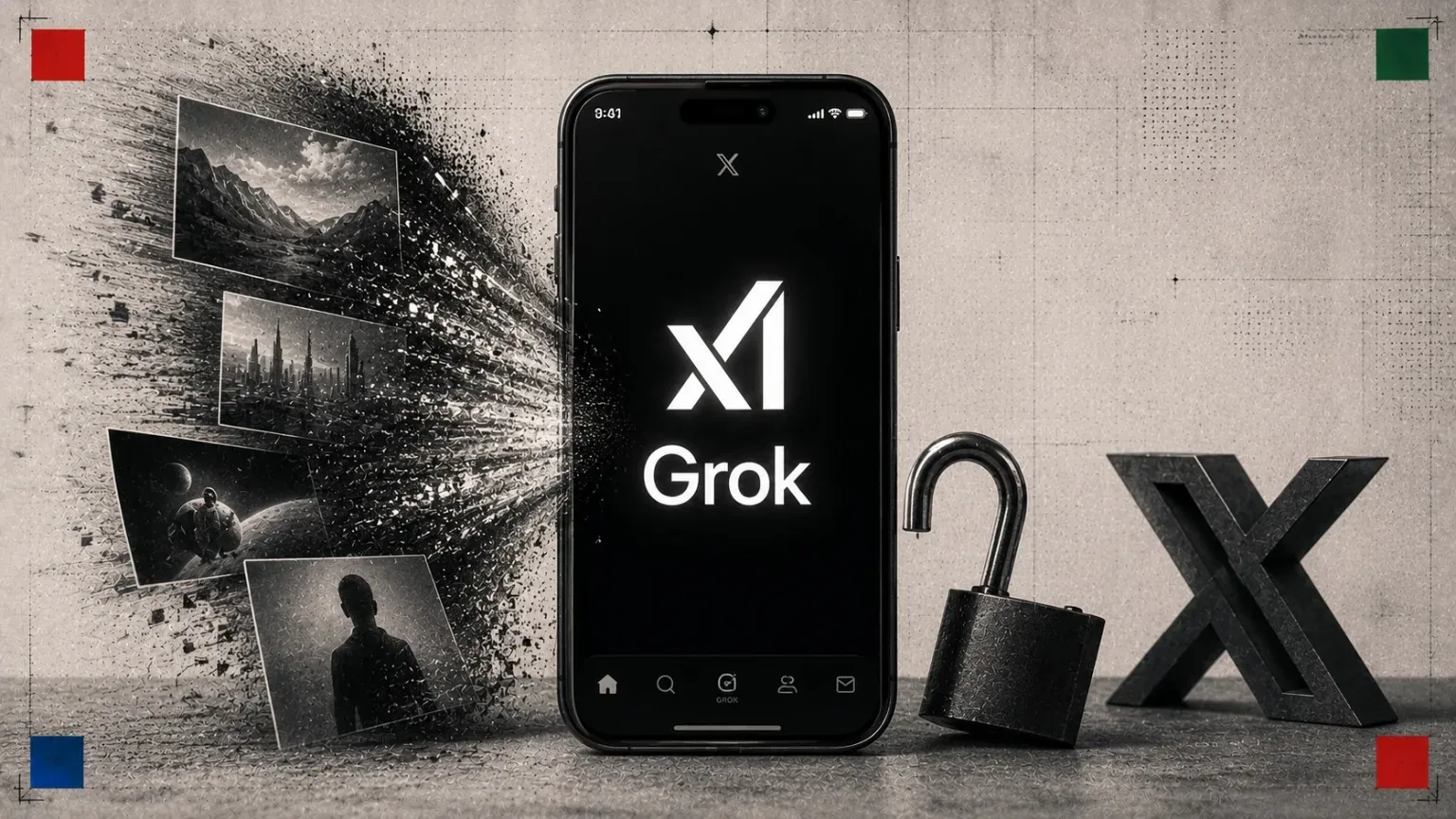
Grok Imagine is xAI’s image and video generation surface, built into the Grok assistant and the X app. Its position in a crowded market rests on two things: speed, and a content policy that is more permissive than most of its competitors. For users who have found the leading generators cautious to the point of frustration, that combination is the draw, and it is why the tool has carved out a distinct niche rather than competing purely on image quality.
Speed and distribution
Speed is the straightforward part. Grok Imagine is designed to return results quickly and to sit where its users already are, inside a chat assistant and a social app rather than behind a separate subscription. That distribution counts as much as the raw generation time: a tool embedded in an app that hundreds of millions of people already open removes the friction of finding, signing up for and learning a dedicated generator. Placing image and video generation directly beside the Grok assistant also means a user can move from a written request to a finished picture without leaving the conversation, which suits the quick, throwaway creation that social feeds run on. For casual creation, and for the fast turnaround of images meant to be posted straight to a feed, being in the right place is most of the battle.
The permissive policy
Permissiveness is the part that needs care. A more relaxed content policy means Grok Imagine will generate material that stricter rivals refuse, which is genuinely useful for legitimate creative work that over-tuned filters tend to block. It also raises questions worth stating rather than waving away. A permissive policy shifts more of the responsibility for how images are used onto the user, and it puts more weight on moderation after the fact than on refusal before it. Where competitors decline a prompt outright, the tool is more likely to produce something and rely on downstream rules to catch misuse.
The likeness problem
The sharpest of those questions concerns likeness. A permissive generator that can render recognisable people invites obvious problems: images of real individuals, public or private, produced without their involvement, in contexts they never agreed to. This is not a hypothetical concern for any tool positioned on permissiveness, and it is where the gap between “the model let me make this” and “I was allowed to make this” is widest. xAI’s approach places comparatively more trust in the user and comparatively less in the filter, and anyone evaluating Grok Imagine should weigh that trade-off before deciding whether it suits them.
The honest framing is that permissiveness is a feature and a liability at once, depending entirely on who is holding the tool. The same relaxed policy that lets a designer work without fighting an over-eager filter also lowers the barrier to producing material a stricter service would never allow. The value and the danger are two readings of the same setting, and which one applies depends on intent rather than on the software. xAI does not pretend otherwise, and neither should anyone assessing the product: the policy is the appeal, and the policy is also the risk.
Where it sits
Grok Imagine occupies one clear end of a spectrum the whole image models market is negotiating, between generators that refuse broadly and those that permit broadly. xAI has planted it firmly at the permissive end, betting that speed, distribution and fewer refusals will win users even as regulators and platforms sharpen their rules on synthetic media and likeness. What to watch is how that bet holds up as scrutiny of AI-generated images intensifies across the AI sector, and whether xAI adjusts its policy under pressure or keeps permissiveness as its defining wager.
The line has since split in two. On 7 August 2026 xAI shipped Imagine Image 2.0, a second-generation image model sold as Quality Mode inside Grok and aimed at precision rather than permissiveness: planned typography, legible small text and region-level editing. Grok Imagine as described on this page remains the fast surface; the newer model is the one to reach for when the picture has to carry words.
More in Image Generation
All Image →- Black Forest LabsFLUX 3 ImageFLUX 3 Image creates and edits pictures with up to ten reference images
- Google DeepMindNano Banana 2.1Image generation, reference pictures and conversational edits
- OpenAIGPT Image 2.5two variants, one price, the top two seats
- OpenAIGPT Image 2the leading line
- AlibabaQwen-Image-2.1one small model for making pictures and editing them
- GoogleNano Banana Pro and Nano Banana 2the 4K value leader