Stripe PayPal takeover bid meets Swift's blockchain push: the payments war goes nuclear
Within hours of each other this week, two of the most consequential names in money movement made their plays, and the Stripe PayPal takeover bid is comfortably the louder of the two.
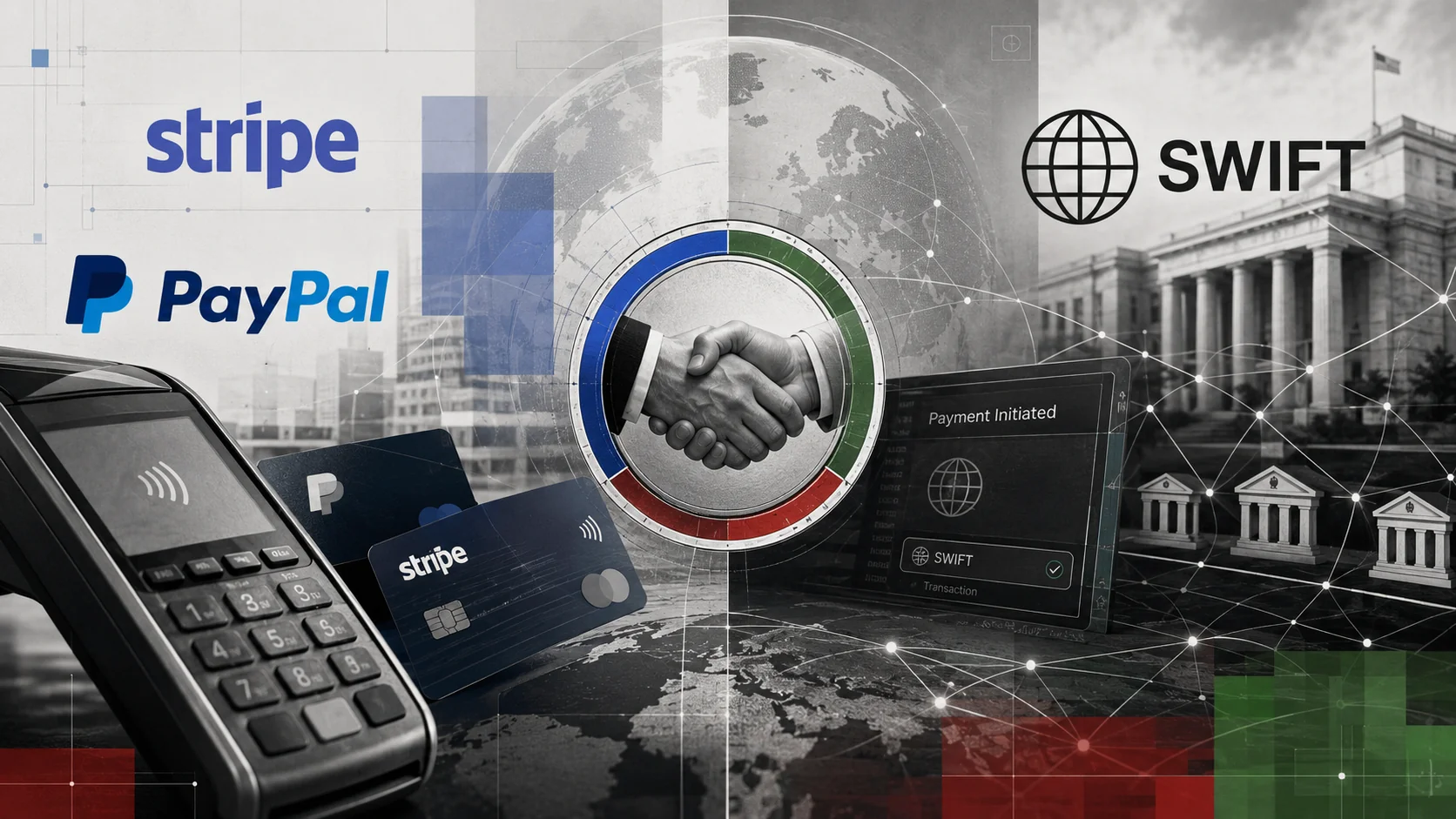
Within hours of each other this week, two of the most consequential names in money movement made their plays, and the Stripe PayPal takeover bid is comfortably the louder of the two. Stripe, alongside private equity firm Advent International, has lodged an unsolicited 53 billion dollar offer for PayPal at 60.50 dollars per share, a 28 per cent premium to the prior close. Reuters reported the approach was submitted earlier this month, having first been floated in April, with around 50 billion dollars in bank financing already committed. PayPal’s shares jumped almost 19 per cent in pre-market trading on 15 July. Its board, according to the same reporting, believes the offer undervalues the company.
The strategic logic is blunt. Combining Stripe’s merchant network with one of the world’s largest consumer wallets would, by one analyst’s arithmetic, put roughly 3.7 trillion dollars of annual volume, about three per cent of global GDP, through a single company, making it the largest US merchant acquirer and reducing reliance on the card networks that currently sit in the middle. Under unified ownership, PayPal’s PYUSD stablecoin and Stripe’s Bridge infrastructure would share a roof, alongside Stripe’s purpose-built payments blockchain Tempo and its wallet arm Privy.
On the very same news cycle, Swift announced the expansion of its blockchain-based settlement network to more than 40 financial institutions. The co-operative that connects over 11,000 banks has spent years piloting tokenised settlement; moving it toward production with several dozen institutions is the clearest signal yet that the incumbent rails intend to compete on crypto’s home turf rather than cede it.
Read together, the two announcements describe the same conclusion reached from opposite ends of finance: the technology argument is over, and the fight has shifted to distribution. Citi’s analysts have described stablecoin competition as a contest to become the default standard, where scale accrues to whichever token sits inside the largest merchant network or consumer wallet, not to whichever chain has the most elegant architecture.
The consolidation evidence is piling up. Mastercard acquired the stablecoin payments firm BVNK for 1.8 billion dollars earlier this year; Visa was an early BVNK investor and partners with Bridge. At the end of June, a reported coalition of more than 140 companies, with Stripe, Visa and Mastercard said to be among the architects, launched Open USD, a consortium stablecoin aimed squarely at the roughly 325 billion dollar market that Tether and Circle currently split about 80/20. When your would-be disruptors and your incumbents both conclude they need their own digital dollar, the category has stopped being an experiment.
The Stripe PayPal takeover bid faces genuine obstacles: antitrust scrutiny of the combined merchant share is inevitable, the financing is enormous, and hostile approaches to reluctant boards have a mixed record. Regulation cuts both ways too, since the GENIUS Act framework taking shape this very week will govern how PYUSD, Bridge and any consortium token operate.
Still, the direction of travel is unmistakable. Payments used to be a fee business layered over bank rails; it is becoming a battle to own the rails themselves, with stablecoins as the settlement layer. Whether the Stripe PayPal takeover bid succeeds or dies in a data room, the week it landed alongside Swift’s expansion will be remembered as the moment traditional finance stopped pretending this was optional. Corporate announcements are available from Stripe, PayPal and Swift directly.
For the incumbent stablecoin issuers, the week’s manoeuvres are double-edged. Tether and Circle built their duopoly on being first and being everywhere, but if the default digital dollar is decided inside a merchant network or a consortium, first mover advantage counts for less than shelf placement. Fintech founders already predict a proliferation of house stablecoins as firms migrate settlement on-chain for cost reasons without adopting anyone else’s token. That world looks less like one dollar to rule them all and more like the early card networks: several interoperable schemes, fierce interchange politics, and value accruing to whoever clears between them.