Quantinuum HPE collaboration builds the bridge to supercomputing
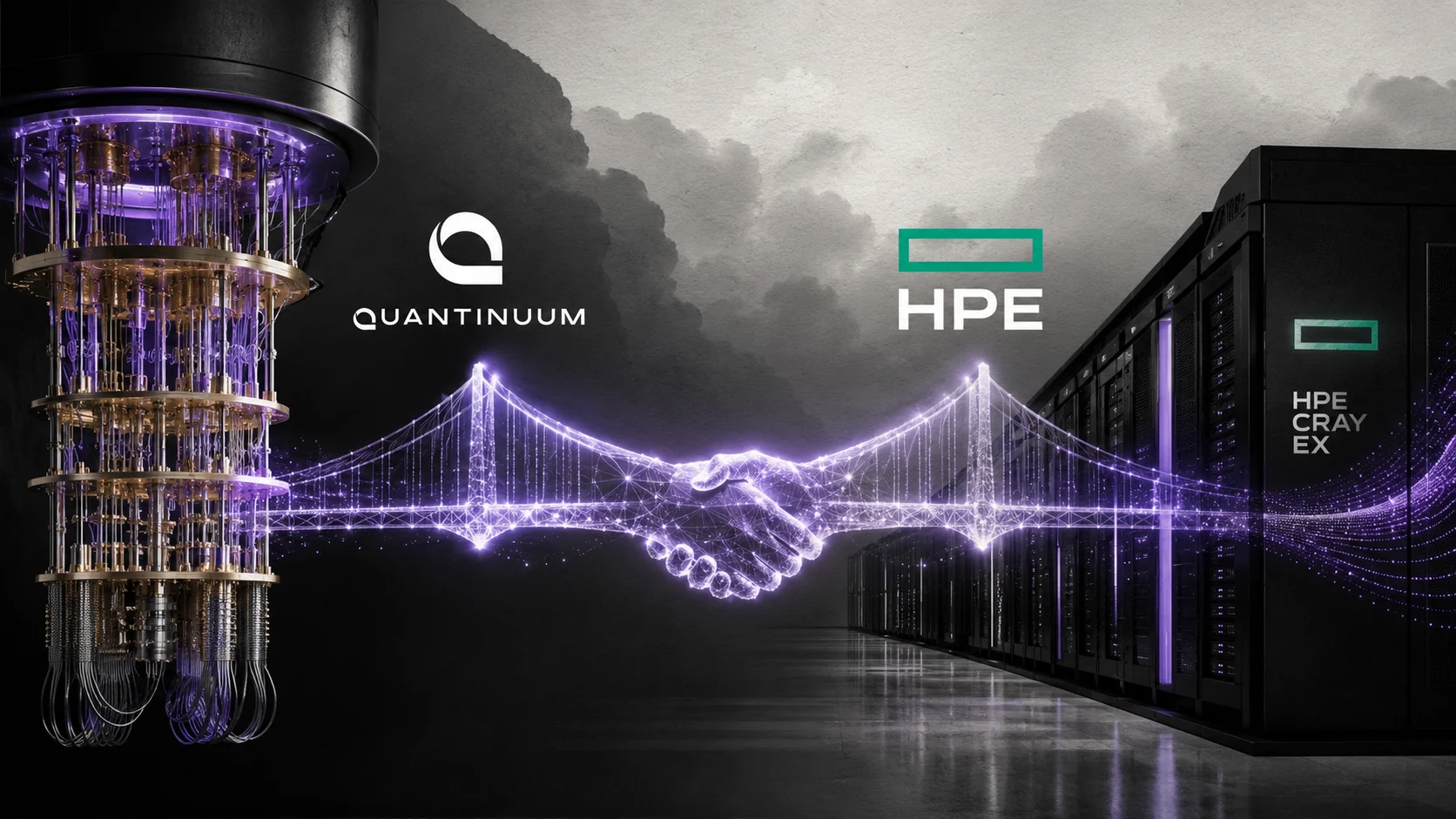
Quantinuum announced a strategic collaboration with Hewlett Packard Enterprise on 22 June to integrate quantum computing with high performance computing and artificial intelligence environments.
Listen to this articleListen
Quantinuum announced a strategic collaboration with Hewlett Packard Enterprise on 22 June to integrate quantum computing with high performance computing and artificial intelligence environments. The Quantinuum HPE collaboration is aimed at establishing a framework for combining the three, and at engaging enterprise customers seeking hybrid solutions across scientific and industrial workloads.
The premise is one the sector has converged on. No quantum computer built this decade will run an application end to end. What they will do is execute specific subroutines within a workflow that is otherwise classical, which means the practical question is integration: how a job is scheduled, how data moves between a supercomputer and a quantum processor, how results are validated, and how the whole thing is presented to a scientist who has no interest in the underlying physics. Those are ordinary systems engineering problems, and HPE has spent decades solving them for classical machines.
HPE’s position gives the Quantinuum HPE collaboration commercial weight. The company builds and operates a substantial share of the world’s supercomputing installations, including systems for national laboratories and research institutions across Europe, the United States and Asia. Those customers are the natural first buyers of quantum capacity, and they already have procurement relationships, facilities and staff. Reaching them through an existing supplier is considerably faster than building that channel independently.
For Quantinuum the timing sits alongside a broader commercial push. The company completed its Nasdaq listing in June at $60 per share, raising $1.68 billion in an upsized offering reported to be more than twenty times oversubscribed, and three weeks after the HPE announcement signed the agreement with Rolls-Royce, Riverlane and EPCC to apply its Helios system to computational fluid dynamics for gas turbine design. The pattern is deliberate: a hardware platform with independently verified fidelities, an integration partner for the classical side, and named industrial customers with defined problems.
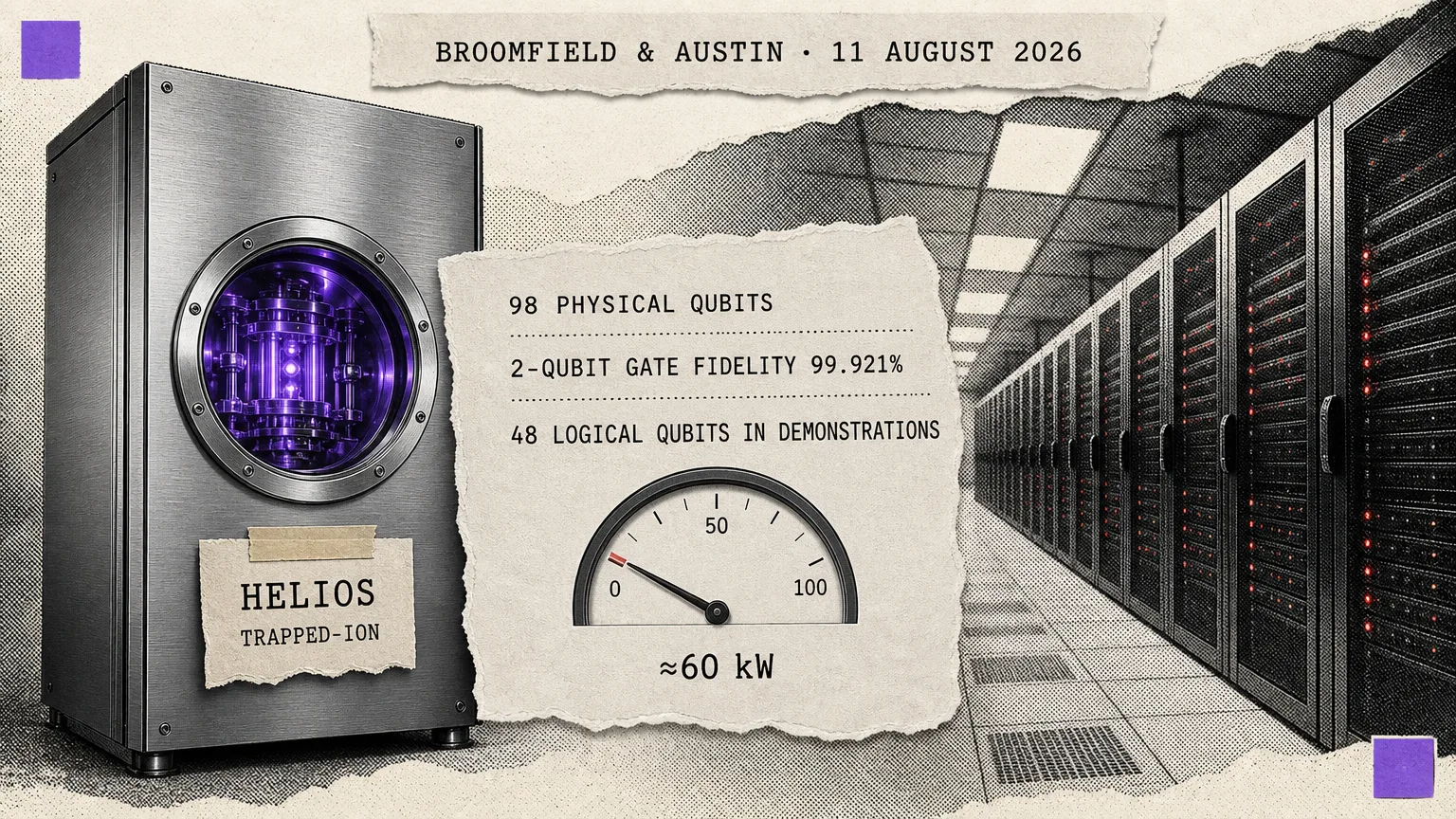
The hardware supports the pitch. Helios operates 98 qubits with average single qubit gate infidelities of 2.5 times ten to the minus five and two qubit gate infidelities of 7.9 times ten to the minus four, independently evaluated by Sandia National Laboratories and published in Nature this month. All-to-all connectivity through a rotatable ion storage ring removes the routing overhead that constrains fixed lattice architectures, which is a genuine advantage for algorithms requiring interaction between arbitrary qubit pairs. Trapped ion systems are slower than superconducting ones per operation and considerably more accurate, a trade-off that favours them for the deep circuits that useful algorithms require.
The competitive context is that everyone is building the same bridge. IQM is delivering a 150 qubit system to be integrated directly with Finland’s LUMI supercomputer. Nvidia has positioned itself as the classical control and decoding layer for other people’s quantum hardware, releasing its open Ising decoder in July with a 347 fold improvement in colour code logical error rates. IBM has been developing hybrid workflows through Qiskit for years. The hybrid architecture is now the consensus, and the competition concerns which combination of quantum hardware, classical infrastructure and software stack customers standardise on.
The financial reality behind the Quantinuum HPE collaboration deserves stating. Quantinuum reported first quarter net revenue of $5.24 million, down almost 73 per cent year on year against a prior period distorted by a $16.5 million upfront lease recognition, with a net loss of $136.59 million. The company carries a market capitalisation around $15.7 billion on that revenue base, which prices a great deal of future success. Partnerships that convert research relationships into recurring enterprise contracts are what closes that gap, and the HPE channel is the most plausible route to it.
Enterprise buyers should read this as infrastructure groundwork and not as a product announcement. There is nothing here to purchase and deploy. What it establishes is that when a quantum subroutine becomes useful for a chemistry, materials or fluid dynamics workload, the plumbing to run it beside an existing supercomputer will exist, supplied by a vendor those customers already work with.
Ends. 30 articles. Compiled 18 July 2026 for yfarmx.com.
Sources
- Hpehpe.com
- Quantinuumquantinuum.com
- Quantinuumquantinuum.com