Quantum computing stocks fall as the narrative trade unwinds
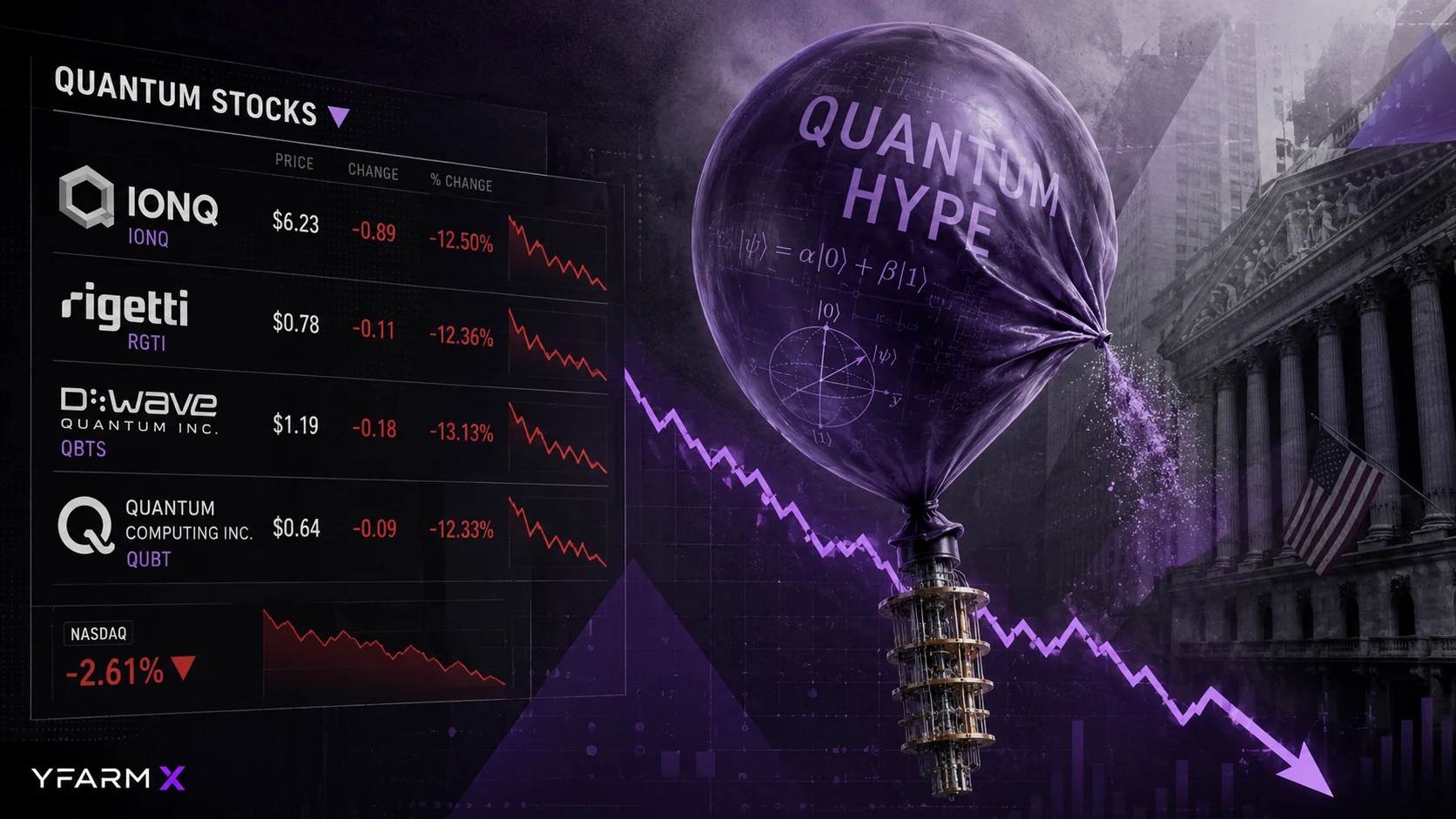
Quantum computing stocks completed a punishing week on 17 July, with IonQ, Rigetti and D-Wave trading between 60 and 76 per cent below their 52 week highs after shedding a further 17 to 20 per cent in five sessions.
Listen to this articleListen
Quantum computing stocks completed a punishing week on 17 July, with IonQ, Rigetti and D-Wave trading between 60 and 76 per cent below their 52 week highs after shedding a further 17 to 20 per cent in five sessions. IonQ closed at $34.25, down 20.4 per cent on the week and 59.5 per cent from its high. Rigetti finished at $13.92, down 76.1 per cent from its high and within touching distance of its 52 week floor of $12.53. D-Wave closed at $16.59. Quantinuum, the most resilient of the group, ended at $56.49, down 34.9 per cent from its peak.
The pattern is a familiar one. These quantum computing stocks rose between 300 and 600 per cent through late 2025 and early 2026 on a combination of supremacy headlines, Google’s error correction results and government funding announcements, at a time when most of the companies concerned had close to no commercial revenue. Valuations detached from fundamentals, and the correction was a question of timing.
The analytical turn came at the Quantum.Tech World Conference on 3 July, where Bank of America set out the constraint: the industry still lacks commercially relevant algorithms and fault tolerant hardware, both of which are required before broad quantum advantage can emerge. In analyst language that translates to a monetisation horizon measured in years. The bank’s preferred exposure is IBM, on the grounds that investors get quantum research attached to a balance sheet and actual revenues.
The wider technology selloff amplified everything. The Philadelphia Semiconductor index fell more than 11 per cent from its June peak and entered bear market territory, with Meta, Intel and Nvidia all lower in the same session. Speculative small capitalisation names with no earnings do not survive that kind of rotation intact.
The revenue picture explains the vulnerability. Rigetti reported first quarter 2026 revenue of $4.4 million, holding $569 million in cash with no debt, which buys time without generating a business. Quantinuum’s first quarter net revenue fell almost 73 per cent year on year to $5.24 million, distorted by a $16.5 million upfront recognition in the prior year quarter, while net loss rose 348 per cent to $136.59 million. IonQ is the exception among the pure plays, having reported first quarter revenue growth of 755 per cent to $64.7 million and raised full year guidance to between $260 million and $270 million.
Against that, the operating news through the month has been better than the share prices suggest. Quantinuum signed a multi-year agreement on 14 July with Rolls-Royce, Riverlane and EPCC to apply its 98 qubit Helios system to computational fluid dynamics for gas turbine design. IQM won a 150 qubit deployment for Finland’s LUMI AI Factory worth approximately its entire 2025 revenue, and listed on Nasdaq and Helsinki on 2 July with 337 million euros of cash. Two executive orders signed on 22 June committed the US federal government to accelerating quantum development and to a binding post-quantum cryptography migration. D-Wave has received a National Science Foundation grant and transfers its listing to Nasdaq on 27 July.
Analyst targets imply substantial upside from current levels, with Mizuho at $35 and Rosenblatt at $43 on D-Wave, roughly two to two and a half times the prevailing price. Those numbers should be read with the usual caution that applies to price targets on pre-revenue companies.
The honest summary for anyone holding quantum computing stocks is that the near term risk remains to the downside absent a specific catalyst, while the long term case rests on a timeline nobody can date precisely. Google research published in March suggested that quantum computers capable of breaking current public key encryption could arrive by 2029, considerably earlier than previous estimates. That is a compelling argument for the sector’s eventual importance and no help at all to 2026 revenues. This is not investment advice, and the gap between technological significance and commercial return is exactly where the sector is currently trading.
Sources
- Ionqinvestors.ionq.com
- Rigettiinvestors.rigetti.com
- Dwavequantumdwavequantum.com