
Meta
Muse Ember
An efficient model for coding subtasks, tools and large batches
Key facts
- 9 Nov 2026Muse Code and Model API
- Released
- 1,048,576tokens
- Context
- 524,288tokens
- Maximum output
- $0.10 / $0.50per million, up to 200K input
- API input / output
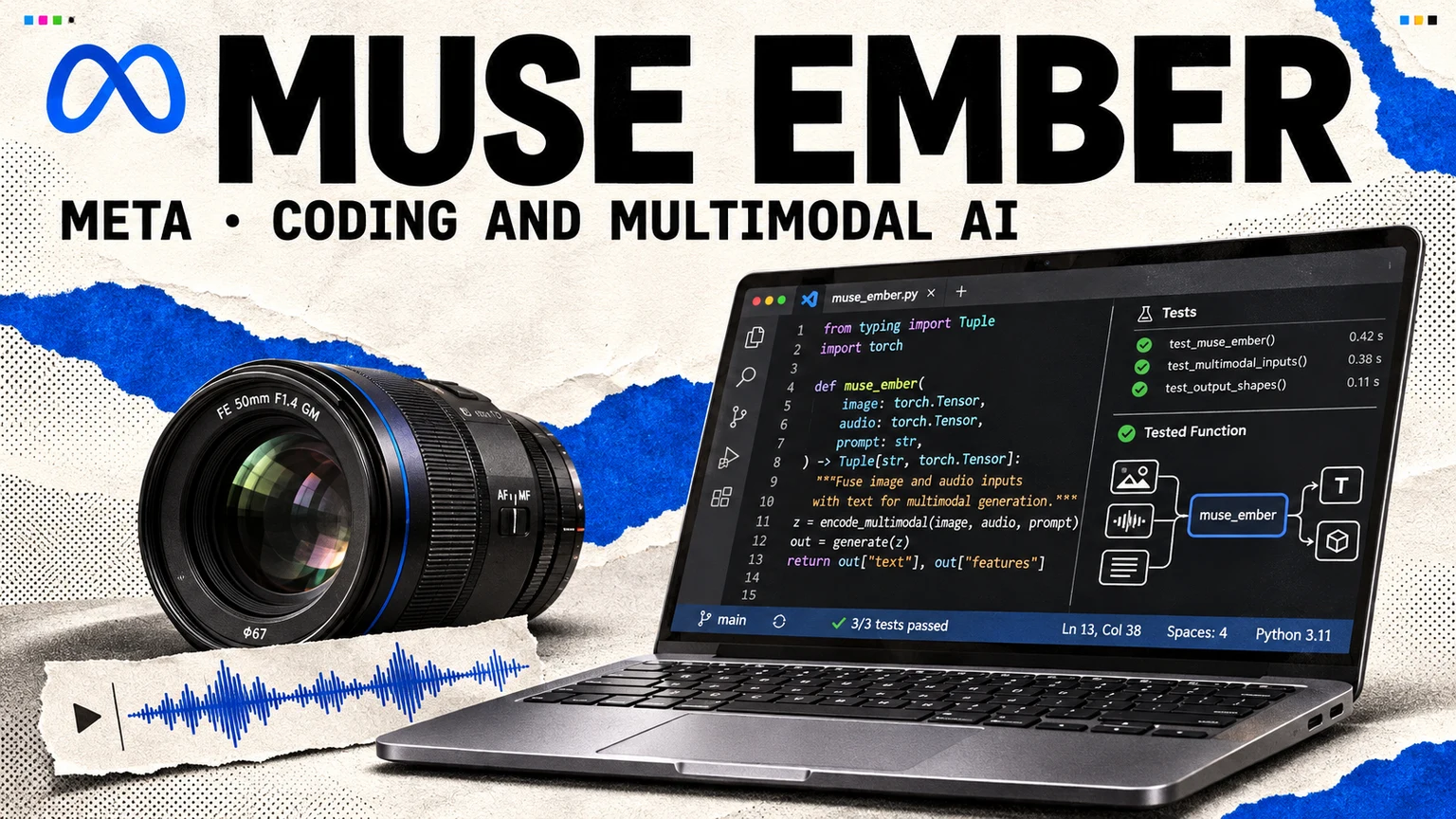
Muse Ember is Meta's AI model for repeated tasks such as checking code, sorting records and extracting information from files. It launched on 9 November 2026 through Muse Code and the Meta Model API. Its lower API price tier covers requests with up to 200,000 input tokens.
Muse Ember is Meta’s AI model for repeated coding, file analysis and tool-driven tasks. Meta released it on 9 November 2026 through Muse Code and the Meta Model API.
Ember handles repeated work inside larger tasks
Meta positions Ember for jobs such as classifying support tickets, extracting fields from documents, checking small code changes and carrying out subtasks assigned by a larger model. Its developer guide recommends Muse Spark or Muse Wonder for harder individual reasoning and coding problems.
The API identifier is muse-ember-1.0. Ember accepts text, images, video, audio and PDFs, and produces text. The documented context limit is 1,048,576 tokens, with up to 524,288 output tokens. Token limits describe pieces of encoded input and output; they are separate from word counts.
Requests over 200,000 input tokens cost more
Meta’s standard API prices are in US dollars per million tokens:
| Usage | Up to 200,000 input tokens | More than 200,000 input tokens |
|---|---|---|
| Input | $0.10 | $0.30 |
| Cached input | $0.004 | $0.012 |
| Output | $0.50 | $1.50 |
Cached tokens and the history of a continued conversation count towards the input threshold. Crossing it applies the higher rates to the whole request. Long conversations can therefore change the cost of both input and output.
Search grounding adds $2.50 per 1,000 search queries to token charges. Muse Code subscriptions have their own allowances; longer inputs consume those allowances faster.
API settings affect how much work Ember performs
The API supports Responses, Chat Completions and Messages endpoints. Reasoning effort runs from minimal to max, with max as the default. Supported features include tool calling, structured output, search grounding and computer use.
A useful evaluation gives Ember a representative batch of tasks, checks the outputs and records total token use. For tool-driven work, review the permissions given to the model and the actions it can carry out. Those choices affect both the cost and the consequences of an incorrect result.
Questions people ask
- What is Muse Ember used for?
- Meta positions Muse Ember for repeated coding subtasks, tool calls, routing requests and processing collections of files or records.
- How much does Muse Ember cost?
- Per million tokens, requests with up to 200,000 input tokens cost $0.10 input, $0.004 cached input and $0.50 output. Above that threshold, the entire request uses $0.30 input, $0.012 cached input and $1.50 output rates.
More in Large Language Models
All LLMs →- MetaMuse SparkMeta's proprietary frontier family
- Google DeepMindGemini 4 CarbonCoding, research and tasks with many steps, now available more widely
- AnthropicClaude Fable 5.2An AI model for difficult coding, research and long-running tasks
- Google DeepMindGemini 4 Argonlonger reasoning, coding and cyber defence
- OpenAIGPT-5.6the flagship from 9 July to 3 September 2026
- OpenAIGPT-6 Astrathe new generation, rolling out from 3 September 2026