
New York opens AI registry ahead of January deadline
New York’s RAISE Portal is open. Large frontier developers must register by 1 January 2027, with separate computation, revenue, safety and incident-reporting tests.

Listen to this articleListen
New York has opened its RAISE Act registration portal, giving large frontier AI developers operating in the state a 1 January 2027 registration deadline. Governor Kathy Hochul announced the portal on 10 November, alongside a statewide research initiative that will independently evaluate advanced AI systems.
The registration duty combines two tests: whether a company develops a frontier model covered by the law, and whether its revenue places it in the large-developer category. The Department of Financial Services’ guidance sets out those tests and separates registration from the safety and transparency duties that apply more widely.
The $500m threshold sits alongside a frontier-model test
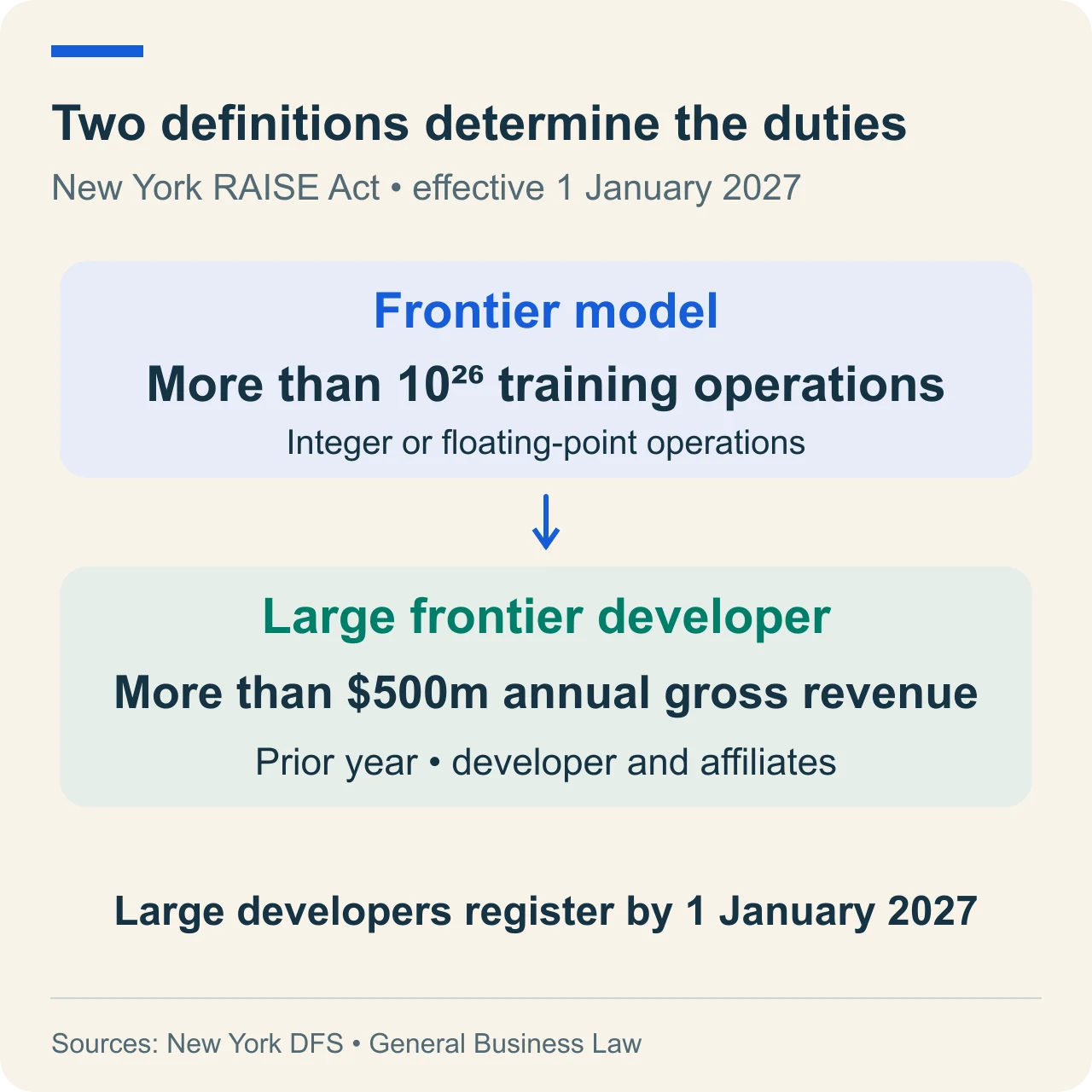
A large frontier developer must have annual gross revenue above $500 million together with its affiliates, measured over the preceding calendar year. The underlying frontier-model definition covers a foundation model trained using more than 10²⁶ integer or floating-point operations.
DFS says that computation includes the original training run and subsequent fine-tuning, reinforcement learning or other substantial modifications by the developer. A frontier developer is an entity that has trained or initiated training using, or intending to use, the covered amount of computation.
The law assigns two levels of responsibility. All covered frontier developers operating in New York have model-transparency and incident-reporting duties. Large frontier developers additionally register, publish safety frameworks and submit quarterly summaries of catastrophic-risk assessments.
| Requirement | Who it covers | Date or reporting clock |
|---|---|---|
| Maintain registration | Large frontier developers | Beginning 1 January 2027 |
| Publish a model transparency report | All frontier developers | Before or with a new or substantially modified model’s deployment |
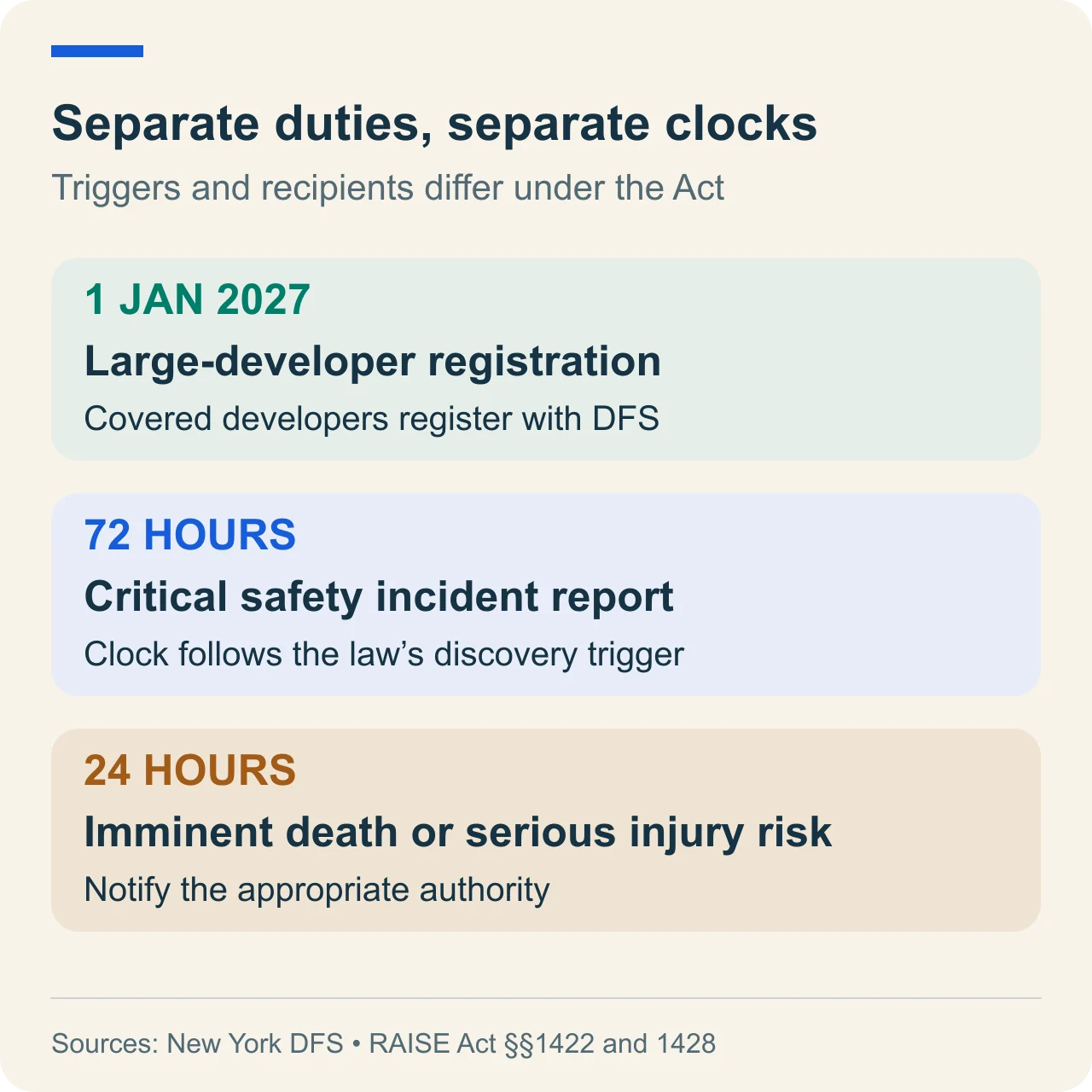
| Report a critical safety incident | All frontier developers | Within 72 hours of the statutory determination or reasonable-belief trigger |
| Notify an appropriate authority of imminent danger | Covered incidents threatening death or serious physical injury | Within 24 hours |
Registration records who operates the model business
The RAISE Portal asks large frontier developers to establish an authorised corporate account and submit a disclosure statement. DFS lists information about the legal entity, its principal place of business, New York offices where applicable, beneficial ownership and designated points of contact.
The account becomes the channel for incident reports, quarterly risk-assessment summaries and assessment payments. DFS says disclosure statements must be renewed every two years, on a transfer of frontier-model ownership, or after a substantial change to previously reported information, whichever comes first.
The statute’s current text records the Act’s effective date as 1 January 2027. The November portal opening gives covered companies time to identify the responsible entity, assemble the required information and complete the registration process before those duties begin.
Safety frameworks and incident reporting follow different clocks
Large frontier developers must publish a safety framework describing how they identify and mitigate catastrophic risks. DFS’s guidance includes incident response, protection of unreleased model weights and internal governance within that framework. It must be reviewed, and updated as appropriate, at least annually.
Quarterly summaries concern catastrophic-risk assessments arising from internal use of frontier models. Model transparency reports follow deployment events. Critical safety incidents follow their own reporting clocks: ordinarily 72 hours, with a separate 24-hour disclosure to an appropriate authority where an incident poses an imminent risk of death or serious physical injury.
New York is building independent testing capacity too
The New York Center for AI Responsibility and Research will bring together more than 80 researchers, the governor’s announcement says. Based at SUNY’s Binghamton University, it will use Empire AI computing resources to study advanced systems and develop evaluation methods.
Cornell Tech’s Greg Morrisett and Columbia University’s Jeannette Wing will serve as interim co-directors. The state says the centre will work with DIGIT, the Office of Digital Innovation, Governance, Integrity, and Trust, including reviews of developers’ published safety frameworks.
The portal creates a record of the companies responsible for covered models. The research centre adds a separate source of technical evidence about those systems. Together, the two initiatives connect legal reporting obligations with the capacity to test the technologies being reported on.