Vulcan targets Friday launch with 40 Amazon Leo satellites
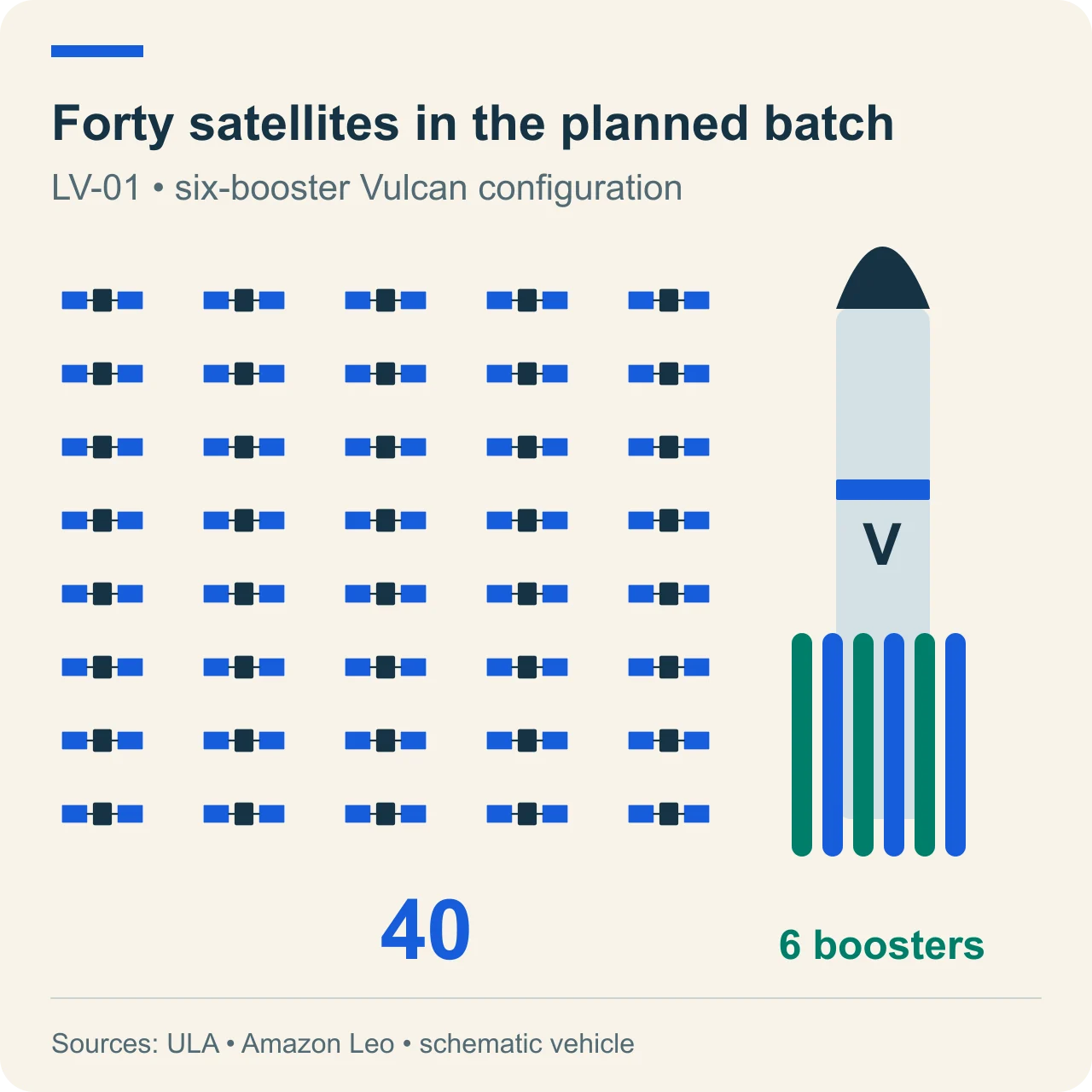
ULA targets 13 November at 12:54pm Florida time for its first Amazon Leo Vulcan mission, using six solid boosters and an optimised Centaur stage.
Listen to this articleListen
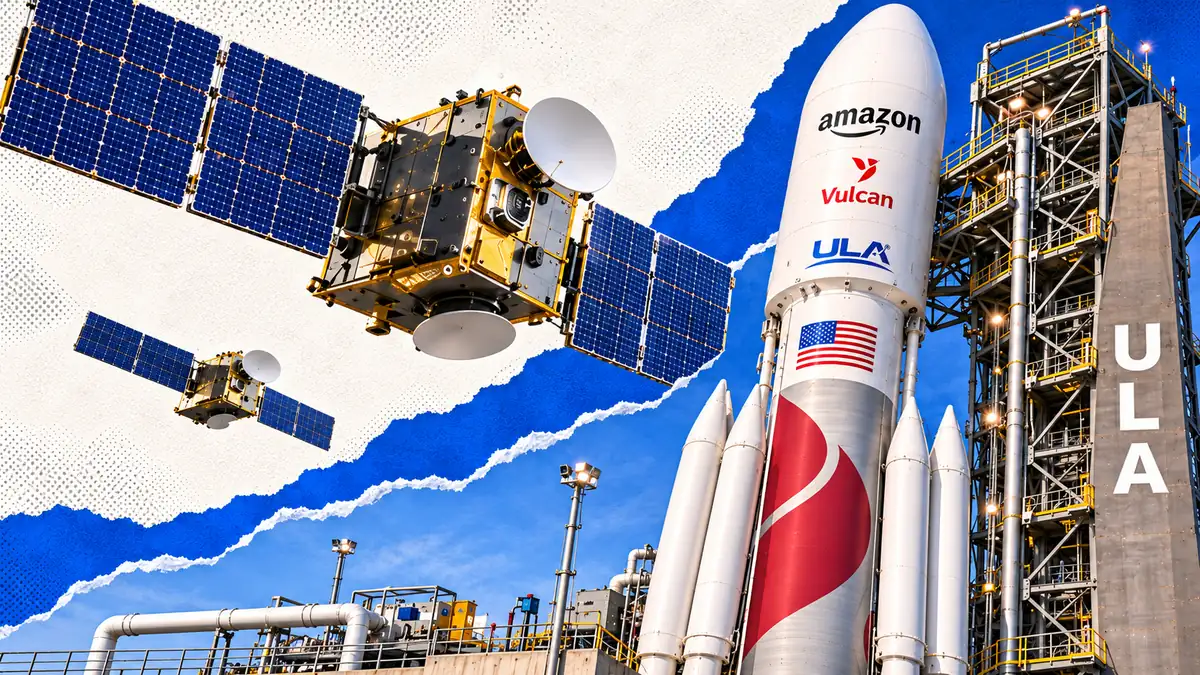
United Launch Alliance is targeting 13 November for a Vulcan rocket to carry 40 Amazon Leo broadband satellites into low Earth orbit. The provider’s mission page gives a target liftoff of 12:54pm Florida time from Space Launch Complex 41 at Cape Canaveral Space Force Station.
Leo Vulcan 1, or LV-01, would be Amazon’s first mission on Vulcan and the largest Leo satellite batch carried by a single launch so far. It also introduces a configuration designed to increase how much of the constellation ULA can deploy on each flight.
Six boosters and a revised upper stage carry the larger batch
LV-01 uses Vulcan’s six-solid-booster configuration and a low-Earth-orbit-optimised Centaur V upper stage. Amazon’s mission account describes the flight as the first use of both that six-booster configuration and the shorter, optimised upper stage.
The configuration combines additional liftoff thrust with an upper stage adapted to the destination orbit. ULA lists a long payload fairing enclosing the satellite stack, with the Centaur stage responsible for carrying and deploying the spacecraft after the main boost phase.
Amazon says the first several Leo–Vulcan flights will introduce new hardware as the vehicle develops, with initial missions carrying 40 satellites and larger configurations planned later. The payload count therefore belongs to this mission’s specific vehicle and satellite combination.
| LV-01 item | Provider’s plan |
|---|---|
| Target launch date | 13 November 2026 |
| Target liftoff | 12:54pm Florida time |
| Launch pad | SLC-41, Cape Canaveral |
| Payload | 40 Amazon Leo satellites |
| Vehicle | Vulcan VC6L, with six solid boosters |
A dedicated launch facility is intended to shorten the turnaround
Amazon-funded facilities at Cape Canaveral allow ULA to prepare two Vulcan missions at the same time, Amazon says. LV-01 uses the dedicated VIF-A vertical-integration facility and a new mobile launch platform for Leo flights.
ULA describes assembling the rocket elements, integrating the spacecraft and moving the completed vehicle to the pad by rail. That parallel preparation capacity gives the programme a way to work on a following mission while the first occupies the launch site.
Amazon says LV-02 is already being prepared and is expected to follow within weeks of a nominal LV-01 flight. That interval remains a company expectation tied to the first mission’s outcome and subsequent preparations.
Vulcan has 38 Leo launches on contract
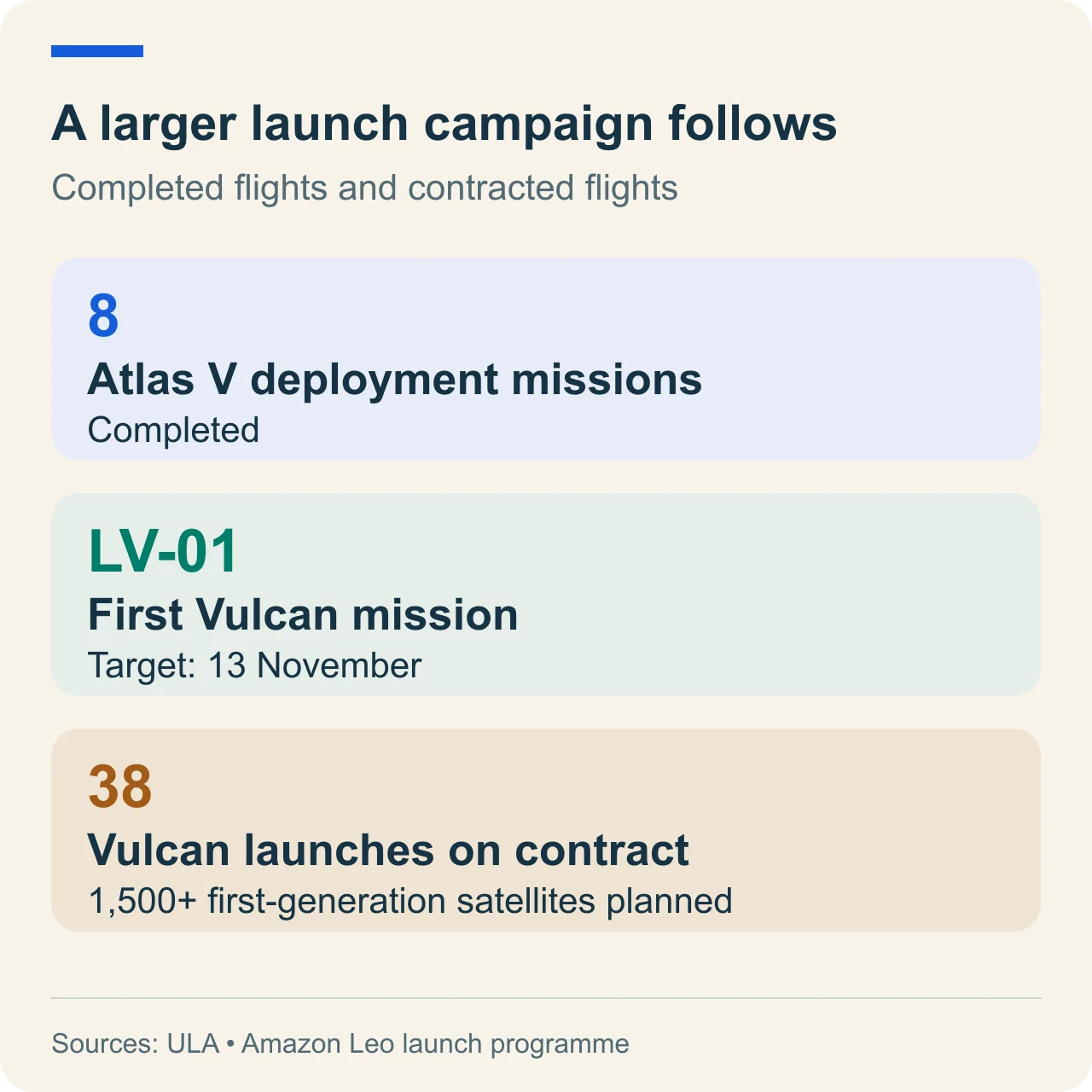
LV-01 is the first of 38 Vulcan launches Amazon has booked, following ULA’s eight successful Atlas V deployment missions for the constellation. Amazon says Vulcan is expected to carry more than 1,500 first-generation Leo satellites across those missions.
Leo, formerly Project Kuiper, is being deployed through several launch providers. Amazon’s portfolio includes ULA, Arianespace, Blue Origin and SpaceX. The strategy spreads deployment across different vehicles and launch infrastructure as each becomes available.
Amazon also says it completed its 1,000th satellite in early September and has hundreds of flight-ready spacecraft awaiting launch. That is a manufacturing milestone; deploying those spacecraft into operational orbits requires the launch campaign now under way.
Falcon 9, Electron and Ariane 6 also have upcoming missions
Rocket Lab’s provider manifest lists its next Electron mission, The Mountain God Rises for iQPS, no earlier than 14 November from Launch Complex 1 in New Zealand. The mission serves a different customer and spacecraft programme from Amazon’s broadband deployment.
SpaceX’s USSF-627 mission page targets a Falcon 9 launch from Vandenberg in California on 11 November, with a four-hour window opening at 6:35pm local time. It lists a backup opportunity on 12 November at 6:21pm California time. These are the provider’s target windows at publication.
Amazon’s own update also targets its next Ariane 6 mission, Leo Europe 4, no earlier than 23 November from Europe’s Spaceport in Kourou, French Guiana. That gives the constellation another route to orbit beyond the new Vulcan configuration.
Launch targets depend on vehicle readiness, range availability and weather. The immediate milestone for Leo is the planned 40-satellite Vulcan flight: a larger batch, a revised upper stage and a dedicated ground operation intended to support the next flights in the contracted campaign.
Sources
- ULA: LV-01 mission and target launch timeulalaunch.com
- Amazon Leo: Vulcan payload, production and launch campaignaboutamazon.com
- Rocket Lab: upcoming provider manifestrocketlabcorp.com
- SpaceX: USSF-627 target and backup windowsspacex.com