
Stable Diffusion 3.5 and Stability AI
the incumbent that got overtaken
Key facts
- 3.5Stable Diffusion
- Version
- Open weightdownloadable
- Licence
- 3 yearscommunity tooling
- Ecosystem
- Thousandscommunity add-ons
- LoRAs
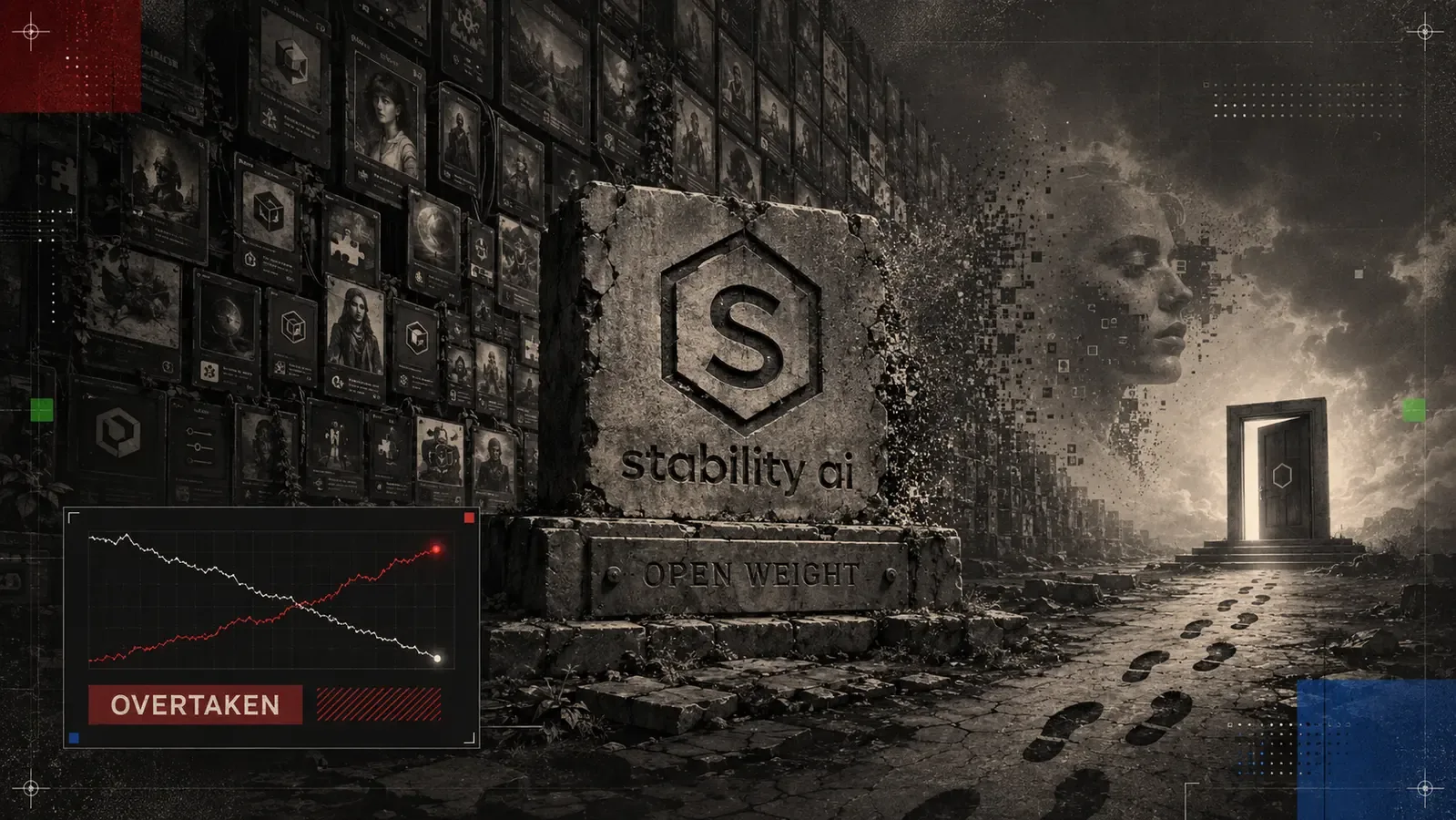
The incumbent that got overtaken. Still owns a slice of the open ecosystem through the enormous library of community fine-tunes, LoRAs and tooling built over three years.
What it is
Stable Diffusion 3.5 is the model that built the open image ecosystem and then watched it move on. Released by Stability AI, it remains widely used, but its story now reads as a case study in how quickly a lead can pass in generative AI. The output quality of Stable Diffusion 3.5 trails FLUX.2 in most head-to-head comparisons, and yet the model still owns a meaningful slice of the open ecosystem, thanks to what was built around it rather than what it can do today.
The library it leaves behind
That slice is the library. Over three years, a community assembled an enormous body of fine-tunes, LoRAs and tooling on top of Stable Diffusion, and that accumulated work does not evaporate the moment a sharper model arrives. A LoRA is a small add-on that nudges a base model towards a particular style or subject without retraining the whole thing; there are thousands of them, alongside interfaces, plug-ins and workflows tuned specifically for this family. For a user with an established pipeline, the switching costs are real, and that inertia is a genuine asset even as raw quality slips behind the newest releases.
How the lead slipped
The history explains the rest. Stable Diffusion created the open image ecosystem, effectively inventing the idea that a capable generator could be downloaded and run by anyone with a suitable machine. Then the founding researchers left Stability AI to build FLUX, and much of the ecosystem’s energy followed them out of the door. FLUX inherited the credibility of the people who had built the original, and the open community, always quick to chase the best available weights, gradually reoriented around the newer family. Stability AI kept shipping, but it was now the incumbent defending a position rather than the insurgent defining one.
This is the point worth being precise about: the ecosystem followed the people, not the brand. Open-source communities are loyal to capability and to the researchers who deliver it, and when those researchers moved, the tooling and the attention moved with them. That is the mechanism behind the description “the incumbent that got overtaken”, and it is a sober lesson for anyone assuming an early lead in AI is durable. A head start buys time; it does not buy permanence, particularly when the talent that created the head start can leave and start again elsewhere.
Still far from obsolete
None of this makes Stable Diffusion 3.5 obsolete. It still runs, the library still works, and for many tasks the difference in output quality is smaller than a benchmark suggests and easily closed by a good fine-tune. A specialist LoRA trained for a narrow subject can lift an older base model past a newer general one on that specific job, which is exactly the kind of advantage a deep community library provides. Teams with years of investment in these workflows have sound reasons to stay, and Stability AI continues to release into an ecosystem it originated. The fair summary is that the model is no longer the frontier of open image generation, but it is a long way from irrelevant, and treating it as a museum piece would be a mistake.
Where it sits
Stable Diffusion 3.5 is the ancestor of much of what surrounds it in the open image models space. It proved that open weights could compete with closed services, and the market it opened now includes the very models that overtook it. What to watch is whether Stability AI can produce another release that pulls the community back, or whether its role settles permanently into that of the respected originator whose ecosystem has outgrown its own models. Either way, the open corner of AI image generation exists because Stable Diffusion made it, which is not a small legacy to hold.
More in Image Generation
All Image →- Black Forest LabsFLUX 3 ImageFLUX 3 Image creates and edits pictures with up to ten reference images
- Google DeepMindNano Banana 2.1Image generation, reference pictures and conversational edits
- OpenAIGPT Image 2.5two variants, one price, the top two seats
- OpenAIGPT Image 2the leading line
- AlibabaQwen-Image-2.1one small model for making pictures and editing them
- GoogleNano Banana Pro and Nano Banana 2the 4K value leader