
Google DeepMind
Lyria 3 Pro
the API-grade music model
Key facts
- Apr 2026Pro, on Vertex AI
- Released
- DeepMindGoogle
- Maker
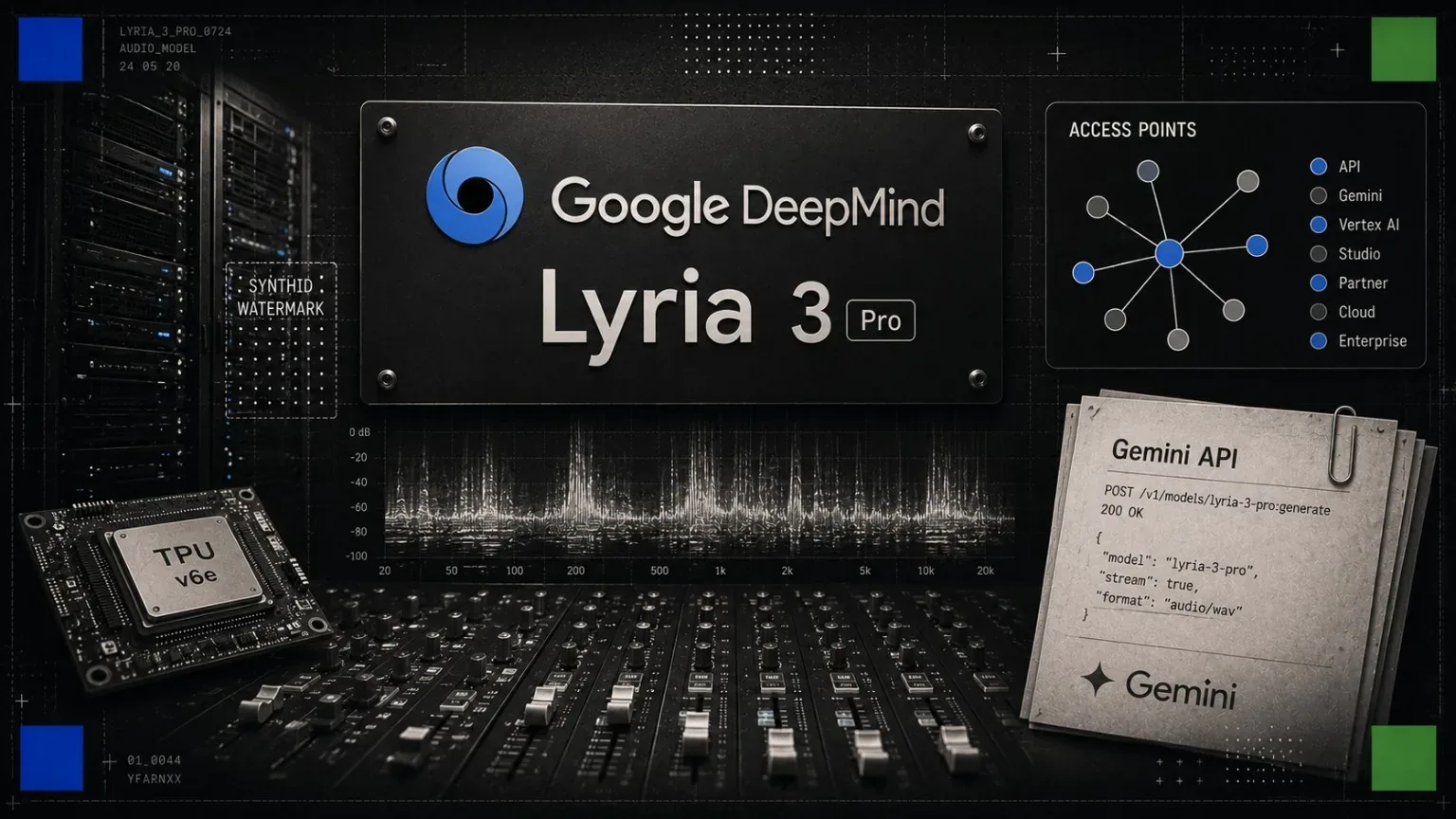
- Gemini APIand Vertex AI
- Access
- SynthIDevery output
- Provenance
- Lyria 3.5GA 3 Sep 2026, Gemini API
- Successor
Google DeepMind's API-first music model, reachable through the Gemini API and watermarked with SynthID.
Lyria 3 is Google DeepMind’s music generation model, and its arrival in February 2026 marked the point at which the search company became a serious presence in generative audio. The significant change was vocal capability. Earlier DeepMind music work could produce instrumental passages, but singing, with intelligible words and a convincing performance, had been the preserve of Suno and Udio. By adding vocals, Lyria 3 closed the most visible gap between Google’s offering and the specialists, and the Pro variant is now positioning itself as the API-grade option for teams that want music generation inside their own products.
Built for the API
The emphasis on the interface is the point of the product. Consumer music tools are built around a website and a prompt box; Lyria 3 Pro is built to be called by other software. It is available through the Gemini API and through Vertex AI, Google’s managed platform for running models in production, which places it in the same environment that developers already use for text, image and video generation. For a company building a game, an app or an advertising tool that needs original music on demand, reaching the model through a familiar API is far simpler than wiring in a separate consumer service, and that convenience is much of the pitch.
Google made the successor, Lyria 3.5, generally available in the Gemini API on 3 September 2026 as lyria-3.5, which its changelog describes as “full-length song generation with improved musical coherence, natural vocals, and fine-grained duration and structural control” in 44.1 kHz stereo, and DeepMind’s Lyria page puts its tracks at up to three minutes long. Google’s deprecations table lists Lyria 3.5 as the recommended replacement for lyria-3-pro-preview, which stays available until Google sets a shutdown date.
Programmatic generation
Programmatic generation is a different discipline from casual creation. A developer calling the model at scale cares about predictable output, sensible rate limits, clear licensing and the ability to generate hundreds of variations without manual steps. Those are the qualities that decide whether a model can sit inside a shipping product, and they are precisely where an API-first design from a large cloud provider tends to be strongest. It is why the Pro line is described as the serious API option rather than the most creative toy: the value is in reliability and integration as much as in the audio itself. For teams shipping software at volume, that predictability is often worth more than a marginal edge in musicality.
Provenance and compliance
Provenance and compliance follow the same logic. Every Lyria 3 output carries SynthID watermarking, DeepMind’s system for embedding an imperceptible, machine-detectable marker that identifies a piece of media as AI-generated. This is the same compliance argument that applies to Veo, Google’s video model, and it reflects a consistent strategy across DeepMind’s generative range: make provenance a built-in property rather than an afterthought. For a business customer facing new disclosure rules and platform policies on synthetic media, a watermark that survives ordinary handling is a practical reason to prefer a watermarked model over one with no provenance signal at all. In a period of tightening rules on AI media, that built-in signal is becoming a selling point in its own right.
Where it sits and what to watch
Placing this in the wider field, Lyria 3 represents the arrival of hyperscaler competition in a market that was, until recently, defined by focused start-ups. Google brings distribution, an established developer base and a compliance story that enterprise buyers already understand, and it can afford to treat music generation as one line item in a much larger AI platform. That changes the competitive shape of the sector: the specialists still lead on raw musical quality and on features aimed at working musicians, while the Pro line competes on being the easiest music model to build against. For readers following the rest of the stack, the model sits alongside the wider AI audio field and DeepMind’s other generative models. What to watch next is how quickly the vocal quality closes on the dedicated tools, and whether an API-first, watermarked model becomes the default choice for developers who need music inside their software rather than a finished track to release. For the broader picture, see our AI hub.
More in Audio and Voice
All Audio →- Alibaba QwenQwen-Audio-3.1Alibaba's upgraded audio stack, announced 23 September 2026
- NvidiaNemotron 3 DiarizationNvidia’s Nemotron 3 Diarization marks when each speaker is active in recorded or live audio
- Microsoft AIMAI-Transcribe-2-Streaming, MAI-Voice-2.1 and MAI-Voice-2.1-Flashlive transcription that tops the streaming accuracy board, and two new voices
- AlibabaHappyShrimp 1.0the name is a eulogy
- Microsoft AIMAI-Transcribe-2speech recognition at ten cents an hour
- SunoSuno v6a flagship, an exploratory variant and a free mini, released together