
Suno
Suno v5.5
the market leader
Key facts
- Mar 2026v5.5
- Released
- v6since 9 Sep 2026
- Flagship
- $5.4bnSeries D, Jun 2026
- Valuation
- 2Mpaid
- Subscribers
- 1293 Elov5 audio
- Quality
- 44.1kHzsample rate
- Output
The largest generative music business, with roughly 2 million paid subscribers reported in February 2026 and a $5.4bn valuation from its June 2026 funding round.
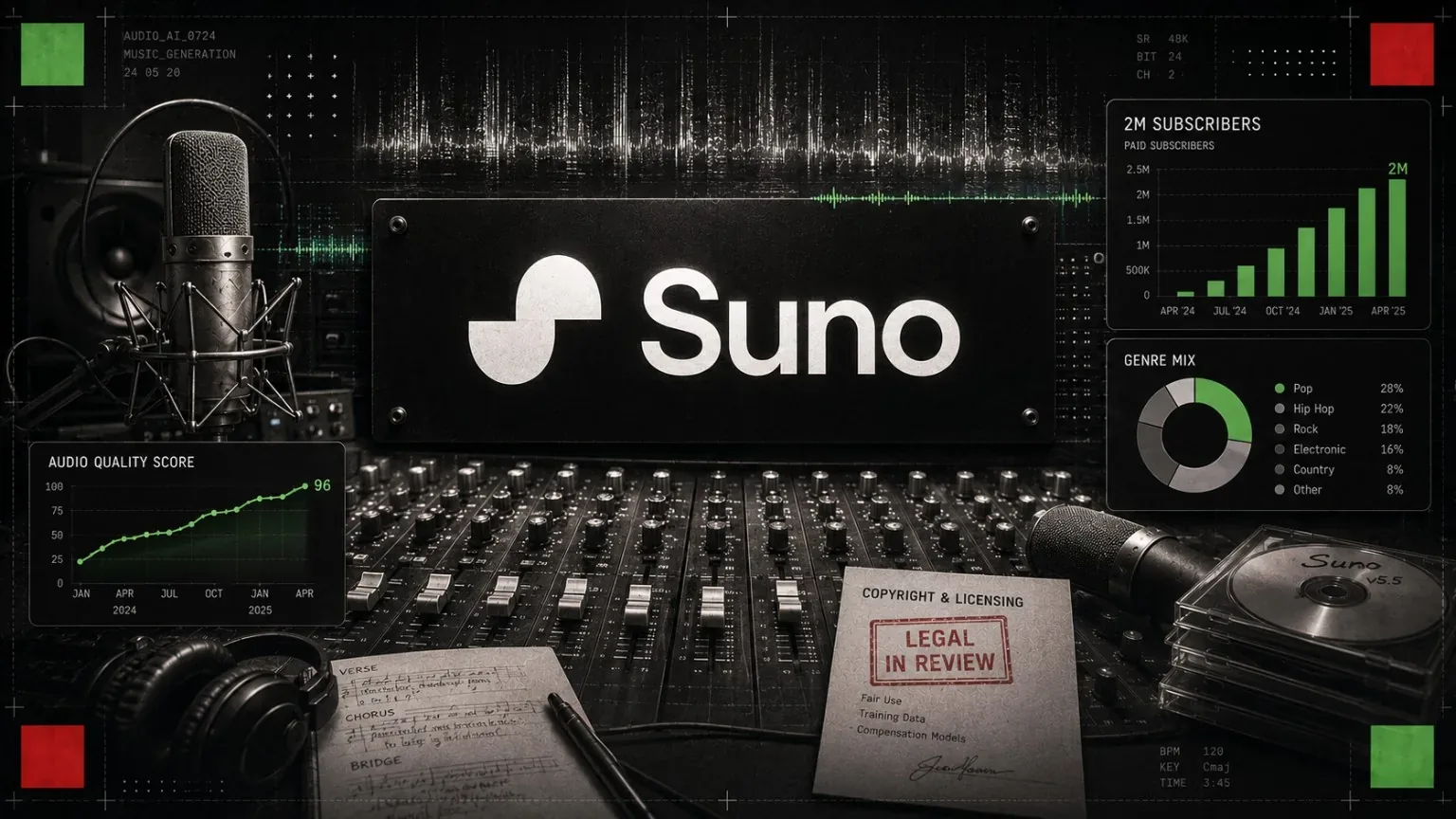
Suno v5.5, released on 26 March 2026, is the model this page covers, from the studio that has become the largest generative audio business by some distance. It carried the flagship title from that release until 9 September 2026, when the v6 family took it over. In February 2026 Suno reported around $300m in annual recurring revenue and roughly 2 million paid subscribers, numbers that put clear water between it and every rival music model. On 3 June 2026 it raised $400m at a $5.4bn valuation, more than double the $2.45bn of its November 2025 Series C, according to its own announcement. Suno is, in short, the market leader, and the scale of its paying base is the clearest evidence of why.
The v6 family
Suno released the v6 family on 9 September 2026, recorded in the company’s release notes. The flagship title now sits with v6, which Suno describes as reliable and precise, delivering polished music across every genre and style. Beside it sit v6-wild, an experimental variant built for exploration that the company calls less predictable and more varied, producing unexpected, textured and ambitious results, and v6-mini, “a faster, more efficient version available to everyone”, which forms the free tier. Both v6 and v6-wild are reserved for paid plans. The family adds partial song editing by text prompt, mashups from multiple sources, beat sampling and isolation, creation from visual or audio references, and single-lyric updates that leave the rest of the track in place. This page keeps v5.5 as its subject: the generation that built the paying base the figures above describe.
How it sounds
The technical case rests on quality that listeners can hear rather than read off a spec sheet. The v5 generation scored a reported 1293 Elo across audio fidelity, musical structure and vocal realism, the three axes on which generative music tends to fall down. Where earlier systems produced convincing thirty-second loops that unravelled over a full song, Suno’s strengths sit in vocal expressiveness, genre breadth and instrument separation. That last point is worth dwelling on: keeping a vocal line, a bassline and a drum pattern legible rather than smeared together is one of the harder problems in the field, and it is central to why Suno v5.5 reads as a finished track rather than a demo.
The production stack
Around the model sits a growing production stack. Suno Studio adds an AI-native environment for arranging and editing generated material, moving the product beyond a single prompt box towards something a working musician might actually sit in front of. Voice cloning and custom style models are included, which lets a user carry a consistent vocal identity or house sound across many tracks rather than starting from scratch each time. Output is delivered at 44.1kHz, the standard CD sampling rate, so finished files slot into ordinary editing and distribution workflows without resampling.
Access and pricing
Access is priced to build a broad base. A Pro plan starts at around $10 a month, and there is a free tier, though the free tier is restricted to non-commercial use, which keeps anyone releasing or monetising music on a paid plan. That split, generous access to try and a modest fee to publish, is a familiar way to grow a large paying base quickly. For a service with roughly 2 million paid subscribers, that structure is doing its job, funnelling casual experimenters towards the paid tiers as soon as their output leaves the platform. It also explains how the company sustains the revenue figures that underpin its valuation.
The legal question
The unresolved question is legal rather than technical. Litigation and licensing with the major record labels remains the live risk hanging over the business, and the position is worth stating carefully rather than predicting. The training data behind modern music models, and the rights attached to it, are being contested in courts and negotiated in boardrooms at the same time, and the outcome will shape what a product like Suno v5.5 is allowed to do and on what commercial terms. A licensing settlement could remove the overhang; an adverse ruling could force expensive changes. Neither is a safe bet today.
Where it sits and what to watch
For readers tracking the wider field, Suno’s flagship line is the point of comparison against which newer entrants are measured, with v6 now carrying that flag and v5.5 standing as the generation that built the base, and it sits at the centre of our AI audio coverage. The competitive pressure is real, with API-first music models and licensed-catalogue rivals arriving steadily, but scale, subscriber numbers and a maturing production suite give Suno a lead that is more than a benchmark score. What to watch next is whether the legal picture resolves in a way that lets the company convert its lead into durable, licensed revenue, and whether Suno Studio pulls enough serious musicians away from traditional tools to make the platform sticky. For a fuller picture of how generative audio fits the rest of the stack, see our AI hub.
More in Audio and Voice
All Audio →- Alibaba QwenQwen-Audio-3.1Alibaba's upgraded audio stack, announced 23 September 2026
- NvidiaNemotron 3 DiarizationNvidia’s Nemotron 3 Diarization marks when each speaker is active in recorded or live audio
- Microsoft AIMAI-Transcribe-2-Streaming, MAI-Voice-2.1 and MAI-Voice-2.1-Flashlive transcription that tops the streaming accuracy board, and two new voices
- AlibabaHappyShrimp 1.0the name is a eulogy
- Microsoft AIMAI-Transcribe-2speech recognition at ten cents an hour
- SunoSuno v6a flagship, an exploratory variant and a free mini, released together