
Alibaba
HappyShrimp 1.0
the name is a eulogy
Key facts
- 17 Aug 20261.0, beta
- Launched
- 2 languagesChinese, English
- Vocals
- 2Fun-Music, inferred
- API models
- 1Beijing, inferred
- API region
- MP3, WAVstreaming or whole file
- Output
- Not publishedaccess by application
- Price
A one-prompt song generator launched on PC web in China and overseas at once, whose Chinese name is a callback to the music service Alibaba shut in 2021.
Alibaba launched HappyShrimp 1.0 in beta on 17 August 2026, a model that turns one written prompt into a finished song with lyrics, melody, arrangement and a sung vocal. Bloomberg reported the launch the same day. It went live on PC web in China and overseas at the same time, which is unusual for a Chinese consumer AI product and is the clearest signal of who Alibaba thinks it is competing with.
The pitch is the removal of vocabulary. Rather than asking a user to select a key, a tempo and a stack of genre tags, HappyShrimp accepts a description of an emotion, a story or a memory and produces a song from it. A user can also supply their own lyrics and have the model compose and perform around them, or ask for an instrumental with no vocal at all. Alibaba lists Chinese style, pop, R&B and soul, hip hop, rock, funk, electronic, classical and jazz among the genres, and the product carries text-to-lyrics, reference-based generation and style transfer alongside the main text-to-song route. On launch day it also announced a tie-up with Taihe Music Group, one of China’s established music companies, covering artist co-creation and content.
The name is the most interesting thing about it
In English, “HappyShrimp” reads as whimsy or as a translation accident. In Chinese it is neither. The product is 快乐虾米, Happy Xiami, and 虾米 was the name of Xiami Music, Alibaba’s own music streaming service. Xiami was an early mover in Chinese digital music and it lost, comprehensively, to Tencent. By October 2020 it was down to 22.4 million monthly users against more than 450 million across Tencent’s three main music apps, and Alibaba closed it in February 2021, with management conceding it had missed crucial opportunities in the fight over licensed catalogues.
So Alibaba has named its generative music model after the streaming business it shut down five years earlier. Read one way that is sentiment. Read another it is a statement about which part of the music industry Alibaba now thinks is winnable: not the licensing race it lost, where catalogue rights decided the outcome, but generation, where the catalogue is produced on demand. The English name drops the reference completely, which is worth knowing when reading English coverage that treats the name as arbitrary.
The naming is also a house convention rather than a one-off. Alibaba Cloud’s model documentation lists HappyHorse, 快乐马, as its video generation family. Happy Horse came first, and Chinese coverage of this launch introduced HappyShrimp as the next product in the same series.
What the documentation actually describes
The consumer site is a prompt box. Alibaba Cloud’s Model Studio documentation carries an end-to-end music model called Fun-Music, whose page was last updated on 1 July 2026, six weeks before the consumer launch. Alibaba never names HappyShrimp in that documentation, so what follows is our reading of what sits underneath, drawn from the timing, the shared capability list and the naming series, rather than anything either page states.
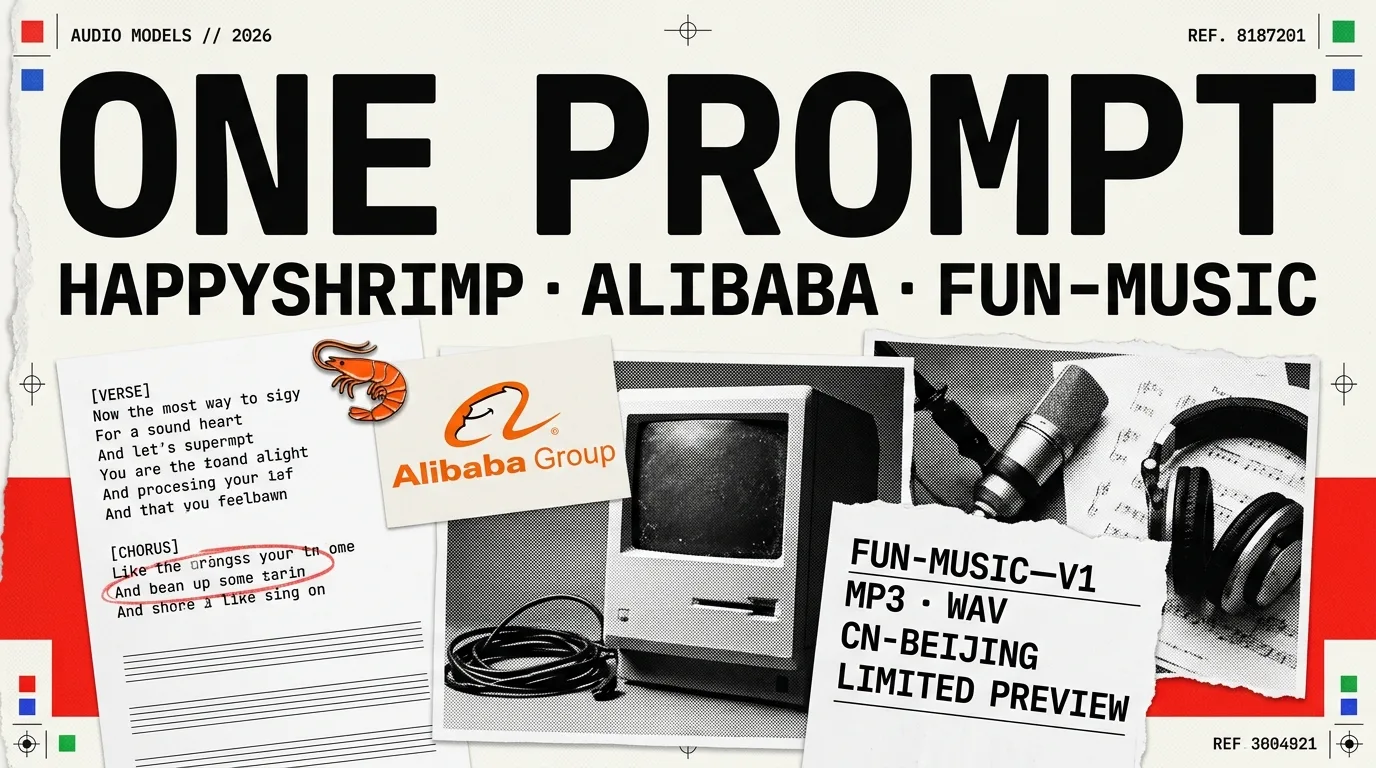
Fun-Music ships as two models. fun-music-v1 takes a prompt describing style, scene, mood and instrument preferences, or a lyrics block, and supports a gender parameter selecting a male or female vocal. fun-music-preview takes the same prompt and lyrics inputs but does not support vocal gender. Where both a prompt and lyrics are supplied, the documentation states that the lyrics take effect. Vocals are documented in Chinese or English. Output is MP3 or WAV, streaming or as a whole file, and lyrics are submitted with structural tags such as [verse] and [chorus] marking the sections.
Two access facts are the ones to note before planning anything around it. The model is in limited preview and requires an application through the Model Gallery, and it is available in the China (Beijing) region only, with requests going to a Beijing endpoint. A consumer product that opened to overseas users on day one would therefore be resting, on that reading, on an API that does not leave one Chinese region.
Where it sits
Not published, for Fun-Music or for HappyShrimp: no maximum song length, no pricing, no free quota, no rate limits, no terms on who owns a generated track or whether it can be sold, and no English product page, which is why this page links the cloud documentation and the launch report rather than a product site.
On the evidence available, HappyShrimp is a credible consumer product from a company with distribution, launched simultaneously in two markets, resting on an API that is regionally confined and gated by application. It is not yet possible to compare its audio against Suno, Udio or Lyria on any published measure, because Alibaba has released no quality figures and no independent evaluation exists. The live tension is the rights one: Suno built roughly two million paid subscribers on a free tier restricted to non-commercial use while litigation with the major labels runs on, and Alibaba has arrived with a licensed-music partner on day one and no published position on the rights attached to its own output. What can be said is that the barrier it removes is the same one Suno removed, and the market it is aimed at is larger than the one it lost.
More in Audio and Voice
All Audio →- Alibaba QwenQwen-Audio-3.1Alibaba's upgraded audio stack, announced 23 September 2026
- NvidiaNemotron 3 DiarizationNvidia’s Nemotron 3 Diarization marks when each speaker is active in recorded or live audio
- Microsoft AIMAI-Transcribe-2-Streaming, MAI-Voice-2.1 and MAI-Voice-2.1-Flashlive transcription that tops the streaming accuracy board, and two new voices
- Microsoft AIMAI-Transcribe-2speech recognition at ten cents an hour
- SunoSuno v6a flagship, an exploratory variant and a free mini, released together
- SunoSuno v5.5the market leader