
Alibaba Qwen
Qwen-Audio-3.1
Alibaba's upgraded audio stack, announced 23 September 2026
Key facts
- 23 Sep 2026Alibaba Cloud Model Studio
- Announced
- 5ASR, ASR-Next, TTS, TTS-Next, Realtime
- Models
- $0.848 / $1.696per M tokens in / out
- TTS-Next price
- 12 hoursASR file transcription
- Longest file
- 82.0%up from 78.4%, τ-Voice
- Realtime success
- 13.0%wrongly answered, from 73.0%
- Background speech
Qwen-Audio-3.1 is a set of five AI audio models from Alibaba's Qwen team, announced on 23 September 2026. Between them they turn speech into text, turn text into speech, hold live spoken conversations and create whole soundtracks with voices, sound effects and background noise. They run as paid services on Alibaba Cloud, and the new TTS-Next model makes a podcast or a film scene's audio from a script in one go.
What Qwen-Audio-3.1 is
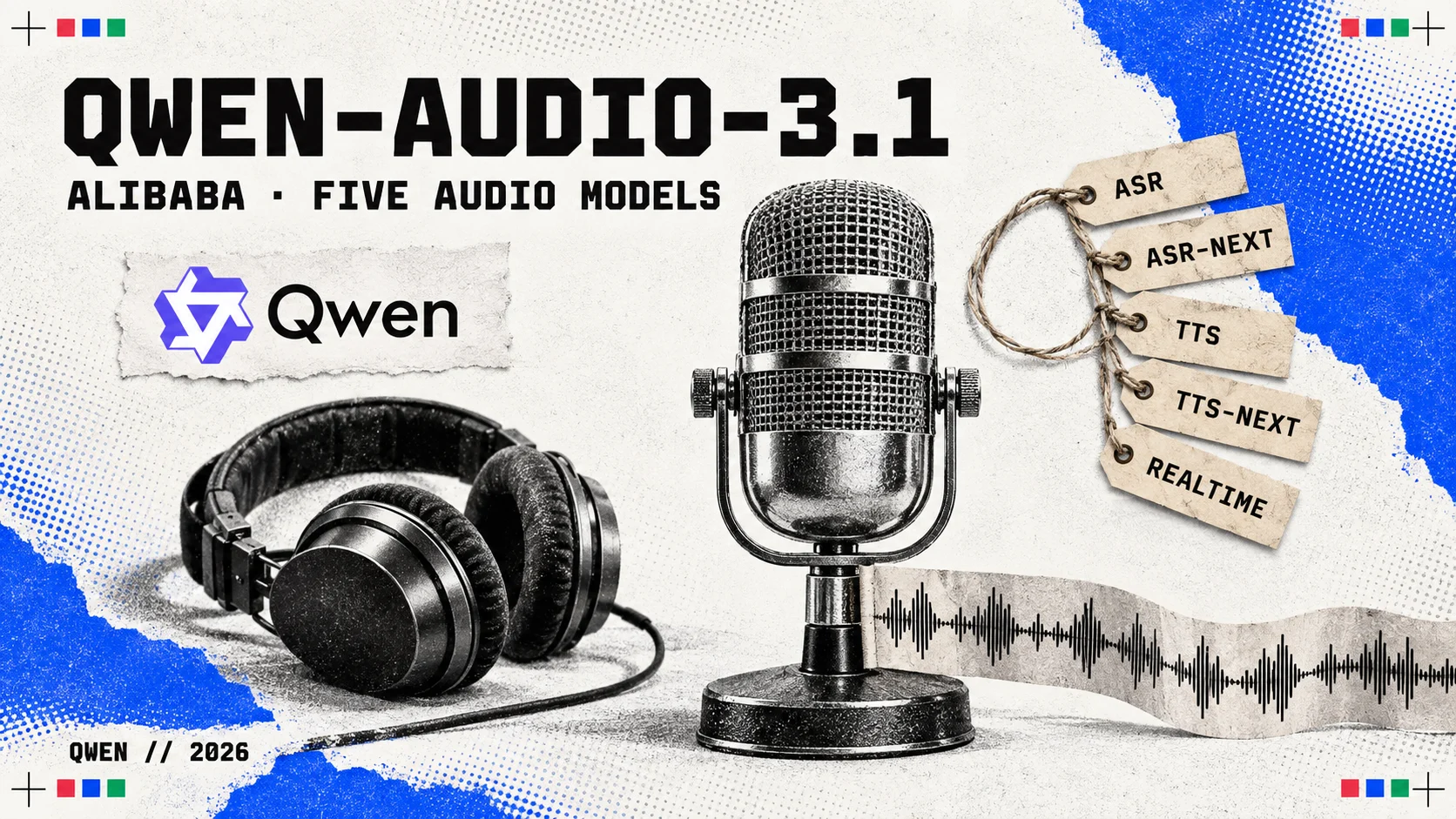
Qwen-Audio-3.1 is a family of five audio models from Qwen, the AI team at Alibaba, announced on 23 September 2026. The five cover the whole path of sound through an AI product: hearing it, understanding it, answering in a voice and producing finished audio.
Qwen’s own post put it in one line: “Five models, one complete audio stack: understanding, generation, interaction & creation.” Three of the models upgrade ones Qwen already sold, speech recognition (ASR), text-to-speech (TTS) and live voice conversation (Realtime), and two are new: ASR-Next for audio understanding and TTS-Next for audio creation.
All five run as hosted services on Alibaba Cloud Model Studio, which is where their documentation, model IDs and prices sit.
The five models
The Qwen-Audio-3.1 family splits into two models that listen, two that speak and one that holds a conversation. The roles below come from Qwen’s announcement and Alibaba Cloud’s Model Studio documentation.
| Model | What it does |
|---|---|
| ASR | Turns speech into text, from short clips to 12-hour files |
| ASR-Next | New: audio understanding, reading meaning from sound |
| TTS | Turns text into a spoken voice |
| TTS-Next | New: makes speech, sound effects and ambient sound together |
| Realtime | Holds a live spoken conversation and can call tools |
TTS-Next makes a whole soundtrack in one pass
Qwen-Audio-3.1-TTS-Next generates speech, sound effects and background sound together from a script, so one request can return a finished podcast segment or a film scene’s audio. Alibaba Cloud’s documentation calls it “an AudioGen model designed for unified audio generation”, and lists multilingual speech, multi-speaker dialogue, podcasts, “cinematic soundscapes”, ambient audio and sound effects among its tasks.
| Specification | Qwen-Audio-3.1-TTS-Next |
|---|---|
| Model ID | qwen-audio-3.1-tts-next |
| Input | Text, timestamps and up to 3 reference audio clips |
| Output | Audio as WAV, MP3 or PCM |
| Languages | Chinese and English |
| Longest input | 3,000 characters |
| Longest output | 240 seconds for podcasts, 120 seconds otherwise |
| Price, Beijing region | $0.848 per million input tokens, $1.696 per million output |
Each reference clip, used to set a voice, can run up to 30 seconds and 10 MB. Alibaba Cloud aims the model at short video, podcasts, film and television, and game audio.
ASR transcribes files up to 12 hours long
Qwen-Audio-3.1’s speech recognition comes in two forms on Model Studio. qwen-audio-3.1-asr-flash handles recordings of up to five minutes, streamed or sent whole. qwen-audio-3.1-asr-flash-filetrans transcribes a single file of up to 12 hours and 2 GB in the background, and adds speaker labels, word and sentence timestamps, custom vocabulary and sensitive-word filtering.
Both run in Alibaba Cloud’s Singapore and Beijing regions.
The 3.0 generation it replaces set a high bar. Qwen’s Qwen-Audio-3.0-ASR technical report, dated 7 September 2026, covers 30 languages and 16 Chinese dialects, and reports these average word error rates, where lower is better:
| Model | GigaSpeechBench | Common Voice 15 |
|---|---|---|
| Qwen-Audio-3.0-ASR | 22.50% | 4.57% |
| Doubao-ASR (ByteDance) | 22.76% | 5.36% |
| Gemini 3.1 Pro | 27.69% | 9.54% |
| GPT-4o Transcribe | 41.89% | 8.76% |
Realtime stops answering speech meant for someone else
Qwen-Audio-3.1-Realtime answered background speech 13.0% of the time on Full-Duplex-Bench v1.5, down from 73.0% for the 3.0 version, according to Qwen’s technical report of 21 September 2026. Background speech is talk in the room that is not addressed to the assistant, such as a television or another conversation, and answering it is one of the commonest faults of voice assistants.
The same report puts Realtime’s task success at 82.0% on Qwen’s speech-to-text adaptation of the τ-Voice benchmark, up from 78.4% for 3.0.
Qwen built the model in three parts, which the report names Think, Act, and Speak and Coordinate. Think transfers reasoning from Qwen’s language models into the audio model; Act trains it to use tools and finish tasks through reinforcement learning in simulated environments; and Speak and Coordinate aligns “how, when, and whether the assistant speaks or acts”.
How Qwen’s audio models got here
Qwen-Audio-3.1 is the latest step in a line that began with Qwen-Audio in November 2023, a research model that paired a Qwen language model with OpenAI’s Whisper encoder to understand sound. Qwen2-Audio followed in July 2024. The line then split: Qwen3-ASR went out as open weights, while the numbered Qwen-Audio-3.0 models of July to September 2026 and the 3.1 family are sold as Alibaba Cloud services.
For other speech and voice models, see ElevenLabs, MAI-Transcribe-2 and the guide to open and real-time audio.
More in Audio and Voice
All Audio →- ElevenLabsElevenLabsthe voice infrastructure standard
- Microsoft AIMAI-Transcribe-2speech recognition at ten cents an hour
- Open and real-time audioStable Audio 3, GPT-Live, Nemotron ASR and Transcribe Arabic
- Technology Innovation InstituteFalcon-ASRspeech recognition with Arabic dialect support
- NvidiaNemotron 3 DiarizationNvidia’s Nemotron 3 Diarization marks when each speaker is active in recorded or live audio
- Microsoft AIMAI-Transcribe-2-Streaming, MAI-Voice-2.1 and MAI-Voice-2.1-Flashlive transcription that tops the streaming accuracy board, and two new voices