
Open and real-time audio
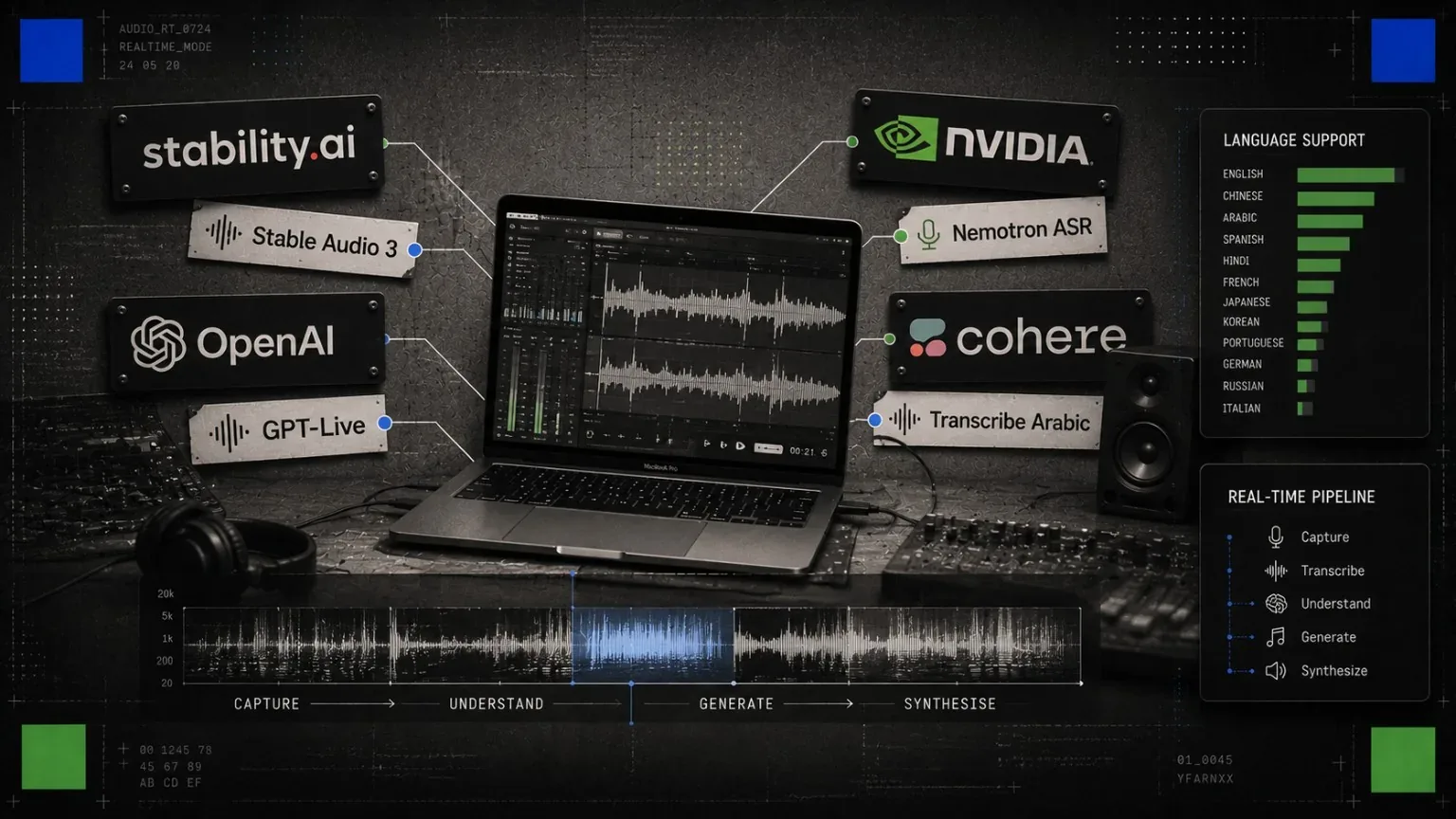
Stable Audio 3, GPT-Live, Nemotron ASR and Transcribe Arabic
Key facts
- 20 May 2026open weights
- Stable Audio 3
- 6 minStable Audio tracks
- Max length
- 600mparams, 40 languages
- Nemotron ASR
- 2bnparams, Apache 2.0
- Transcribe Arabic
- 25.87Hugging Face lead
- Arabic WER
- 8 Jul 2026full-duplex voice
- GPT-Live
Open weights, permissive licences and real-time voice pushing generative audio onto local hardware and into more languages.
This roundup gathers the open and real-time audio releases that sit outside the big four music models, and the anchor of the group is Stable Audio 3.
Stable Audio 3: music on a laptop
Launched on 20 May 2026 by Stability AI, it shipped with open weights, meaning anyone can download and run it, produced tracks of up to six minutes, and generated them in a few seconds on a MacBook Pro M4. That last detail is the significant one: it makes Stable Audio 3 the first credible local music model, a system good enough to be useful yet light enough to run on a laptop rather than a data centre. For anyone who wants music generation without sending prompts to a paid API, this is the arrival point.
GPT-Live: voice in real time
Where Stable Audio 3 pushes music generation onto local hardware, OpenAI’s GPT-Live pushes voice into real time. Shipped on 8 July 2026, GPT-Live is a full-duplex system, which means it can listen while it is speaking rather than waiting for each party to finish, the behaviour that makes a spoken exchange feel natural. It comes in two sizes, GPT-Live-1 and GPT-Live-1 mini, with nine remastered voices, real-time translation and a Hey Chat wake word. The GPT-Live API became generally available on 10 September 2026. Its session charge is $0.05 per minute, with backend model usage billed separately, according to the current model documentation. OpenAI’s own system card discloses small safety regressions against the earlier Advanced Voice Mode, a candid note worth flagging for anyone weighing the model for sensitive use.
Open speech recognition
The other significant movement is in speech recognition, where open models are advancing quickly. NVIDIA’s Nemotron 3.5 ASR is a 600m-parameter open multilingual streaming model for speech to text, covering 40 languages and reported at roughly seventeen times the throughput of comparable baselines while being half their size. Streaming, here, means the model transcribes as words arrive rather than waiting for a complete recording, which is what live captioning and voice agents require. Efficiency of that order is what lets speech to text run cheaply and at scale, and doing it in the open lowers the barrier for anyone building on top.
Cohere added to the open-recognition tier by open sourcing Transcribe Arabic on 7 July 2026. The model has 2bn parameters, ships under the permissive Apache 2.0 licence, and led the Hugging Face Arabic leaderboard with a reported 25.87 word error rate, around eleven points ahead of Whisper Large V3. Word error rate measures the share of words a transcriber gets wrong, so a lower figure is better, and a gap of that size against a widely used baseline is substantial. A dedicated, openly licensed model for a language spoken by hundreds of millions of people is a meaningful piece of infrastructure, not a curiosity. Rounding out the API-first tier, MiniMax Music 2.5 arrived in January 2026, keeping the commercial, hosted end of the market competitive alongside these open releases.
What it shows
Taken together, these releases show generative audio spreading in two directions at once: down onto local hardware, as with the Stability release, and outward into more languages and lower latency, as with the ASR models and GPT-Live. The through-line is that capable audio is no longer confined to a handful of hosted services. Open weights, permissive licences and efficient designs are putting music generation, real-time voice and multilingual transcription within reach of independent developers and researchers, and Stable Audio 3 is the clearest emblem of that shift. For readers tracking the flagships alongside these releases, our AI audio hub covers the leading music and voice models in full, and the wider AI hub sets them in context. What to watch next is how applications use the now-available GPT-Live API, whether local models like Stable Audio 3 close the quality gap on the hosted leaders, and how far open speech recognition can push into the world’s less-served languages.
More AI
All AI →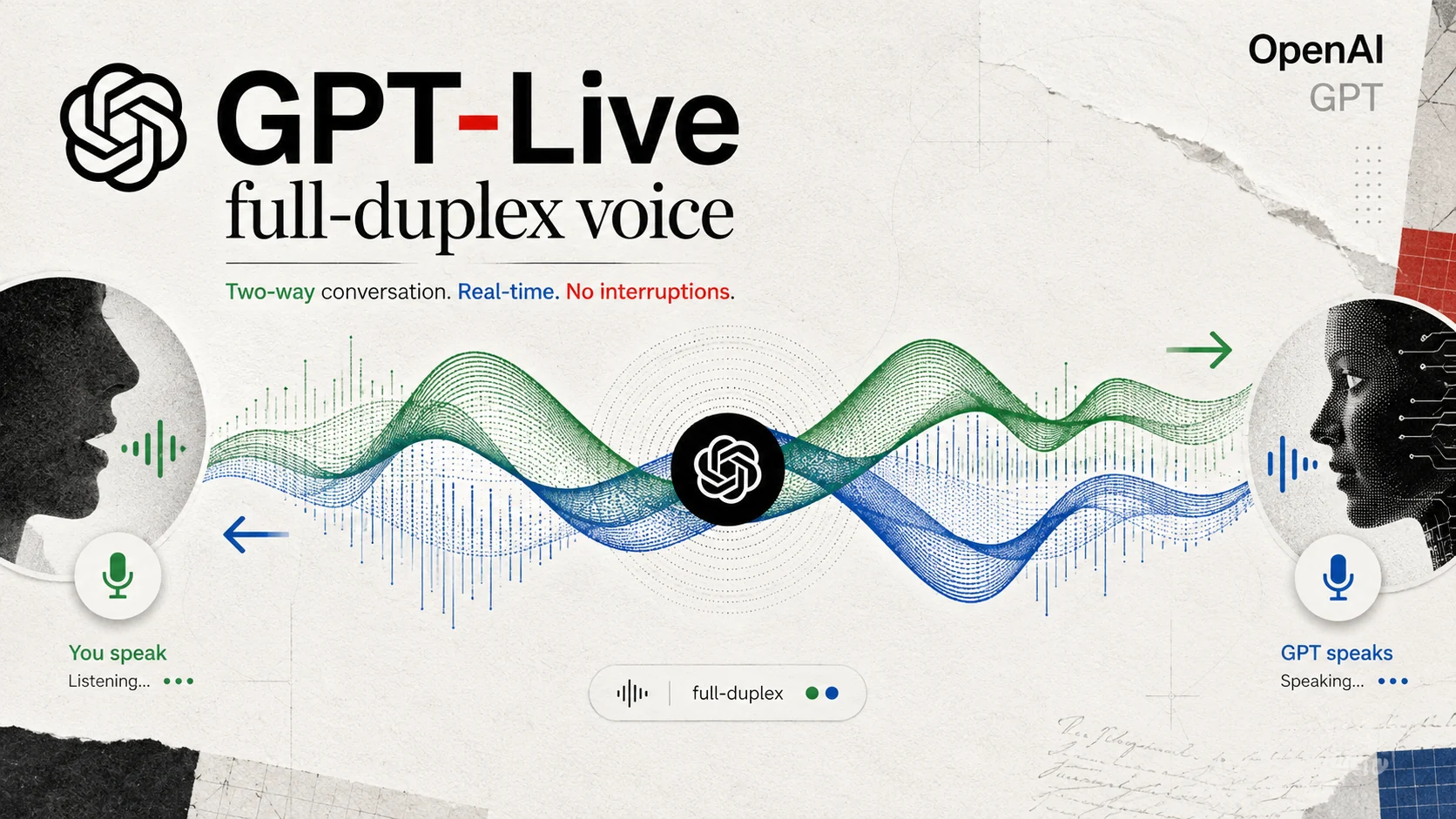
GPT-Live Voice brings full duplex conversation to ChatGPT
OpenAI shipped GPT-Live on 8 July, a voice system that listens while it speaks. The distinction is technical and consequential. Previous voice assistants operate in turns: you speak, they process, they reply.
More in Audio and Voice
All Audio →- Alibaba QwenQwen-Audio-3.1Alibaba's upgraded audio stack, announced 23 September 2026
- NvidiaNemotron 3 DiarizationNvidia’s Nemotron 3 Diarization marks when each speaker is active in recorded or live audio
- Microsoft AIMAI-Transcribe-2-Streaming, MAI-Voice-2.1 and MAI-Voice-2.1-Flashlive transcription that tops the streaming accuracy board, and two new voices
- AlibabaHappyShrimp 1.0the name is a eulogy
- Microsoft AIMAI-Transcribe-2speech recognition at ten cents an hour
- SunoSuno v6a flagship, an exploratory variant and a free mini, released together