
Udio
Udio v1.5
the licensing test case
Key facts
- 48kHzsample rate
- Output
- Oct 2025settlement
- UMG deal
- 4UMG, Warner, Merlin, Kobalt
- Rights holders
- Disabledduring transition
- Downloads
The music tool testing whether an AI company can co-develop a fully licensed platform with the record labels.
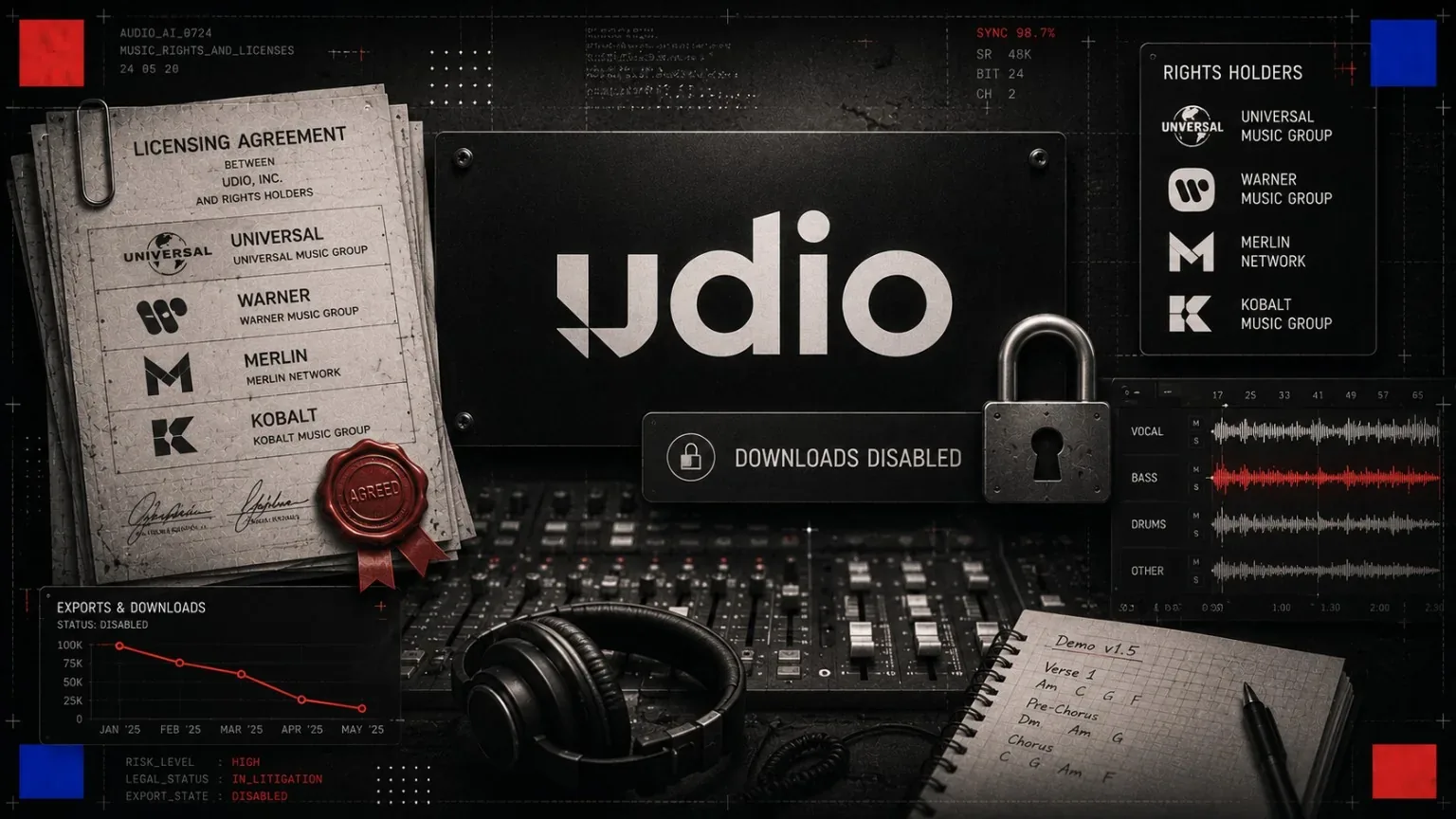
Udio v1.5 is the generative music tool that has turned into the industry’s clearest test of whether an AI music company can make peace with the record labels. Rather than fight the rights holders in court to the end, Udio settled with Universal Music Group in October 2025 and signed with Warner Music, with Merlin and Kobalt also in place. The stated destination is a fully licensed, co-developed platform, an arrangement in which the labels are partners in the product rather than plaintiffs against it. The v1.5 model itself is not new, having shipped on 23 July 2024 with no successor since; the story here has been legal rather than technical. If that model holds, Udio v1.5 will be the template others are pushed towards; if it stalls, it will be a cautionary tale.
The export lock
The cost of that pivot is visible in the product today. During the transition, audio, video and stem downloads are disabled, which means Udio v1.5 is currently unusable for anything that needs to leave the platform. A user can generate music inside the service, but cannot export a finished file to drop into a video, a game or a release. That changes what the tool is for right now: it is a place to experiment and to preview what a licensed model can do, not yet a production pipeline. The restriction is a direct consequence of renegotiating the ground the product stands on, and it is the price of the licensing deals rather than a technical limit.
Under the bonnet
Look past the export lock and the underlying engine is strong. Udio v1.5 produces 48kHz output, a higher sampling rate than the CD standard and a signal of studio-oriented intent. It offers inpainting, the ability to regenerate a single section of a track while leaving the rest untouched, which turns generation into something closer to editing than to rolling the dice on a whole song. It also provides stem separation, splitting a finished piece back into its component parts such as vocals, drums and bass. Taken together, 48kHz output, inpainting and stem separation make Udio v1.5 the closest thing in the field to an AI-native digital audio workstation, the kind of environment a working producer expects rather than a single prompt-to-track box. For a producer used to working in sections and layers, that is a far more natural way to build a track than generating a whole song and hoping for the best.
Why it is worth watching
That combination explains why Udio is worth watching despite being partly switched off. The features point at a serious tool for people who edit music rather than merely generate it, and the licensing strategy points at a version of that tool that businesses could adopt without legal anxiety. The open question is timing: how long the transition lasts, when downloads return, and on what commercial terms a fully licensed platform will operate. Until exports are restored, the product’s ambitions run ahead of what a user can actually ship.
Where it sits and what to watch
Placed in the wider field, Udio is the experiment the rest of the sector is watching most closely. Rivals have chosen different paths: some are litigating, some are building on already-licensed catalogues, and some are pressing ahead and hoping the law settles in their favour. Udio has chosen partnership, and the results will shape how much room every other music model has to operate. For readers tracking the broader picture, Udio sits within our wider AI audio coverage and the ongoing question of how generative tools and rights holders share the value they create. What to watch next is simple: the return of downloads, the final shape of the co-developed platform, and whether a licensed model can match the quality and freedom that unlicensed rivals still offer. For more across the field, see our AI hub.
More in Audio and Voice
All Audio →- Alibaba QwenQwen-Audio-3.1Alibaba's upgraded audio stack, announced 23 September 2026
- NvidiaNemotron 3 DiarizationNvidia’s Nemotron 3 Diarization marks when each speaker is active in recorded or live audio
- Microsoft AIMAI-Transcribe-2-Streaming, MAI-Voice-2.1 and MAI-Voice-2.1-Flashlive transcription that tops the streaming accuracy board, and two new voices
- AlibabaHappyShrimp 1.0the name is a eulogy
- Microsoft AIMAI-Transcribe-2speech recognition at ten cents an hour
- SunoSuno v6a flagship, an exploratory variant and a free mini, released together