
Perplexity
Sonar
search-native answering
Key facts
- Search-nativelive search
- Focus
- In-houseby Perplexity
- Built
- Groundedretrieved sources
- Method
Perplexity's in-house models are tuned for search-native answering, composing replies grounded in retrieved sources.
What it is
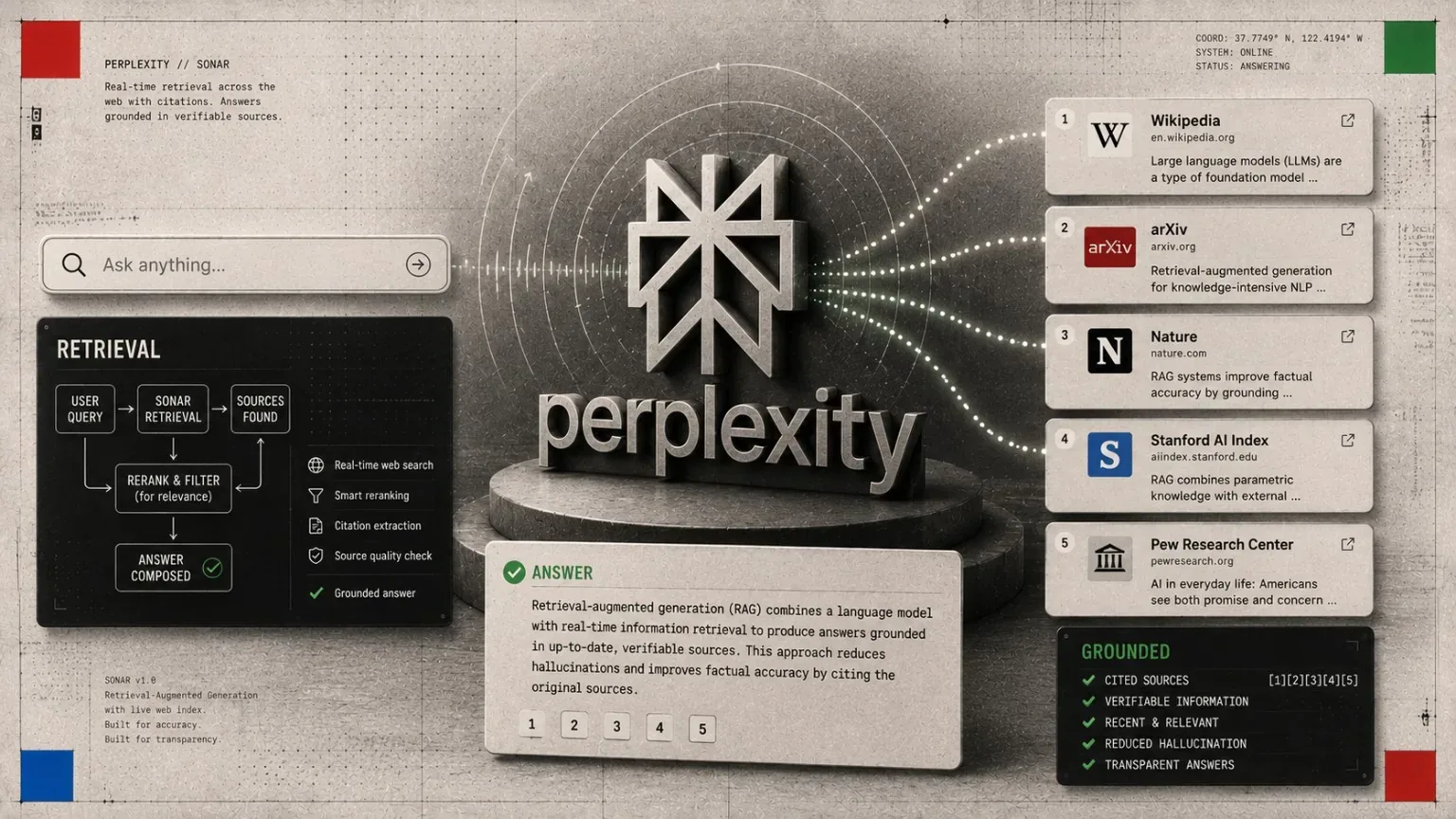
Perplexity Sonar is the family of in-house models built by Perplexity, the company behind the answer engine of the same name, and its purpose is narrow and clear: to answer questions well by drawing on live search rather than on memory alone. Where a general-purpose chatbot tries to hold everything it needs inside its own weights, Perplexity Sonar is tuned for search-native answering, in which the model works hand in hand with a retrieval system that fetches relevant sources and then composes a reply grounded in what it finds.
Built for the product
The design reflects the product it serves. Perplexity built its name on answering questions with citations, pointing users to the sources behind each reply rather than asking them to trust an unsourced paragraph. A model suited to that job needs particular skills: reading retrieved material quickly, pulling out the parts that bear on the question, weaving them into a clear answer and attributing claims to where they came from. A model tuned for those skills, rather than for open-ended conversation, is what Perplexity Sonar is meant to be, and its search-tuned character is the point of building it.
Choosing to build in-house is a decision worth examining. An answer engine can run on models licensed from other labs, and many do, but relying on an outside provider carries drawbacks: the cost of every query flows to a third party, the provider’s roadmap sets the pace, and the model is tuned for general use rather than for the specific job of grounded answering. By developing Perplexity Sonar itself, the company gains control over all three. It can tune the model directly for its own retrieval pipeline, manage the economics of serving answers at volume, and shape the behaviour that its users experience without waiting on someone else’s release schedule.
Grounding the answer
Grounding is the idea at the heart of the approach, and it addresses one of the best-known weaknesses of language models. A model answering purely from its trained weights can state something fluent and wrong, because it is predicting plausible text rather than consulting a source. Tying the answer to retrieved material gives the reply something to stand on and gives the user a way to check it. Search-native answering does not remove the risk of error, but it changes the task from recalling facts to reading and summarising current sources, which is better suited to questions about recent events and to any topic where being up to date is essential.
Why a search-tuned model is different
The wider point about Perplexity Sonar is that it treats the model and the search system as parts of a single product rather than as a clever model bolted onto a search box. The question of how to make language models reliable when accuracy is essential has become one of the central problems in applied AI, and grounding answers in retrieved sources is among the most practical responses to it. Building a model expressly for that pattern, and controlling it end to end, is Perplexity’s answer to the problem.
What to watch is how well search-tuned models hold up as expectations rise. Users increasingly want answers that are current, sourced and trustworthy, and meeting that demand consistently is harder than producing a fluent paragraph. A model built for grounded answering holds a structural advantage in that contest, but it still has to get the reading and the attribution right, and it has to do so at the speed and cost a live service requires. For readers following how models are being specialised for particular jobs, our large language models hub tracks the field, and the broader AI section covers the companies and strategies behind it.
For the current Sonar models and the details Perplexity chooses to publish, the company’s own site is the authoritative source and the right place to check before relying on any specific claim.
More in Large Language Models
All LLMs →- Google DeepMindGemini 4 Argonlonger reasoning, coding and cyber defence
- OpenAIGPT-5.6the flagship from 9 July to 3 September 2026
- OpenAIGPT-6 Astrathe new generation, rolling out from 3 September 2026
- OpenAIGPT-6.1 Solthe upgraded mid-price GPT-6 model, released 29 September 2026
- OpenAIGPT-6 Sol and Lunathe mid-price and budget GPT-6 models, released 22 September 2026
- AnthropicClaude Opus 5.5the first Claude 5.5 model, cheaper and faster than Opus 5