Microduck's press kit asks reporters not to call it open-source hardware
Pollen Robotics launched a $399 reinforcement-learning biped on 27 August. The software is Apache-2.0, the simulation geometry is non-commercial, and the mechanical and electronic design files are withheld. The press kit says so in writing.
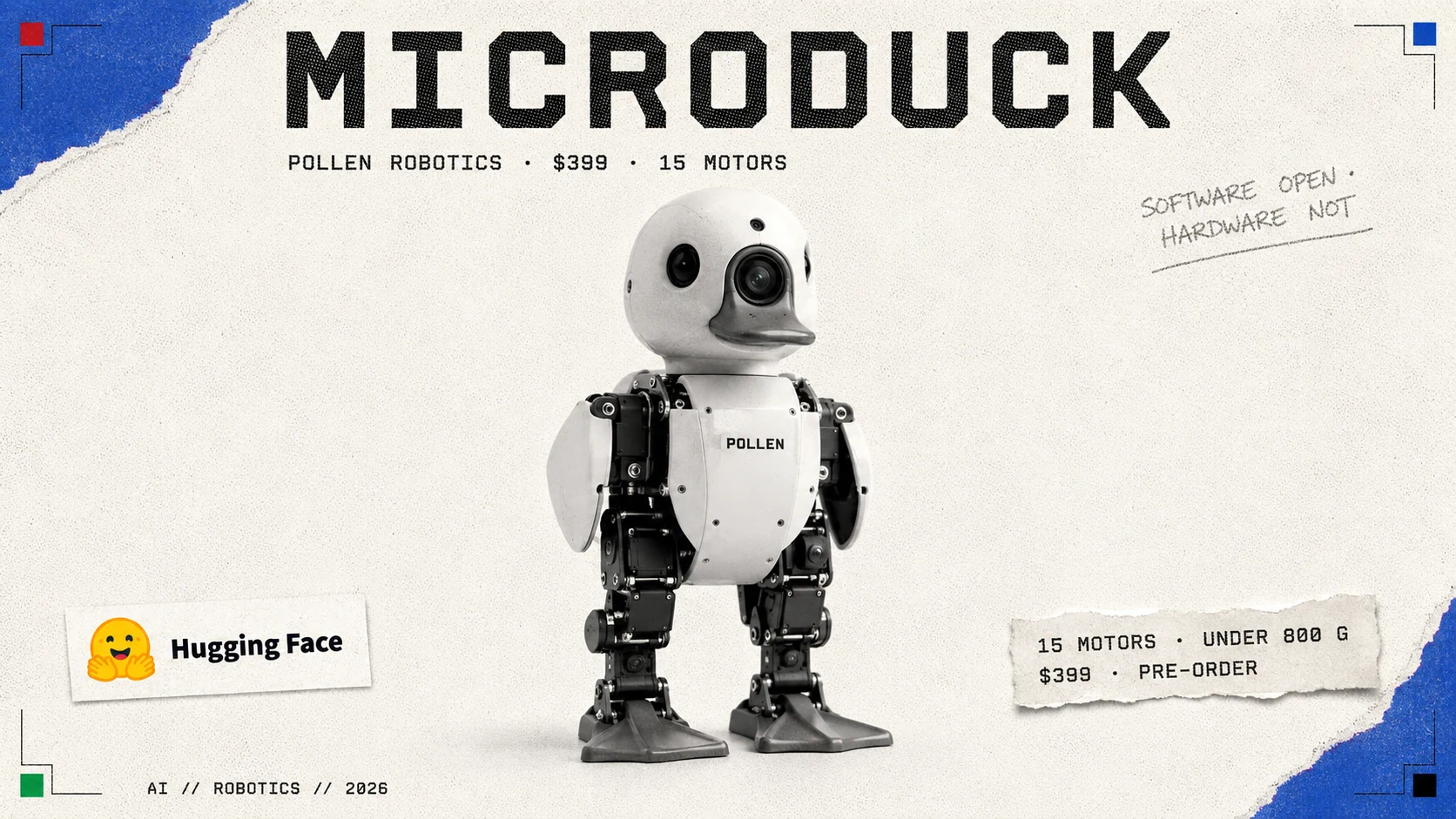
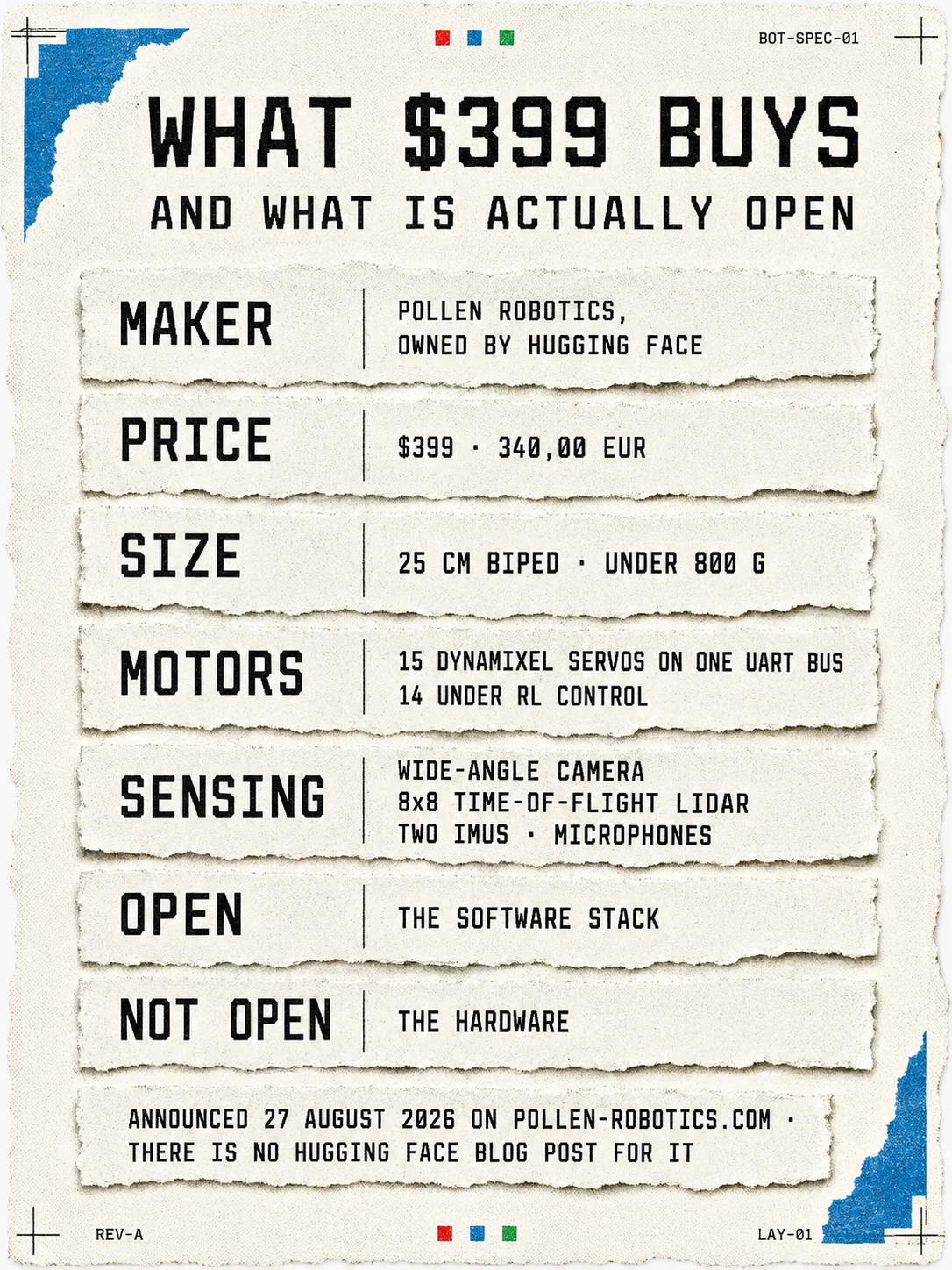
Pollen Robotics, the Bordeaux robotics team Hugging Face bought in April 2025, launched Microduck on Thursday 27 August 2026: a 25cm biped, under 800g, fifteen motors, $399 before taxes and shipping, sold on the premise that you train its behaviours yourself with reinforcement learning.
The launch language calls it open. Thomas Wolf, Hugging Face’s co-founder and chief science officer, announced it on X as “a 25 cm tiny open-source biped”. The product page says: “The SDK, the simulation and the full RL training stack are on GitHub. What the robot runs is what you can read, fork and retrain.”
The press kit is stricter than that, and it is the company’s own document.
What Pollen tells the press
Under a heading that reads “Open source = software”, the press kit says:
The open-source statement covers the software stack. The mechanical and electronic design files are not, so please do not describe the robot as open-source hardware.
We went looking for the files anyway. The pollen-robotics GitHub organisation carries three Microduck repositories: the Rust onboard runtime, the reinforcement-learning environments, and a GStreamer plugin build for the Rockchip video encoders. None contains CAD, schematics, PCB files or a bill of materials.
One piece of 3D geometry is in public, under a licence that is not an open-source one. The training repository’s README ends: “This project is licensed under the Apache 2.0 License. See the LICENSE file for details. 3D model files are licensed under Creative Commons BY-SA-NC.” Those are the MJCF simulation meshes exported for the physics engine, not manufacturing drawings, and BY-SA-NC forbids commercial use, which means it is not an open-source licence by any of the usual definitions.
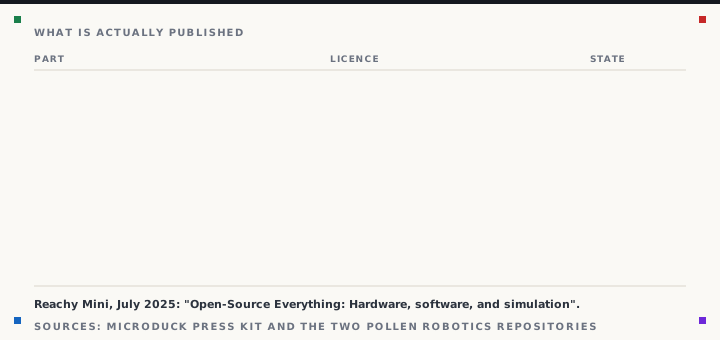
The software really is open, and the training stack is more complete than most: mjlab on MuJoCo Warp, PPO, a documented sim-to-real recipe with domain randomisation on battery voltage, voltage sag, command delay and friction, and ONNX export. The dependency manifest is worth one note for anyone expecting the house framework: there is no LeRobot anywhere in it.
The pledge this replaces
Fourteen months ago Pollen and Hugging Face launched Reachy Mini on the Hugging Face blog, at the same $399 for the lite version. That post made a different promise, in a bulleted list, in bold:
Open-Source Everything: Hardware, software, and simulation environments fully open-source and community-supported. Stay tuned for the hardware release!
When Fortune reported the Pollen acquisition in April 2025, it described Hugging Face’s goal as open-sourcing robot hardware completely, so that anyone could download the blueprints. Microduck’s press kit is the first time we have seen the company ask reporters, in advance and in writing, not to use the phrase.
Microduck also has no Hugging Face blog post at all. The announcement lives on pollen-robotics.com, co-signed by Wolf alongside five Pollen staff. Both plausible Hugging Face blog paths return 404, and the product does not appear on the blog index.
Fifteen motors, fourteen of them driven
The specification everywhere says fifteen degrees of freedom. The runtime’s own design document is more precise about what that buys you.
The servos sit on a single UART bus running the Dynamixel protocol at 1 Mbps: five in the left leg at IDs 20 to 24, five covering neck, head and mouth at 30 to 34, five in the right leg at 10 to 14, with the IMU board answering at ID 200 in the same sync read.
Every shipped policy has the same shape, and the document states it as a verified fact: “Every alpha policy is obs[1,61] → actions[1,14]”. Fourteen, not fifteen. The line underneath explains which one is missing: “Joints exclude the mouth throughout; actions map back into 15 motor slots with index 9 left at zero.”
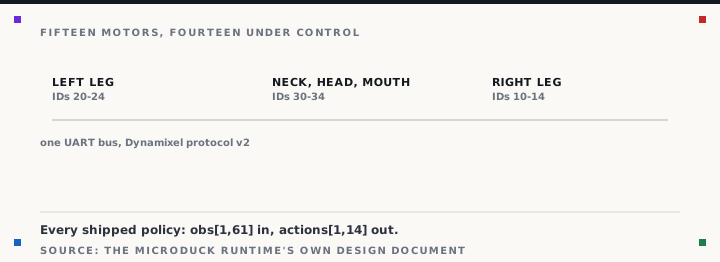
The press kit describes the fifteen as covering “articulated legs, head and neck”, which leaves the beak out of the count entirely even though it is one of the servos on the bus. The repository is the better source, and what it shows is a beak that is real hardware and is outside the reinforcement-learning contract.
The servos are modelled in training as the Dynamixel XL330 using the BAM M6 actuator model, with plus or minus one degree of gear play simulated in series with each of the fourteen joints. A usable gait takes about one to two hours on a CUDA GPU at 4,096 environments.
The sharing loop is not built yet
The pitch is that owners train behaviours and share them on the Hugging Face Hub. That part is running, and it is running from the community rather than the company.
Models tagged microduck on the Hub now number eight, the earliest dated 28 August, the day after launch. None of them is published by the pollen-robotics organisation, whose nine models are all Reachy and vision work. Three of the eight come from a Pollen engineer’s personal account.
Pollen’s own roadmap, rewritten on 26 August, the day before launch, says why. It lists “the app, the SDK, the model channel, the autonomous brain, and reaching a robot from outside the LAN” as missing. The same document records the recovery net, the mechanism that stops a bad update bricking a robot, as built and shipped and never exercised on a board.
The SDK’s status is contradictory across three of the company’s own pages: the product page says it is on GitHub in the present tense, the press kit says it will be “released before the first robots ship”, and the roadmap has it in a milestone marked in progress with the design choice still open.
The ducks sold faster than they can be made
Wolf posted at 17:12 UTC on launch day that Microduck had “just passed $1,000,000 in sales”, roughly six and a half hours after the unveiling. Pollen engineer Remi Fabre posted the next evening: “We sold over $2,500,000 worth of Microducks in the first 24 hours.”
Those are the only sales figures anyone has published, they come from two employees on X, and no order count exists.
What the store shows today is the consequence. A banner sits above the product:
The community ordered a lot of ducks. We can’t promise Christmas delivery for new microduck orders anymore, but we’re ramping up production. First ordered, first shipped. Current estimate for new orders: 4-6 months.
The press kit still reads “First deliveries Targeted before Christmas 2026”, and so does the announcement post. Both were live when we checked this morning, alongside the banner that withdraws the promise.
There is one more thing the press kit is careful about, and it is unusually candid for a launch document: camera resolution and field of view, LiDAR range, radio versions, SDK languages and any age recommendation are all listed as still being finalised, with a request to treat them as provisional. A robot whose specification sheet is provisional four months before it ships is being honest about where it is.
Sources
- Meet Microduck (Pollen Robotics)pollen-robotics.com
- Microduck press kit (Pollen Robotics)pollen-robotics.com
- Microduck product pagepollen-robotics.com
- Microduck on the Pollen Robotics storestore.pollen-robotics.com
- The Microduck onboard runtime READMEraw.githubusercontent.com
- The robotd control-loop design documentraw.githubusercontent.com
- The Microduck roadmap, rewritten 26 August 2026raw.githubusercontent.com
- The microduck_rl training README, with the licence statementraw.githubusercontent.com
- The microduck_rl dependency manifestraw.githubusercontent.com
- Reachy Mini launch post, 9 July 2025 (Hugging Face)huggingface.co
- Hugging Face Hub models tagged microduckhuggingface.co
- Models published by the pollen-robotics organisationhuggingface.co
- Thomas Wolf's $1,000,000 sales post, 27 August 2026x.com
- Remi Fabre on first-day sales, 28 August 2026x.com
- Pollen Robotics SAS legal noticestore.pollen-robotics.com
- Hugging Face buys humanoid robot company Pollen Robotics (Fortune)fortune.com