How we identified two anonymous AI models, Ox Alpha and Union Alpha, before their makers did
Union Alpha and Ox Alpha arrived on OpenRouter with no owner named. We identified Ox Alpha as Z.ai's GLM line on 21 August 2026, and Union Alpha as Circuit and Chisel's Pareto at 04:51 UTC on 17 September, 18 hours before its operator confirmed it. Here is the working.
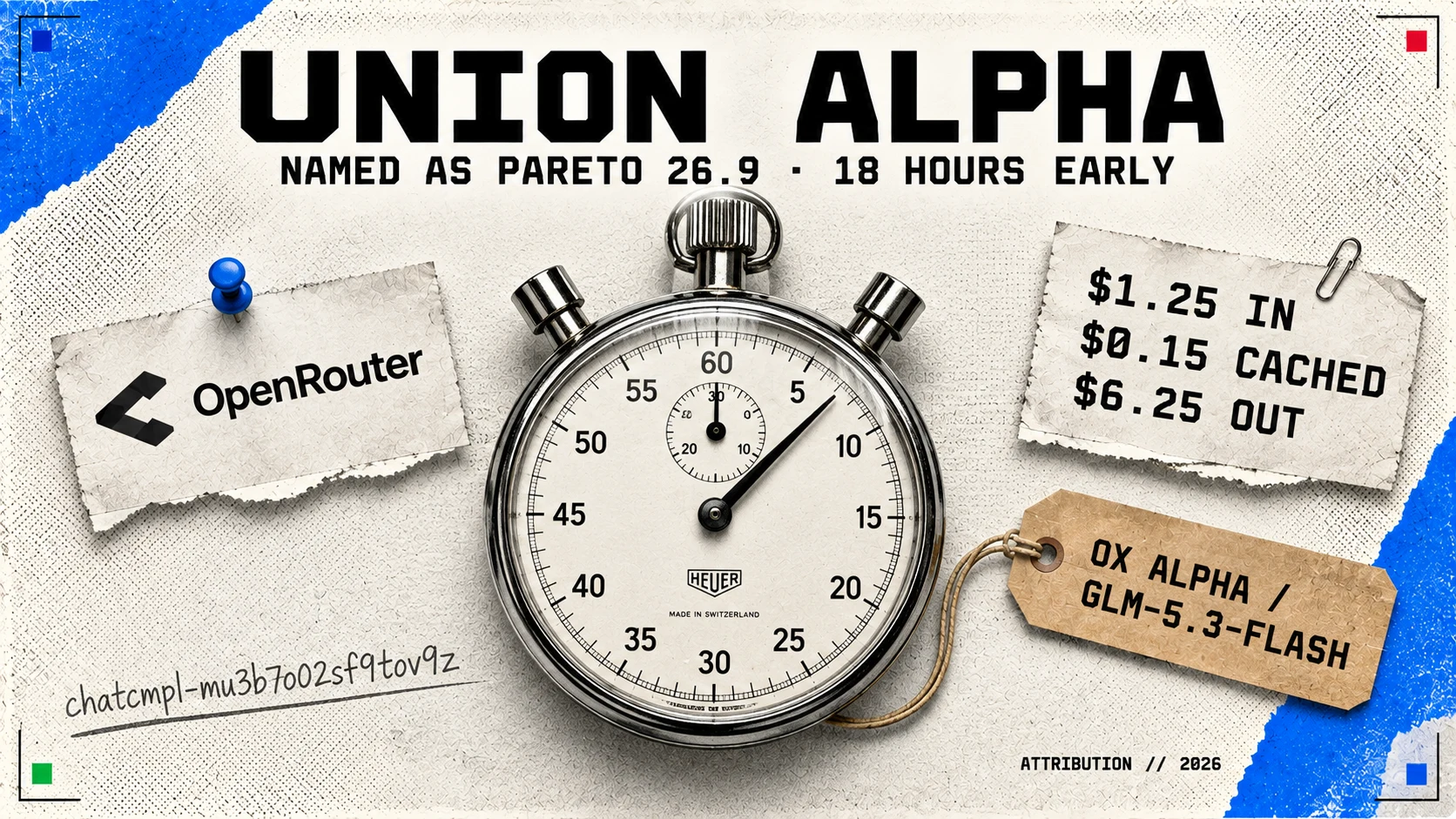
At 04:51:17 UTC on 17 September 2026 we posted that Union Alpha, the anonymous model that had appeared on OpenRouter the previous afternoon, was Pareto, built by Circuit and Chisel and sold through Unbiased. Eighteen hours and fourteen minutes later the company posted “You found us” and named Pareto 26.9.
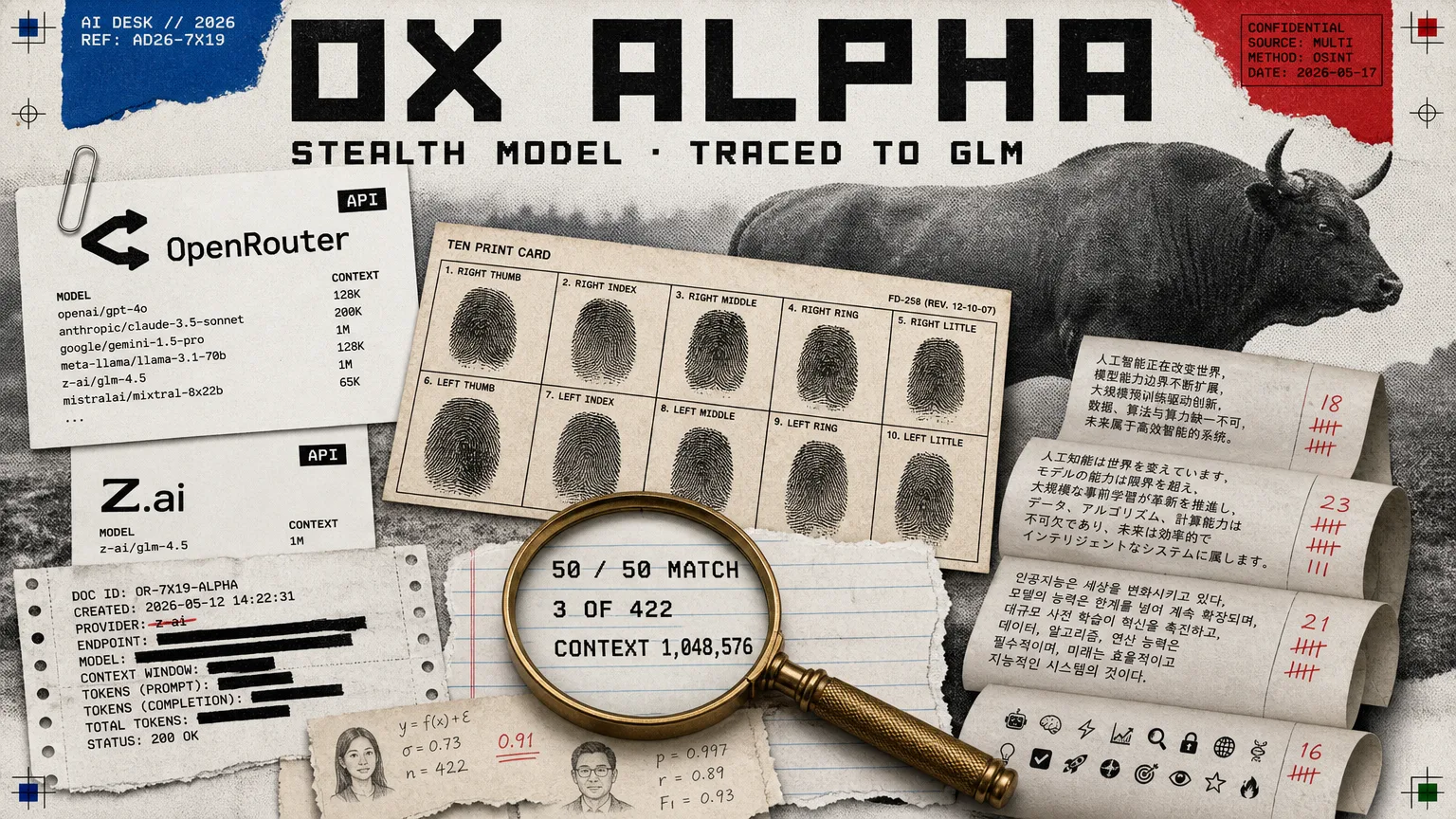
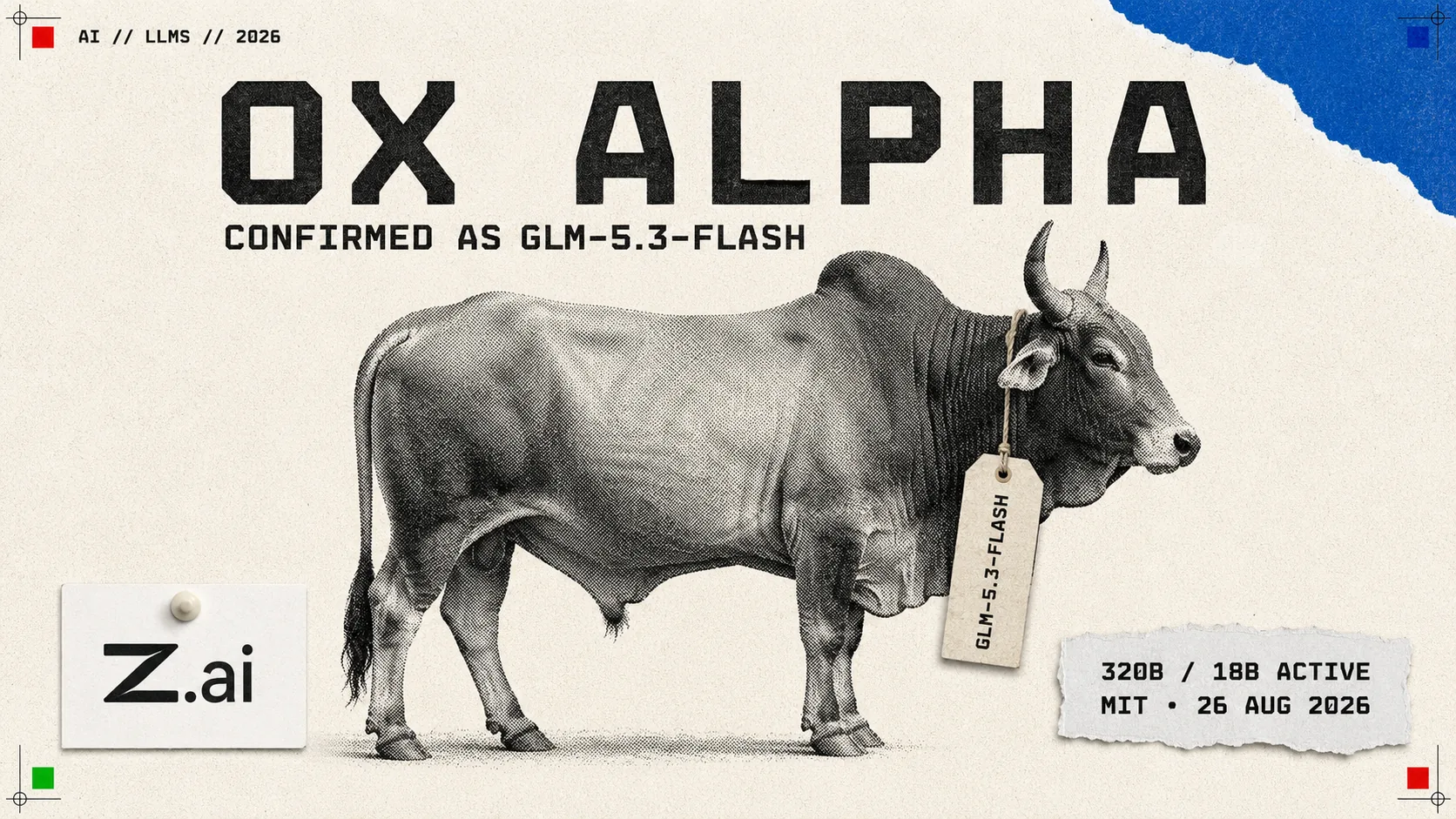
The method had already run once. On 21 August we published that an earlier anonymous listing, Ox Alpha, counted tokens exactly as Z.ai’s GLM-5.3 did, on all fifty of our test strings. Z.ai confirmed it five days later as GLM-5.3-Flash, a model with no public existence on the day we measured it.
Both calls are checkable, and this page is the working: the timestamps, the arithmetic, the raw completion IDs and every reading in the order we took it.
The post naming Pareto went up at 04:51 UTC

Every time below is UTC, read from the X API rather than from a screenshot, so each one can be looked up against the post ID it belongs to.
| Time, 2026 | Who | What happened |
|---|---|---|
| 16 Sep 14:42:03 | OpenRouter | The catalogue record for stealth/union-alpha is created |
| 16 Sep 14:50:33 | Union Alpha | “It’s time. Live on OpenRouter. Zero data retention. Frontier for free.” |
| 16 Sep 16:59:27 | @tinybluedev | “Union Alpha = GLM-5.4-Flash” |
| 16 Sep 19:26:41 | Union Alpha | “Over 100B tokens. Running about 500M tokens a minute right now.” |
| 17 Sep 00:23:03 | Union Alpha | “Nice detective work, but keep digging!” |
| 17 Sep 02:44:02 | Cary Palmer | Reports the completion prefix chatcmpl-mu and says he finds no match for it |
| 17 Sep 04:51:17 | YFarmX | Names Circuit and Chisel’s Pareto, from the pricing and the architecture wording |
| 17 Sep 06:23:33 | @aitrackerbot | Names Circuit and Chisel, citing a release-note pull request |
| 17 Sep 21:17:43 | Cary Palmer | Matches the completion IDs to Unbiased’s platform and the same vLLM fleet |
| 17 Sep 21:20:52 | Cary Palmer | “Thanks for the help sidestepping the red herring @YFarmX @cheatyyyy” |
| 17 Sep 23:02:58 | OpenRouter | The catalogue record for unbiased/pareto is created |
| 17 Sep 23:05:32 | The Unbiased Co | “You found us” |
| 17 Sep 23:24:41 | OpenRouter | “Union Alpha is revealed on OpenRouter as @TheUnbiasedCo Pareto!” |
To place our post against everyone else’s, we pulled every entry in X’s index mentioning Union Alpha alongside Pareto, Unbiased, Chisel or Circuit and Chisel: 132 posts, sorted by time. Four posts from 16 September come before ours, and all four use Pareto as the economics term, praising the model’s position on the Pareto frontier of price against performance. None names the company.
So the honest claim is the narrow one. Ours is the earliest public post we can find connecting Union Alpha to Circuit and Chisel’s Pareto, and the search that establishes it is one anyone can rerun.
OpenRouter put the same point in its own words when it lifted the cloak: “Impressive detective work and demand from the community cut this stealth period short.”
The rate card falls out of Cloudflare’s own examples
Cloudflare documented Union Alpha on 16 September in pull request 33478, which added stealth-union-alpha.json alongside entries for three other models. The page carries five worked examples, each with its request, its token counts and a dollar cost.
Two of the uncached examples give two equations in two unknowns, in millionths of a dollar:
19 x input + 46 x output = 311.25
14 x input + 39 x output = 261.25
Solving returns $1.25 per million input tokens and $6.25 per million output, with nothing assumed. Those rates then reproduce the other two uncached examples to the cent. The fifth example is 29 input tokens of which 28 were cached, plus five output, at $0.0000367, and with the first two rates known it forces a third: $0.15 per million cached input.
When we ran that arithmetic, Unbiased published Pareto at exactly those three numbers. Three for three, including the cached-input discount, which is the figure a coincidence has to work hardest to produce.
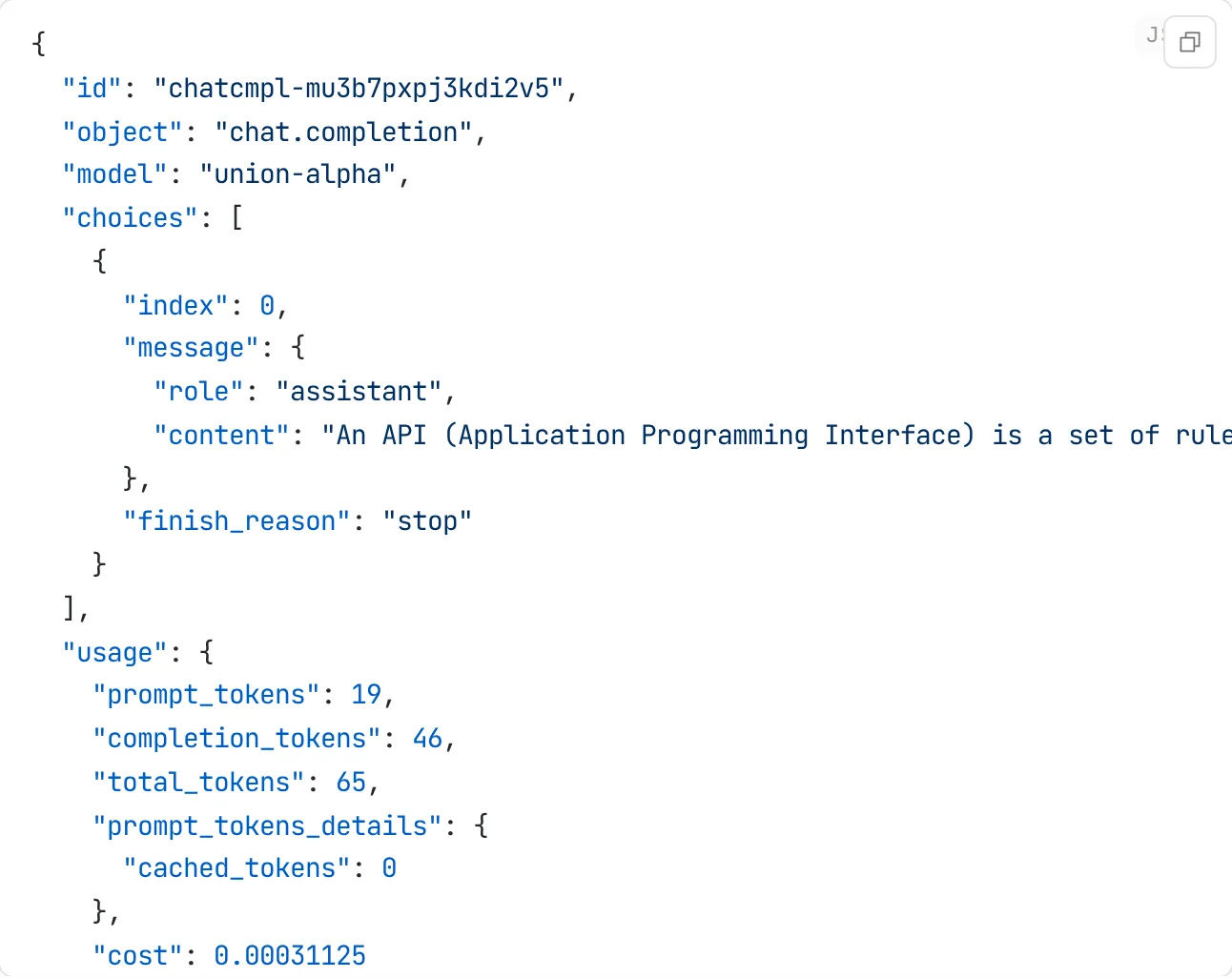
Pareto’s own card has moved since. Unbiased now lists $2.50 input, $0.25 cached and $7.50 output, the paid 26.9 rates announced at the reveal. The match we found dates the documents it was run on: those examples were priced the way Pareto was priced when they were written.
One caution we published at the time and keep here. The arithmetic connects two documents, Cloudflare’s page and Unbiased’s price list. On its own it leaves open that Cloudflare’s entry was adapted from Pareto’s documentation while a third party served the endpoint, in which case both clues share one origin and must never be multiplied together as independent evidence. What closed that distance was the reveal.
The same endpoint counted tokens two different ways
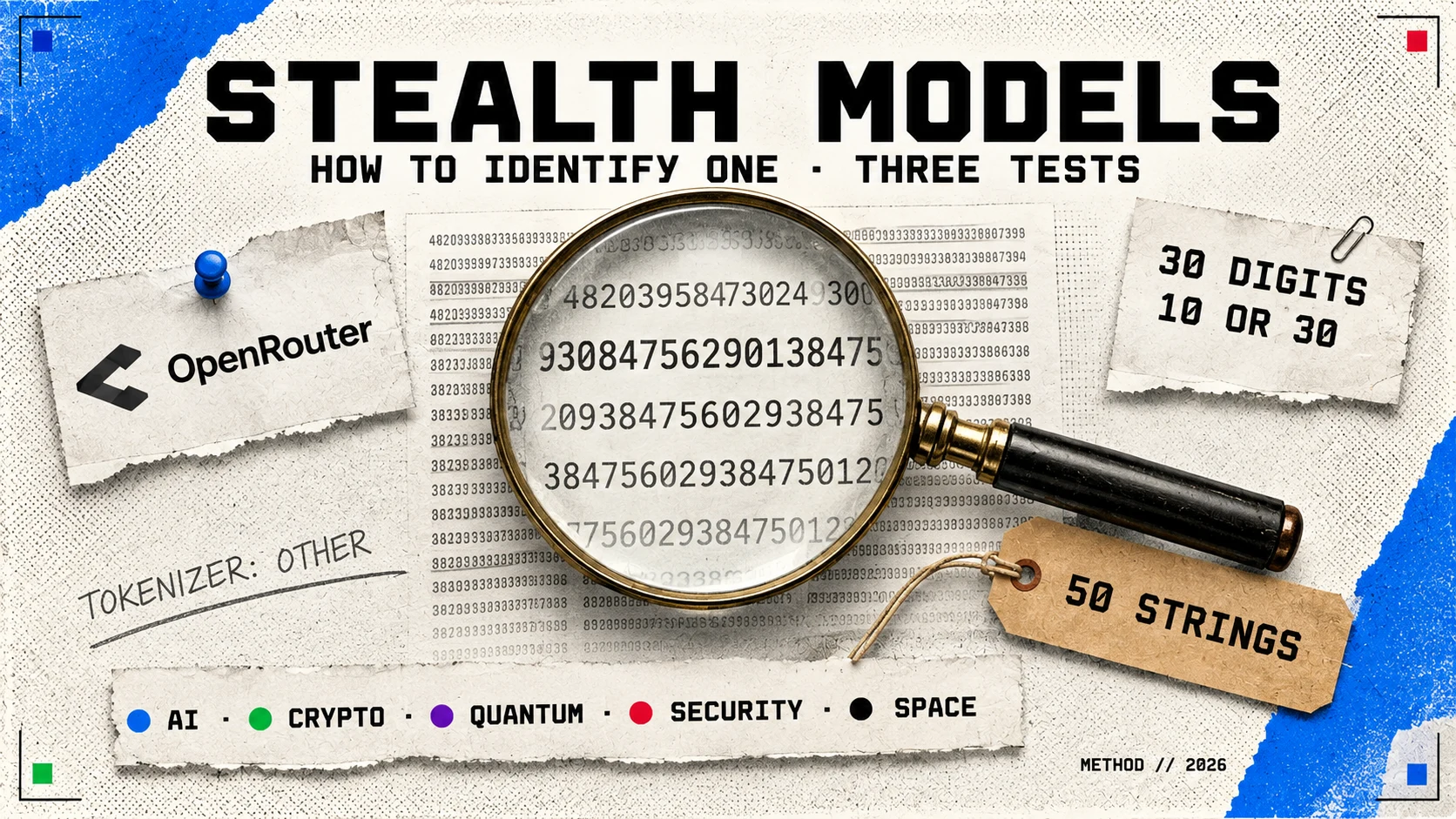
The second leg was the measurement. Only one number is read, usage.prompt_tokens, with the reply capped at one token, so nothing the model generates can reach it.
A tokenizer is exactly proportional to its content, which gives a test that needs no trust in the endpoint’s overhead. Send a string, then send twice as much of the same content, and subtract. Everything fixed cancels, the chat template included, and what survives is the content’s own cost.
Thirty digits are the sharpest single probe. The Llama 3 vocabulary bundles digits in threes, so thirty digits cost it ten tokens. The Qwen vocabulary splits them one per token, so the same thirty cost thirty. Union Alpha returned both, from requests identical down to the byte.
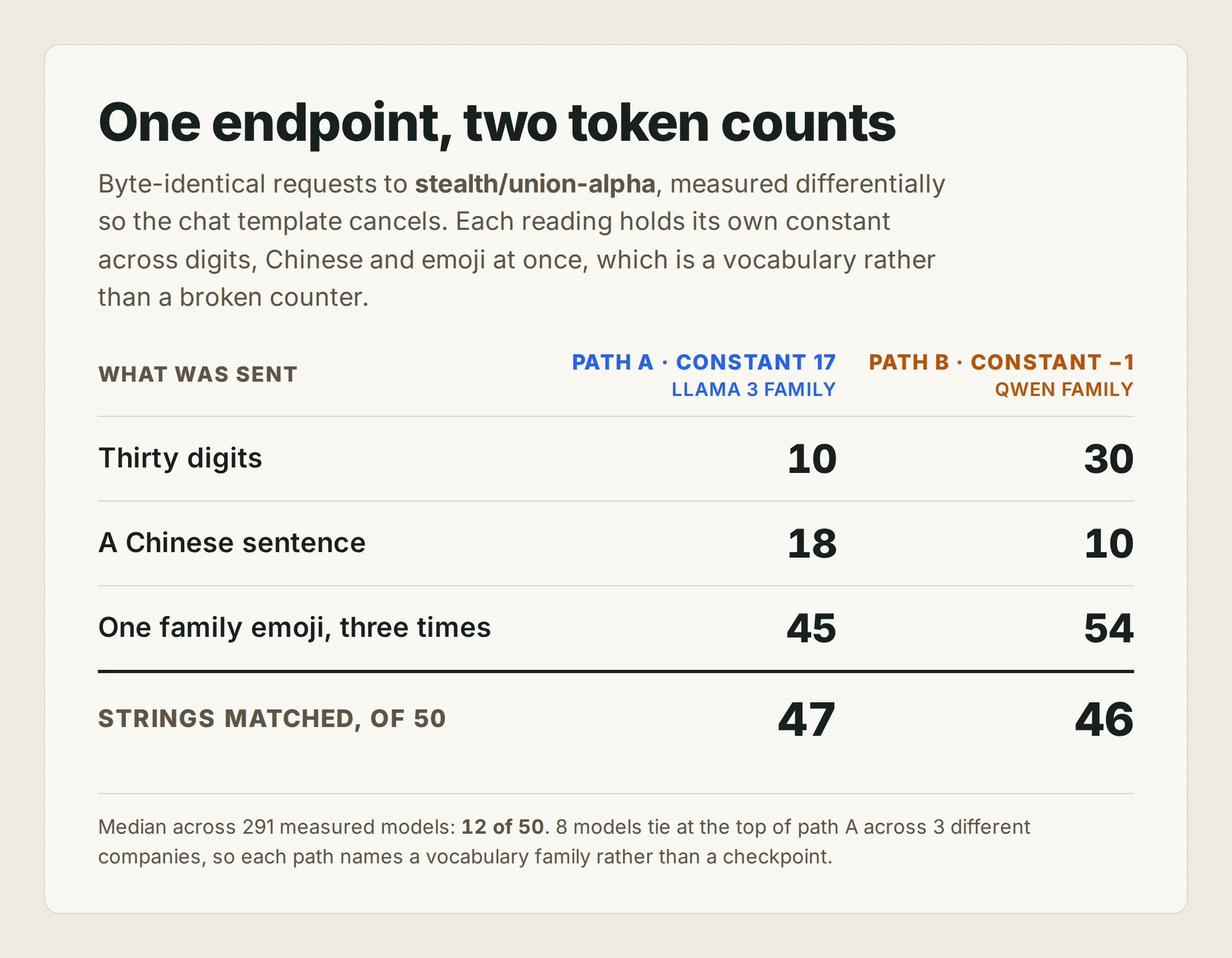
Scored across all fifty strings against a frozen corpus of 291 models measured on 3 September, one reading matches the Llama 3 family on 47 and the other matches the Qwen family on 46, against a median of 12. Forty-three of the fifty strings returned both, and not one returned a reading that fitted neither.
There is a control that makes this mean something. Union Alpha is tagged tokenizer: "Other" in OpenRouter’s metadata, and if that tag made the platform fall back to one shared estimator, every model carrying it would score alike. In the corpus, 104 models carry the same tag and their scores run from 94% down to zero. The agreement is a property of the models.
An image made it answer as a third family
Attach an image and the alternation stops. Fourteen identical readings out of fourteen, and the same under a tool declaration, both landing on the GLM family rather than on either text path.
Digits cannot separate Llama 3 from GLM, because both charge ten for thirty, which is why the image path needs strings chosen to split them. Our first reading of that path used digits and landed in the Llama 3 group. Re-running with eight strings that do separate the two, drawn from emoji, Thai, Hindi and combining marks, the image path resolves to the GLM family on seven of eight, while plain text under those identical strings resolves to Llama 3 on eight and Qwen on three, with no GLM at all.
Three tokenizers behind one address is the finding, and at the time we could not say what produced it. A router picking a model per request, speculative decoding with a draft model from another family, and two backends under an A/B test all produce the same signature. The reveal named the shape: several models working the same request, which carries several tokenizers because it carries several models.
The completion IDs carry a clock
Cloudflare’s five archived examples each carry a generation ID. These are the raw values, still on the page today:
chatcmpl-mu3b7o02sf9tov9z
chatcmpl-mu3b7pxpj3kdi2v5
chatcmpl-mu3b7t0objtvuaa4
chatcmpl-mu3b7wo2jrkvi2t8
chatcmpl-mu3b80ptkze4dltt
Read the first eight characters as base-36 milliseconds since the epoch and they decode to a single run:
| Example | Decoded | Gap |
|---|---|---|
| Simple Question | 15 Sep 2026, 23:35:12.194 | |
| System Guidance | 15 Sep 2026, 23:35:14.701 | +2.507s |
| Coding Example | 15 Sep 2026, 23:35:18.696 | +3.995s |
| Follow-up Conversation | 15 Sep 2026, 23:35:23.426 | +4.730s |
| Creative Writing | 15 Sep 2026, 23:35:28.673 | +5.247s |
Five calls inside 16.479 seconds, strictly increasing, in the order the file lists them, about 15.1 hours before the OpenRouter catalogue record was created. That is what a scripted capture run looks like shortly before a launch.
It also explains something about the pattern Palmer matched. He identified Union Alpha’s completion IDs as chatcmpl-mu followed by 14 lowercase alphanumeric characters. The mu is the leading edge of that clock: in this scheme every ID minted between 13 September and 8 October 2026 begins mu. So the prefix match carries an era and a shared ID-minting library, which makes it a lead. The load-bearing half of his finding is the other one.
What the clock establishes is narrow. It dates the completion. Whoever ran the capture, and the moment the cost field beside it was calculated, both sit outside what an ID can carry.
Palmer read the plumbing and arrived at the same name
A researcher posting as Cary Palmer worked the infrastructure while we worked the documents, and published his own identification at 21:17:43 UTC on 17 September, before the reveal. He reported matching the completion-ID pattern exactly against The Unbiased Co’s platform, then watching a request he sent to Union Alpha answered by the same vLLM fleet that answers Unbiased. He closed with “CASE CLOSED”, and three minutes later credited the earlier work here.
Weigh the two observations differently. An ID format travels between systems that share software, and as the clock above shows, part of that prefix is a date. Two names answered by one backend fleet is the strong one. Both are his reports of his own testing rather than something anyone else can rerun, and the confirmation arrived two hours later in the operator’s own words.
We read Qwen first, then Llama 3, then the blend
On 16 September our research register measured Qwen, on 46 of 50 strings. By that evening we had re-measured and read Llama 3, on 47 of 50, which is where an independent toolkit, stealthprint, had arrived from its own testing, and that is the reading our first public post on the tokenizer carried. The register keeps every reading in the order we took it, because the sequence is the evidence.
Both counts came from real tokenizers, because the endpoint was returning both from byte-identical requests. That pair is what sent us looking for a system behind the address. A third team reported GLM behaviour on image requests, and once we re-ran that path with strings chosen to separate GLM from Llama 3 we reproduced it exactly: a third family, on images and on tool declarations.
Three families behind one address, each of them a real component, and the differential test named all three. That is the reading the reveal confirmed, and the register carries each step that got there.
Ox Alpha in August is where the method came from
Ox Alpha appeared on OpenRouter on 20 August 2026, free, with a million-token context and video input, and no stated owner. Two measurements ran against it.
The API contract came first. Of the 418 models OpenRouter listed, exactly three carried Ox Alpha’s complete seven-field contract: the stealth entry itself, z-ai/glm-5.3, and the ~z-ai/glm-latest alias. GLM-5.2 matched two fields of seven, so the contract had changed at the 5.3 generation rather than being a standing Z.ai template.
The tokenizer came second, and it is the measurement the obvious objection cannot explain, because the inference backend produces it rather than OpenRouter’s metadata. On the fifty strings, Ox Alpha and GLM-5.3 returned identical counts every time. Kimi K3 is the control: it carries the same tokenizer: "Other" tag and scored 18%.
We published on 21 August. Z.ai confirmed on 26 August, and the answer carried a correction for us: the model was GLM-5.3-Flash. Our own write-up had already flagged the misfit that turned out to be the key, because Ox Alpha accepted video, and video arrived in the series with the Flash model, the first natively multimodal one.
How far this evidence goes
Read precisely, the token counts support less than people want them to, and the discipline is the whole of the method.
- A shared vocabulary places a family, and families have guests. Perplexity’s Sonar pair and the Hermes line sit in the Llama 3 group, Kwaipilot sits in the Qwen group, and none of those companies created the vocabulary it uses. Kwaipilot’s KAT Coder returns counts identical to Qwen 3.6 on all fifty strings, so the test cannot separate them at all.
- Input accounting follows the text as far as the tokenizer and no further. Under a blend that reading held exactly: the models that counted the prompts sat inside a system that also called stronger ones to write the answers.
- The documents name the operator. The pricing, the architecture wording, the completion IDs and the infrastructure trace carried this from a family to a company. The tokenizer’s job was to place the family, and it did that to 47 of 50.
Fingerprinting a stealth endpoint now means fingerprinting a system. Our full method, including the controls that stop a false positive, is written up in how to identify a stealth AI model, and the measurements sit on the model fingerprints page with the raw readings beside them.
Check it yourself
Open Cloudflare’s model page, now filed under its Pareto listing, and read the four examples: the token counts, the costs and the completion IDs are all there. Two of them give the rate card. Decode a completion prefix with one line:
node -e 'console.log(new Date(parseInt("mu3b7o02",36)).toISOString())'The frozen catalogue revisions, the tokenizer readings, the differential pairs and the 291-model scoring corpus are committed in our research folder, and the dated claims we wrote before the reveal are in it too, scored against what the reveal showed.
Claims we checked
Union Alpha is GLM-5.4-Flash, a model from the Zhipu GLM family.
The operator confirmed Union Alpha as Pareto 26.9 from Circuit and Chisel on 17 September 2026. GLM-family token counts do appear on the endpoint's image and tool paths, so a GLM model plausibly sat inside the system, but the identity was never a single GLM checkpoint.
A Circuit and Chisel release-note pull request dated 14 September names union-alpha as a per-account public name for Pareto.
The repository circuitandchisel/unbiased-releases returned 404 by the time we looked, no Wayback Machine snapshot exists of the pull request or the repository root, and the diff has never been produced. The removal itself is verified. The conclusion it points at was confirmed a day later by the operator, through other means.
Questions people ask
- Who identified Union Alpha first?
- YFarmX. Our post naming Circuit and Chisel's Pareto went up on X at 04:51:17 UTC on 17 September 2026, while the model was still anonymous. Searching X's index for every post that mentions Union Alpha alongside Pareto, Unbiased or Circuit and Chisel returns 132 posts, and ours is the earliest to name the company. The next was @aitrackerbot at 06:23:33 UTC, one hour and 32 minutes later, working from a GitHub pull request rather than the pricing. The operator confirmed the identity at 23:05:32 UTC the same day.
- What was Union Alpha?
- Pareto 26.9, built by Circuit and Chisel and sold through Unbiased. It is a system rather than a set of weights: several models, open and frontier, work the same request, a harness checks the output, and stronger models are called when the work needs them. That architecture is why the endpoint returned three different tokenizer signatures while it was anonymous.
- Who unmasked Ox Alpha, and what was it?
- YFarmX published the fingerprint on 21 August 2026, a day after the model appeared. Ox Alpha matched Z.ai's GLM-5.3 on all fifty tokenizer test strings and was one of only three entries in a 418-model catalogue carrying its complete API contract. Z.ai confirmed the model on 26 August as GLM-5.3-Flash, which had no public existence on the day we measured it.
- How do you fingerprint a model you cannot see inside?
- Read one number, usage.prompt_tokens, with the reply capped at a single token, so only the input is measured. Send a string, then send twice as much of the same content, and subtract: everything fixed cancels, including the chat template, and what survives is the cost of the content alone. Thirty digits are the sharpest single test, because the Llama 3 vocabulary bundles digits in threes and charges ten, while the Qwen vocabulary splits them and charges thirty. Score the result against a frozen corpus of measured models.
- Was Union Alpha GLM-5.4?
- No. That reading circulated widely on 16 and 17 September 2026 and the reveal settled it: the model was Pareto 26.9, a multi-model system from Circuit and Chisel. GLM-family counts did appear on Union Alpha's image and tool paths, which is consistent with a GLM model sitting inside the blend as one component.
- Did a deleted GitHub pull request name union-alpha before the reveal?
- It was reported to, and we could not check it. The repository circuitandchisel/unbiased-releases stopped resolving on 17 September 2026, the Wayback Machine holds no snapshot of it, and we never saw the diff. We record the report and the removal, both of which are real, and we do not record the contents of a document nobody has produced.
- Can I check any of this myself?
- Yes. The five worked examples are on Cloudflare's own model page with their token counts, their costs and their completion IDs. Two of them give two equations in two unknowns, and solving them returns the rate card with nothing assumed. The tokenizer measurements, the frozen catalogue revisions and the scoring corpus are committed in our research folder, and the scoring corpus covers 291 models.
Sources
- YFarmX naming Circuit and Chisel's Pareto, 17 September 2026, 04:51:17 UTCx.com
- The Unbiased Co, "You found us", 17 September 2026, 23:05:32 UTCx.com
- OpenRouter announcing the reveal, 17 September 2026, 23:24:41 UTCx.com
- Cary Palmer matching the completion IDs and the vLLM fleet, 17 September 2026, 21:17:43 UTCx.com
- AI Tracker Bot naming Circuit and Chisel from a release-note pull request, 17 September 2026, 06:23:33 UTCx.com
- Union Alpha announcing the listing, 16 September 2026, 14:50:33 UTCx.com
- Union Alpha on day-zero volume, 16 September 2026, 19:26:41 UTCx.com
- Union Alpha, "Nice detective work, but keep digging!", 17 September 2026, 00:23:03 UTCx.com
- Cary Palmer on the completion prefix, before he had a match, 17 September 2026, 02:44:02 UTCx.com
- The GLM-5.4-Flash reading, 16 September 2026, 16:59:27 UTCx.com
- YFarmX reading the tokenizer as Llama 3, 16 September 2026, 23:38:09 UTCx.com
- Union Alpha model page, with the five worked examples and their completion IDs (Cloudflare AI Gateway documentation)developers.cloudflare.com
- Pull request 33478, [AI Gateway] Add Astra, H3, H3 Max, and Union Alpha models (cloudflare/cloudflare-docs)github.com
- Pareto pricing (Unbiased)unbiased.ai
- How Pareto works (Unbiased)unbiased.ai
- Circuit and Chiselcircuitandchisel.com
- OpenRouter models API, carrying the unbiased/pareto recordopenrouter.ai
- GLM-5.3-Flash: Frontier Intelligence, Flash Cost (Z.ai)z.ai
- stealthprint, an independent reading of the same endpointgithub.com