Cohere
Command A+
Cohere's open-weights flagship for business agents
Key facts
- 20 May 2026command-a-plus-05-2026
- Released
- 218B25B active per token
- Size
- 128K / 64Ktokens in / out
- Context
- 48EU languages included
- Languages
- Apache 2.0open weights
- Licence
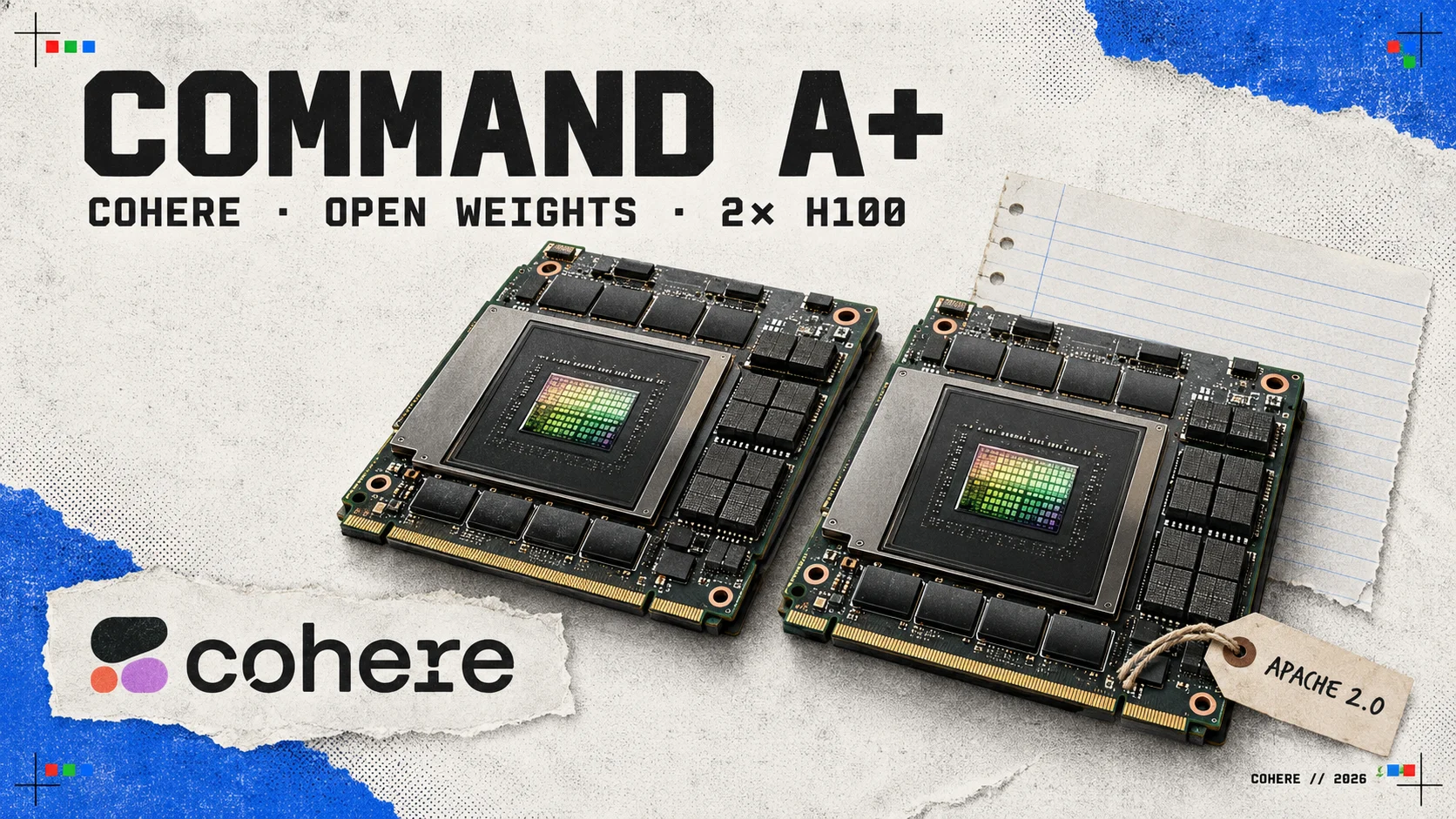
- 2× H100or 1× B200, at 4-bit
- Minimum hardware
Command A+ is a large language model from Cohere, the Canadian AI company that sells to businesses and governments. Released on 20 May 2026, it reads text and images, reasons through problems, calls software tools and works in 48 languages. Cohere gives the weights away under the Apache 2.0 licence, so a company can run it on its own servers, and the smallest version fits on two NVIDIA H100 graphics cards.
What Command A+ is
Command A+ is a large language model made by Cohere, released on 20 May 2026 and called on Cohere’s API as command-a-plus-05-2026. It reads text and images, writes text, reasons step by step and calls software tools, and it works in 48 languages. Cohere built it for businesses that want AI agents running inside their own systems: answering questions from company files, analysing spreadsheets and working through multi-step tasks.
Cohere’s launch post calls it “Our fastest and most powerful language model yet”, an “open-source enterprise workhorse built for complex reasoning, multimodal and multilingual agentic tasks”. Its release notes call it “the last model in the Command A family”.
The weights are free to download under the Apache 2.0 licence, one of the most permissive open licences there is, which allows commercial use. That is the point of the release for Cohere, which sells what it calls sovereign AI: models a bank, a government or a telecoms company can run on hardware it controls, so its data stays in-house.
One model in place of four
Command A+ replaces four earlier Cohere models with one. Before it, Cohere sold Command A for tool use, Command A Reasoning for step-by-step problems, Command A Vision for images and Command A Translate for languages, each around 111 billion parameters. Cohere’s launch post says Command A+ “surpasses every previous generation in the Command series and unifies their capabilities into a single scalable model”.
| Model | Size | What it does | Languages |
|---|---|---|---|
| Command A+ | 218B total, 25B active | Reasoning, images, tool use | 48 |
| Command A | 111B | Tool use | 23 |
| Command A Reasoning | 111B | Reasoning, tool use | 23 |
| Command A Vision | 112B | Images | 6 |
Command A Translate, the fifth member of the family at 111 billion parameters and 23 languages, handled translation alone. Command A+ is also Cohere’s first multimodal reasoning model, meaning the first that can think step by step about an image.
How it is built
Command A+ is a sparse mixture-of-experts model: 218 billion parameters in total, of which 25 billion do the work on any one token. It is the first mixture-of-experts model Cohere has shipped; every earlier Command model was dense, using all its parameters on every token. The detail below comes from the Hugging Face model card.
| Specification | Command A+ |
|---|---|
| Total parameters | 218 billion |
| Active per token | 25 billion |
| Experts | 128, with 8 active per token plus 1 shared |
| Attention | Sliding-window and global layers, 3 to 1 |
| Context | 128,000 tokens in, 64,000 out |
| Input | Text and images |
| Languages | 48, including every official EU language |
| Licence | Apache 2.0 |
The context window is half that of the original Command A, which Cohere lists at 256,000 tokens. A new tokenizer, first used on Command A+, cuts the number of tokens a reply needs, and Cohere says the saving is 20% for Arabic, 16% for Korean and 18% for Japanese against the one before it.
What it costs
Cohere’s pricing page lists Command A+ as free: the API key costs $0 and the model download costs $0.
Businesses pay Cohere for Command A+ in two ways. Model Vault is Cohere’s managed, dedicated inference service, where the model runs on hardware reserved for one customer. Private deployments put it inside a customer’s own data centre or isolated cloud. Cohere tuned the model on its paid workplace AI platform, North: the launch post says Command A+ was “Born from a year of deploying North with our customers”.
The Cohere release notes say Command A+ “is now available for all Cohere users through our standard API endpoints”, and the model can also be tried in Cohere’s hosted Hugging Face Space.
What hardware it needs
Command A+ runs on as little as two NVIDIA H100 graphics cards or a single NVIDIA B200, using its 4-bit W4A4 version. Cohere publishes three versions of the weights on Hugging Face and says “All three quantizations show negligible differences in benchmark quality and performance”. The minimum hardware for each, from the model card:
| Version | NVIDIA Blackwell | NVIDIA Hopper |
|---|---|---|
| BF16, 16-bit | 4× B200 | 8× H100 |
| FP8, 8-bit | 2× B200 | 4× H100 |
| W4A4, 4-bit | 1× B200 | 2× H100 |
Cohere recommends W4A4 for most uses. The model runs on vLLM and Hugging Face Transformers.
Two H100s puts a 218-billion-parameter model within reach of a company that owns one server, which is what makes the sovereign pitch practical. The Japanese IT company Fujitsu plans to offer it to its own customers, and Vivek Mahajan, its chief technology officer, said in Cohere’s launch post that the model’s “mixture-of-experts architecture and strong agentic performance align well with our commitment to deliver innovative, sovereign AI solutions through Takane and the Kozuchi Enterprise AI Factory.”
How much faster it is
Command A+ writes up to 63% more tokens a second than Command A Reasoning and delivers its first token up to 17% sooner, at the same quantisation and load, according to Cohere’s launch post. The 4-bit version adds a further 47% in speed and 13% off latency, and speculative decoding tuned for the mixture-of-experts design adds another 1.5 to 1.6 times.
Cohere’s release notes give a larger figure for production deployments: “up to 110% throughput increase and 30% decrease in latency over Command A Reasoning”.
How it scores
Command A+ scores 85% on τ²-Bench Telecom, a test of an agent handling customer-service tasks, up from Command A Reasoning’s 37%. Every figure below is Cohere’s own, from its launch post of 20 May 2026, set against the earlier Command model it replaces.
| Benchmark | Command A+ | Earlier Command model | Which one |
|---|---|---|---|
| τ²-Bench Telecom (agent tasks) | 85% | 37% | Command A Reasoning |
| Terminal-Bench Hard (agentic coding) | 25% | 3% | Command A Reasoning |
| MMMU (image understanding) | 75.1% | 65.3% | Command A Vision |
| MathVista (maths from images) | 80.6% | 73.5% | Command A Vision |
| CharXiv reasoning (charts) | 52.7% | 46.9% | Command A Vision |
| North memory test | 54% | 39% | Command A Reasoning |
Cohere adds 63% on MMMU Pro, and says Command A+ “achieved a score of 37 on the Artificial Analysis Intelligence Index, outperforming other leading open models”. On its own North workplace tests, it reports gains of 20% on answering questions from connected company files and 32% on spreadsheet analysis over Command A Reasoning. Those North tests are Cohere’s internal evaluations, scored by another language model acting as judge.
What to watch
A successor line. Cohere calls Command A+ the last Command A model, so its next flagship arrives under a new name.
The big clouds. Cohere’s own documentation for Amazon Bedrock lists the Command R generation, and a Bedrock, Azure or Oracle listing for Command A+ would take it to customers who buy through those marketplaces.
Aleph Alpha. On 16 September 2026 Cohere signed a definitive agreement to combine with the German AI company Aleph Alpha, operating globally as Cohere with headquarters in Toronto and Berlin, subject to regulatory approval. Aleph Alpha builds specialised language models for governments, the same buyers Command A+ is aimed at.
For the Command generations before it, see Command R+ and Command A; for other open-weights models a company can run itself, Mistral Large 3 and Llama 4.