
DeepSeek
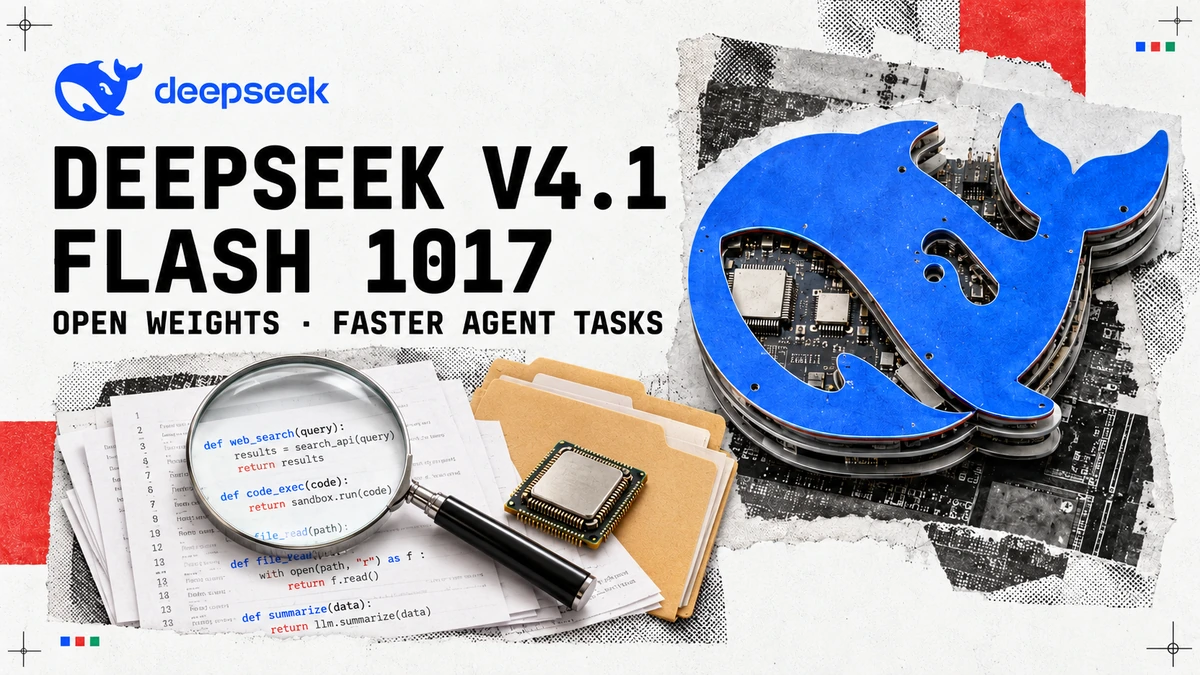
DeepSeek-V4.1-Flash-1017
An open-weight update for coding and tool-using agents
Key facts
- 17 October 2026MIT-licensed weights
- Released
- 1M tokens384K maximum output
- Context
- deepseek-flashNow serves the 1017 update
- API name
- 77.0Company-reported result
- DeepSWE v1.1
- $0.60 / $1.20Per million tokens, off-peak / peak
- Output price
- MITRepository and model weights
- Licence
An open-weight model for text, images, coding and tool-using agents, released on 17 October 2026. The update improves several company-reported agent benchmarks while keeping the deepseek-flash API name and token prices. DeepSeek also claims shorter responses and faster task completion.
What is DeepSeek V4.1 Flash 1017?
DeepSeek V4.1 Flash 1017 is an open-weight AI model that accepts text and images and can generate answers, code and tool calls. Released on 17 October 2026, it updates V4.1 Flash for reasoning, coding and agent tasks, where a model works through several steps using software tools.
DeepSeek publishes the repository and weights under the MIT licence. The company reports better results on several agent benchmarks together with shorter outputs, lower task costs and faster completion.
Which benchmark results improved?
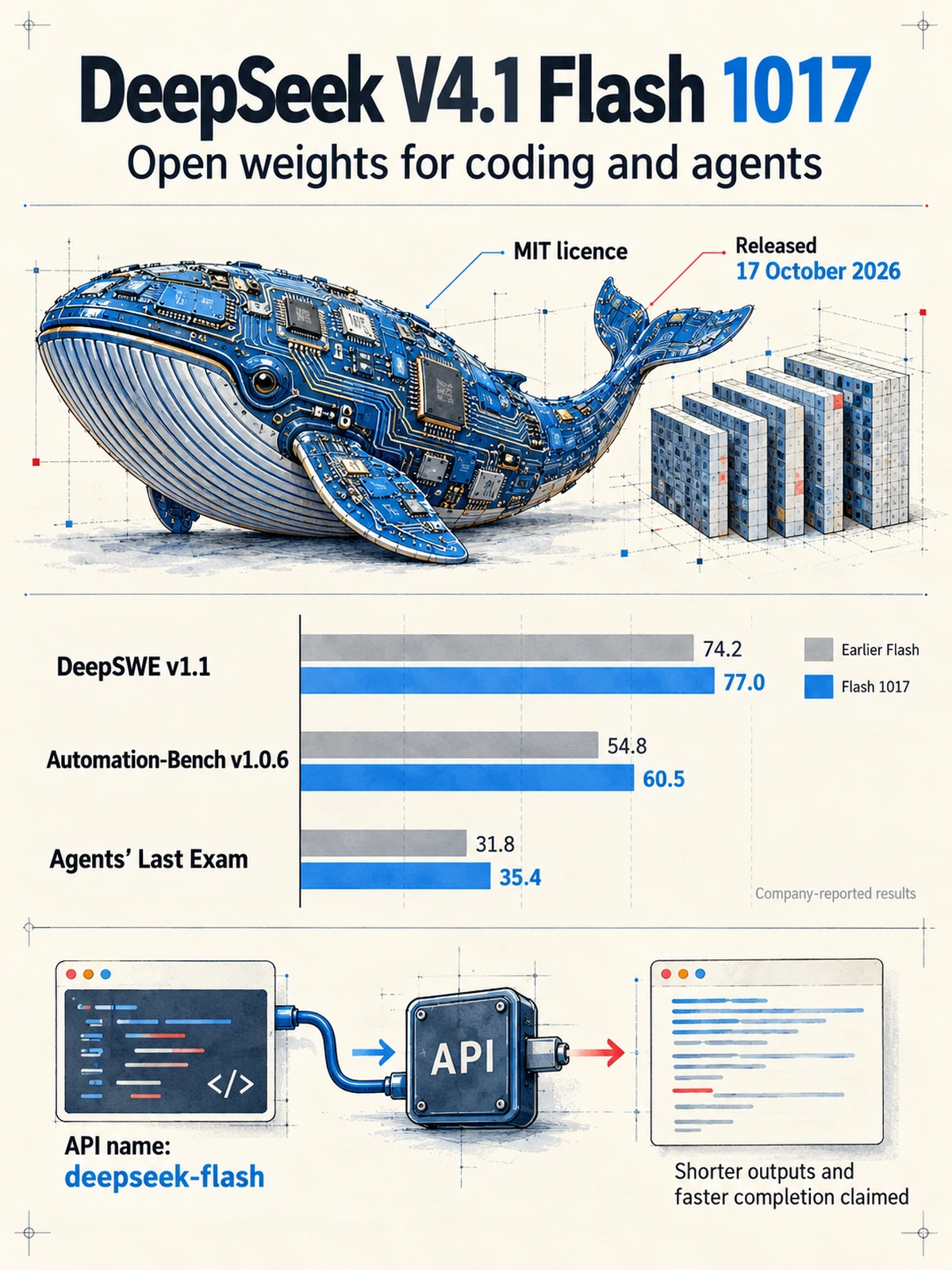
DeepSeek’s release table shows gains over the earlier Flash version across coding, automation and reasoning tasks. The figures below are company-reported results from the 1017 model card.
| Benchmark | Flash 1017 | Earlier Flash | Opus 5 |
|---|---|---|---|
| Terminal-Bench 4.0 | 42.3 | 31.2 | 51.8 |
| DeepSWE v1.1 | 77.0 | 74.2 | 74.0 |
| ProgramBench | 29.1 | 20.3 | 37.0 |
| Automation-Bench v1.0.6 | 60.5 | 54.8 | 50.3 |
| Agents’ Last Exam | 35.4 | 31.8 | 28.6 |
The comparison varies by task. Flash 1017 leads the listed Opus 5 result on DeepSWE, Automation-Bench and Agents’ Last Exam; Opus 5 leads on Terminal-Bench 4.0 and ProgramBench.
The release specifies Claude Code for Terminal-Bench 4.0 and Mini-SWE-V2 for DeepSWE v1.1. A harness determines how a model receives tasks and interacts with tools, so those settings belong alongside the model name when comparing results.
How do you access the update?
The DeepSeek API serves the update through the existing deepseek-flash model name. The change log also records the rollout to DeepSeek’s web and app products.
The current API specification lists a one-million-token context window and 384,000-token maximum output. It supports tool calls, vision and thinking or non-thinking operation. Legacy Flash aliases remain accepted and route to the updated model.
For a self-hosted deployment, the published weights give operators control over inference and their deployment environment. The inherited V4.1 Flash architecture uses a sparse mixture of experts: different parts of the model activate for each token, reducing the work compared with activating its whole backbone.
What does it cost?
DeepSeek lists separate input-cache and output rates, with off-peak prices half the peak rates. Prices below are in US dollars per million tokens, from the current pricing page.
| Usage | Off-peak | Peak |
|---|---|---|
| Input, cache hit | $0.003 | $0.006 |
| Input, cache miss | $0.15 | $0.30 |
| Output | $0.60 | $1.20 |
Peak hours are 01:00–04:00 and 06:00–10:00 UTC, Monday to Friday, excluding Chinese public holidays. Other hours, weekends and Chinese public holidays are off-peak.
Per-task cost also depends on tokens consumed and the number of attempts needed. Shorter successful runs can lower a bill even when the price of each token stays unchanged. A useful evaluation therefore measures completed tasks, total tokens and retries together.
What do local integrations need?
The 1017 repository supplies a reference prompt encoder, and DeepSeek Recipe provides a maintained protocol-aware toolkit. DeepSeek Recipe converts supported request formats into the model’s conversation representation and parses generated output, including thinking and tool calls.
The toolkit has Rust libraries and Python bindings. Model inference, tool execution and HTTP transport remain responsibilities of the application using it. That division lets an operator combine the published model format with its own serving and agent components.
For an agent evaluation, keep the task set, tools and success criteria fixed while comparing versions. The October model is a practical candidate for workloads where completing an automation task cheaply is more useful than producing a long answer.
More in Large Language Models
All LLMs →- DeepSeekDeepSeek-V4.1-Flasha 552B open-weight model built around its cache
- DeepSeekDeepSeek V4 Prothe price disruptor, raising its prices
- Moonshot AIKimi K3the largest open-weight model yet released
- Z.ai / ZhipuGLM-5.3-Flasha new base, natively multimodal, at a tenth of GLM-5.2's price
- Google DeepMindGemini 4 Argonlonger reasoning, coding and cyber defence
- OpenAIGPT-5.6the flagship from 9 July to 3 September 2026