
Z.ai / Zhipu
GLM-5.3-Flash
a new base, natively multimodal, at a tenth of GLM-5.2's price
Key facts
- 26 Aug 2026as ox-alpha from 20 Aug
- Released
- 320B18B active per token
- Parameters
- 1M / 128ktokens in / out
- Context
- $0.15 / $0.50per M tokens
- List price
- $0.075 / $0.25half price to 9 Sep 2026
- Promotion
- MITon Hugging Face, day one
- Weights
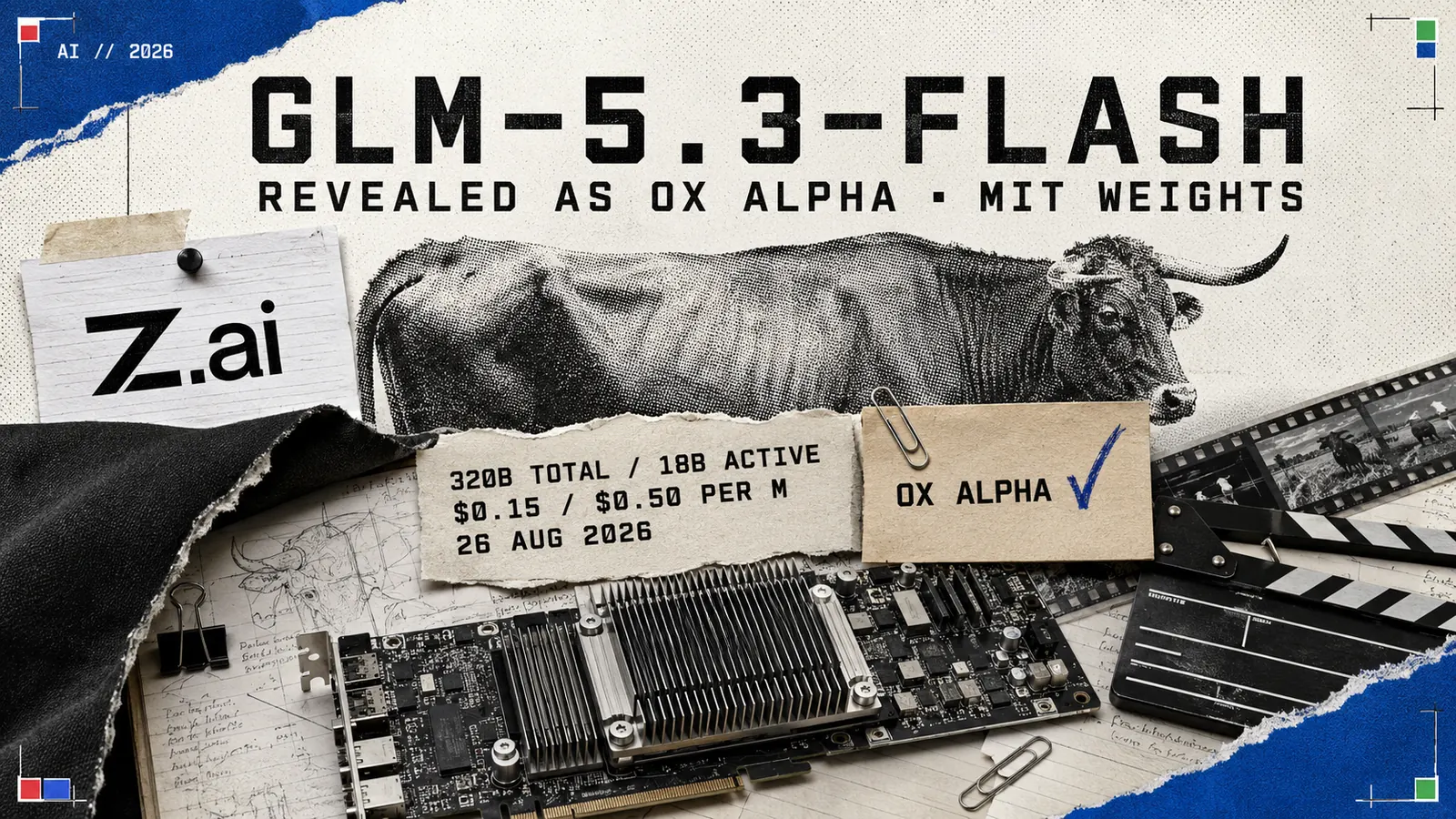
Z.ai's cheap tier, and the first GLM-5 model that takes video. It is built on a new base rather than a trimmed GLM-5.3, ships MIT-licensed weights on launch day, and lists at $0.15 per million tokens in and $0.50 out. Z.ai's launch post also revealed what it had been doing for the previous six days: running the same model anonymously on OpenRouter as ox-alpha.
What it is
GLM-5.3-Flash is the cheap tier of Z.ai’s GLM-5 line, published on 26 August 2026 under the title “GLM-5.3-Flash: Frontier Intelligence, Flash Cost”. It is the first natively multimodal model in the series: video, images, text and files go in, text comes out.
Z.ai’s own one-sentence summary: “With 320B total parameters and just 18B active parameters, it outperforms GLM-5.2 across benchmarks and real-world workloads at one-tenth the price, while approaching Claude Opus 4.8 on coding and agentic benchmarks.” Those are Z.ai’s claims, on Z.ai’s own runs, and so is almost everything in the tables below.
The published config.json gives a context window of 1,048,576 tokens, documented by Z.ai as one million, with output up to 128,000 tokens. OpenRouter’s catalogue reports the maximum completion as 131,072. Reasoning is always on, with three effort levels, low, high and max, defaulting to max, and there is no setting to switch it off.
The weights went up the same day under an MIT licence, which puts this release at the permissive end of Z.ai’s recent practice. GLM-5.2 was MIT when its weights appeared on 16 June. GLM-5.3 was held back a fortnight for safety hardening and landed on 28 August under a bespoke licence of its own.
The model that ran as Ox Alpha
Z.ai’s launch post closes a question this site had spent a week on. Its own words: “Before release, we tested GLM-5.3-Flash anonymously as ox-alpha on OpenCode and OpenRouter to gather user feedback. It quickly became the most popular model of the week”. The sentence goes on to say that all of that traffic was served on Chinese AI chips. The codename is set as ox-alpha in a code element in the post, so the identification is Z.ai’s own and carries no hedge.
An anonymous model called Ox Alpha had appeared on OpenRouter on 20 August 2026 with no owner attached to it, free, with a million-token context and video input. We published our identification on 21 August, five days before Z.ai said anything: two fingerprint tests, one on the model’s published API contract and one on the way it counts tokens, both landing on Z.ai’s GLM 5 line. On fifty strings chosen to force disagreement between tokenizers, Ox Alpha and GLM-5.3 returned identical counts every time, while a control of two Llama fine-tunes from unrelated vendors agreed on 48 of 50.
What the tests could not do was name the exact release, and our Ox Alpha page said so at the time. A shared tokenizer establishes lineage rather than identity, and the API contract, which does separate one release from another, pointed at GLM-5.3. The model behind the cloak turned out to be a sibling built to the same contract. The single detail that refused to fit was video: Ox Alpha accepted it, and Z.ai’s documentation says GLM-5.3 takes text only. The page called that an unannounced multimodal member of the family and labelled the reading as an inference. GLM-5.3-Flash is exactly that.
A new base, not a smaller GLM-5.3
The name suggests a trimmed flagship. It is not one, and this is the part of the release most easily read wrong.
GLM-5.3 runs the GLM-5.2 base with scaled-up post-training, and Z.ai has been explicit that every gain there came after pre-training. GLM-5.3-Flash starts from a newly trained base instead, on a 30-trillion-token multimodal corpus. It is the first model in the GLM series to combine sparse and linear attention, and it adds a technique Z.ai calls Manifold-Constrained Hyper-Connections. On Z.ai’s figures the combination cuts attention compute by 3.01 times and the KV cache by 4.44 times against GLM-5.3.
The config file backs the shape rather than the claims: 45 layers, 288 routed experts with eight active per token, a vocabulary of 154,880, and both image_token_id and video_token_id present, which is where native multimodality shows up as something other than marketing.
Against the older flagship, efficiency is the argument Z.ai makes: “Despite a similar total parameter count (320B vs. 355B), it nearly halves both the activated parameter count (18B vs. 32B) and the number of layers (45 vs. 92).” The 355-billion comparison there is GLM-4.5.
Z.ai also published base-model scores, before any post-training, which is the cleanest look at what the new pre-training run bought. All four rows are Z.ai’s own runs.
| Base model | MMLU | LiveCodeBench-Base |
|---|---|---|
| GLM-4.5-Base | 86.1 | 28.1 |
| GLM-5-Base | 88.3 | 34.4 |
| DeepSeek-V4-Flash-Base | 88.5 | 29.9 |
| GLM-5.3-Flash-Base | 88.1 | 37.6 |
On general knowledge the new base sits level with the field and a fraction behind DeepSeek’s. On code it is more than three points clear of the next best, which is where the new pre-training run shows. Z.ai’s technical report for the generation, “GLM-5: from Vibe Coding to Agentic Engineering”, is on arXiv as 2602.15763.
What Z.ai’s own table shows
Every row below comes from Z.ai’s launch table, and the harnesses are footnoted on its model card: Terminal Bench 2.1 was run inside Claude Code 2.1.207, DeepSWE through mini-swe-agent at 400K context, and Humanity’s Last Exam was judged by GPT-5.6-luna at medium effort. Two rows were not run in house. GDPval-AA v2 is “evaluated by Artificial Analysis”, and Toolathlon Verified comes from “the official evaluation service”, reported as pass@1 averaged over three runs.
| Benchmark | GLM-5.3-Flash | GLM-5.2 |
|---|---|---|
| DeepSWE v1.1 | 63.4 | 46.2 |
| AutomationBench v1.0.6 | 48.8 | 26.2 |
| Terminal Bench 2.1 | 84.3 | 81.0 |
| NL2Repo | 56.3 | 48.9 |
| Toolathlon Verified | 78.4 | 59.9 |
| Agents’ Last Exam | 26.3 | 20.4 |
| Humanity’s Last Exam, with tools | 55.3 | 54.7 |
| GDPval-AA v2 | 1773 | 1504 |
The vision rows in Z.ai’s table carry no GLM-5.2 figure at all, because GLM-5.2 is text-only. Read the two columns together and the pattern is a large jump on agentic and tool-heavy work, a modest one on terminal tasks, and almost nothing on the hardest reasoning suite: Humanity’s Last Exam moves six tenths of a point.
Against the wider field on the same table, the position is cheaper rather than better.
| Benchmark | GLM-5.3-Flash | Leader on the same table |
|---|---|---|
| Terminal Bench 2.1 | 84.3 | 87.4 GPT-5.6 Terra |
| DeepSWE v1.1 | 63.4 | 69.6 GPT-5.6 Terra |
| MVbench | 77.8 | 82.2 Gemini 3.7 Flash |
GLM-5.3-Flash takes none of those three rows, and GPT-5.6 Terra takes two of them. The other two columns Z.ai printed are Claude Opus 4.8, at 85 on Terminal Bench, 58 on DeepSWE and 67.1 on MVbench, and DeepSeek-V4-Vision-Exp at 83.9, 59.3 and 69.4. The new model is within a point of Opus 4.8 on terminal work and five points ahead of it on DeepSWE, while Gemini 3.7 Flash is four and a half points clear of everything on video understanding.
The claim Z.ai actually leads with is about price and position rather than the top score: it says the model “pushes the Pareto frontier of the Artificial Analysis Intelligence Index v4.1.1, scoring 57 at just $0.045 per task (discounted)”. That is Z.ai citing a third party’s index rather than running its own test. Treat the number as a signpost rather than a like-for-like comparison with scores on this site: our Gemini 3.7 Flash page records Artificial Analysis putting that model at 56 in August, but Google’s table did not name an index version and Z.ai’s does, so the two figures are not safely comparable. Both are also readings of a superseded board: Artificial Analysis has rebased the index twice since Z.ai’s v4.1.1 citation, most recently to v4.3 on 7 September 2026, and the v4.3 board re-scores the whole field.
Price and access
Z.ai’s own pricing page lists $0.15 per million input tokens, $0.03 per million for cached input, and $0.50 per million output. A launch promotion halves all three, to $0.075, $0.015 and $0.25, and it runs until midnight on 9 September 2026, Singapore time.
| Per million tokens | List | Promotion to 9 Sep 2026 |
|---|---|---|
| Input | $0.15 | $0.075 |
| Cached input | $0.03 | $0.015 |
| Output | $0.50 | $0.25 |
Three routes in. The Z.ai API platform, with the model code glm-5.3-flash. The GLM Coding Plan, where Z.ai gives the model three times the quota it allows GLM-5.3. And the weights, which anyone can download and serve: the model card lists SGLang, vLLM, TokenSpeed, Transformers, KTransformers and Unsloth. By 30 August the Hugging Face repository had recorded 346,516 downloads and 1,677 likes.
OpenRouter listed z-ai/glm-5.3-flash on 26 August 2026 at 13:59 UTC, at the promotional rate of $0.075 in, $0.25 out and $0.015 for a cache read, with a batch variant at list price. Its catalogue records the modality as text, image and video in, text out, with a 1,048,576-token context.
Z.ai now also serves the model as GLM-5.3-FlashX, a faster tier documented on the same model page that delivers up to 200 tokens a second, priced on Z.ai’s pricing page at $0.37 per million input tokens, $0.075 cached and $1.25 output.
Z.ai’s recommended settings are temperature 1, top_p 0.95, reasoning_effort at max and thinking.clear_thinking false. Because thinking cannot be disabled, output-token budgets on this model have to account for reasoning tokens even on short answers.
What to watch
Whether anyone outside Z.ai reproduces the tables. Every benchmark above is the company’s own run except two, and the harness notes show why that is worth stating: a Terminal Bench figure produced inside Claude Code is not the same measurement as one produced in a different agent.
Whether the new base becomes the line. GLM-5.3 and GLM-5.3-Flash share a version number, a release month and an API contract, and almost nothing else underneath. The next GLM release will show which of the two architectures Z.ai is actually building on.
The 9 September date. Anyone budgeting on $0.075 per million input tokens is budgeting on a promotion with ten days left on it. The list price is double.
The chips. Z.ai says the anonymous test traffic was served on Chinese AI chips. It does not say whose, and it published no figures on throughput or cost from that run.
For the flagship this sits beside, see GLM-5.3; for the model it is measured against throughout Z.ai’s own table, GLM-5.2; and for how the stealth listing was identified before the reveal, Ox Alpha.
More AI
All AI →
Ox Alpha was GLM-5.3-Flash, a model that did not exist publicly when we fingerprinted it
Z.ai confirmed on 26 August that the anonymous OpenRouter model Ox Alpha was GLM-5.3-Flash. Our 21 August fingerprint put it on the GLM 5 line and flagged one thing that did not fit. That detail is what the answer turned on.

NEAR AI Cloud brings GLM 5.3 Flash to OpenRouter
NEAR AI Cloud now serves GLM 5.3 Flash through OpenRouter. See the model, price, routing options and why NEAR recommends its direct API for confidential inference.
More in Large Language Models
All LLMs →- Anonymous (Stealth)Ox Alphaan anonymous listing, measured rather than guessed
- Z.ai / ZhipuGLM-5.3a post-training update with an emergent cyber capability
- Z.ai / ZhipuGLM-5.2strongest open-weight all-rounder before K3 landed
- Google DeepMindGemini 3.7 FlashAugust’s Flash release and its API successor
- DeepSeekDeepSeek V4 Prothe price disruptor, raising its prices
- Google DeepMindGemini 4 Argonlonger reasoning, coding and cyber defence