
TypeSafe
Jev
a decision model that returns a typed answer and a confidence
Jev 1.13's catalogue record · the measured identity evidence: fingerprint, providers and history
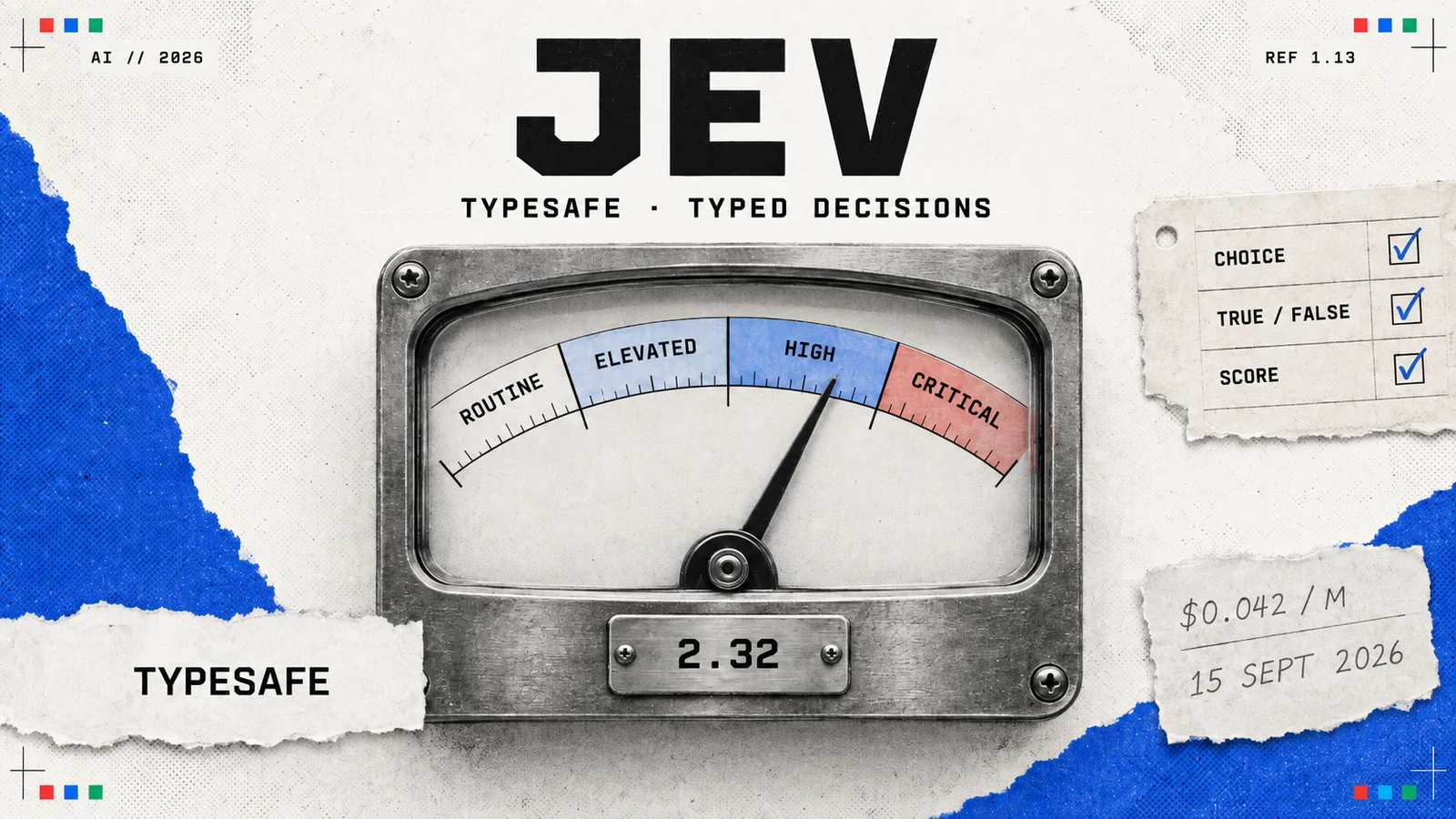
Key facts
- 15 Sept 2026TypeSafe's first model
- Early access
- $0.042 / Moutput tokens free
- Input price
- 32,000tokens, 28,800 out
- Context
- 230 ms31 calls, 3 questions each
- Our median latency
- $0.0000214509 input tokens
- Our cost per call
- up to 255TypeSafe's stated ceiling
- Options per choice
TypeSafe's first System One model, in early access since 15 September 2026. You hand it a block of state and a set of typed questions, and it answers all of them in one call: a choice from a fixed list, a true/false probability, or a score against ordered anchors, each carrying its own confidence. It runs on OpenRouter's decisions route at $0.042 per million input tokens with output free, and YFarmX measured a median 230 ms round trip over 31 calls on a three-question routing task.
Most models on this hub answer in sentences. Jev answers in types.
TypeSafe opened early access to it on 15 September 2026 and calls it the first System One model: you give it a block of state and a set of questions, each declared as a choice, a true/false or a score, and it returns an answer to every one of them in a single call, with a probability attached. The company’s founder is Diogo Almeida, who worked at OpenAI on the methods behind ChatGPT.
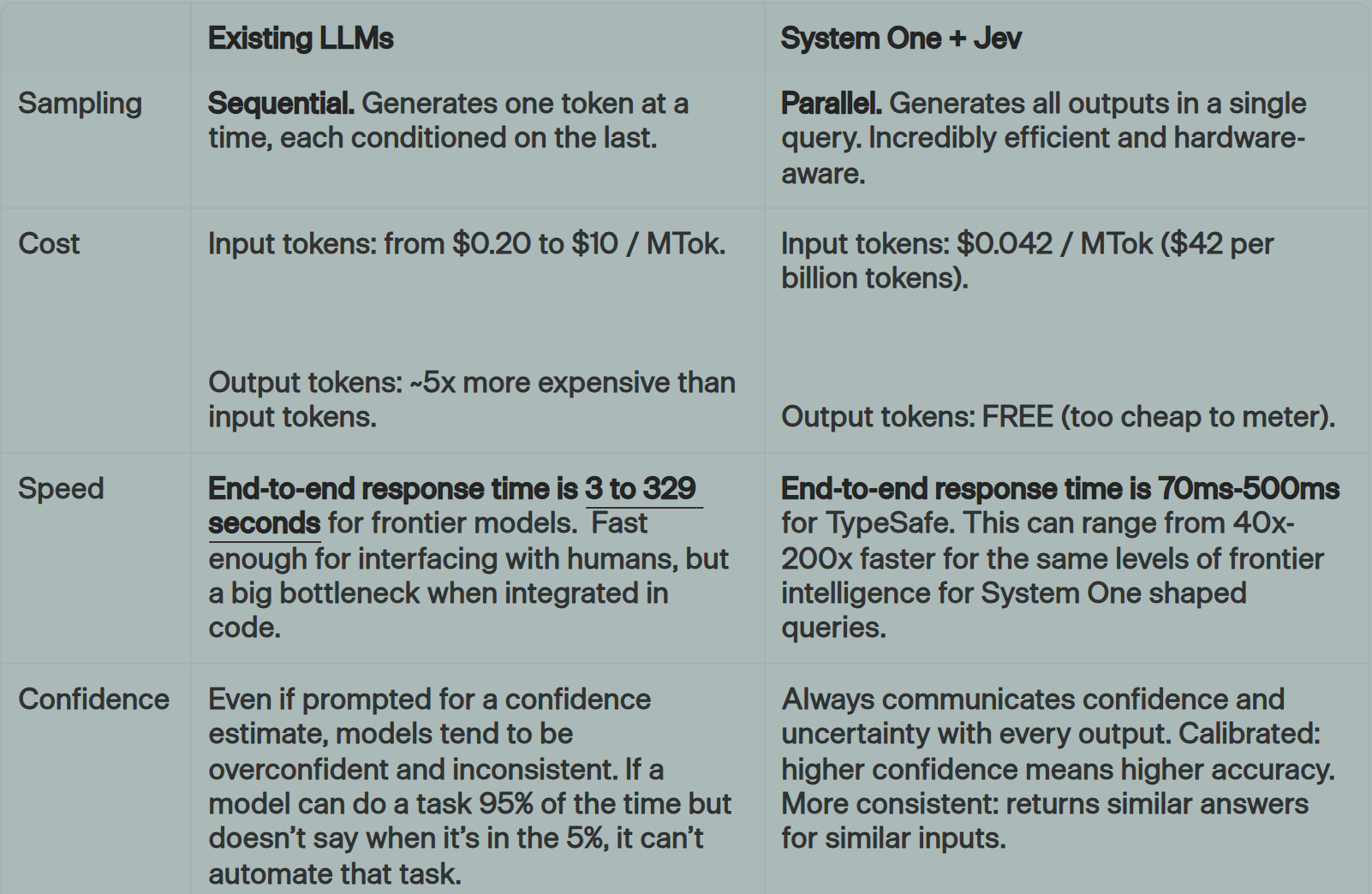
You hand it state and typed questions
A call carries three things: the model name, a state string holding whatever
the software knows, and a questions object. Each question declares its own
shape. A choice names its options, a noul gives the true and false
conditions, and a score lists ordered anchors.
YFarmX sent it a support email and asked three questions at once. This is the answer that came back, trimmed to the fields that carry the result:
{
  "model": "typesafe/jev-1.13-20260917",
  "answers": {
    "is_support_request": { "type": "noul", "noul": 0.97 },
    "route_to": {
      "type": "choice",
      "choice": "billing",
      "probabilities": { "billing": 1, "technical": 0, "account": 0, "sales": 0 },
      "confidence": 1
    },
    "urgency": {
      "type": "score",
      "score": 2.32,
      "legend": { "0": "Routine", "1": "Elevated", "2": "High", "3": "Critical" },
      "probabilities": { "0": 0, "1": 0.01, "2": 0.66, "3": 0.33 },
      "confidence": 0.66
    }
  },
  "usage": { "input_tokens": 509, "output_tokens": 79, "cost": 0.000021378 }
}
The useful part is the third answer. The email described a card declined twice with a suspension due on Friday, and the model put 0.66 on “High” and 0.33 on “Critical” rather than picking one and discarding the doubt. The score, 2.32, is where those weights land on the four-point scale.
We timed it on a support inbox
Thirty-one identical calls, each carrying the three questions above, run from
a container on 18 September 2026 against ~typesafe/jev-latest:
| Measure | Result |
|---|---|
| Median round trip | 230 ms |
| 90th percentile | 320 ms |
| Fastest | 185 ms |
| Slowest | 982 ms |
| Input tokens per call | 509 |
| Cost per call | $0.000021378 |
Most calls landed between 185 ms and 320 ms. Two sat outside that: the first call of the run at 433 ms, which is the shape a cold connection usually makes, and one later call at 982 ms.
The cost is worth checking against the published price, because it confirms it exactly: 509 tokens at $0.042 per million is $0.000021378, which is the figure the response itself reported. Output tokens were billed at zero. At that rate a million routing decisions of this size cost about $21.
The score moves while the decision holds
Running the same call fourteen times showed something a builder needs to know before wiring Jev into a test.
The decision was stable. route_to came back billing all fourteen times,
at probability 1.0. The boolean came back 0.97 every single time.
The score moved: 2.26, 2.27, 2.29, 2.31, 2.32, 2.33, six distinct values across a range of 0.07. It stayed inside the “High” band throughout, so every run agreed on the answer while disagreeing in the second decimal place.
This has a practical edge. A score is continuous across the bands, so code that
compares it to an exact value, or looks it up as an integer, finds nothing. Our
own model-guard command line tool hit exactly this: both of its score rows
printed “unavailable” on every live run until they were rounded onto the
nearest band. Read the band, not the decimal.
What people have built with it
Early access opened on 15 September 2026, and by 18 September the community list at awesome-jev was carrying more than a hundred public projects. The table below holds the ones YFarmX opened and confirmed, ordered by GitHub stars read on 18 September 2026.
Checking them one by one was worth the time. Three of that list’s best-known entries describe no Jev use at all on their own pages, including a project with 23,600 stars, so every row below was read on the project’s own repository before it went in.
| Project | Built by | What Jev does in it | Stars |
|---|---|---|---|
| Jev Ultrafast | browser-use | Picks the next browser action and the element to act on, in one request per page state. A Google Flights search from Zürich to London finished in 7.073 seconds, and browser protocol calls fell from 1,092 to 101 | 5.1k |
| AI CLI | Vercel Labs | Ships Jev as the default evaluation model for its evaluate command |
799 |
| NanoJev | TianyuCodings | A 0.6B open replica on a Qwen3-0.6B backbone, with the training pipeline and weights published | 327 |
| TypeSafe Mario | fhshaik | Chooses one of seven NES controller inputs from parsed RAM state, with no screenshots involved | 260 |
| Agent skills | TypeSafe | The company’s own skills package, teaching coding agents the decision workflow | 222 |
| unclutter | kitze | A browser extension asking Jev to sort each page element into keep, ad, promotion, newsletter, social, cookie or uncertain | 77 |
| jev-mcp | jkudish | Exposes verification, screening and ranking to any agent as MCP tools | 71 |
| jev-drone | RomanSlack | Tactical judgment for a camera-only quadrotor in MuJoCo at about 2.5 Hz, with a 50 Hz safety reflex holding a veto | 58 |
| Abide | coldtea | Asks one question per repository rule on every edit a coding agent makes, and gets a probability back | 1 |
| PageGrade | kitze | Scores page sections for clarity, writing and on-page SEO against five ordered anchors | 1 |
| Jev Pong | Ably Labs | Moves the ball one step per decision, so latency is visible as speed | 0 |
| jev-plays-pokemon | milanboers | Answers parallel yes/no questions on a text snapshot of Pokémon Red each turn | 0 |
Two of those carry measurements worth repeating.
Ably Labs timed Jev against chat models on the same task, recorded on 17 September 2026: Jev averaged 227 ms and 4.4 decisions a second, against 2.5 s for Claude Haiku 4.5, 3.2 s for Gemini 3.8 Flash and 3.5 s for GPT-5.6 Sol. Its own note records that the chat models answered correctly 95 to 100% of the time, so what the demo shows is the speed rather than the judgment.
The Pokémon agent published its running costs: about one decision a second, 1,600 to 2,100 input tokens per decision, and roughly $0.27 an hour, or $0.76 per 10,000 decisions. It reaches the starter Pokémon and returns to Pallet Town without help.
Where it runs and what it costs
Jev is served on OpenRouter’s alpha decisions route, POST /api/alpha/decisions, billed to an OpenRouter account, and through the Vercel
AI Gateway. Input is $0.042 per million tokens and output is free. Context is
32,000 tokens with a 28,800 token output ceiling, and a single choice
question can carry up to 255 options.
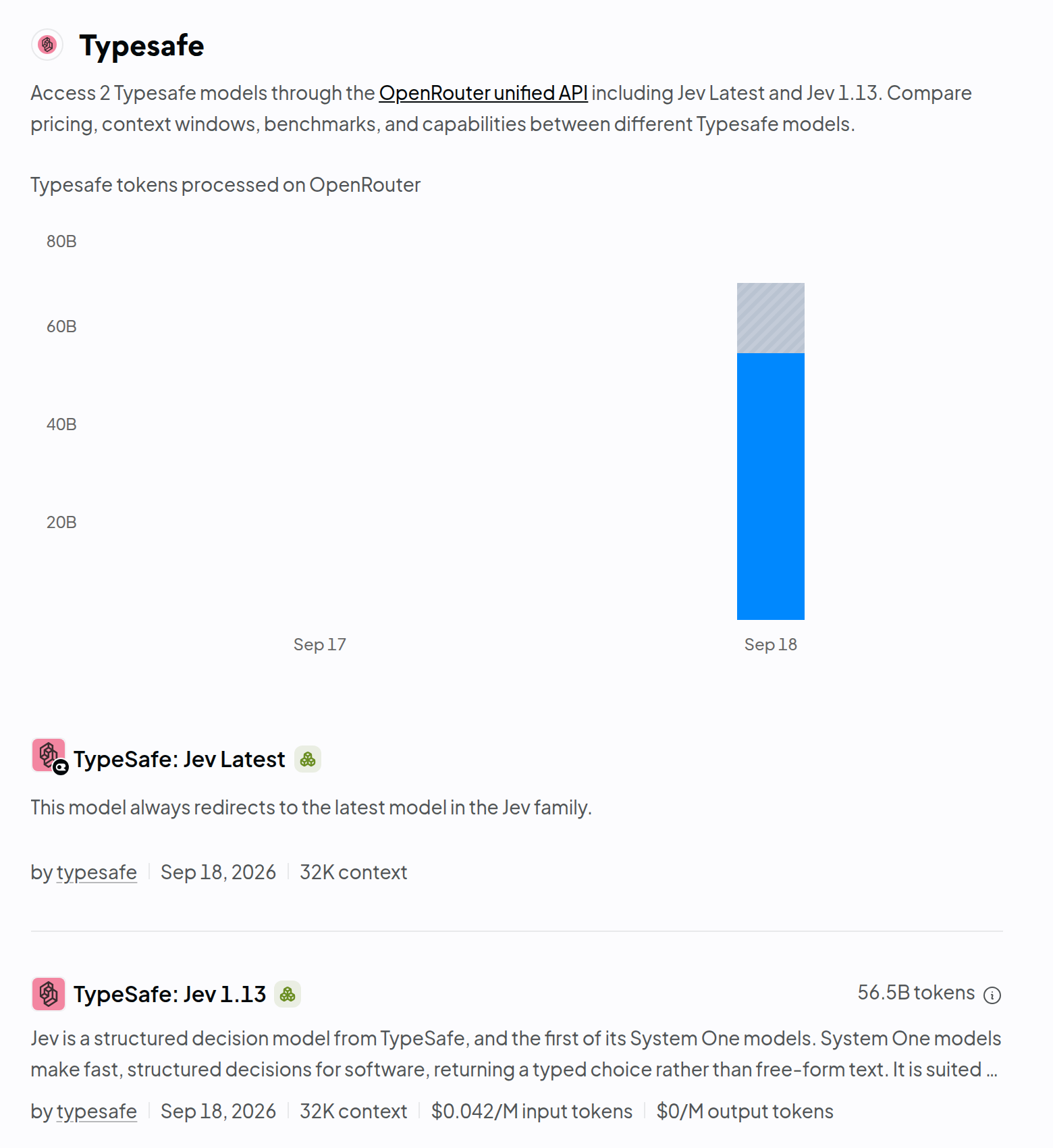
Its first days carried real volume. The provider page recorded 56.5 billion tokens processed on Jev 1.13 by 18 September 2026, three days after early access opened.
One thing to expect when looking it up: the model is absent from OpenRouter’s
/api/v1/models catalogue, because it answers on the decisions route rather
than chat completions. A catalogue lookup returns nothing and the endpoint
still answers. Probe the endpoint itself.
The build served to us on 18 September identified itself as
typesafe/jev-1.13-20260917, a dated build of the 1.13 line, and the provider
field read TypeSafe.
How the fingerprint reads
YFarmX measures the tokenizer signature of every model in its catalogue, and
Jev has a record like any other. It was measured on 18 September 2026 across
the decisions route: 50 clean rows, no corrupt rows, signature
tk_5e398719.
Its declared tokenizer family is “Other”. The closest model in the catalogue is Tencent’s Hunyuan A13B Instruct, which agrees on 24 of 50 probes, with Tencent’s HY-MT2-7B level at 24 and Poolside’s Laguna XS 2.1 at 21. Agreement at that level is what two unrelated tokenizers look like, so the signature reads as its own: distinct from everything measured so far, and held open for the day a closer match arrives.
Read the record and compare it against anything else in the catalogue:
- Jev 1.13’s own catalogue record
- Jev 1.13 against Hunyuan A13B Instruct, its nearest neighbour
- The fingerprint comparison tool, for any pair in the catalogue
- How the fingerprinting works, and what the probes measure
More AI
All AI →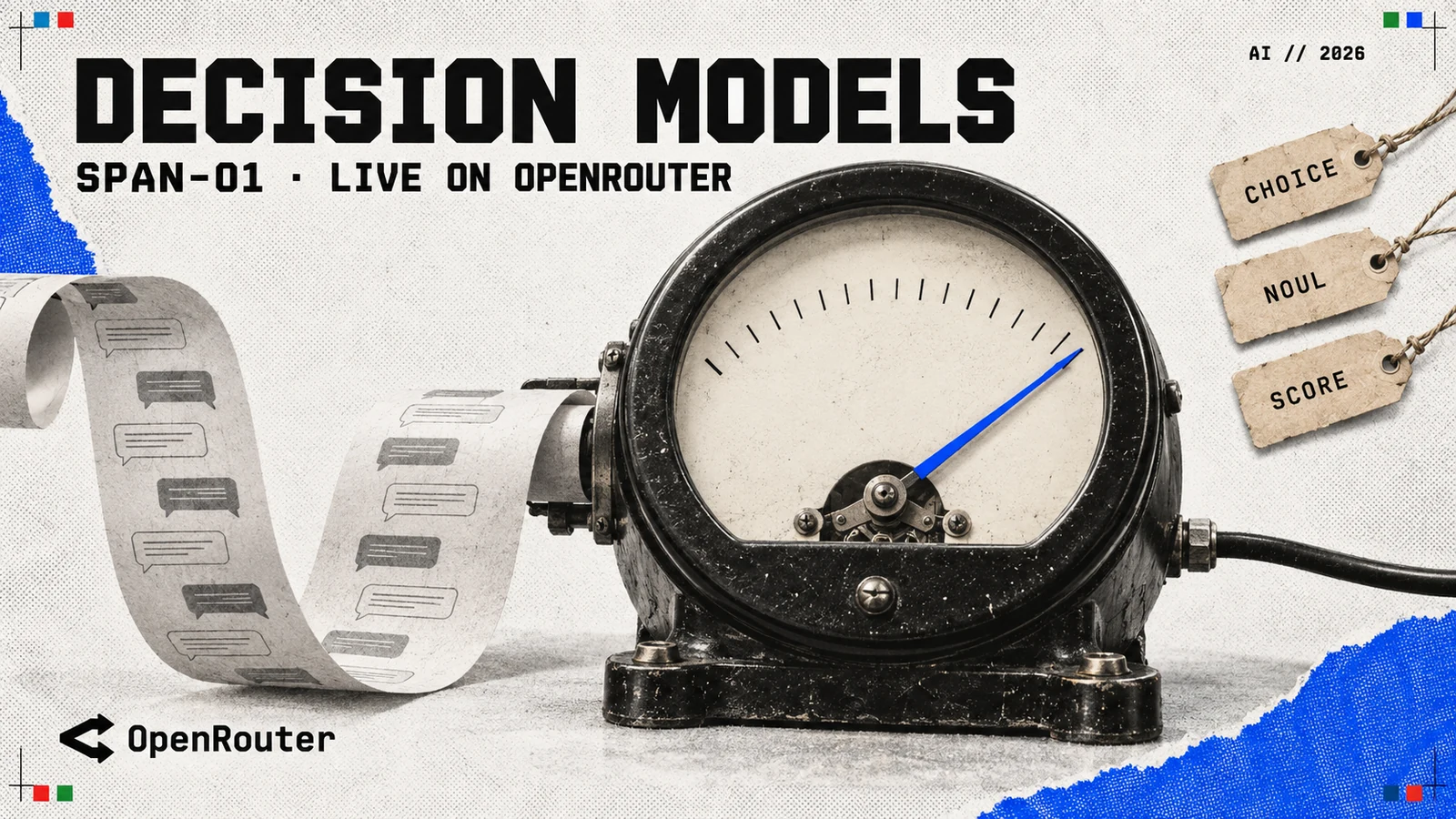
OpenRouter adds Span-01, a decision model that checks AI agents
A decision model reads text and answers set questions with probabilities. Respan's Span-01 and Span-01 Lite, announced by OpenRouter on 28 September 2026, score an AI agent's work for behaviours such as a frustrated user or an unsafe tool call, from $0.02 per million tokens.
More in Large Language Models
All LLMs →- AI model fingerprintscounting tokens across 353 models to see which ones share a lineage
- DeepSeekDeepSeek-V4.1-Flasha 552B open-weight model built around its cache
- AnthropicClaude Haiku 4.5the fast cheap tier
- Google DeepMindGemini 3.8 Flashthe workhorse again, plus a cyber variant behind a gate
- Google DeepMindGemini 4 Argonlonger reasoning, coding and cyber defence
- OpenAIGPT-5.6the flagship from 9 July to 3 September 2026