
Unbiased (Circuit and Chisel)
Pareto 26.10 Preview
one endpoint that runs several models on every request, now 57% to 88% cheaper per token
Key facts
- 1 Oct 2026Unbiased and OpenRouter
- Preview released
- $0.80 / $3.20per M tokens in / out
- Price
- $0.03 / M88% less than 26.9
- Cached input
- 1,048,576tokens, OpenRouter listing
- Context
- 92.4%Unbiased's preliminary run
- GPQA Diamond
- $0.004Unbiased's preliminary run
- Cost per GPQA task
Pareto is a blended AI model: you send one request to one endpoint, several models work on it in parallel, and the system combines their results into one answer. Unbiased, the platform run by the lab Circuit and Chisel, released Pareto 26.10 Preview on 1 October 2026 at $0.80 per million input tokens and $3.20 per million output, against $2.50 and $7.50 for Pareto 26.9. Its first benchmark results are Unbiased's own preliminary runs, which it says may change before final publication.
Pareto is a blended AI model. You send one request to one endpoint, several models work on it at once, and the system combines their results into one answer. Unbiased, the platform run by the lab Circuit and Chisel, released Pareto 26.10 Preview on 1 October 2026, two weeks after Pareto 26.9, at $0.80 per million input tokens and $3.20 per million output.
“Frontier intelligence, zero data retention, and open-source pricing are usually a pick-two. This is all three,” the launch post says. The post calls it a preview that “will continue to improve over the coming week”, and every Pareto 26.10 score on this page is Unbiased’s own preliminary run.
One request, several models
Every Pareto request goes to several models in parallel, and their results are combined according to the task, Unbiased’s documentation says. “You send one request and get one answer. The blend includes frontier and open models.” Unbiased keeps the models’ names private, and says “Model composition can change.”
Routers “read the prompt, estimate its complexity, and pick a single model”, Unbiased’s documentation says; Pareto engages several models on every request, and its home page says it never switches models mid-conversation. Pareto 26.9 first ran on OpenRouter as an anonymous model called Union Alpha, which YFarmX named as Pareto while it was still anonymous, before Unbiased confirmed it.
26.10 costs 57% to 88% less per token than 26.9
Unbiased prices Pareto 26.10 Preview at $0.80 per million input tokens, $0.03 per million cached input and $3.20 per million output, cuts of 68%, 88% and 57% on Pareto 26.9. The same rates appear on its pricing page and on OpenRouter. The launch post sets them against two frontier models:
| Per million tokens | Input | Cached input | Output |
|---|---|---|---|
| Pareto 26.10 Preview | $0.80 | $0.03 | $3.20 |
| Pareto 26.9 | $2.50 | $0.25 | $7.50 |
| GPT-6.1 Sol | $2.00 | $0.10 | $10.00 |
| Claude Fable 5.1 | $10.00 | $0.25 | $50.00 |
“What won’t change: the price won’t go up, and the preview slug won’t break under you,” Unbiased says. Subscriptions run alongside the per-token rate: Personal at $10 a month for 25 million tokens a week, Personal Max at $100 a month for 300 million, and a pay-as-you-go Team plan. When 26.10 leaves preview, Unbiased says the weekly allowances double at the same prices.
Unbiased’s first scores for 26.10
On Unbiased’s preliminary runs of 1 October 2026, Pareto 26.10 Preview scores about the same as 26.9 on all four benchmarks, while each task costs between 17% and 83% less. The figures come from Unbiased’s model card, which says the 26.10 results “may change before final publication” and that the other results “are not independently validated”.
| Benchmark | 26.10 Preview, score and cost a task | 26.9, score and cost a task |
|---|---|---|
| GPQA Diamond | 92.4% at $0.004 | 91.6% at $0.016 |
| Humanity’s Last Exam, text only | 49.9% at $0.008 | 49% at $0.048 |
| DeepSWE v1.1 | 69.9% at $0.24 | 70% at $0.29 |
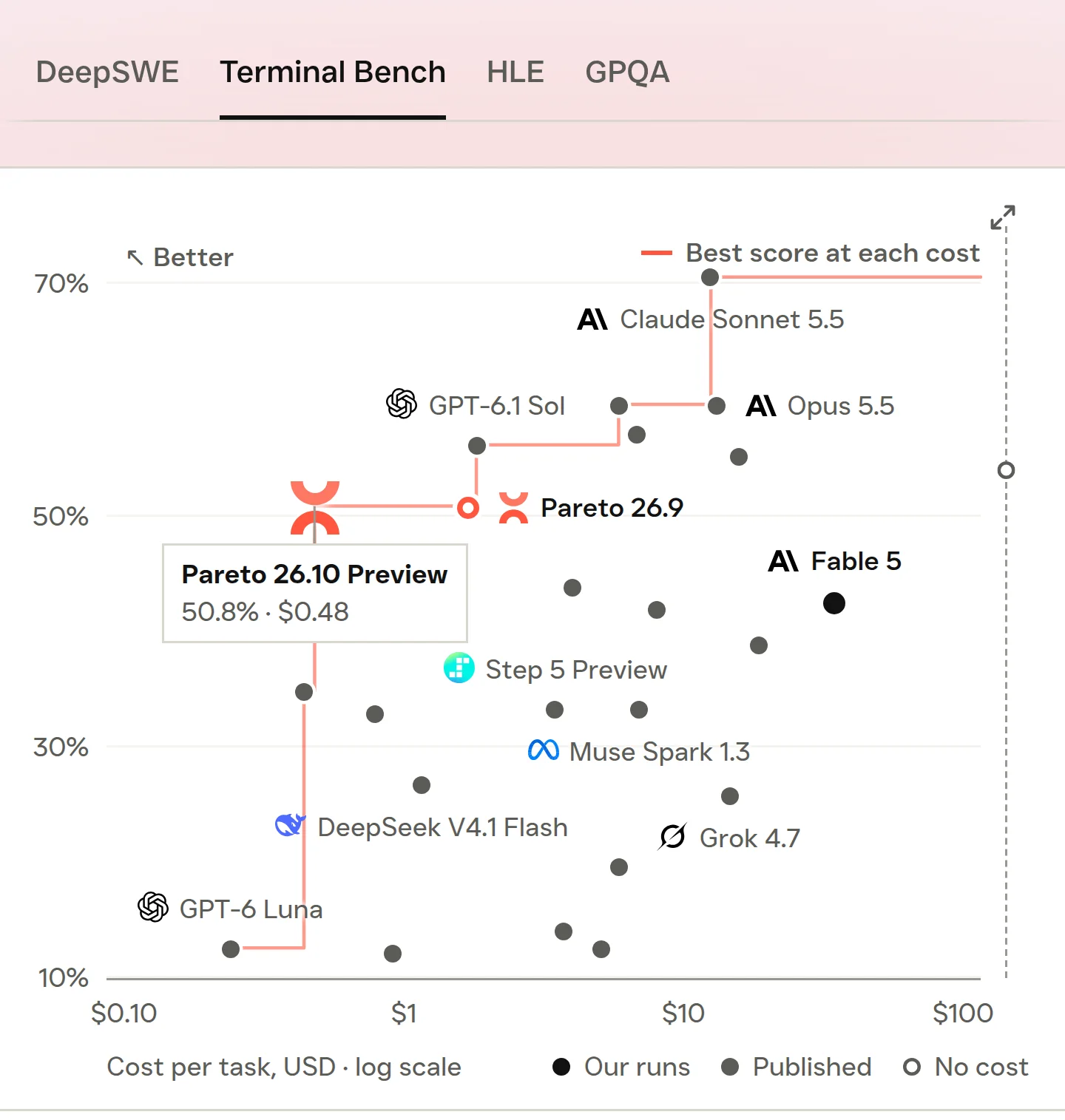
| Terminal-Bench 4.0 | 50.8% at $0.48 | 50.8% at $1.69 |
Unbiased adds that “Denominators and cost methodology require confirmation”, and that its 26.9 DeepSWE result used a 30-task slice of the benchmark.
Its claim is the cost per task
On raw score, Pareto 26.10 Preview sits below the leading models wherever Unbiased lists them; its claim is that no model scores higher for the same cost per task. “In these preliminary results, it matches or sets the Pareto frontier on all of them,” the launch post says, the frontier being the best score available at each price. On Humanity’s Last Exam, OpenAI’s GPT-6.1 Sol scores 52.9% at $0.078 a task, about ten times Pareto’s $0.008 for three more points.
| Benchmark | Pareto 26.10 Preview | GPT-6.1 Sol | Claude Sonnet 5.5 |
|---|---|---|---|
| GPQA Diamond | 92.4 | 95.4 | 95.6 |
| Humanity’s Last Exam, text only | 49.9 | 52.9 | 55.0 |
| DeepSWE v1.1 | 69.9 | 75.2 | 71.0 |
| Terminal-Bench 4.0 | 50.8 | 56.1 | 70.6 |
GPT-6 Astra scores 96.3 on GPQA Diamond, 54.7 on Humanity’s Last Exam, 74.0 on DeepSWE v1.1 and 59.6 on Terminal-Bench 4.0, in Unbiased’s comparison.
The rival scores in that table are other labs’ and evaluators’ published figures, and Unbiased says they “use their own task sets and harnesses, so they are not directly comparable with our runs”.
A full zero-data-retention tier and a bigger window
Pareto 26.10 adds “a full zero-data-retention tier”, and Unbiased says all of its OpenRouter and Cloudflare traffic runs on it. Its terms, effective 24 September 2026, say traffic on that tier will have no prompt or response content retained or accessed after inference. Other traffic can be kept for up to 30 days, the terms say.
OpenRouter’s listing gives the preview a context window of 1,048,576 tokens, four times 26.9’s 262,144, with output capped at 131,072 tokens, and lists text and image input with tool use. Unbiased says 26.10 has “Lower latency across the board”, with “the biggest gains” on long agentic runs.
How to get it
Pareto 26.10 Preview runs on Unbiased’s own API and platform, where the changelog says “The model string stays pareto”, and on OpenRouter as unbiased/pareto-26.10-preview. OpenRouter’s listing advises using Pareto 26.9 for stable behaviour while the preview changes. Unbiased reviews and approves new accounts by hand. For the models Pareto measures itself against, see GPT-6 Sol and Luna, GPT-6 Astra and Claude Sonnet 5.5.
Questions people ask
- What is Pareto 26.10?
- Pareto 26.10 Preview is the October 2026 version of Pareto, a blended AI model sold by Unbiased and built by the lab Circuit and Chisel. Every request is sent to several models in parallel, frontier and open ones, and their results are combined into a single answer. Unbiased released the preview on 1 October 2026 and says it will keep improving over the following week.
- How much does Pareto 26.10 cost?
- Unbiased prices Pareto 26.10 Preview at $0.80 per million input tokens, $0.03 per million cached input tokens and $3.20 per million output tokens. Pareto 26.9 cost $2.50, $0.25 and $7.50, so the new rates are 68%, 88% and 57% lower. Subscriptions start at $10 a month for 25 million tokens a week.
- How good is Pareto 26.10?
- On Unbiased's own preliminary runs of 1 October 2026, it scores 92.4% on GPQA Diamond, 49.9% on Humanity's Last Exam (text only), 69.9% on DeepSWE v1.1 and 50.8% on Terminal-Bench 4.0. Unbiased describes these as preliminary and not independent validation. On raw score it sits below the leading models it compares itself with; its claim is the cost per task.
- Which models does Pareto use?
- Unbiased's documentation says several models, frontier and open ones, work in parallel on every request and that the composition can change. That sets it apart from a model router, which picks one model per prompt. Unbiased keeps the models' names private.
More in Large Language Models
All LLMs →- AI model fingerprintscounting tokens across 353 models to see which ones share a lineage
- OpenAIGPT-6 Sol and Lunathe mid-price and budget GPT-6 models, released 22 September 2026
- AnthropicClaude Sonnet 5.5faster everyday coding and office work at Sonnet prices
- OpenAIGPT-6 Astrathe new generation, rolling out from 3 September 2026
- Google DeepMindGemini 4 Argonlonger reasoning, coding and cyber defence
- OpenAIGPT-5.6the flagship from 9 July to 3 September 2026