
Reflection AI
Beam
A sparse model with an October open-weight release planned
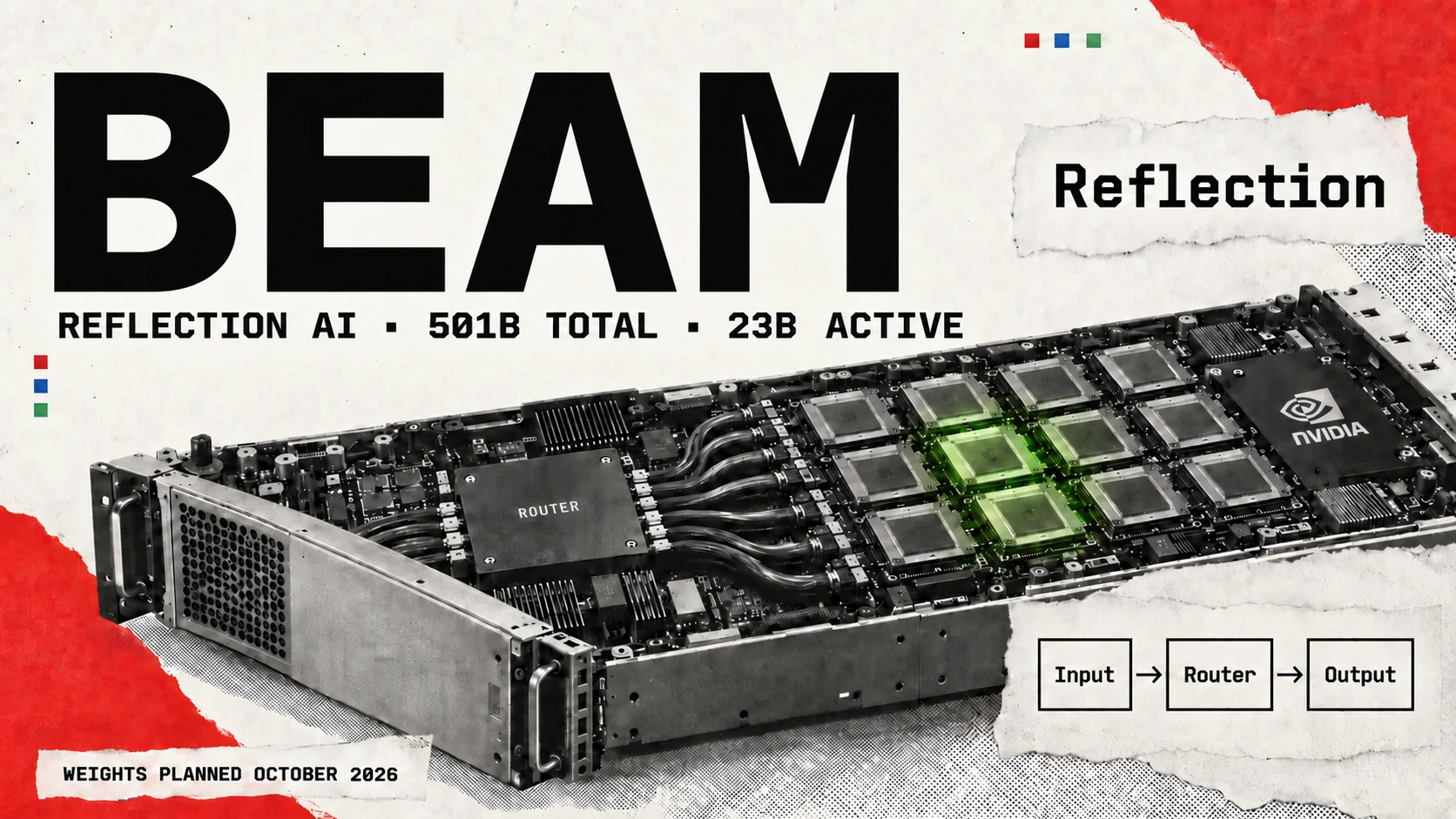
Key facts
- 501B
- Total parameters
- 23B
- Active per token
- October 2026
- Weights planned
- Apache 2.0
- Planned licence
Beam is an AI model for writing code, solving problems and using software tools. Reflection announced it on 5 October 2026, with downloadable weights planned later that month.
Listen to the model guide
Podcast: Beam's size and compute claims
Beam is an AI model for writing code, solving problems and taking actions through software tools. Nvidia-backed Reflection AI announced it on 5 October 2026, with an open-weight release planned for October.
An open-weight release provides the model’s learned numerical settings so developers can run and adapt it. Early access to Beam currently opens through Reflection’s waitlist.
How does a mixture of experts work?
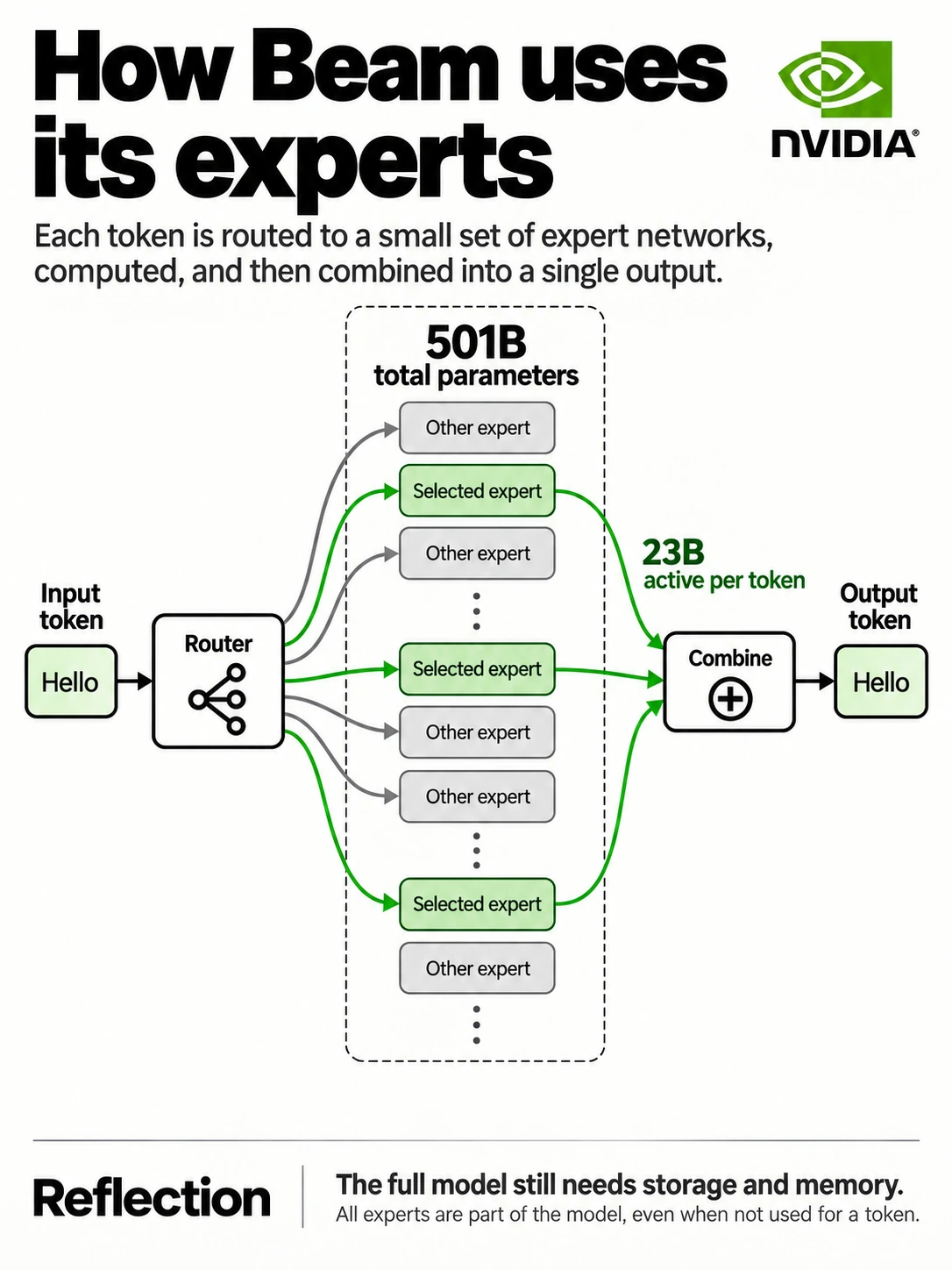
A mixture-of-experts model routes each token, a piece of text, through selected parts of its network. Nvidia’s explanation describes a learned router that activates a subset of expert subnetworks for each token.
Beam has 501 billion total parameters and 23 billion active per token. That split lets a large model use a smaller share of its network at each step.
The full set of weights still needs storage and memory. Deployment also has to handle routing and communication between processors. For a team planning to host a model, active parameters help explain computation; total parameters help explain the size of the system it has to accommodate.
How does Beam compare with GLM-5.2?
Reflection’s launch table reports the following selected scores. These are the company’s published comparisons; each row uses a different evaluation.
| Evaluation | Beam | GLM-5.2 |
|---|---|---|
| DeepSWE v1.1 | 44.4 | 44.0 |
| Terminal Bench v2.1 | 80.1 | 81.0 |
| GPQA Diamond | 90.5 | 91.2 |
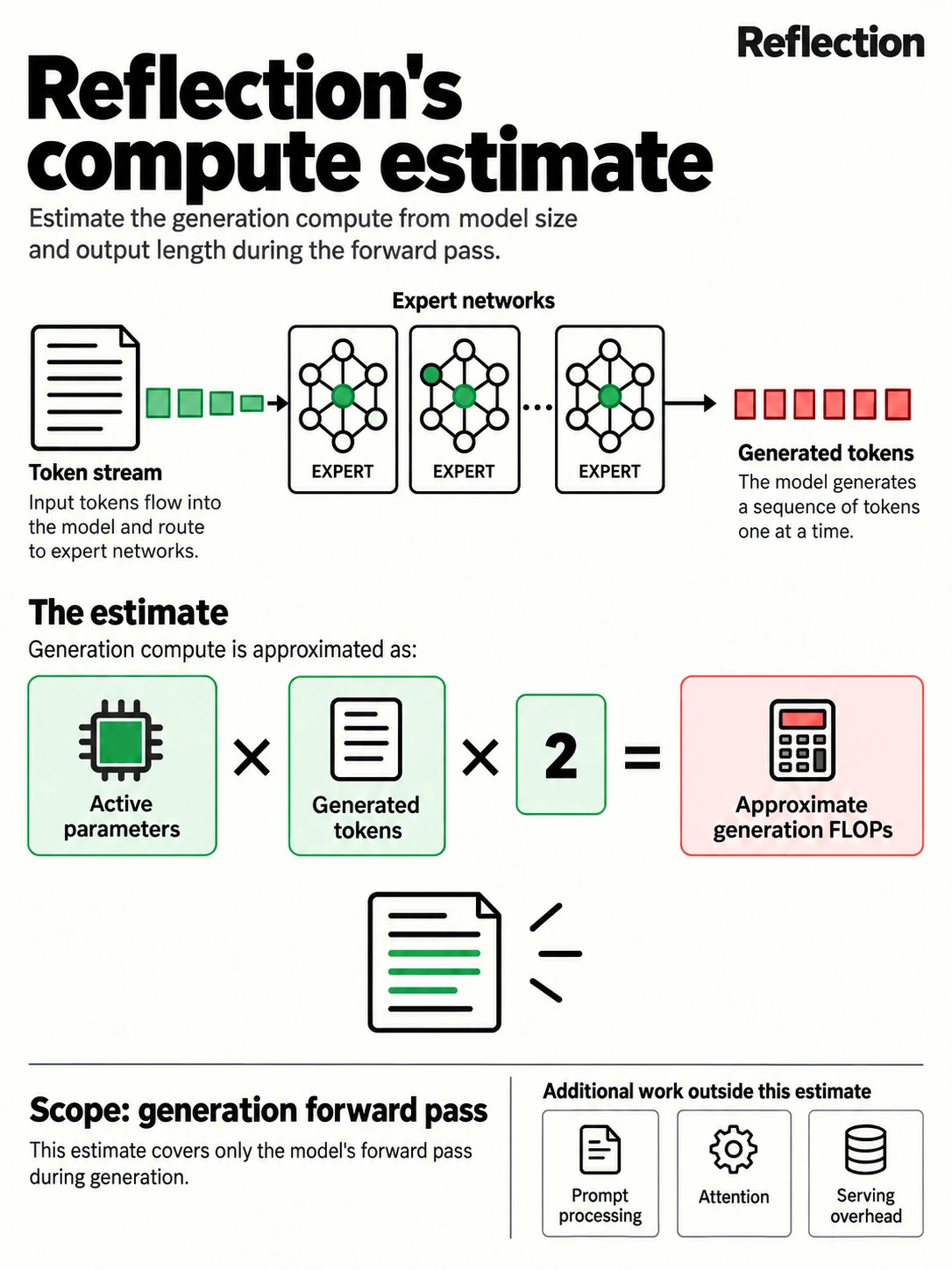
Reflection claims comparable advanced-reasoning performance with three to four times less estimated inference compute. Its estimate multiplies active parameters by generated tokens and two operations per multiply-add. The calculation covers generation’s forward pass; prompt processing, context-dependent attention and serving overhead sit outside that estimate.
For developers comparing models, the useful next step is a repeatable test on their own codebase, tools and response-length settings. Record success rates, elapsed time, token use and the resources consumed by the complete task.
What will the Apache 2.0 release allow?
Reflection plans to publish Beam’s weights under Apache 2.0 later in October 2026. That is the announced release timetable.
The Apache licence permits use, modification and distribution, including commercial use, subject to its conditions. Redistribution includes providing the licence, retaining required notices and marking changed files. The licence also contains a patent grant and warranty terms.
Teams choosing an open-weight model can control their hosting environment and adapt the weights. They take responsibility for the deployment, its resources and how its tools access other systems.
Who is behind Reflection?
Reflection was founded in 2024 by former DeepMind researchers Misha Laskin and Ioannis Antonoglou. Reuters reported in October 2025 that the Nvidia-backed company raised $2 billion at an $8 billion valuation. Those figures describe that funding round.
Beam’s announcement gives developers a model to assess for coding and tool-based work. The scheduled weight release will give hosting teams the files they need to test those claims on their own systems.
More in Large Language Models
All LLMs →- Z.ai / ZhipuGLM-5.2strongest open-weight all-rounder before K3 landed
- Moonshot AIKimi K3the largest open-weight model yet released
- DeepSeekDeepSeek-V4.1-Flasha 552B open-weight model built around its cache
- Google DeepMindGemini 4 Argonlonger reasoning, coding and cyber defence
- OpenAIGPT-5.6the flagship from 9 July to 3 September 2026
- OpenAIGPT-6 Astrathe new generation, rolling out from 3 September 2026