
NEAR cross-chain tools
Quotes, authorisation and asset delivery
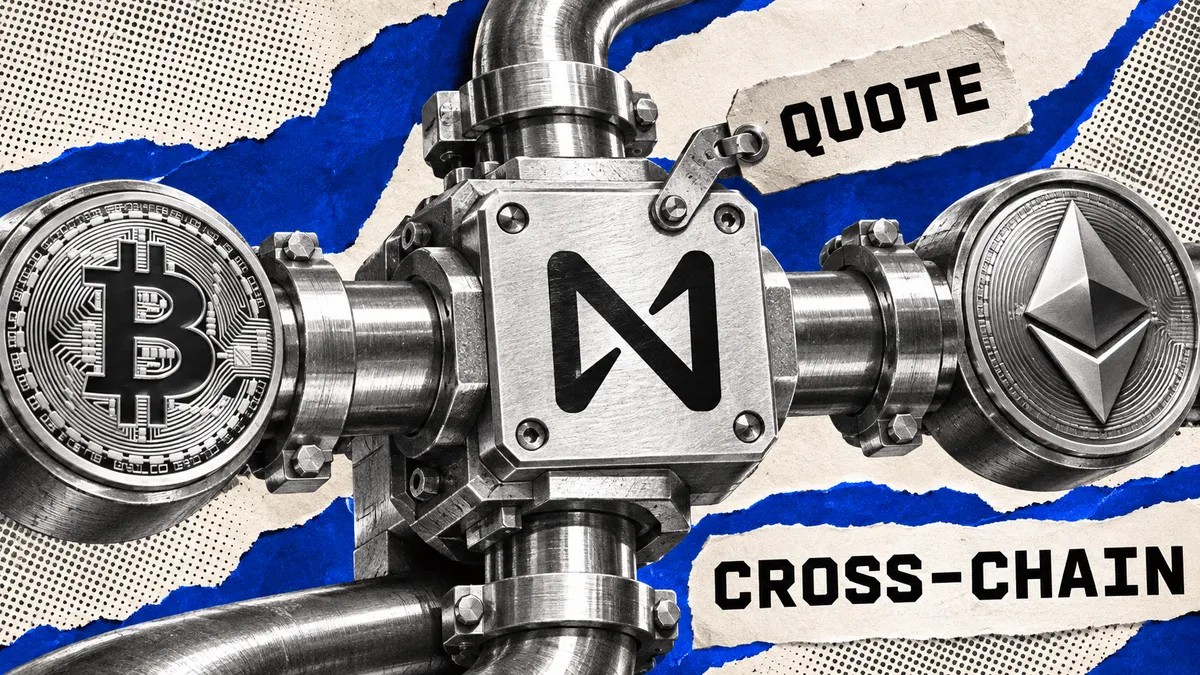
Chain abstraction means hiding some of the work of using several blockchains. In NEAR’s toolkit, Intents handles requested outcomes, Chain Signatures handles authorisation on other chains, and bridges handle asset movement.
Intents starts with the result
With an intent, a user specifies an outcome such as receiving a particular asset on a chosen network. Solvers, also called market makers, compete off-chain to fulfil the request. The selected quote is presented for approval, and an accepted intent is verified and settled through a contract on NEAR. Review the destination asset, amount, network, expiry and refund terms before approval.
Follow a cross-chain swap
Imagine exchanging an asset on one network for a stablecoin on another. The user specifies the outcome and reviews a quote. A solver provides the exchange, while the relevant contracts and transfer infrastructure handle settlement and delivery. The interface combines those steps. The recipient still needs the intended token contract on the intended destination network.
How NEAR Intents works. Chain abstraction.
Chain Signatures supplies authorisation
Chain Signatures lets a NEAR account, including a contract account, request a signature for a transaction on another blockchain. A multiparty computation service produces that signature collectively, so a threshold of operators must cooperate. The external transaction then needs to be submitted and processed on its destination chain. Signing a transaction is separate from proving what happened on another chain.
OmniBridge moves assets
OmniBridge supports transfers between networks using a hybrid design. Its documentation lists different inbound verification methods for different routes, including light clients, Wormhole and MPC verification, combined with Chain Signatures. A bridge’s security assumptions therefore need to be checked for the particular route. A token’s ticker alone cannot establish its origin or backing.
OmniBridge routes and verification.
What the simpler interface still depends on
A cross-chain action can involve a quote service, solver, verifier contract, signing service, bridge and destination network. A user should establish where funds sit while a request is pending and how a failed or expired request is handled. Compare the final amount delivered, rather than treating the source network’s gas fee as the whole cost.
How NEAR Intents works. Chain Signatures. OmniBridge routes and verification.
More Crypto
All Crypto →
NEAR Intents, a simple way to move value across chains
NEAR Intents collapses multi-chain busywork into one signed request.
Chainlink’s CCIP: The Backbone of Cross-Chain Innovation
Chainlink’s CCIP is reshaping DeFi, payments, and gaming with cross-chain interoperability.

How Bitget's $387.5 million hack unfolded
An attacker stole $387.5 million from Bitget on 24 September 2026, in Ethereum, XRP, Bitcoin, Zcash and stablecoins. Below, we follow the money from the exchange through swaps, bridges, coinjoins and Zcash's shielded pool, with every transaction on the public chain.