What we know about DeepSeek V4.1 Pro
DeepSeek's V4.1 research describes specialist teachers, AI teamwork and training on workplace failures. Together, they suggest how the next Pro could handle bigger projects.
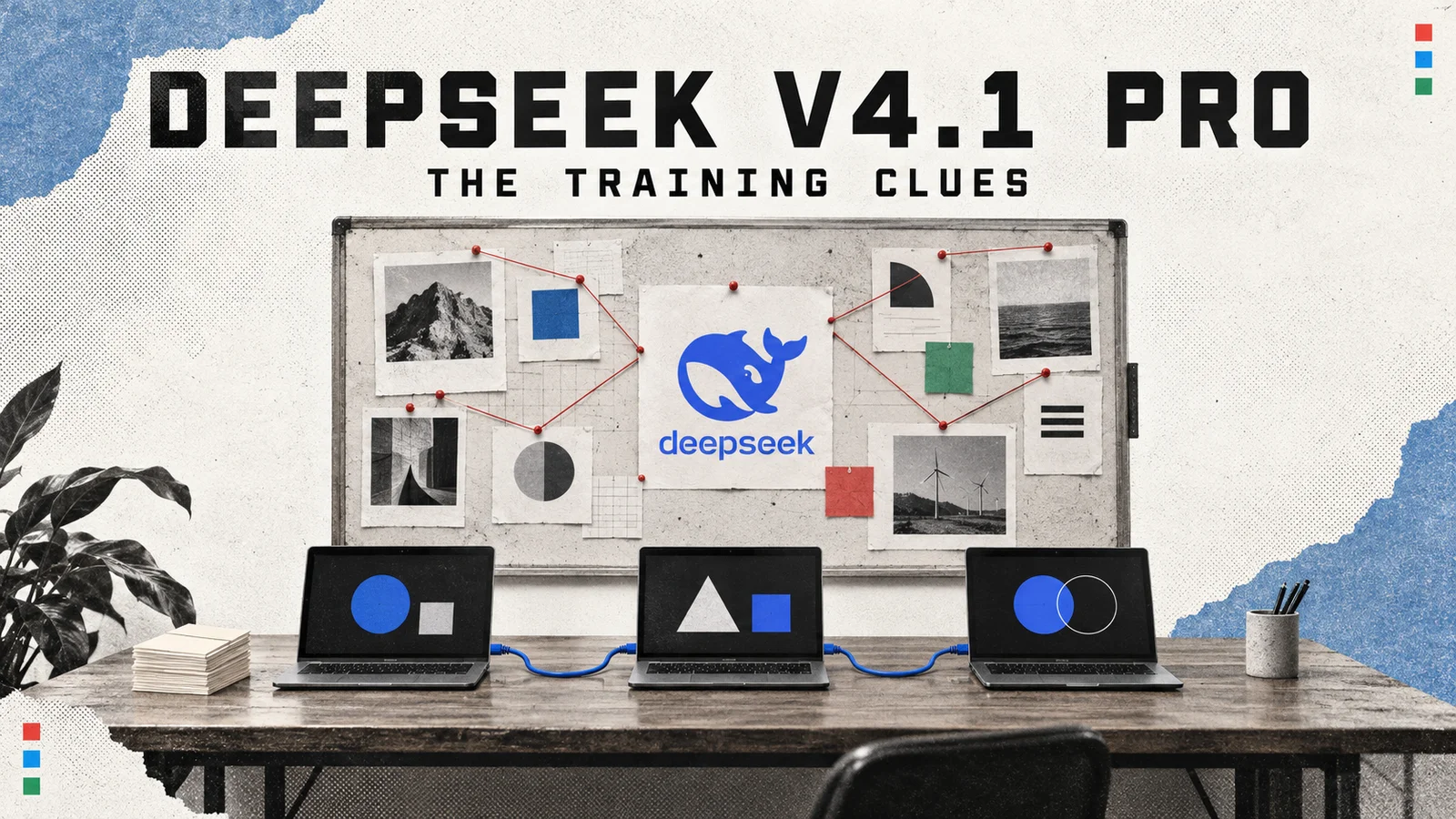
DeepSeek V4.1 Pro could take on harder projects by coordinating several AI assistants, each responsible for part of the work. That is our reading of the research behind V4.1 Flash, the first released member of DeepSeek’s new model family.
DeepSeek explicitly names the forthcoming Pro in its 10 September launch announcement, and describes Flash as the family’s smallest model, designed to scale. The published training and engineering results concern Flash and its supporting systems. Their combination into Pro is the forecast.
Flash learned from over 40 teacher models
DeepSeek trained V4.1 Flash using more than 40 teacher models, selected for different subject areas. Those teachers can have different architectures and come from different stages of development. Their guidance helps train one model with a broader set of skills. Technical report, section 5.2.4.
For a user, the attraction is continuity: an assistant that can help with the research, writing and coding involved in one assignment. Our expectation is that Pro will build on this approach to specialist training.
DeepSeek is teaching AI assistants to work together
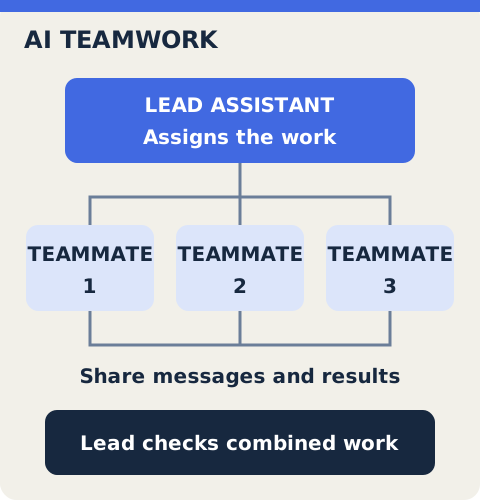
DeepSeek’s Agent Team experiments let a lead assistant delegate tasks, exchange messages with teammates and check their combined work. Training rewards collaboration and penalises delays along the sequence of work that determines completion time. Technical report, section 5.3.5.
Consider a website project: one assistant could investigate a problem, another implement a fix and a third test it. Useful teamwork means sharing discoveries, respecting dependencies and checking that the pieces fit. That is the kind of coordination this training targets.
Failed workplace tasks become practice exercises
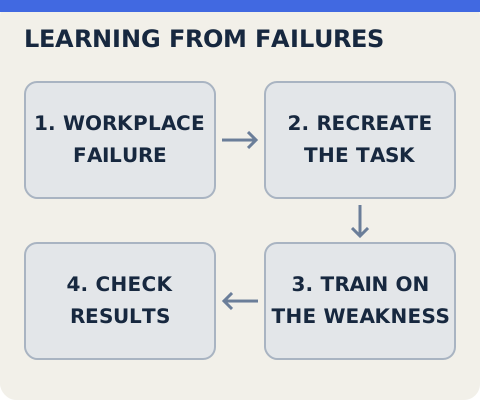
DeepSeek collects employee-submitted failures, recreates the tools and interactions involved, and trains against the weaknesses exposed. The exercises reproduce circumstances from real workflows. Technical report, section 5.1.1.
That creates a practical feedback loop. A difficult assignment can become something future training repeatedly tests. For someone handing over work, the useful improvement would be an assistant that handles the awkward steps between receiving a request and delivering a checked result.
Extra memory capacity creates room for bigger jobs
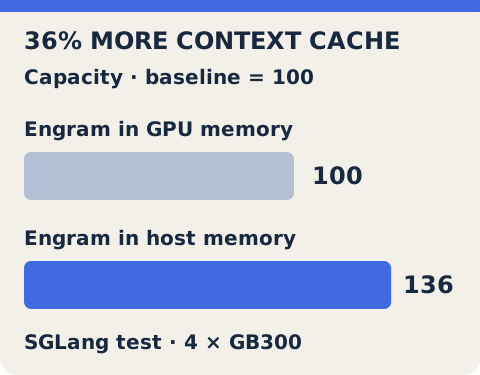
SGLang engineers found a way to give V4.1 Flash more space for ongoing tasks. Its Engram component stores learned information in large lookup tables. Moving those tables from GPU memory into the computer’s main memory freed capacity for the context cache, which stores information used while processing a request.
Their four-GB300 test reported:
| Measurement | Result |
|---|---|
| Capacity available for the context cache | 36% higher |
| Output speed and time to the first token | Comparable to the baseline |
| Test completions matching the baseline | All 28 |
The engineers stress that the best arrangement depends on the hardware and workload. Extra cache capacity could accommodate longer contexts or more simultaneous requests. That is useful infrastructure for a project with several assistants, each carrying its own instructions and results.
Pro could coordinate harder projects
Our prediction is that DeepSeek V4.1 Pro will push further into substantial assignments that benefit from specialist skills and coordinated assistants. Imagine handing over a project brief and receiving work that has been divided, completed and checked as a whole.
DeepSeek’s stated direction is to scale model capacity, training data and reinforcement learning together. The existing work on teaching, teamwork, failure practice and memory capacity gives that ambition a practical foundation. Technical report, conclusion.
For the released model’s specifications and access options, see our DeepSeek V4.1 Flash guide.