DeepSeek plans at least 160,000 Huawei Ascend chips in Inner Mongolia
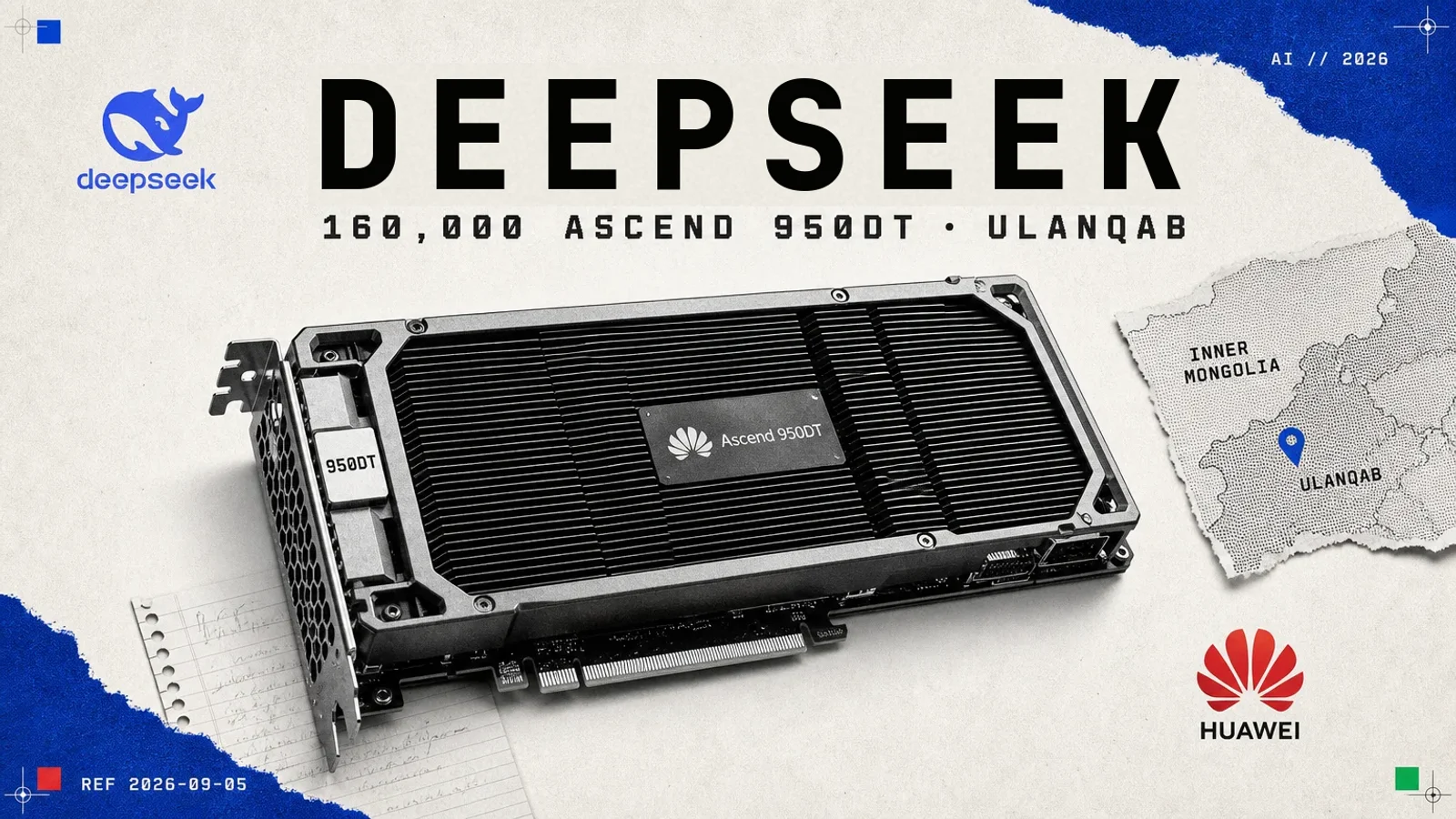
Bloomberg says DeepSeek wants at least 160,000 of Huawei's Ascend 950DT accelerators for a data centre at Ulanqab in Inner Mongolia. Huawei sells that chip for decode and training. DeepSeek's plan uses it for decode, and keeps Nvidia for the training runs.
Listen to this articleListen
Bloomberg reported on 4 September that DeepSeek intends to install at least 160,000 of Huawei’s Ascend 950DT accelerators at a data centre it is building at Ulanqab, in Inner Mongolia. The report attributes the plan to unnamed people, puts delivery at more than a year, says shortages of high-bandwidth memory will hold 950DT output to the low hundreds of thousands across this year, and says DeepSeek has asked Beijing to help persuade Huawei to allocate more chips to it, and sooner. DeepSeek intends to run its models on those chips, and to keep training them on Nvidia.
As of 5 September that report is the only account of the order, and both companies have left it to stand on its own. The chip, the site and the rule that governs the alternative are all documented, so those are the parts a reader can check.
What Huawei sells the 950DT for
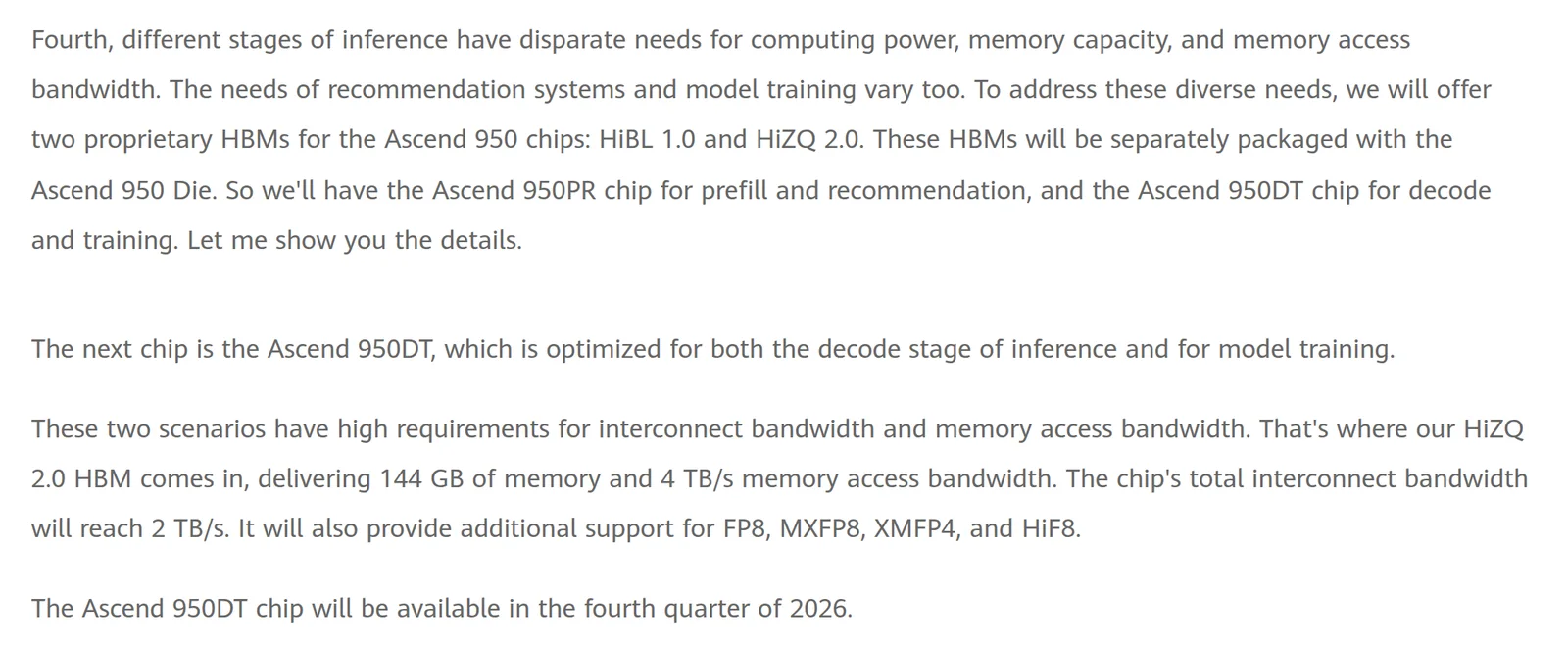
Huawei’s rotating chairman Eric Xu set out the Ascend roadmap in his keynote at Huawei Connect 2025 in Shanghai on 18 September 2025. He split the 950 generation across two parts on a shared die: “So we’ll have the Ascend 950PR chip for prefill and recommendation, and the Ascend 950DT chip for decode and training.”
The DT part is the one DeepSeek is reported to want. In Xu’s words it “is optimized for both the decode stage of inference and for model training”, and its specification is built around the bandwidth those two jobs need: Huawei’s own HiZQ 2.0 memory, 144GB of it, 4TB/s of memory access bandwidth and 2TB/s of total interconnect. He dated it to the fourth quarter of 2026.
| Ascend part | Job Huawei names for it | Memory | Availability |
|---|---|---|---|
| Ascend 950PR | Prefill and recommendation | HiBL 1.0 | Q1 2026 |
| Ascend 950DT | Decode and model training | HiZQ 2.0, 144GB at 4TB/s | Q4 2026 |
| Ascend 960 | Training and inference | Twice the 950’s capacity and bandwidth | Q4 2027 |
| Ascend 970 | Training and inference | Specs still being set, bandwidth at least 1.5x the 960 | Q4 2028 |
Both 950 parts carry 2TB/s of interconnect, which Xu put at 2.5 times the Ascend 910C, and both deliver 1 PFLOPS in FP8 and 2 PFLOPS in MXFP4.
Why does the training stay on Nvidia?
Because the two workloads break differently when the hardware is unfamiliar. A training run is one job held together across every chip for weeks: a fault, a numerical difference or a slow collective anywhere in the cluster propagates into the run, and a restart costs whatever was between checkpoints. Serving a model is thousands of short independent requests, so a chip that is a little slower or a little quirkier costs latency on some fraction of them and nothing else. The cheapest place to prove new silicon is therefore the serving fleet.
DeepSeek’s published numbers show what the training side has cost it so far. Its V3 technical report records a cluster of 2,048 Nvidia H800 GPUs, 2.788 million GPU hours in total, and a figure of $5.576m at an assumed $2 per GPU hour. Its later work, including DeepSeek V4, has stayed on that side of the house.
The serving side, by contrast, already has Ascend history, and Huawei is the one that said so. Xu opened the same 2025 keynote by crediting DeepSeek for the year Huawei had just had: “Huawei Cloud has worked around the clock to support DeepSeek’s fast-growing user base and traffic. Between January and April 30, our AI R&D teams worked closely to make sure that the inference capabilities of our Ascend 910B and 910C chips can keep up with customer needs.”
The site sits inside a hub Beijing designated in 2021
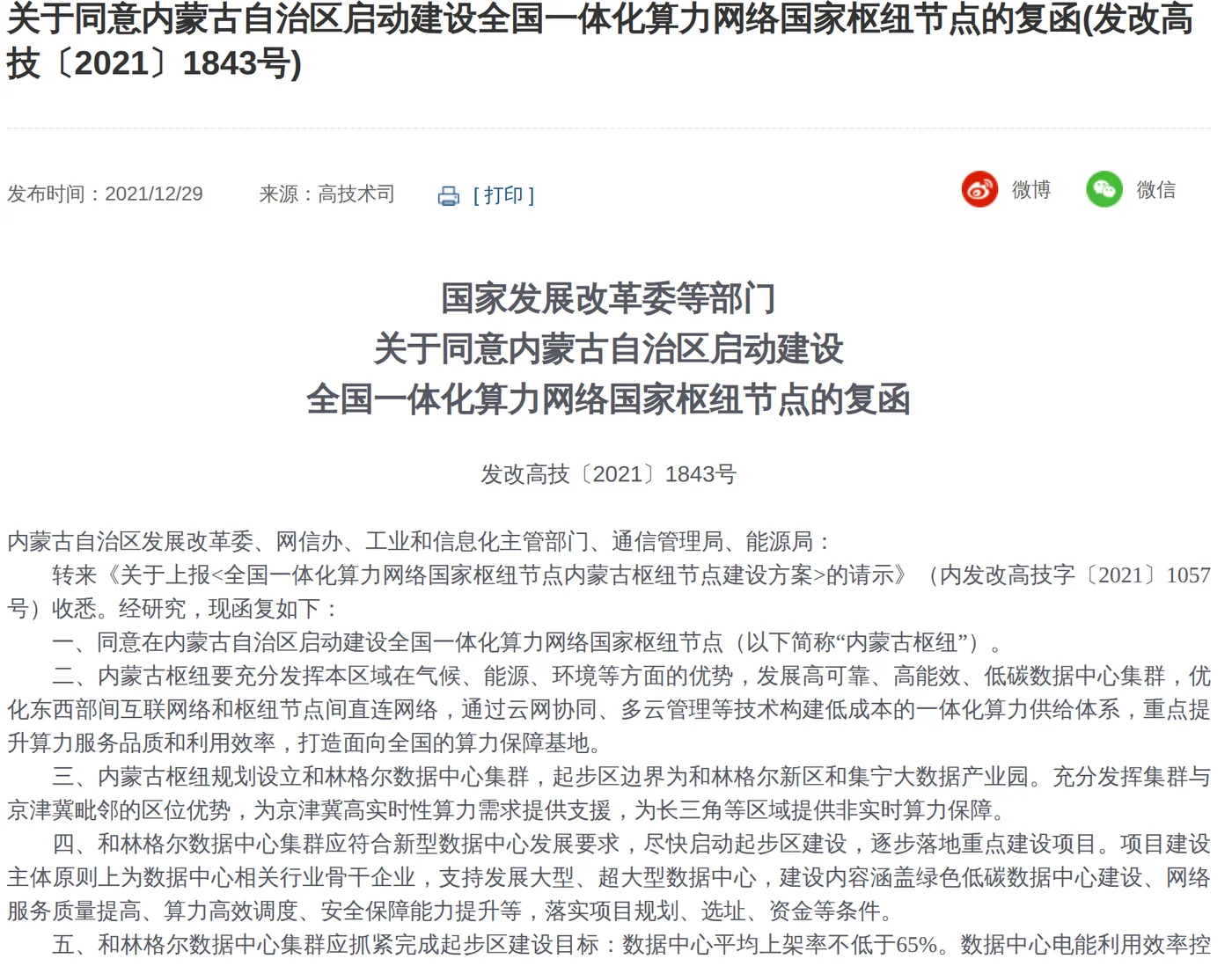
Ulanqab is not an improvised location. On 29 December 2021 the National Development and Reform Commission published reply 发改高技〔2021〕1843号, agreeing to start construction of a national hub node of the integrated national computing network in the Inner Mongolia Autonomous Region. The reply plans a Horinger data centre cluster whose start-up zone is bounded by the Horinger New Area and the Jining Big Data Industrial Park, Jining being Ulanqab’s central urban district. It sets the cluster two hard numbers: average rack occupancy of at least 65 per cent, and power usage effectiveness held below 1.2.
The document also states the reasoning, which is climate and energy rather than proximity: the hub is to use the region’s advantages in climate, energy and environment to build low-carbon data centre clusters, serving Beijing-Tianjin-Hebei for latency-sensitive work and regions such as the Yangtze River Delta for everything else.
Other companies are building at gigawatt scale in the same city, on their own account. Envision announced on 6 August 2026 that it had commissioned its own Galaxy Campus at Ulanqab, a 120,000 square metre site designed to scale beyond 2GW and to support up to one million AI accelerators, which its own release puts at one million PFLOPS of AI compute at full build-out. “The next frontier of AI is infrastructure,” Ricky Zheng, general manager of Envision’s AIDC, said in that announcement. “As AI models become larger and more compute-intensive, the limiting factors are increasingly power availability, network performance and energy efficiency.” That release is Envision’s own project and names no customer and no chip supplier, so it stands beside DeepSeek’s reported plan rather than behind it. What the two share is the city, and the reason to be in it.
The scale, measured in Huawei’s own units
Huawei sells the 950DT in pods. Its Atlas 950 SuperPoD, dated to the same fourth quarter of 2026, holds up to 8,192 Ascend 950DT chips across 160 cabinets and about 1,000 square metres, and 64 of those pods make an Atlas 950 SuperCluster of more than 520,000 chips rated at 524 EFLOPS in FP8.
Put the reported order into those units and it is a little under twenty Atlas 950 SuperPoDs, or roughly 30 per cent of one SuperCluster. On Huawei’s per-chip figure of 1 PFLOPS in FP8, 160,000 chips come to about 160 EFLOPS. Those three are our arithmetic on Huawei’s published numbers rather than figures Huawei or Bloomberg has printed.
The constraint Bloomberg names is memory. High-bandwidth memory is the part of an accelerator China has had the hardest time sourcing, which is why Huawei packaged its own HiZQ 2.0 with the 950 die in the first place, and an order of this size sits against a year’s output rather than a quarter’s.
What the US rule currently allows
Nvidia is available to Chinese buyers on narrow terms. A BIS final rule effective 15 January 2026, published at 91 FR 1684, moved exports of certain accelerators to China and Macau from a presumption of denial to case-by-case review. The rule draws the line by performance rather than by product name: it covers commodities with a total processing performance below 21,000 and total DRAM bandwidth below 6,500 GB/s, “such as the NVIDIA H200 or AMD MI325X”.
Four conditions come with it. The rule requires that the chip is commercially available in the United States when the rule publishes, and that the exporter certifies sufficient US supply, that production for export to China will not divert foundry capacity from US customers, that the recipient has demonstrated sufficient security procedures, and that the item passes independent third-party testing in the United States to verify its performance. Anything above those two thresholds stays under a presumption of denial.
That is the route by which any new Nvidia silicon reaches a Chinese buyer now, and Washington can narrow it whenever it chooses. DeepSeek’s own published training hardware, the 2,048 H800s of the V3 report, was bought long before the rule existed. A serving fleet on domestic chips holds its value on those terms: it is the half of the workload that keeps running when a licence is refused.
How far the evidence goes
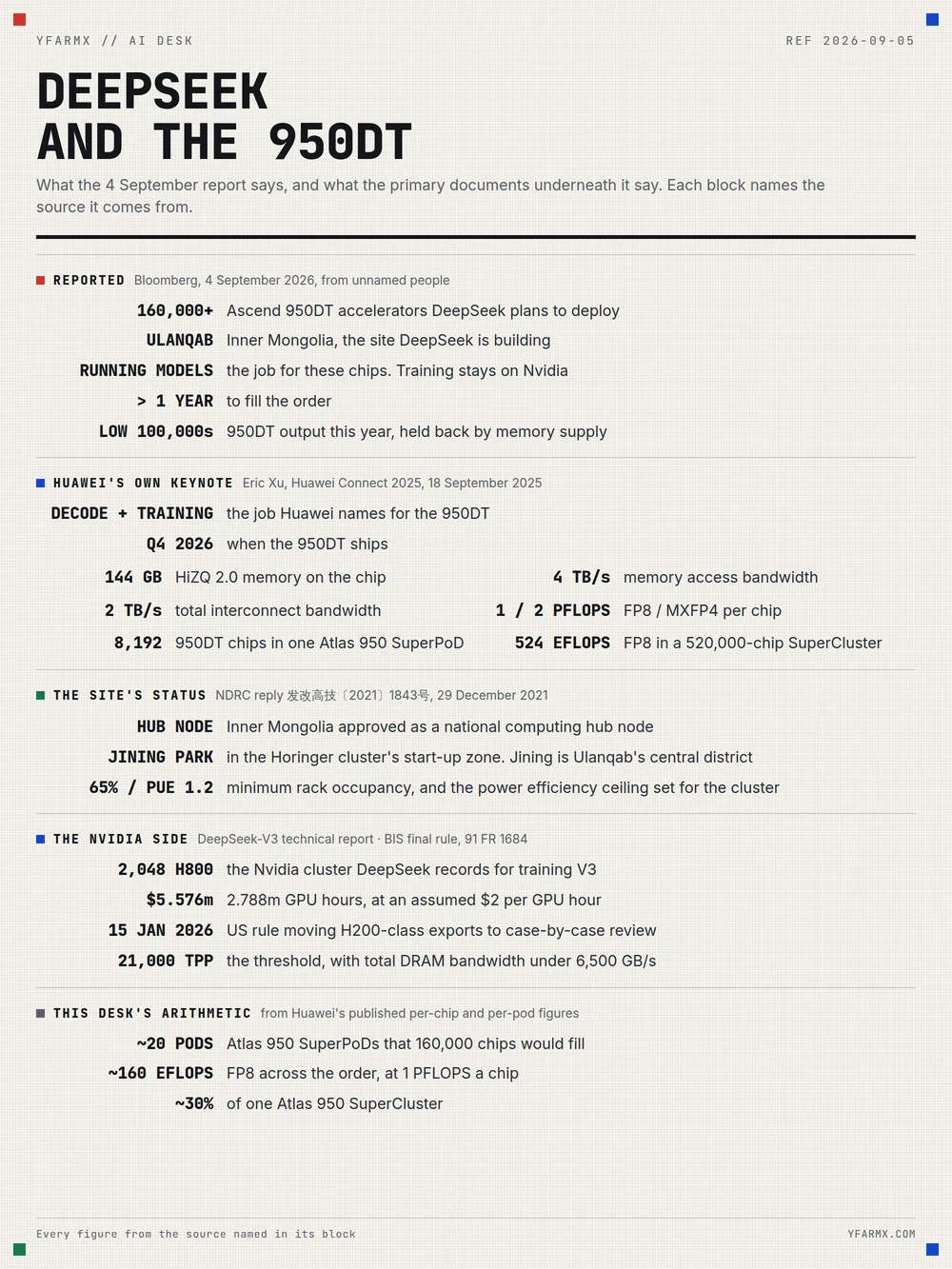
The chip count, the location, the split between serving and training, the delivery timetable, the memory constraint and the approach to Beijing all rest on Bloomberg’s 4 September report and its unnamed sources. Everything under them is documented: the 950DT’s design, specification and ship quarter come from Huawei’s own published keynote; Ulanqab’s status as part of a national computing hub comes from the NDRC’s own reply; the training figures come from DeepSeek’s own technical report; and the licensing position comes from the Federal Register. Bloomberg.com answers a datacentre request with a 403, so this desk read the report through pickups carrying its wording rather than from the page itself.
Memory supply decides whether this becomes a cluster
Huawei has a chip designed for exactly the job DeepSeek wants done, dated to a quarter that starts next month, sold in pods that would take twenty of themselves to fill the order. Memory sets the pace from here: HiZQ 2.0 output governs how many 950DTs exist at all, which is why Bloomberg’s delivery window runs past a year, and why, on the same report, DeepSeek has asked Beijing to help persuade Huawei to allocate it more chips and sooner.
The test from here is industrial. Huawei has already shown it can carry DeepSeek’s traffic on Ascend, and said so in its own keynote. Whether it can hand one customer the better part of a year’s production of its newest part, while every other Chinese buyer wants the same silicon, is the question the fourth quarter answers.
Sources
- Bloomberg: DeepSeek Plans Big Huawei AI Chip Order to Power New Data Center (4 September 2026)bloomberg.com
- Huawei: Groundbreaking SuperPoD Interconnect, keynote by Eric Xu, Huawei Connect 2025huawei.com
- NDRC reply 发改高技〔2021〕1843号 approving the Inner Mongolia national computing hub nodendrc.gov.cn
- BIS final rule, Revision to License Review Policy for Advanced Computing Commodities, 91 FR 1684federalregister.gov
- Department of Commerce revises license review policy for semiconductors exported to Chinabis.gov
- DeepSeek-V3 Technical Report (arXiv:2412.19437)arxiv.org
- Envision commissions Galaxy Campus in Ulanqab (6 August 2026)prnewswire.com