
DeepSeek
DeepSeek V4
the open-weight price disruptor
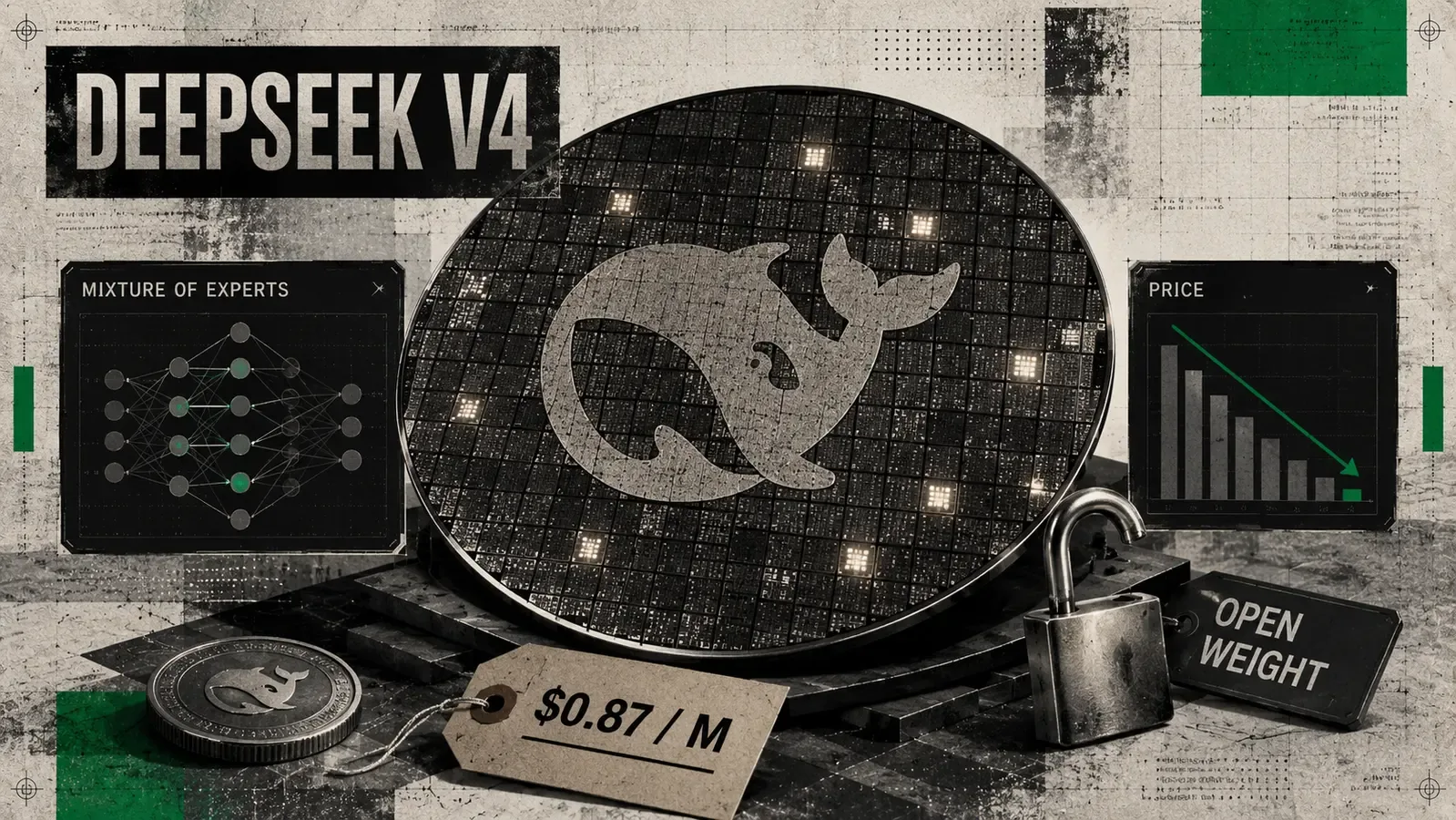
Key facts
- 1.6Ttotal, 49B active
- Parameters
- 284Btotal, 13B active
- Flash tier
- 1Mtokens
- Context
- $1.98 / $3.96per M out, off-peak / peak
- Price
- 24 Apr 2026open-sourced
- Released
- Open weightPro & Flash
- Licence
The open-weight price disruptor. V4 Preview released and open-sourced 24 April 2026.
What it is
DeepSeek V4 is the open-weight release that has done most to push down the price of frontier-grade AI in 2026. DeepSeek released the V4 Preview and open-sourced it on 24 April 2026, in two sizes: DeepSeek V4 Pro, with 1.6 trillion total parameters and 49 billion active at any one time, and V4-Flash, at 284 billion total and 13 billion active. Both carry a one-million-token context window, putting long-document work within reach even at the lower end of the range.
Two later releases grew out of this preview: V4-Flash-0731 entered public beta on 31 July 2026, and the Pro tier reached general availability on 13 August 2026 as DeepSeek V4 Pro, which now has its own page. The GA launch carried a pricing change with it. At 16:00 UTC on 16 August 2026 the flat $0.87 per million output rate ended, and the API moved to peak and off-peak billing: deepseek-v4-pro output now costs $1.98 per million off-peak and $3.96 at peak, and the then-current deepseek-v4-flash launched at $0.66 off-peak and $1.32 at peak, with peak set at 01:00 to 04:00 and 06:00 to 10:00 UTC, Monday to Friday, with weekends and Chinese public holidays billed off-peak throughout (DeepSeek pricing). The Flash line also gained an experimental image-input variant, DeepSeek-V4-Flash-Vision-Exp, released on 21 August 2026 at the same prices as V4-Flash, which DeepSeek’s changelog pitches at agent tasks needing visual understanding. No weights have been published for it. Both Flash models were retired on 10 September 2026, when DeepSeek V4.1 Flash took over the tier on a new causal encoder-decoder backbone under an MIT licence, and both legacy names began routing to it. Current V4.1 Flash output costs $0.60 per million tokens off-peak and $1.20 at peak.
How the mixture-of-experts design works
The gap between total and active parameters is the key to how DeepSeek V4 keeps costs down. Like other modern large models, V4 is a mixture-of-experts design: only a fraction of its parameters fire for any given token, so V4-Pro runs with 49 billion of its 1.6 trillion parameters active at a time. That is what lets a very large model be served cheaply, because the compute per query tracks the active count rather than the full total.
The two-model split is itself a statement of intent. V4-Pro is the capability play, a very large system meant to compete near the top of the field, while V4-Flash, at 284 billion total and 13 billion active parameters, is the smaller sibling built to run faster and cheaper for high-volume work. Offering both, and open-sourcing them together, lets DeepSeek cover everything from demanding reasoning down to routine, cost-sensitive tasks from a single release. The “Preview” label on V4 also signals that a more polished version is expected to follow. DeepSeek has kept iterating on the smaller sibling in the meantime: a post-training update, V4-Flash-0731, arrived on 31 July 2026 with stronger agent capabilities at the same address and price.
Efficiency engineering
DeepSeek has pushed that efficiency further with a set of new techniques. The model uses a hybrid attention scheme combining what it calls Compressed Sparse Attention and Heavily Compressed Attention, alongside Manifold-Constrained Hyper-Connections. The pay-off shows up at long context: at one million tokens, DeepSeek says V4-Pro needs only 27% of the inference compute and 10% of the memory cache of the previous V3.2. Cutting the cost of long-context inference so sharply is the sort of engineering that makes cheap pricing sustainable rather than a loss-leading stunt.
Capability and price
On capability, DeepSeek positions V4 as open-source state of the art for agentic coding at launch, the multi-step, tool-using work that has become this year’s competitive front line. On world knowledge, the company says V4 trails only Gemini 3.1 Pro across all the models it compared, open or closed. Those are DeepSeek’s own claims and await independent confirmation, but they place DeepSeek V4 unusually close to the closed flagships for a freely available model. Agentic coding is a demanding test in particular, because it asks a model to plan, call tools and correct itself over many steps rather than answer in a single shot, so leading the open-source field there is a claim with real weight behind it.
Price is where the release bites. Output ran at around $0.87 per million tokens from launch, which made DeepSeek V4 the cheapest of the frontier-adjacent set by a wide margin. That flat rate has since gone: from 16 August 2026 the Pro tier bills at $1.98 per million output off-peak and $3.96 at peak, while the current V4.1 Flash service costs $0.60 and $1.20. Its uncached input rates are $0.15 and $0.30, with cached input at $0.003 and $0.006. For developers, that changes the arithmetic of building on a capable model, and it puts pressure on the premium labs to justify charging many times more. Because the weights are open, users can also run the model on their own hardware rather than pay per token at all, an appealing option for anyone with data they would rather not send to a third party.
What to watch
In the wider field, DeepSeek V4 stands as the clearest expression of the open-weight, low-price challenge to the closed US labs. The combination of near-flagship claims, genuine efficiency engineering and pricing far below the incumbents is what makes the release significant. The tests to watch are independent benchmarks and whether the peak and off-peak split spreads to the other cheap open-weight APIs. For the wider picture, see our large language models hub and broader AI coverage.
More AI
All AI →
DeepSeek V4 on Huawei chips would mark a serious shift in China’s AI hardware stack
Reports that DeepSeek V4 will run entirely on Huawei chips point to more than supply-chain improvisation. They suggest China’s AI stack is becoming more vertically coherent under pressure.
More in Large Language Models
All LLMs →- Google DeepMindGemini 4 Argonlonger reasoning, coding and cyber defence
- OpenAIGPT-5.6the flagship from 9 July to 3 September 2026
- OpenAIGPT-6 Astrathe new generation, rolling out from 3 September 2026
- OpenAIGPT-6.1 Solthe upgraded mid-price GPT-6 model, released 29 September 2026
- OpenAIGPT-6 Sol and Lunathe mid-price and budget GPT-6 models, released 22 September 2026
- AnthropicClaude Opus 5.5the first Claude 5.5 model, cheaper and faster than Opus 5