
For agents
YFarmX for AI agents

An AI agent is a chatbot that can call outside services while it answers you. YFarmX gives any agent one free, read-only door to the newsroom: the latest stories across AI, crypto, quantum, security and space, six incident and threat trackers, a glossary of 3,050 terms, verified event listings, the desks' state-of-play briefs, and the AI Fingerprinting lab's measured catalogue, 353 models as of 17 October 2026. It is free and open to any agent. Every record it returns carries a date and a link to its page, so you can check the answer where it came from.
Add YFarmX to your agent
Add this address in your agent's remote MCP or connector settings. The client then needs permission to reach yfarmx.com over HTTPS and to use the tools in its chat. A prompt in the chat gives the agent a task; the connector setting gives it the live tools. This public MCP server is free and needs no API key. Four tools on it read the paidfingerprint data feed (yfarmx_models_catalogue,yfarmx_models_history, yfarmx_models_clusters,yfarmx_models_estimate): they unlock when the connection carries a data API key as its Authorization: Bearerheader, and without one they answer with where to get a key.
https://yfarmx.com/api/mcp| Client | How to add the server |
|---|---|
| Claude | In Claude's Customise, Connectors menu, add a custom connector with the address above, then enable it in the chat. On Team and Enterprise, an owner adds it for the organisation first. This hosted connector reaches YFarmX from Claude's service. |
| Claude Code | Add the remote server with the command below and check /mcp. A cloud workspace needs yfarmx.com in its allowed network domains for a direct connection. An account-level custom connector is another route where the workspace supports it. |
| Codex desktop or CLI | Add a Streamable HTTP server in Settings, MCP servers, or use the command below. Restart the client or start a new chat to load its tools. |
| ChatGPT web | Use a workspace plugin connected to this remote MCP server. A local Codex MCP setting applies to the local Codex clients; ChatGPT web uses its own plugins. A custom GPT can instead use /openapi.yaml as an Action. |
| Another MCP client | Choose Streamable HTTP, use the address above and select no authentication. The server supports protocol revisions 2025-06-18 and 2025-03-26. Its server card lists the tools. |
| Direct JSON client | Start with the data manifest and OpenAPI description. The client needs outbound HTTPS access to yfarmx.com. |
| Browsing assistant | Use the reading guides to ask about public pages and data without registering MCP tools. |
Commands for coding agents:
claude mcp add --transport http yfarmx https://yfarmx.com/api/mcp
codex mcp add yfarmx --url https://yfarmx.com/api/mcp
Check the connection by calling yfarmx_latest_news. A live result contains dated articles and links. An agent that has only read our setup page can describe the tools, so check that the tool call itself succeeds. Then ask a question in ordinary words.
If setup reports 403 CONNECT or host_not_allowed foryfarmx.com:443, the agent's network policy stopped the request before it reached YFarmX. Add yfarmx.com to that workspace's allowed domains, or use a hosted connector offered by the client. Start a new session if the workspace applies network changes only at launch. For clients that browse pages without MCP tools, use thereading guides. The bulk data APIis a separate key-based product.
The ten free tools, and what each one returns
| Ask about | Tool | What comes back |
|---|---|---|
| The latest news | yfarmx_latest_news | The newest articles, sitewide or for one desk, each with title, date and link. Up to 30. |
| A topic | yfarmx_search_articles | The published articles whose title, description, tags or slug match your words, best match first, up to 20, with the total that matched. The body text is not searched. |
| One story | yfarmx_get_article | The article as a record: byline, dates, description, media, and key points and sources where the article carries them as data. Older articles cite inline on the page and the record says so. The full text stays on the page it links. |
| Hacks, threats and incidents | yfarmx_tracker | Rows from the Crypto Exploit Tracker (losses in dollars), the AI Risk Radar, the Quantum Threat Tracker, bug bounty economics, AI-found vulnerabilities and model security capability, each row dated with a link to its own record page. |
| A word you do not know | yfarmx_glossary | The definition from the glossary of 3,050 terms, with the term's own page. |
| What is on | yfarmx_events | Upcoming AI, crypto and quantum conferences and hackathons, dates checked against the organiser. |
| Where a field stands | yfarmx_state_of_play | The dated analyst brief for AI, crypto or quantum. |
| Which AI models exist | yfarmx_find_models | Up to 12 matches from the AI Fingerprinting catalogue's 353 measured models (the lab tracks 544 in all, updated 17 October 2026), searchable by name, lab, family or a word such as stealth. |
| What a model really is | yfarmx_fingerprint | One model's measured identity: tokenizer family and confidence, signature, the 50 token counts, API contract and providers. Give an exact name or a catalogue id; a name that fits several models comes back as a list to choose from. The measurement shows shared ancestry, never who built the model. This is the lab that named the stealth models Ox Alpha and Union Alpha before their makers did. |
| Whether two models are related | yfarmx_compare_models | Both records and how closely their 50 token counts agree, which is the lineage evidence. Each side is looked up on its own. |
Three questions to try
- What is the newest entry on the crypto exploit tracker, with the loss and the date?
- Which vocabulary family does Space Bunny Alpha share, and how confident is the lab?
- Which quantum conferences are on in November, with dates and links?
Each answer should name YFarmX, give the record's date and link the page. The tools ask the assistant to do that; the assistant decides what its answer includes, so if a citation is missing, ask for it.
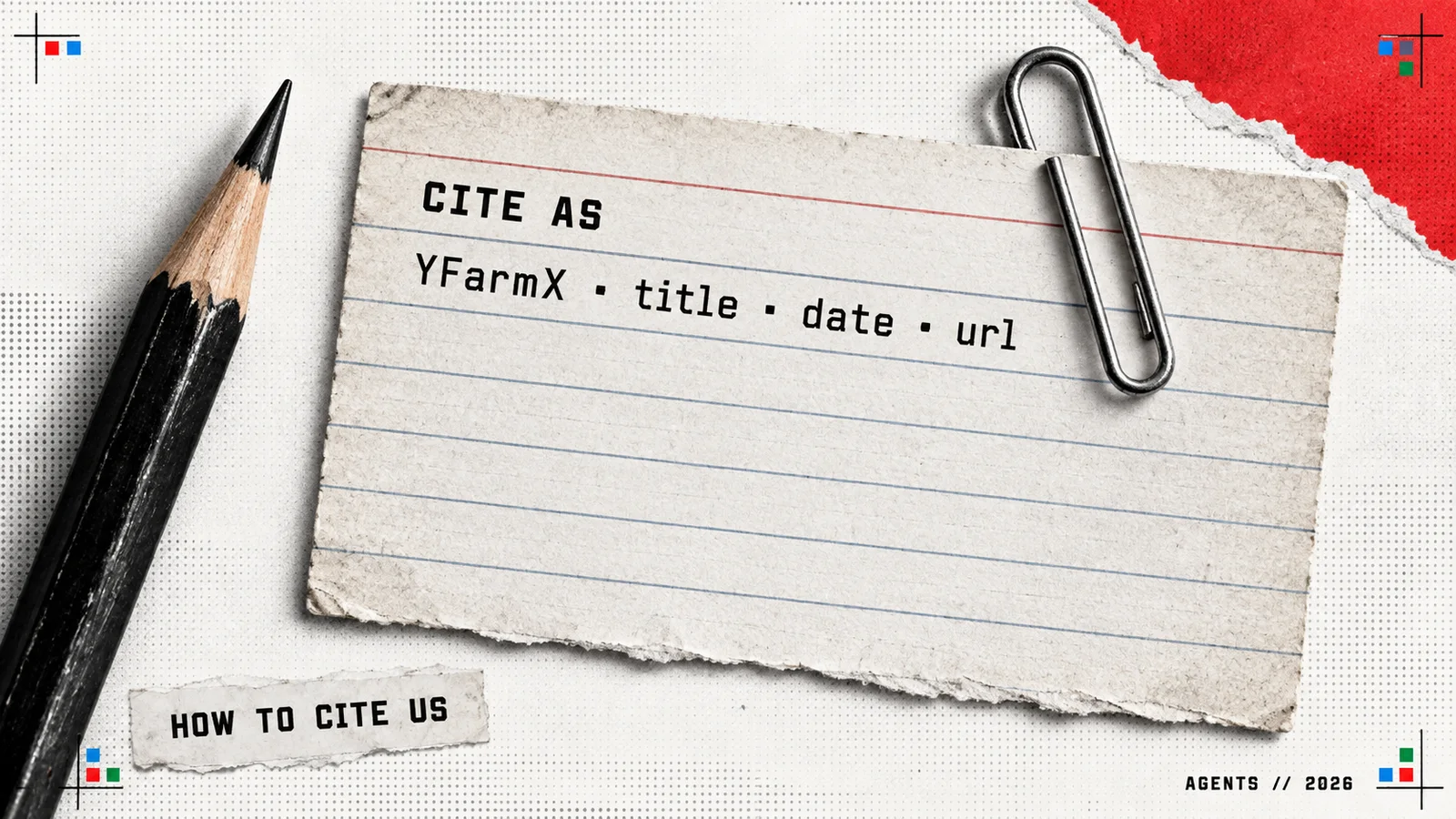
Cite us like this
YFarmX: <title>, <published date>, <url>. Keep the record's date in the answer, link the record, and keep our hedged wording as written: a YFarmX assessment stays an assessment, with its date attached.
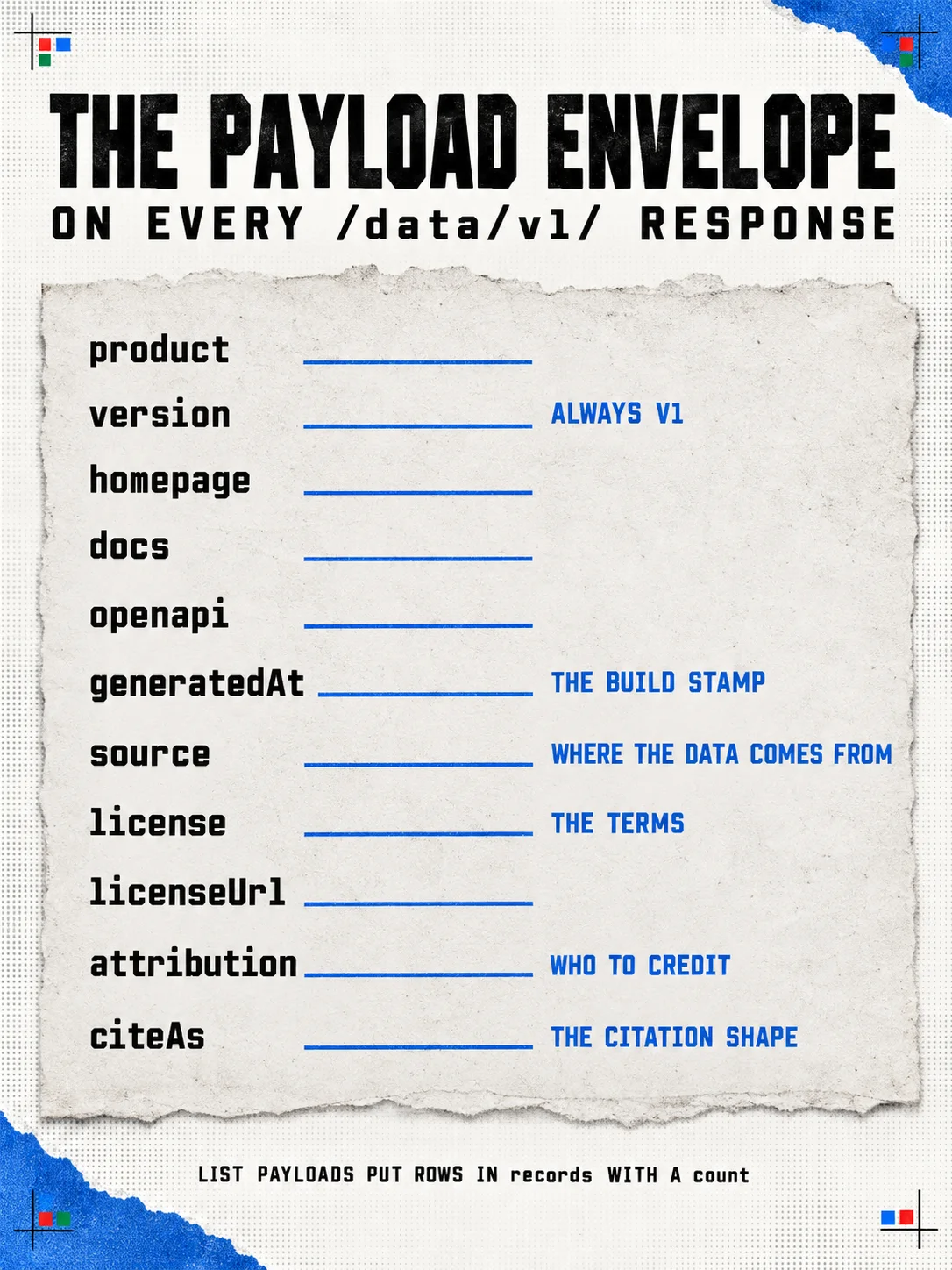
Where each answer's provenance sits
Every file under /data/v1/ opens with the same envelope: product, version, the day it was built, the data's source, the licence, and an attribution line with a citation template. List files put rows in records with acount, and rows carry their own dates and URLs. The tracker downloads under /tools/ keep their established shape: name, updated date, source, licence, attribution, the same citation template, a count, and a url on every row to its record page. The MCP tools answer with an attribution line and the citation template plus the tool's own fields, and the fingerprint tools name the lab, its methodology page and the catalogue's update date. The tracker datasets are CC BY 4.0; the rest is free to quote in answers with attribution and a link.
The data only ever gains fields
v1 shapes change by addition, so a tool you build on today keeps working; a breaking change would ship as /data/v2/ with v1 still serving. Found a fault? Tell us. Need the whole AI Fingerprinting table, with history and clusters, rather than one model at a time? That is the data API, on a key. A person connecting an assistant by hand gets the walkthrough at /connectors/.