Alibaba
Qwen-Image-2.1
one small model for making pictures and editing them
Key facts
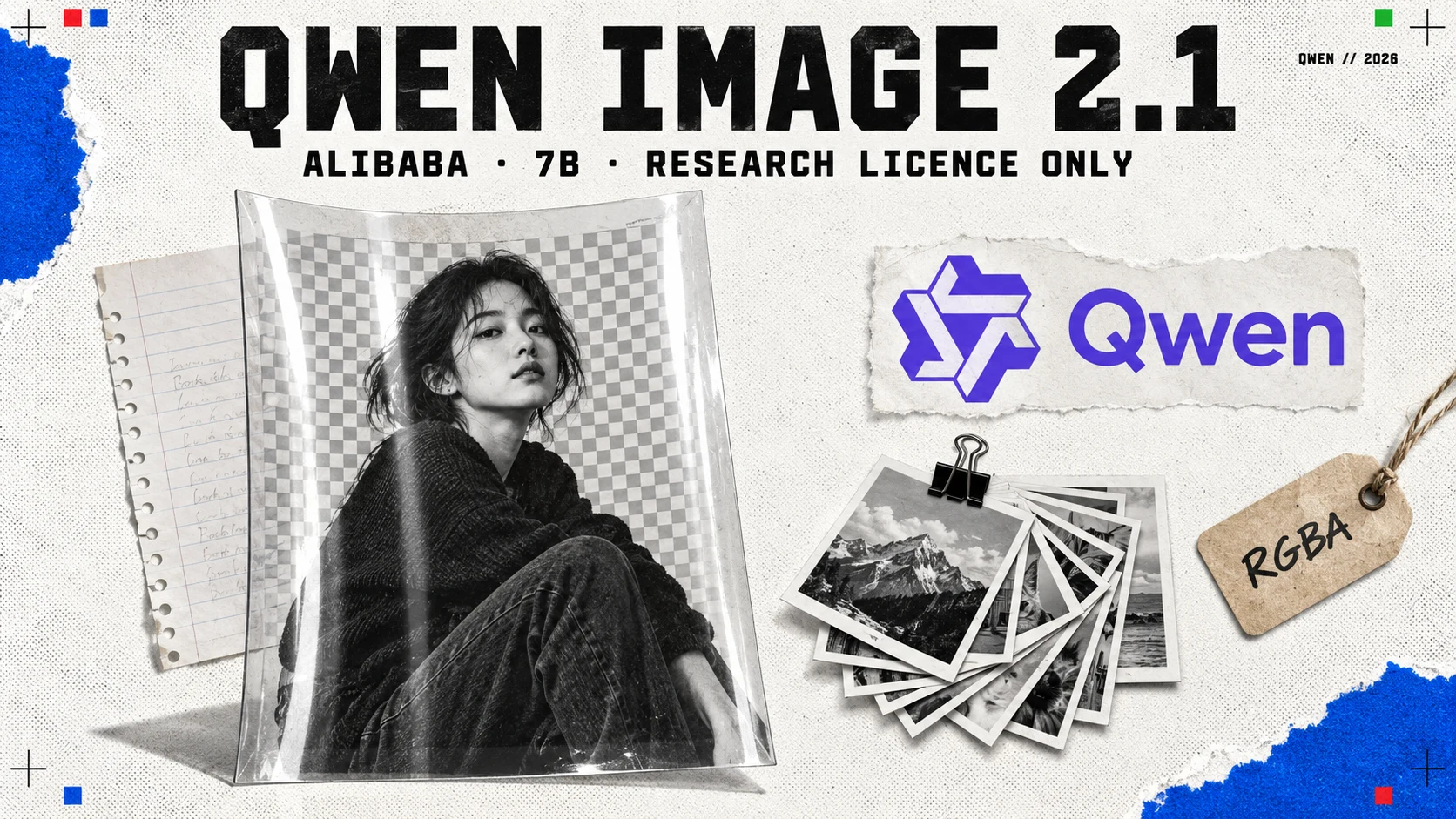
- 20 Sep 2026weights same day
- Released
- 7B32 DiT layers
- Generator size
- 2K nativeseven aspect ratios
- Output
- Up to 10in one edit
- Reference images
- Native RGBAno cut-out step
- Transparency
- Research onlyno commercial use
- Licence
Qwen-Image-2.1 is an image generator you can download and run on your own hardware. It makes a picture from a written description, edits a picture you hand it, and can produce the subject on a transparent background so it drops straight into a design. The generator is small for what it does, at 7 billion parameters, and Alibaba's own tests rank it above every other open-weight image model. The catch is the licence: research and evaluation only, where the previous Qwen-Image was Apache 2.0.
What Qwen-Image-2.1 is
Qwen-Image-2.1 is an image model from Alibaba’s Qwen team, published on 20 September 2026. Give it a written description and it draws the picture. Give it a picture and an instruction and it edits that picture. Ask for a transparent background and it returns a PNG with a real alpha channel, so the subject sits on nothing and can be dropped onto any design without a cut-out step.
One model does all three jobs, which is the point of the release. Alibaba’s own summary: “a unified text-to-image generation and image editing model in the Qwen family”. The weights are published in full on Hugging Face and ModelScope.
The 7 billion parameters are the drawing component alone. A working pipeline also loads a Qwen3-VL 8B text encoder and the autoencoder, so the memory a run actually needs is larger than the headline figure, and Alibaba ships a CPU offload switch, enable_model_cpu_offload(), for cards that cannot hold it all.
Output is native 2K across seven aspect ratios, from 2,048 by 2,048 square to 2,752 by 1,536 at 16:9, and the default is 40 denoising steps.
The licence permits research and evaluation only
Qwen-Image-2.1 ships under the Qwen Research License Agreement, dated 20 September 2026, and its grant of rights is limited to non-commercial use. The licence defines “Non-Commercial” as “for research or evaluation purposes only”, and section 2b reads: “You shall not use the Materials for any commercial purpose without obtaining a separate commercial license from us.” Commercial licences are requested from Hangzhou Tongyi Laboratory Technology Co., Ltd at [email protected].
This is a change of terms from the model it follows. Qwen-Image, published in August 2025, carries an Apache 2.0 tag on Hugging Face, which places no restriction on commercial use at all. Anyone who adopted the earlier model on the strength of that licence is looking at a different bargain here.
Two further conditions apply to anything built on it. Redistribution requires passing on the agreement, marking modified files, and carrying the notice “Qwen is licensed under the Qwen RESEARCH LICENSE AGREEMENT, Copyright (c) 2026 Hangzhou Tongyi Laboratory Technology Co., Ltd. All Rights Reserved.” And any model trained or fine-tuned on its outputs has to display “Built with Qwen” or “Improved using Qwen” in its documentation.
How it is built
Qwen-Image-2.1 is a single-stream diffusion transformer, paired with a text encoder and an autoencoder. Alibaba describes the design on its GitHub repository, and the published configuration files confirm the figures.
| Component | Specification |
|---|---|
| Transformer | 32 layers, 7B parameters, single-stream, block-causal attention |
| Attention heads | 32, at a head dimension of 128 |
| Text encoder | Qwen3-VL 8B, encoding text and condition images together |
| VAE | 64-channel RGBA autoencoder, 16x spatial compression |
| Scheduler | Flow matching, Euler discrete, with dynamic shifting |
| Default steps | 40 |
Transparency is built into the autoencoder rather than bolted on afterwards. A 64-channel RGBA autoencoder means the alpha channel is learned with the colour channels, which is why the model can generate a transparent image, edit the contents of a transparent layer, and pull a subject out of an ordinary photograph as an RGBA layer. Alibaba had shipped this separately before: “In December 2025, we introduced Qwen-Image-Layered as a dedicated model supporting transparent image generation. Qwen-Image-2.1 now integrates this capability into a unified model, using the prompt to determine whether to output a regular image or an image with a transparency channel.”
The attention design is what keeps editing fast. Text uses a token-level causal mask and images use a chunk-level bidirectional one, a combination Alibaba calls mixed-granularity attention. Because the text instruction and the input images form a static prefix, they are computed once at the first denoising step and cached for every step after it. The configuration flag that switches this on, causal_condition, is set true by default.
Ten reference images in a single edit
Qwen-Image-2.1 accepts up to 10 reference images in one editing call, and composes them into a single coherent picture. Alibaba’s published examples run to six portraits combined into one group photograph, five images of a model, clothing, shoes, a bag and a hat assembled into a complete outfit, and ten pieces of furniture arranged into a room.
Local edits can be pointed at in three ways. A coloured circle drawn on the image marks a region, and several circles work at once: one of Alibaba’s examples issues “Remove the metal watch in the blue circle, change the hair in the red circle to black, and replace the area in the green circle with gray short-sleeved linen pajamas” as a single instruction. Painted annotation marks a region the same way. And where the marking would cover something worth keeping, the model takes the original image and a separate mask as two inputs instead.
Alibaba also names panoramas, infographics and storyboards as supported editing tasks, with examples turning a selfie into a panorama and a three-view character sheet into a storyboard.
A 7B model comes seventh on Alibaba’s own chart
Alibaba scores Qwen-Image-2.1 at 60.28 on Qwen-Image-Bench, its own evaluation, which puts it seventh of the 29 models on the launch chart: ahead of every other model with downloadable weights, and behind six commercial ones that publish neither weights nor sizes. The figures below are read from the comparison chart published with the launch post, where a padlock marks a model whose parameter count is undisclosed.
| Model | Score | Parameters |
|---|---|---|
| GPT Image 2.5 Sunburst | 67.01 | Undisclosed |
| GPT Image 2 | 64.69 | Undisclosed |
| Grok Imagine 2.0 | 63.47 | Undisclosed |
| Qwen Image 3 Pro | 62.36 | Undisclosed |
| Muse Image | 62.34 | Undisclosed |
| MAI Image 2.5 Pro | 61.02 | Undisclosed |
| Qwen Image 2.1 | 60.28 | 7B |
| Nano Banana 2.0 | 59.82 | Undisclosed |
| GPT Image 1.5 | 59.65 | Undisclosed |
| Seedream 5 Pro | 59.53 | Undisclosed |
| Nano Banana Pro | 59.45 | Undisclosed |
| FLUX 2 Max | 55.33 | 32B |
| Qwen Image 2512 | 52.06 | 20B |
| Hunyuan Image 3.0 | 50.81 | 80B |
| Qwen Image | 49.23 | 20B |
| GLM Image | 48.19 | 16B |
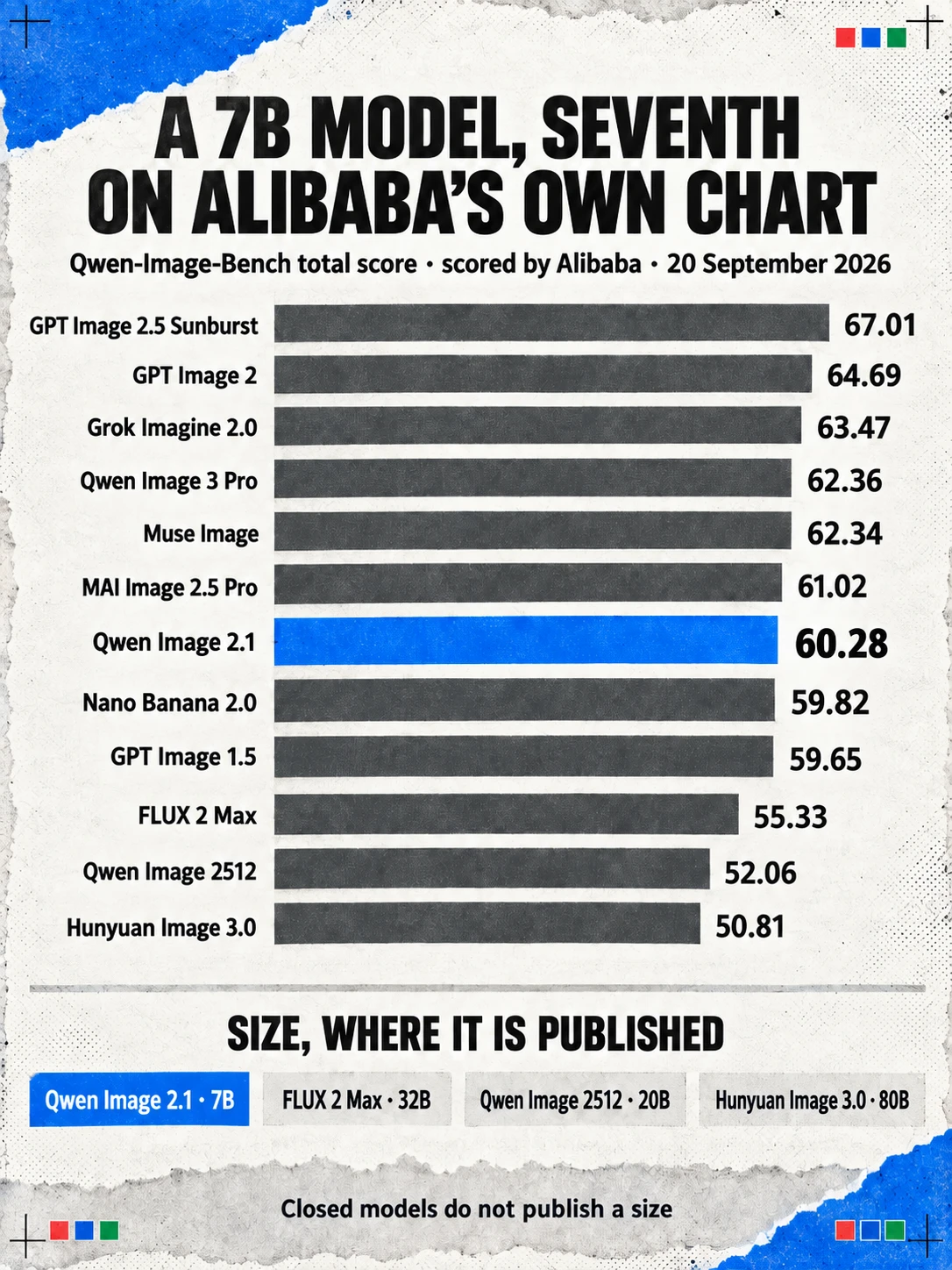
Read the padlocks carefully, because they report one thing only. Alibaba’s legend for them reads 闭源模型参数量未公开, meaning a closed-source model whose parameter count is undisclosed, so a model without a padlock has published its size. Published weights are a separate question the chart does not answer: FLUX 2 Max discloses 32 billion parameters and is still an API product, since Black Forest Labs publishes weights for the [dev] and [klein] tiers alone.
Among models that genuinely ship downloadable weights, Qwen-Image-2.1 leads by a wide margin. The nearest is Alibaba’s own Qwen Image 2512 at 52.06, eight points back from a generator nearly three times the size, and every other downloadable model on the chart sits below that: Boogu at 51.40, Tencent’s Hunyuan Image 3.0 at 50.81 from 80 billion parameters, the original Qwen Image at 49.23, GLM Image at 48.19. Against Alibaba’s own back catalogue the line runs 49.23, then 52.06, then 60.28 here.
Alibaba’s own larger models still beat it. Qwen Image 3 Pro scores 62.36 on the same chart with its parameter count withheld, which puts the open release two points below its closed sibling.
Every score here comes from a benchmark Alibaba built and ran. Treat the ordering as the company’s claim until an independent board scores the same field.
Editing at ten reference images takes 1.59 seconds
Alibaba published an inference-time chart alongside the benchmark, measuring seconds to produce a 2K image against the number of input images. Qwen-Image-2.1 finishes an edit with ten reference images in 1.59 seconds, and a hosted variant it labels Qwen-Image-2.1-Pro takes 6.31 seconds for the same job.
The comparison is against Alibaba’s larger line. Qwen-Image-3.0 takes 79.5 seconds at three input images, and Qwen-Image-3.0-Pro takes 112.5 seconds. Both curves climb steeply with each image added, while the 2.1 curves stay almost flat across all ten, which is the prefix cache doing its work.
Alibaba’s release history now records the Pro and Turbo API launch on 9 October 2026, alongside downloadable Turbo weights. Runware separately documented Pro availability on 5 October and Turbo availability on 9 October. These hosted tiers have their own access terms.
How to run it
Five inference stacks supported Qwen-Image-2.1 on the day it launched. Diffusers exposes it as QwenImage21Pipeline, handling text-to-image and image-conditioned generation in the same pipeline. ComfyUI supports it natively, with published workflow templates for generation and editing and a repackaged weight set at Comfy-Org/Qwen-Image-2.1, which had recorded 535,365 downloads when this page was written on 22 September 2026. vLLM-Omni, SGLang and LightX2V all shipped support on the same day, covering FP8 quantisation, prefix caching, CUDA graphs and multi-GPU parallelism.
Alibaba also published two prompt rewriters, both fine-tuned from Qwen3.5-VL 9B: Qwen-Image-2.1-PE-T2I for generation and Qwen-Image-2.1-PE-I2I for editing. They expand a short prompt into a detailed one and return a suggested aspect ratio alongside it. Running them is optional, and Alibaba recommends it for best results.
For transparent output, Alibaba’s recommended prompt wrapper is explicit: “This is an RGBA image with transparency. <your description>. The image has alpha channel and the background is transparent.”
Hardware options reach past NVIDIA. AMD Radeon cards run it through ROCm, PyTorch and Diffusers, and the FlagOS stack publishes prebuilt images and weights for eight chip platforms, with Alibaba stating that “Inference accuracy across all platforms has been aligned with the official implementation.” For users in mainland China, wuli.art offers all the model’s features free in its chat and canvas interfaces.
What to watch
Whether the research licence sticks. Alibaba shipped Qwen-Image under Apache 2.0 in 2025 and Qwen-Image-2.1 under a non-commercial licence in 2026. Which way the next release goes decides whether this line stays usable in a product.
An independent score. Qwen-Image-Bench is Alibaba’s own, and the 60.28 that places the model above Nano Banana 2.0 and GPT Image 1.5 has not yet been tested on a board somebody else runs.
How the hosted tiers compare. Pro and Turbo now have documented API access. Compare their quality, latency and costs on the same task, and distinguish the hosted service terms from the research licence covering downloaded weights.
Whether the small-model result holds. A 7-billion-parameter generator scoring within seven points of GPT Image 2.5 Sunburst is the claim most worth checking, and, because the weights are downloadable, the easiest one to check.
For the model this replaces, see Qwen-Image; for the open-weight model it measures itself against, FLUX 2; and for the closed models above it on Alibaba’s chart, GPT Image 2.5 and Nano Banana Pro and Nano Banana 2.
More in Image Generation
All Image →- AlibabaQwen-Imagethe free self-hosted option
- Black Forest LabsFLUX.2the strongest open-weight family
- GoogleNano Banana Pro and Nano Banana 2the 4K value leader
- ByteDanceSeedream 5.0the reasoning image model
- OpenAIGPT Image 2.5two variants, one price, the top two seats
- Black Forest LabsFLUX 3 ImageFLUX 3 Image creates and edits pictures with up to ten reference images