
MBZUAI IFM
K2 Horizon
a six-model Apache 2.0 fleet released with its checkpoints, logs and datasets
Key facts
- 3 Sept 2026Apache 2.0, all six models
- Released
- 0.9B to 375Bfour dense, two MoE
- Fleet
- 524,288tokens; 128K on the 0.9B
- Context
- 375B-A23B23B active per token
- Flagship
- per stagebranches through training
- Checkpoints
- 30.8v4.3, 375B, Artificial Analysis
- Intelligence Index
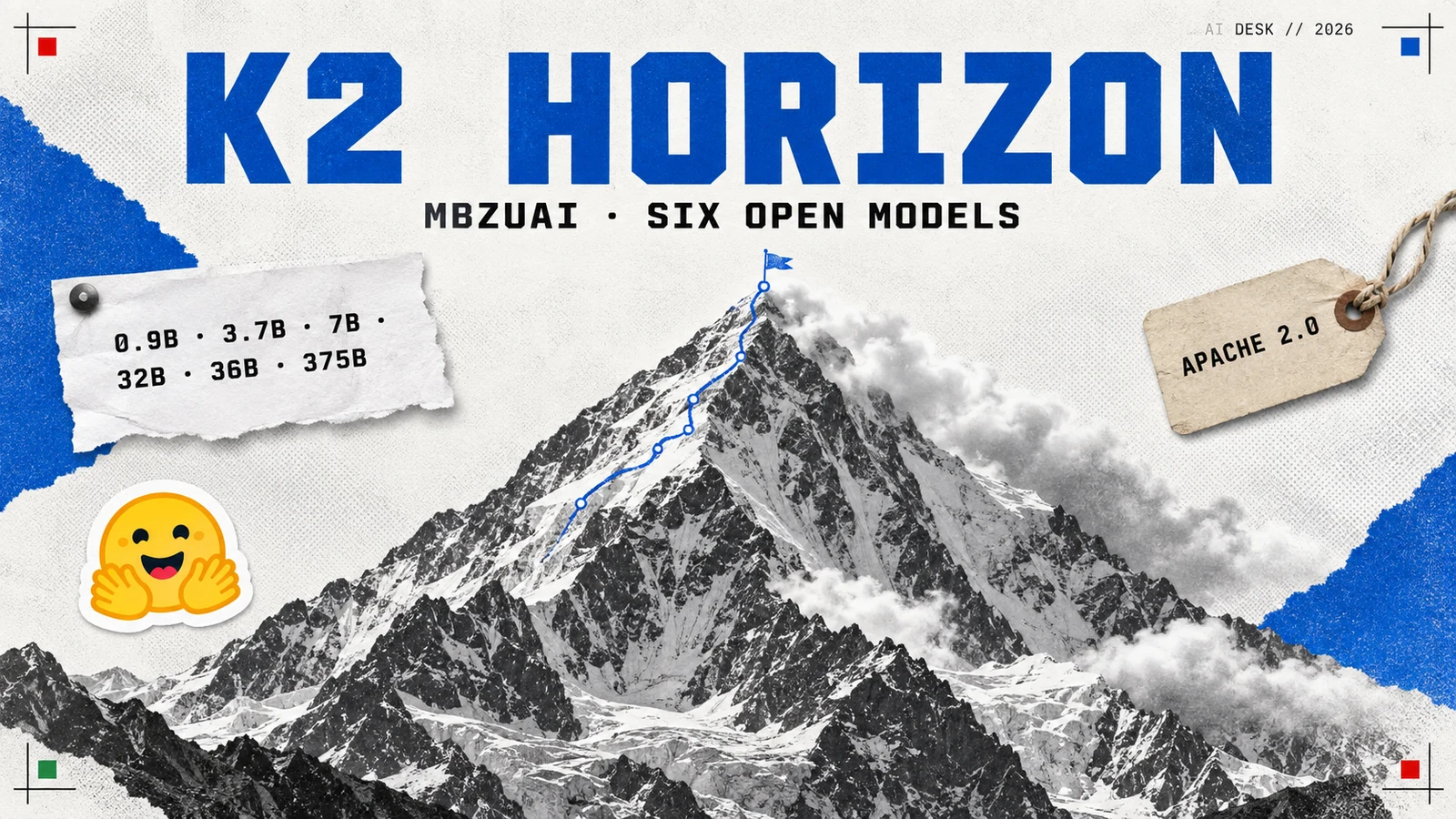
MBZUAI's Institute of Foundation Models published the K2 Horizon fleet on 3 September 2026: six Apache 2.0 language models, dense from 0.9B to 32B and mixture of experts at 36B and 375B, released with checkpoints from across their training and with the full data and code promised.
What it is
K2 Horizon is a fleet of six open-weight language models from the Institute of Foundation Models, published on Hugging Face under Apache 2.0 on 3 September 2026. Four are dense, at 0.9B, 3.7B, 7B and 32B parameters. Two are sparse mixtures of experts: K2-Horizon-MoVA-36B-A4B, which stores 36B parameters and runs 4B per token, and the flagship K2-Horizon-375B-A23B, which stores 375B and runs 23B. Artificial Analysis, which evaluates the fleet independently, records the release date as 3 September 2026; the six Hugging Face repositories went up within half an hour of each other late on 1 September UTC, and the FP8 and GGUF builds followed on 3 September.
The maker sits inside a university. IFM describes itself as “a global AI research lab dedicated to open and independent development of frontier-class foundation models”, launched in May 2025 by MBZUAI, the Mohamed bin Zayed University of Artificial Intelligence, a graduate research institution in Abu Dhabi. The lab operates from Abu Dhabi, Silicon Valley and Paris, and K2 Horizon extends a K2 line it has published on Hugging Face since 2024, through K2-Think in 2025 and K2-V2 last December.
The fleet
Each size has its own card, and each card states its place in the line-up:
- K2-Horizon-0.9B, the compact dense member, with a 128K context window.
- K2-Horizon-3.7B and K2-Horizon-7B, the small and medium dense members, both with a 512K context window.
- K2-Horizon-32B, the large dense member, also at 512K. Its card labels the published weights Stage 1 of the final training run, with the final checkpoint to follow.
- K2-Horizon-MoVA-36B-A4B, a mixture of experts built on Mixture-of-Values attention, which gives the variant its name. Final checkpoint released.
- K2-Horizon-375B-A23B, the flagship mixture of experts, 512K context, final checkpoint released.
The native long context is 524,288 tokens, reached through the midtraining stages, and the 0.9B holds 128K. Alongside the six sits K2-Horizon-7B-Uno, a LoRA adapter that adds a discrete-diffusion decoding pathway to the 7B’s own weights, from the lab’s paper on lossless speedups via discrete diffusion, with a matching build on the 0.9B. The fleet’s collection carries 22 items in all: the six models, the two Uno adapters, four FP8 and five GGUF builds, and five training datasets: TxT360-v2, Code-Reasoning, Math-Reasoning, SFT-Reasoning and Pretrain-Behaviors.
How open the release is
The licence is Apache 2.0 on all six model repositories, and the badge Hugging Face renders on each page reads apache-2.0. One card carries a wrinkle: the 0.9B’s metadata holds a second licence field, named internal-only, beside the Apache declaration, so the smallest member’s terms rest on that Apache field alone until IFM squares the card. Artificial Analysis lists the flagship as an open-weights model whose licence allows commercial use. The release goes further than weights. The 32B card’s promise is short: “Training data/recipe and the training code will be made public.” The flagship card carries the same commitment in its opening line: “We have released the final checkpoint; intermediate checkpoints, along with the data and the training code, will be released.”
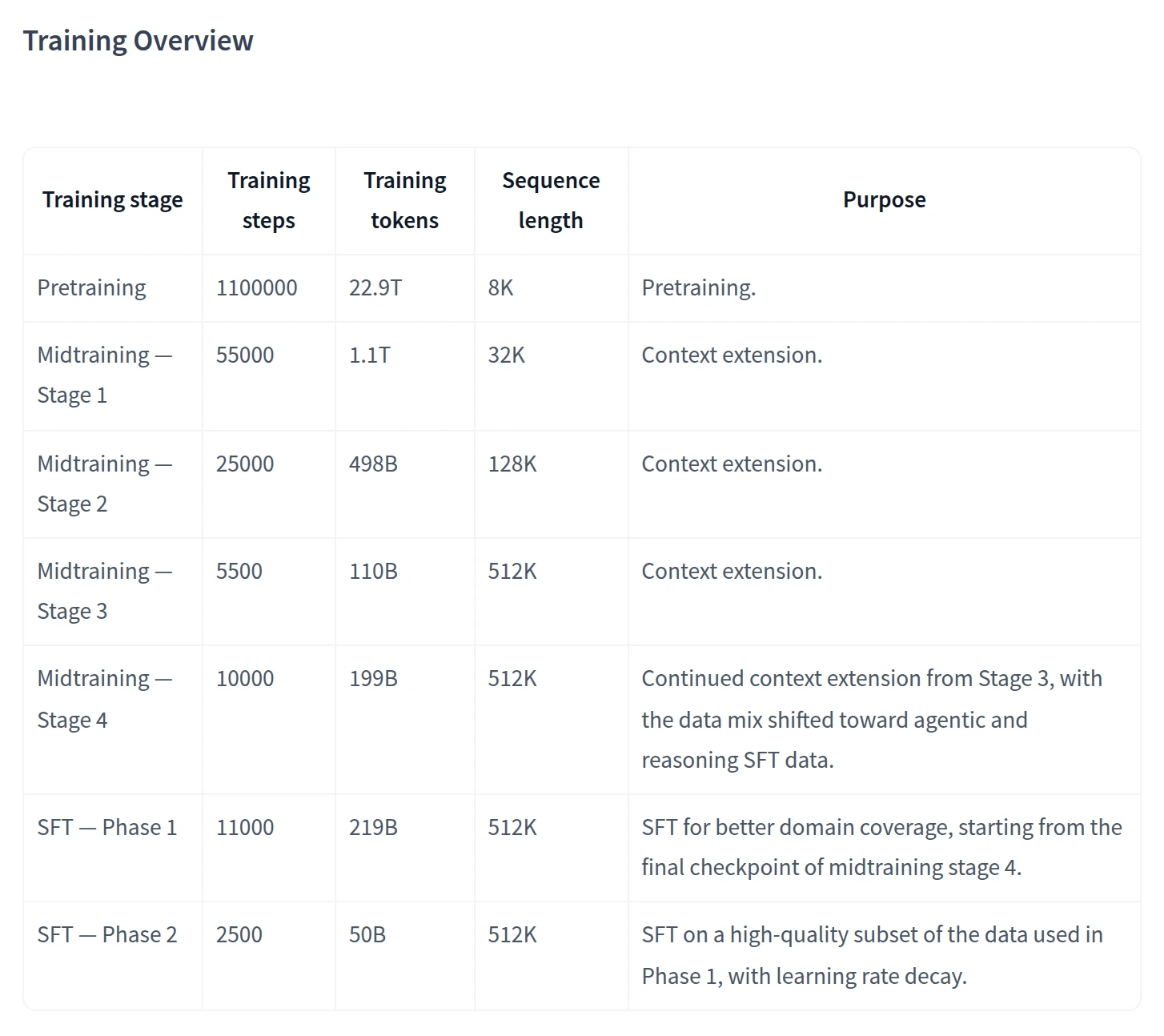
What is already up is unusual for a model launch. The 32B card prints its whole training run as a table: pretraining for 1,100,000 steps over 22.9T tokens at a sequence length of 8K, four midtraining stages that extend the context to 524,288 tokens, and two SFT phases. Each stage’s checkpoints live as branches of the model repository, so --revision pretrain_1100000 loads the final pretraining checkpoint and sft_2_2500 the finished model, and the card’s inventory marks the intermediate checkpoints of every stage as available. Training logs are public on Weights & Biases. The two artefacts still to come are dated on the card itself: the technical report and the code repository are both due by the end of September 2026.
What the cards report
Every launch figure below is IFM’s own, and the 32B card states that its baseline scores come from Artificial Analysis.
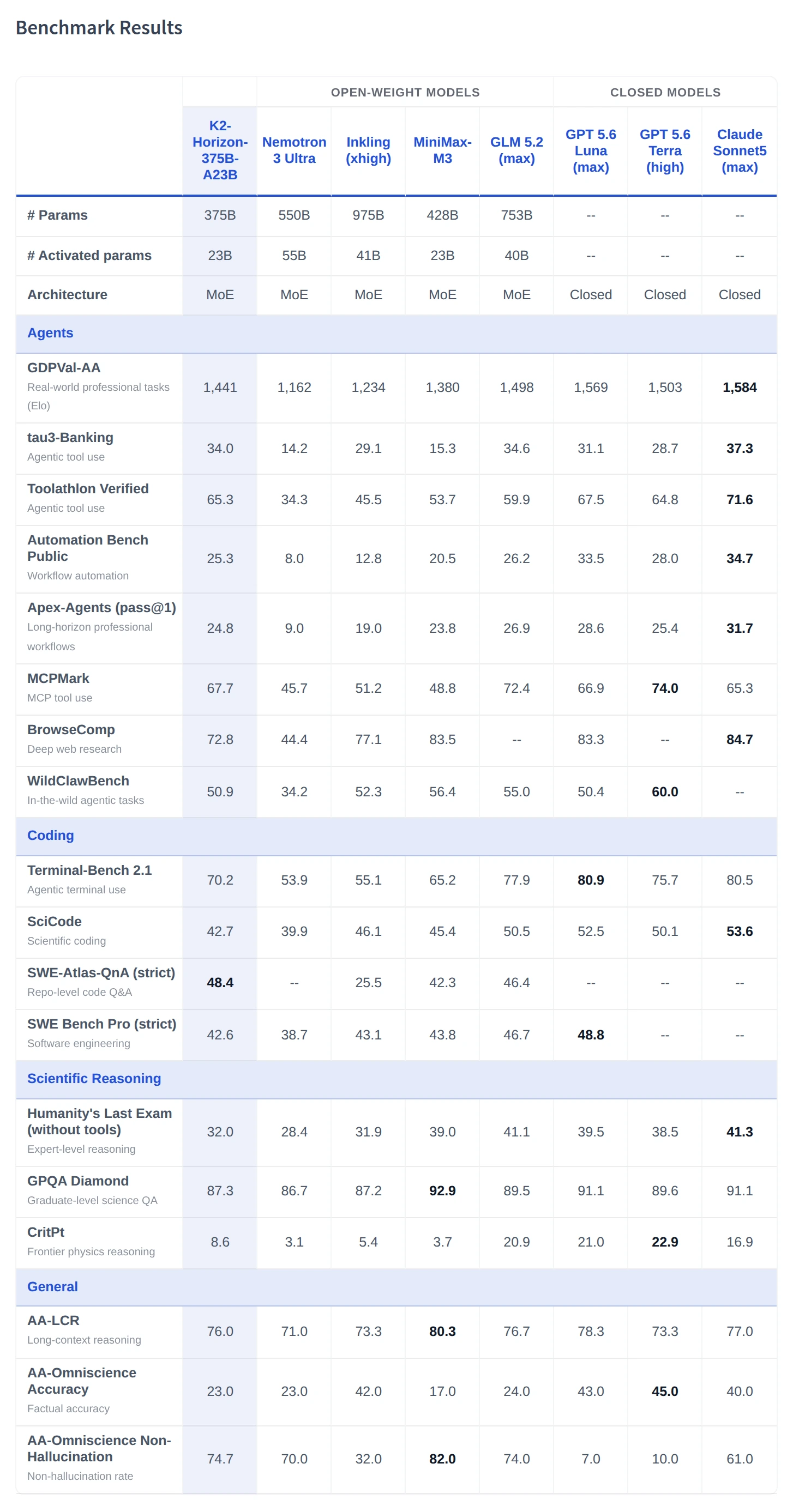
The flagship’s card claims it “matches or beats open-weight MoE models up to 2.6× its size and is competitive with closed frontier models”. Its table sets K2-Horizon-375B-A23B against Nemotron 3 Ultra, Inkling, MiniMax-M3 and GLM 5.2 on the open side and three closed models on the other. On the card’s own figures the flagship scores 70.2 on Terminal-Bench 2.1, 65.3 on Toolathlon Verified, 67.7 on MCPMark, 48.4 on SWE-Atlas-QnA in strict mode, 87.3 on GPQA Diamond, 32.0 on Humanity’s Last Exam without tools and 76.0 on AA-LCR. The 2.6× in the claim is Inkling, listed at 975B stored parameters. Read the table’s leaders too: GLM 5.2, listed at 753B, takes Terminal-Bench 2.1 at 77.9 and Humanity’s Last Exam at 41.1 on the same card, and MiniMax-M3 takes GPQA Diamond at 92.9.
The 32B’s card is a different kind of document: a Stage 1 baseline, published mid-run, with the Stage 2 results promised as “out soon”. On its own figures the dense 32B scores 82.3 on GPQA Diamond, 36.6 on Terminal-Bench 2.1, 22.8 on Humanity’s Last Exam without tools and 65.3 on AA-LCR. The card prints the stronger baseline in the next column: Qwen3.8-27B, at 90.5, 79.8, 33.9 and 77.3 on the same four rows. Publishing a comparison table the current checkpoint loses is a working demonstration of the openness the fleet is built around, and the final 32B is the row to re-read when it lands.
The independent scoreboard
Artificial Analysis carries its own evaluations of the fleet, run on its Intelligence Index v4.3. As of 15 September 2026 the flagship K2 Horizon 375B A23B scores 30.8, on a board where Qwen3.8 27B records 33.9, DeepSeek V4 Pro 36.3, MiniMax-M3 29.6 and Inkling 25.5. The listing confirms the release facts from the outside: a 524,288-token context window, 375B parameters with 23B active, open weights under Apache 2.0, released 3 September 2026, creator MBZUAI Institute of Foundation Models.
Where it sits among the open fleets
The biggest open fleets K2 Horizon lines up against are Chinese. Qwen3.8-Max tops the open-weight boards at 2.4 trillion parameters, with its cheaper sibling Qwen3.8-Flash-Next shipping under Alibaba’s own qwen-community-1.0 terms; GLM-5.3 and Kimi K3 fill out the frontier tier, and GLM 5.2 is the model the flagship’s own card shows ahead of it on most agent rows.
K2 Horizon’s position in that field rests on two things the cards support. It spans six sizes under one licence, from a 0.9B compact to the 375B flagship, released together. And it treats the training run itself as the product: per-stage checkpoints as repository branches, public training logs, five datasets already in the collection, and the data, recipe and code committed to follow. The flagship’s scores land in the upper open-weight tier on Artificial Analysis’s index; the training record is where this fleet stands alone.
What to watch
The technical report and the code repository, both due by the end of September 2026 on the cards’ own artefact index. The data and recipe promise is the release’s central claim, and those two artefacts are where it gets kept.
The final 32B checkpoint. The published Stage 1 weights trail Qwen3.8-27B on nearly every row of the card’s table, and the card promises Stage 2 results soon. The size of that jump will show what the last stages of the recipe are worth.
The five RL-expert checkpoints the flagship’s card dates to mid-September 2026, a due date that has now arrived.
The Uno pathway. A diffusion decoding adapter that reuses the dense weights is the most distinctive research artefact in the collection, and its evaluation suite is still being released.
More in Large Language Models
All LLMs →- AlibabaQwen3.8-Maxthe first Qwen Max released with open weights
- Z.ai / ZhipuGLM-5.3a post-training update with an emergent cyber capability
- Moonshot AIKimi K3the largest open-weight model yet released
- AlibabaQwen3.8-Flash-Nextthe cheap tier, and a preview of what Qwen4 is built on
- Google DeepMindGemini 4 Argonlonger reasoning, coding and cyber defence
- OpenAIGPT-5.6the flagship from 9 July to 3 September 2026