
Alibaba
Qwen3.8-Flash-Next
the cheap tier, and a preview of what Qwen4 is built on
Key facts
- 26 Aug 2026weights on day one
- Released
- 125Babout 6B active per token
- Parameters
- 262,1441M with YaRN
- Context
- $0.15per M tokens
- Input
- $0.47per M tokens
- Output
- qwen-community-1.0open weights, custom terms
- Licence
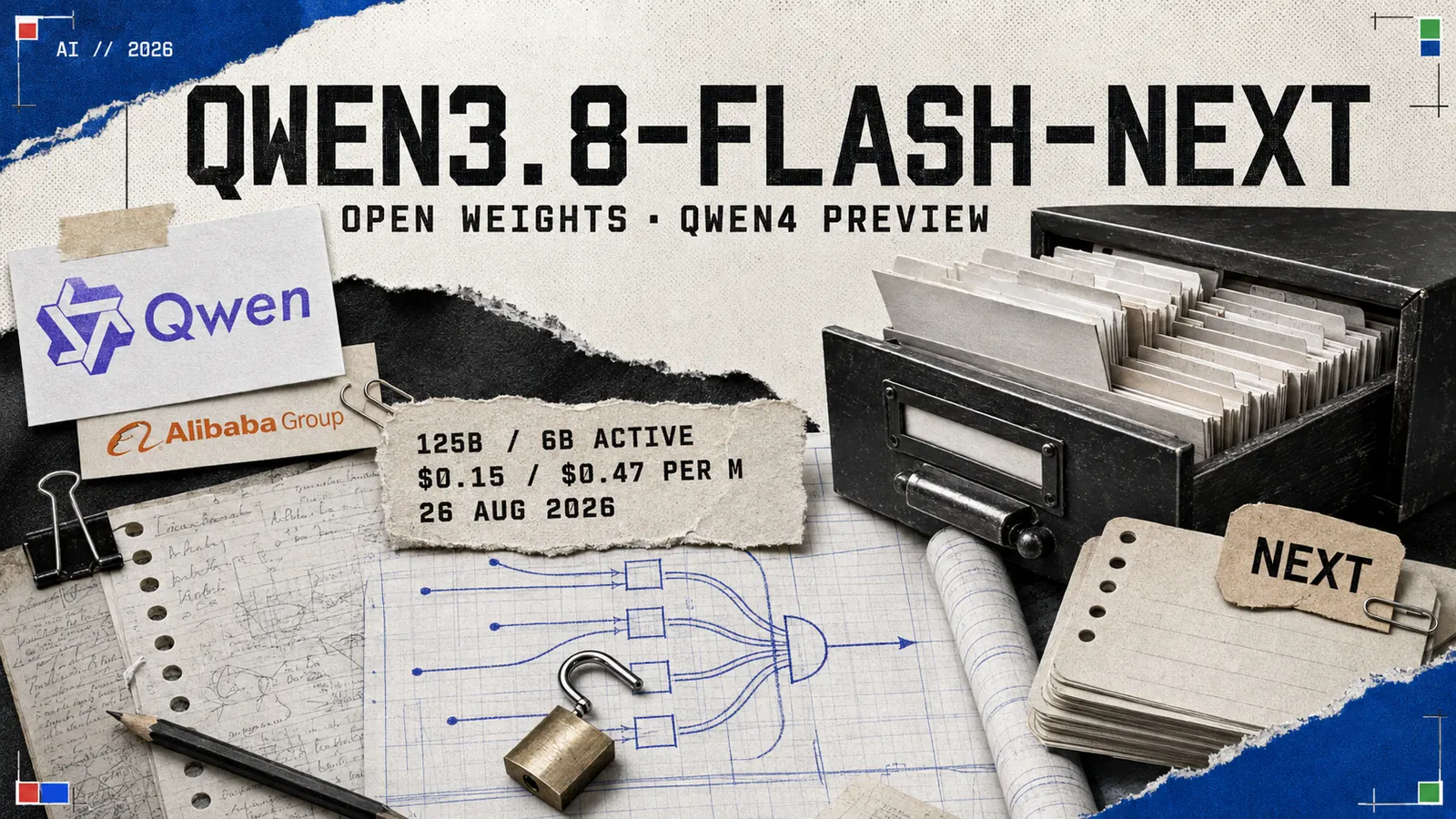
Alibaba's cheap tier, and the model the Qwen team is using to show the architecture Qwen4 will be built on. It activates about 6 billion of its 125 billion parameters per token, carries a 20-million-entry n-gram embedding table alongside the main model, costs $0.15 per million tokens in and $0.47 out, and the weights were published the day it launched.
What it is
Qwen3.8-Flash-Next is a multimodal mixture-of-experts model from Alibaba’s Qwen team, with the weights published on 26 August 2026. Qwen is doing two things with one release, and says so: “In this release we are opening the weights of Qwen3.8-Flash-Next, a multimodal MoE model that also serves as an early preview of the architecture used in Qwen4. It plays the same role that Qwen3-Next played for Qwen3.5.”
So this is the cheap tier and a research preview in the same download. It sits a long way below the flagship on both scale and price. Qwen3.8-Max is 2.4 trillion parameters at $2.00 per million tokens in and $6.00 out; Flash-Next is 125 billion parameters with about 6 billion active on any token, at $0.15 and $0.47.
The efficiency claim is the one Qwen leads on: “Compared with Qwen3.7-Plus, Qwen3.8-Flash-Next substantially reduces both training and inference cost”. The company puts training at roughly a ninth of what Qwen3.7-Plus took, while claiming better results on coding and office tasks. Both halves of that are Alibaba’s own accounting, with no external audit attached.
The four changes Qwen names
The architecture is where the Qwen4 preview lives, and Qwen describes four departures from its previous generation.
- Hybrid attention, GDN plus QSA. Gated DeltaNet compresses history into a fixed state, while Qwen Sparse Attention picks which parts of the context to attend to at micro-block granularity rather than one token at a time. Selecting blocks rather than tokens is what keeps the selection itself cheap as the context grows.
- Gated Residual. The residual stream, the path information takes straight through the network, is widened into four branches, with a dynamic gate deciding what each layer reads from it and writes back.
- N-gram Embedding. A lookup table of 20,000,000 bigram and trigram entries sits at layer 2. It can be offloaded to host memory and prefetched asynchronously, so the parameters live off the accelerator until they are needed.
- The Muon optimiser, with a scaling law refitted for it, in place of the optimiser used for the previous generation.
The n-gram table shows up in the parameter count as well as in the diagram, because Qwen counts it separately from the model itself.
What the parameter count covers
The headline 125 billion is the main model. Two blocks sit alongside it: 51 billion parameters of n-gram embeddings, and a 4-billion-parameter multi-token-prediction layer. A download therefore carries considerably more than the number in the description, which is worth knowing before sizing hardware.
Inside the main model, on Qwen’s own card: 48 layers, a hidden dimension of 2,560, 512 experts of which 10 routed and one shared activate per token, an expert intermediate dimension of 640, and a padded token embedding of 248,320.
Native context is 262,144 tokens, extensible to 1,000,000 with YaRN. The hosted build serves the million by default.
Qwen’s own benchmark table
Every figure below is Alibaba’s own run, published with the launch. The comparison set is Qwen’s choice too: its own 27-billion-parameter sibling, its previous Plus tier, a DeepSeek release and one Anthropic model, named in the table as Claude-Opus-4.6 Max. Two cells in the full table were left blank, and both are named below.
| Benchmark | Qwen3.8-Flash-Next | Qwen3.7-Plus | Leader on the same table |
|---|---|---|---|
| DeepSWE 1.1 | 58.7 | 16.5 | Qwen3.8-Flash-Next |
| SWE-bench Pro | 62.5 | 55.8 | Qwen3.8-Flash-Next |
| SWE-bench Multilingual | 81.0 | 75.8 | Qwen3.8-Flash-Next |
| NL2Repo-Bench | 48.1 | 41.1 | 54.2 DeepSeek-V4-Flash-0731 |
| CoWorkBench | 73.9 | 65.1 | Qwen3.8-Flash-Next |
| JobBench | 55.7 | 27.6 | Qwen3.8-Flash-Next |
The columns not printed above are the ones that complicate it. Qwen3.8-27B, the small open sibling, scores 42.2, 61.7, 73.8, 42.3, 70.7 and 33.4 straight down the six rows in the order printed. Claude-Opus-4.6 Max was not run on DeepSWE 1.1, and takes 53.4, 77.5, 47.6, 68.2 and 36.6 on the other five. DeepSeek-V4-Flash-0731, which takes the NL2Repo-Bench row above, scores 54.4 on DeepSWE, 56.0 on SWE-bench Pro, 45.1 on CoWorkBench and 41.3 on JobBench, and was not run on SWE-bench Multilingual.
Three things stand out. The jump over Qwen3.7-Plus on DeepSWE is enormous, 16.5 to 58.7, and a jump that size usually says as much about how the older model was harnessed as about the new one. The 27-billion-parameter sibling is within a point on SWE-bench Pro, 61.7 against 62.5, which puts a strain on the case for the larger model on that particular task. And Flash-Next loses one row outright: DeepSeek’s release leads NL2Repo-Bench at 54.2 against 48.1, a six-point margin Qwen printed itself.
No independent evaluation existed when the model launched, so the whole table should be read as the maker’s own measurement of its own release.
The hosted build and the open one
There are two models with almost the same name, and they are not the same thing.
Qwen3.8-Flash-Next is the open-weight research release. Qwen3.8-Flash is the hosted production build on QwenCloud, described by Qwen as “the official version based on Qwen3.8-Flash-Next with more production features, e.g., 1M context length by default, official built-in tools.”
QwenCloud’s own model page lists image, text and video in and text out, compatibility with both the OpenAI and Anthropic protocols, prefix completion, function calling and a context cache. The open model card is labelled image-text-to-text, while Qwen’s launch post calls the model multimodal, so the fuller video handling is documented on the hosted route rather than on the download.
OpenRouter carries the hosted build as qwen/qwen3.8-flash, listed on 26 August 2026 at $0.15 per million input tokens and $0.47 output, with a one-million-token context and text, image and video in.
Price and access
Qwen’s stated pricing, in its own words, is that the model is “priced at 0.15 USD per million input tokens and 0.47 USD per million output tokens”. OpenRouter’s listing matches.
The weights are on Hugging Face as Qwen/Qwen3.8-Flash-Next, with an FP8 build alongside it, and on ModelScope. By 30 August the two repositories had recorded 121,976 and 76,935 downloads, with 4,347 likes on the main repository and 157 on the FP8 build. Transformers, vLLM, SGLang and TokenSpeed are the serving frameworks named on the card.
The licence is Alibaba’s own, qwen-community-1.0, declared on the model card as license: other. As with Qwen3.8-Max, whose 2.4-trillion-parameter weights carry bespoke terms of their own, open weight is the accurate description here and open source is not. Anyone planning commercial use has to read the terms rather than assume Apache 2.0.
One date correction worth recording, because an automated reader gets it wrong. Some text extractors return a published date of 3 August 2026 for the launch post. That is the date of the separate Qwen3.8-Max announcement. The Hugging Face commit history settles this release: the first weight upload is timestamped 26 August 2026 at 08:17 UTC, with README edits on 26 and 27 August, and the OpenRouter listing appeared the same day.
What to watch
Whether the architecture carries into Qwen4. That is the entire stated purpose of the release. Qwen3-Next preceded Qwen3.5 the same way, so the four changes above are the best available guide to what the next flagship will be built from.
The n-gram table in practice. Offloading 51 billion parameters to host memory and prefetching them is the kind of design that behaves very differently on a rented GPU than in a lab. Anyone serving this locally will find out before the benchmarks do.
Whether the small sibling is enough. Qwen3.8-27B is within a point on SWE-bench Pro and twenty-two points behind on JobBench, and both models are downloadable, so the trade is testable rather than argued.
How far the hosted build drifts from the open one. Qwen3.8-Flash on QwenCloud already has a longer default context and built-in tools that the download does not. The two names will keep being used interchangeably, and they will keep not being the same model.
For the flagship above it, see Qwen3.8-Max; for the Max tier before that one, and Alibaba’s closed turn, Qwen3.7-Max; and for the other cheap open-weight multimodal release of the same week, GLM-5.3-Flash.
More in Large Language Models
All LLMs →- AlibabaQwen3.8-Maxthe first Qwen Max released with open weights
- AlibabaQwen3.7-MaxQwen's premium, API-only tier
- Z.ai / ZhipuGLM-5.3-Flasha new base, natively multimodal, at a tenth of GLM-5.2's price
- Moonshot AIKimi K3the largest open-weight model yet released
- DeepSeekDeepSeek V4 Prothe price disruptor, raising its prices
- Google DeepMindGemini 4 Argonlonger reasoning, coding and cyber defence