
Xiaomi
MiMo V2.6
Flash, Pro and Pro UltraSpeed, released together
Key facts
- 21 Sep 202622 Sep on Xiaomi's log
- Released
- 1.02T42B active per token
- Pro
- 309B15B active per token
- Flash
- 1M / 128ktokens in / out
- Context
- $0.14 / $0.28per M tokens
- Flash price
- MITPro and Flash, day one
- Weights
MiMo is Xiaomi's family of large language models, and V2.6 is the September 2026 generation. Two models carry the release: Flash, at 309 billion parameters, and Pro, at 1.02 trillion. Both read text, images, video and audio, both hold a million tokens of context, and Xiaomi published the weights of both under an MIT licence on launch day. A third name on the price list, Pro UltraSpeed, is the same Pro model served faster, and Xiaomi charges exactly ten times as much for it.
What MiMo V2.6 is
MiMo is the family of large language models built by Xiaomi, the Chinese consumer electronics company, and V2.6 is the generation it released on 21 September 2026. A MiMo model takes text, images, video and audio as input and writes text back. It is sold through Xiaomi’s own API, it runs inside Xiaomi’s desktop app, and, unusually for a model this large, anyone can download it and run it on their own machines.
The release carries two models. MiMo-V2.6-Flash is the cheaper one, at 309 billion total parameters with 15 billion active on any given token. MiMo-V2.6-Pro is the flagship, at 1.02 trillion total parameters with 42 billion active. Both hold a context window of one million tokens and write up to 128,000 tokens back.
A third name appears on the price list, mimo-v2.6-pro-ultraspeed. It is the same Pro model, served on an inference stack tuned for speed, and Xiaomi prices it at ten times Pro.
There are two models, and UltraSpeed is a way of serving one of them
Xiaomi’s own launch post is direct about the count: “The MiMo-V2.6 series comprises two native fully multimodal models, namely Pro and Flash.” UltraSpeed appears later in the same post, under access rather than architecture: “MiMo-V2.6-Pro also provides the UltraSpeed ultra-high-speed mode on the Open Platform, delivering up to 20x inference speed.”
Three pieces of evidence agree that UltraSpeed is a serving mode rather than a separate model. Xiaomi published weights for Pro and Flash and none for UltraSpeed. OpenRouter’s catalogue entry, listed on 21 September 2026 at 20:07 UTC, describes it as “the fast speed edition of Xiaomi’s flagship foundation model, MiMo-V2.6-Pro. Built from the same 1T MiMo-V2.6-Pro checkpoint, it matches the original model in quality while delivering roughly 10x the output speed.” And Xiaomi’s model list gives UltraSpeed the same one-million-token context and 128,000-token output ceiling as Pro.
Xiaomi has run an UltraSpeed mode before, and the terms were different. In June 2026 it announced the mode for MiMo-V2.5-Pro with the inference company TileRT, saying “The UltraSpeed mode of Xiaomi MiMo-V2.5-Pro enables the output speed of flagship models with trillions of parameters to exceed 1000 tokens/s for the first time.” That version ran as an application-based trial from 9 to 23 June 2026, and Xiaomi priced it “at 3 times that of MiMo-V2.5-Pro, while providing approximately 10 times the output speed improvement”. Its own summary of the deal: “3 times the price increase, 10 times the output experience.” Xiaomi says more than 3,000 companies and developers applied within twelve hours of the announcement.
So the premium has moved from three times to ten, although the V2.5 figure was a trial price on an application-only beta and the V2.6 figure is the standing rate.
Two techniques did the work in June, and both appear again in V2.6. Xiaomi quantised the mixture-of-experts layers alone to FP4 through quantisation-aware training, leaving every other module at full precision, because “its Experts account for the vast majority of the parameters and have the highest tolerance for quantization accuracy”. And it added “an efficient speculative decoding DFlash based on block-level masked parallel prediction”. Together those took a trillion-parameter model past a thousand tokens a second “using only a standard 8-card general-purpose GPU node”. Both V2.6 model cards describe their speculative decoder as a five-layer sliding-window drafter in that same DFlash style, predicting seven tokens per forward pass for parallel verification.
What each one costs
Xiaomi’s pricing page, last updated on 21 September 2026, lists the overseas rates below in US dollars per million tokens. The company states that V2.6 inherited the V2.5 price list unchanged: “The MiMo-V2.6 series adopts the same API pricing as the V2.5 series.”
| Per million tokens | mimo-v2.6-flash | mimo-v2.6-pro | mimo-v2.6-pro-ultraspeed |
|---|---|---|---|
| Input, cache miss | $0.14 | $0.435 | $4.35 |
| Input, cache hit | $0.0028 | $0.0036 | $0.036 |
| Output | $0.28 | $0.87 | $8.70 |
| Batch input | $0.07 | $0.2175 | No batch API |
| Batch output | $0.14 | $0.435 | No batch API |
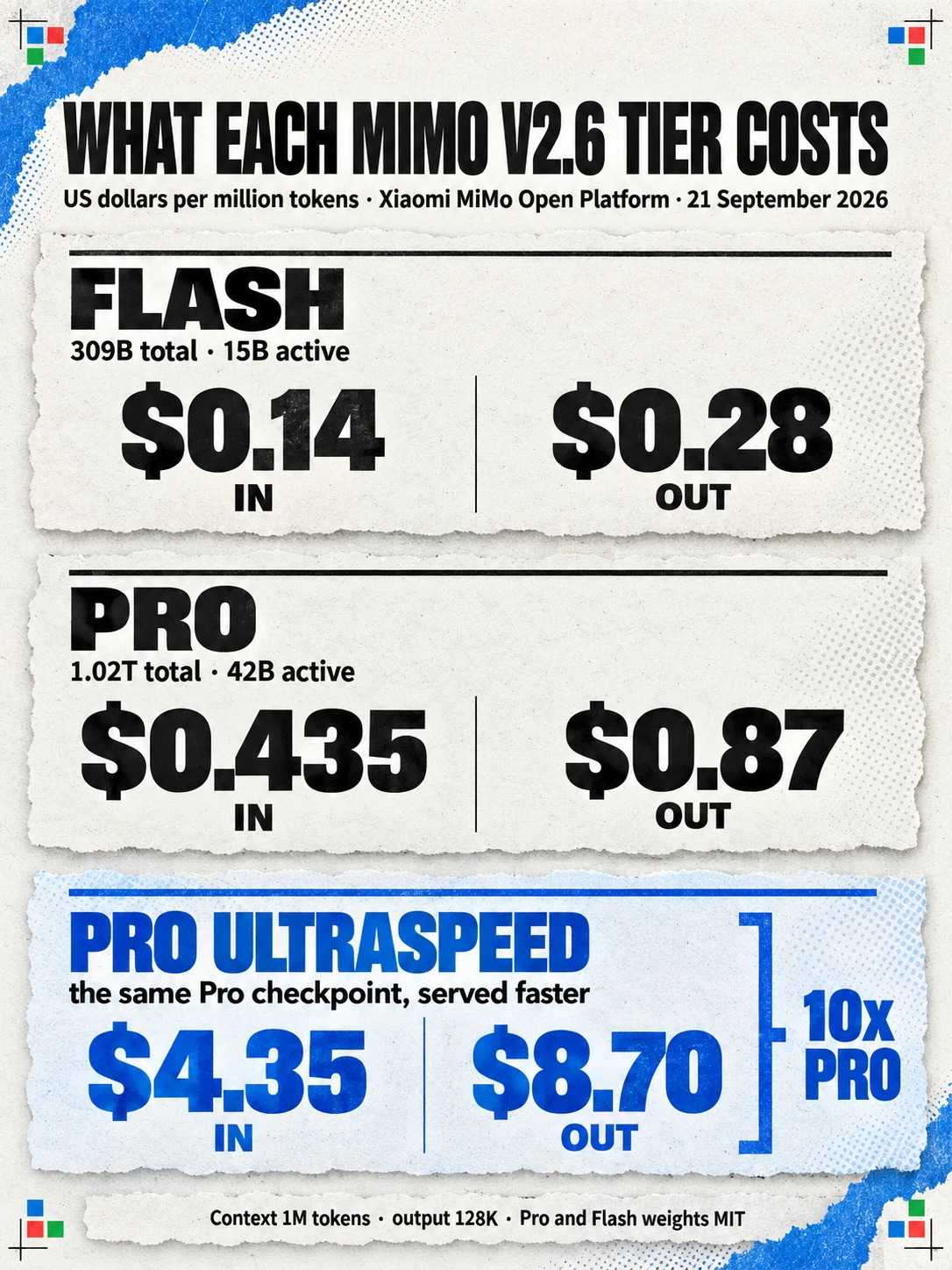
In renminbi, for customers billed in China, Xiaomi charges ¥1.00 and ¥2.00 per million tokens for Flash, ¥3.00 and ¥6.00 for Pro, and ¥30.00 and ¥60.00 for UltraSpeed. Cache writes are free for a limited time, and web search is billed separately at $5 per thousand calls overseas.
Rate limits separate the tiers as sharply as price does. Pro and Flash each allow a maximum of 100 requests per minute and 10 million tokens per minute. Against UltraSpeed, Xiaomi’s model list prints no number at all, only “Customized services available, please contact us”.
Xiaomi has set the deprecation of the two models V2.6 replaces, mimo-v2.5-pro and mimo-v2.5, for 10:00 Beijing time on 21 October 2026.
UltraSpeed costs ten times Pro, and the speed claim comes in two sizes
The UltraSpeed premium is exact. Every UltraSpeed rate on Xiaomi’s price list is precisely ten times the matching Pro rate: $4.35 against $0.435 in, $8.70 against $0.87 out, $0.036 against $0.0036 on a cache hit.
The speed figure is less settled. Xiaomi’s launch post says UltraSpeed delivers “up to 20x inference speed”, and its release log repeats it as “Flagship V2.6-Pro performance, up to 20x faster”. OpenRouter’s listing for the same model says “roughly 10x the output speed”. Xiaomi has published no tokens-per-second figure for V2.6 UltraSpeed, so the honest reading is that the price is set at ten times and the ceiling Xiaomi advertises is twenty times. Anyone budgeting on throughput should measure it on their own traffic before committing, because the break-even against plain Pro sits at exactly ten times faster.
Access to UltraSpeed arrived alongside the desktop app. Xiaomi’s post says “MiMo Desktop is launched with the UltraSpeed mode of MiMo-V2.6-Pro synchronously”, and that the earlier invitation-only beta ends a week after the launch, with existing testers continuing once they switch the model name.
How Flash and Pro are built
Both models are sparse mixture-of-experts transformers with a hybrid attention stack, and they share every encoder. The figures below come from the two Hugging Face model cards.
| Component | MiMo-V2.6-Flash | MiMo-V2.6-Pro |
|---|---|---|
| Total parameters | 309B | 1.02T |
| Active per token | 15B | 42B |
| Layers, total / SWA / global | 48 / 39 / 9 | 70 / 60 / 10 |
| Hidden size | 4,096 | 6,144 |
| Attention heads, Q / KV (SWA) | 64 / 8 | 128 / 8 |
| Head dimensions, QK / V | 192 / 128 | 192 / 128 |
| Sliding window | 128 | 128 |
| Routed experts, total / active | 256 / 8 | 384 / 8 |
| Max context | 1M | 1M |
The first transformer block in each model uses global attention with a dense feed-forward network. Every block after it alternates local sliding-window attention with global attention, and both kinds use sparse mixture-of-experts feed-forward networks with no shared experts.
The encoders are identical across the two models, which is a large part of why Flash comes close to Pro on visual work: 71.5 against 72.3 on MiMo VisualCoding, from less than a third of the parameters. Vision runs through MiMo ViT, 681 million parameters across 28 layers, 24 of them sliding-window and four full, at a patch size of 2 by 16 by 16. Audio runs through a 308-million-parameter AudioTokenizer encoder with 20 residual vector-quantisation codebooks, feeding a 127-million-parameter patch encoder that packs four frames per patch and drops the rate from 25 Hz to 6.25 Hz. Both models carry the same five-layer speculative decoder.
Pro leads on agent work and trails on offensive security
MiMo-V2.6-Pro beats Claude Opus 5, GPT-5.6 Sol and Claude Fable 5 on two general agent benchmarks and ties Claude Opus 5 on a third, and sits 30.6 points behind GPT-5.6 Sol on ExploitBench. Every figure in the two tables below is Xiaomi’s own run, published on the MiMo-V2.6-Pro-RL and MiMo-V2.6-Flash-RL model cards on 21 September 2026, so read them as the company’s claim rather than an independent result.
Against Xiaomi’s own previous flagship, both new models improve on every row that carries a figure.
| Benchmark | MiMo-V2.6 Pro | MiMo-V2.6 Flash | MiMo-V2.5 Pro |
|---|---|---|---|
| DeepSWE v1.1 | 71.9 | 67.9 | 19.0 |
| ProgramBench | 26.5 | 26.0 | 12.5 |
| MiMo Code Bench | 63.2 | 61.2 | 40.4 |
| AutomationBench v1.0.6 | 53.1 | 52.3 | 16.0 |
| Toolathlon-Verified | 76.9 | 73.6 | 49.1 |
| GDPval-AA 2.1 | 1673 | - | 1107 |
| Agents’ Last Exam | 31.6 | 27.6 | 13.2 |
| Terminal Bench 4.0 | 34.9 | 28.8 | 1.5 |
| Terminal Bench 2.1 | 89.9 | 87.6 | 65.2 |
| JobBench | 62.0 | 61.2 | 25.0 |
| CyberGym | 94.0 | 95.1 | 40.0 |
| MiMo Cyber Bench | 80.2 | 77.2 | 0.0 |
| ExploitGym | 17.8 | 6.0 | 0.2 |
| ExploitBench | 47.9 | 25.3 | 16.6 |
| SEC Bench Pro | 66.3 | 47.5 | 17.7 |
Flash, at less than a third of Pro’s size, clears MiMo-V2.5-Pro on all fourteen rows where it has a score, which is the claim Xiaomi leads with: “MiMo-V2.6-Flash has comprehensively outperformed MiMo-V2.5-Pro”. The fifteenth row, GDPval-AA 2.1, carries no Flash figure.
Set against the frontier models on the same card, Pro beats all three of them on two benchmarks and ties Claude Opus 5 on a third. The fifteen rows below are the ones where Xiaomi printed a competitor figure at all; CyberGym and MiMo Cyber Bench carry none, so neither appears here.
| Benchmark | MiMo-V2.6 Pro | Best on the same card | Whose |
|---|---|---|---|
| AutomationBench v1.0.6 | 53.1 | 50.3 | Claude Opus 5 |
| Terminal Bench 2.1 | 89.9 | 89.1 | Claude Opus 5 |
| Agents’ Last Exam | 31.6 | 31.6 | Claude Opus 5, tied |
| MiMo VisualCoding | 72.3 | 73.4 | GPT-5.6 Sol |
| DeepSWE v1.1 | 71.9 | 74.0 | Claude Opus 5 |
| Toolathlon-Verified | 76.9 | 80.6 | Claude Opus 5 |
| OSWorld-Verified | 82.0 | 86.0 | Claude Fable 5 |
| GDPval-AA 2.1 | 1673 | 1708 | Claude Opus 5 |
| JobBench | 62.0 | 65.7 | Claude Opus 5 |
| MiMo Code Bench | 63.2 | 68.6 | Claude Opus 5 |
| ProgramBench | 26.5 | 37.0 | Claude Opus 5 |
| Terminal Bench 4.0 | 34.9 | 49.0 | Claude Opus 5 |
| ExploitGym | 17.8 | 30.3 | GPT-5.6 Sol |
| SEC Bench Pro | 66.3 | 79.1 | GPT-5.6 Sol |
| ExploitBench | 47.9 | 78.5 | GPT-5.6 Sol |
General agent work is where Pro is strongest: AutomationBench and Terminal Bench 2.1 both go to Xiaomi, and Agents’ Last Exam ends level with Claude Opus 5. Claude Opus 5 leads outright on seven rows, most decisively on Terminal Bench 4.0, where 49.0 against Pro’s 34.9 is the widest margin on the card.
Offensive security is where Pro falls furthest behind. ExploitBench puts Pro at 47.9 against GPT-5.6 Sol’s 78.5 and Claude Opus 5’s 70.0, and ExploitGym puts it at 17.8 against 30.3. The defensive and reproduction benchmarks run the other way: on CyberGym, Flash scores 95.1 and Pro 94.0, and Xiaomi printed no competitor figures on that row or on MiMo Cyber Bench.
Two third-party placements sit in Xiaomi’s launch post rather than the tables. It says Pro “scores 46 points in the Artificial Analysis Intelligence Index (AA Composite Intelligence Index), surpassing Kimi K3 and Qwen3.8 Max to become the most powerful open-source model available”, while adding that “there is still a gap when compared with the strongest closed-source models Claude Fable 5.1 and GPT-6 Astra”. On the Design Arena leaderboard it says Pro “has achieved a level comparable to that of Claude Opus 5 and GPT-5.6 Sol”.
Six days of training, at $850,000 and $2.62 million
Xiaomi published what the reinforcement learning run cost, which almost no lab does. Its launch post states: “In less than 6 days, MiMo-V2.6-Flash and MiMo-V2.6-Pro completed 30 steps each with a cumulative total of approximately 750,000 trajectories, at training costs of around 850,000 and 2.62 million US dollars respectively”.
The published gains from that run are on DeepSWE v1.1, an out-of-sample software engineering benchmark. Xiaomi reports Flash moving from 48.8 to 65.7 and Pro from 58.4 to 72.6 across the six days, which it describes as improvements of roughly 17 and 14 points. The released checkpoints score 67.9 and 71.9 on the same benchmark, because a distillation stage follows the reinforcement learning, so the two sets of numbers describe different moments rather than disagreeing.
Three levers did the scaling, in Xiaomi’s account. Each update used 1,568 prompts with 16 rollouts apiece, which the technical report works out as 25,000 sequences a step at roughly 110,000 to 150,000 tokens each, trained at the full one-million-token context across thousands of GPUs in a single run. That comes to 3.5 to 3.7 billion tokens a step in the launch post, and 2.7 to 3.7 billion in the report. The task mixture spanned code, general agent work, visual tasks and cybersecurity, with several agent harnesses mixed into the same batch. And the grader itself was scaled: Xiaomi calls the method Groupwise Agentic Grading, splitting it into Groupwise Reward Synthesis, which builds rubrics offline from contrasting rollouts, and Groupwise Advantage Redistribution, which ranks passing trajectories online and pushes reward toward the better ones.
Two stability measures are worth recording because they name real failure modes. Xiaomi froze the mixture-of-experts router during the run “to suppress expert load drift”, and built a defence against reward hacking spanning “reward design, adversarial evaluation, anomaly detection and cross-verification of validators”.
What Xiaomi released alongside the weights
Xiaomi open-sourced more than the two checkpoints. The technical report, MiMo_V2_6_technical_report.pdf, ships inside both model repositories, and the collection sits at huggingface.co/collections/XiaomiMiMo/mimo-v26.
More than 7,000 reinforcement learning task environments, covering software engineering, vulnerability reproduction, knowledge work and web development, went out with the models. An end-to-end RL training framework built on verl, uni-agent and mini-swe-agent covers environment interaction, trajectory collection, reward evaluation and policy optimisation.
A 9-billion-parameter starting point came with them. MiMo-V2.6-Distill-Qwen-9B is a supervised fine-tune of Qwen3.5-9B on MiMo-generated data, trained on a mixture of 77.4 billion tokens of which 27.2 billion carry loss. Xiaomi released it so researchers can run reinforcement learning experiments at a size they can afford, and published what happens when they do: starting RL from that checkpoint lifted all eleven benchmarks Xiaomi measured, taking SWE-bench Verified from 61.1 to 66.2, MiMo Cyber Bench from 31.3 to 47.0, Terminal Bench 2.1 from 37.1 to 52.8 and MiMo Visual Coding from 64.0 to 72.4.
MOPD checkpoints of both models followed on 27 September 2026. Xiaomi uploaded MiMo-V2.6-Pro-MOPD and MiMo-V2.6-Flash-MOPD to Hugging Face under the same MIT licence, each described on its card as “the MOPD upgrade” of the matching RL checkpoint. The extra stage “fuses several domain-specialized teachers into one model”, reaching areas where answers are hard to verify during training, such as long-horizon game development and scientific research. It also targets tool-call repetition, where an agent keeps issuing the same or nearly the same tool call while making no progress. The Pro architecture stays at 1.02T total and 42B active parameters with a 1M-token context.
The two flagship checkpoints carry an MIT licence, which is as permissive as open weights get. The distilled 9B checkpoint carries no licence tag on its Hugging Face repository, so anyone building on it commercially should check with Xiaomi first.
How to run it
Four routes reach MiMo V2.6. The Xiaomi MiMo Open Platform serves all three model codes, which Xiaomi requires in lower case: mimo-v2.6-pro, mimo-v2.6-flash and mimo-v2.6-pro-ultraspeed. OpenRouter lists all three as well, at the same dollar prices, with a 1,048,576-token context and a 131,072-token completion ceiling. The MiMo Desktop app carries Pro and Flash on a subscription, and accepts a customer’s own API key. And the weights for Pro and Flash download from Hugging Face.
Self-hosting is a serious undertaking at these sizes. Xiaomi’s own SGLang command for Pro spans two nodes with tensor parallelism of 16 and expert parallelism of 16; Flash halves that to a tensor parallelism of 8. Both support vLLM, with a MiMo reasoning parser and tool-call parser, and Xiaomi recommends sampling at temperature 1.0 with top_p 0.95.
What to watch
Whether anyone outside Xiaomi reproduces the tables. All seventeen benchmark rows above are Xiaomi’s own runs against harnesses Xiaomi chose, and three of the benchmarks carry Xiaomi’s name in their titles: MiMo Code Bench, MiMo Cyber Bench and MiMo VisualCoding.
The real speed of UltraSpeed. Xiaomi advertises up to twenty times, OpenRouter reports roughly ten, and the price is set at exactly ten. A published tokens-per-second figure, of the kind Xiaomi gave for V2.5 with TileRT, would settle it.
Whether the RL costs hold up. Publishing $850,000 and $2.62 million for six days of reinforcement learning invites the field to check the arithmetic, and the open task environments and training framework are exactly what a third party would need to try.
The 21 October deprecation. Anyone still calling mimo-v2.5-pro or mimo-v2.5 has until 10:00 Beijing time on 21 October 2026, and the replacement models cost the same.
For the models Xiaomi measures itself against, see Claude Opus 5, Kimi K3 and Qwen3.8 Max; for the other large Chinese open-weights releases of the same season, GLM-5.3 and DeepSeek V4 Pro.
More in Large Language Models
All LLMs →- Moonshot AIKimi K3the largest open-weight model yet released
- AlibabaQwen3.8-Maxthe first Qwen Max released with open weights
- Z.ai / ZhipuGLM-5.3a post-training update with an emergent cyber capability
- DeepSeekDeepSeek V4 Prothe price disruptor, raising its prices
- AnthropicClaude Opus 5frontier work with a dial on the bill
- Google DeepMindGemini 4 Argonlonger reasoning, coding and cyber defence