
Perplexity
Perplexity Decider v1 27B
the decision model behind Perplexity's Decisions API, with open weights
Key facts
- 1 Oct 2026Perplexity Decisions API
- Launched
- $0.04 / Minput tokens; output free
- Price
- 26.1BQwen3.8-27B base
- Size
- 262,144tokens a request, just under
- Input limit
- 85.71%its own 11-benchmark panel
- Perplexity's score
- Apache 2.0weights; code MIT
- Licence
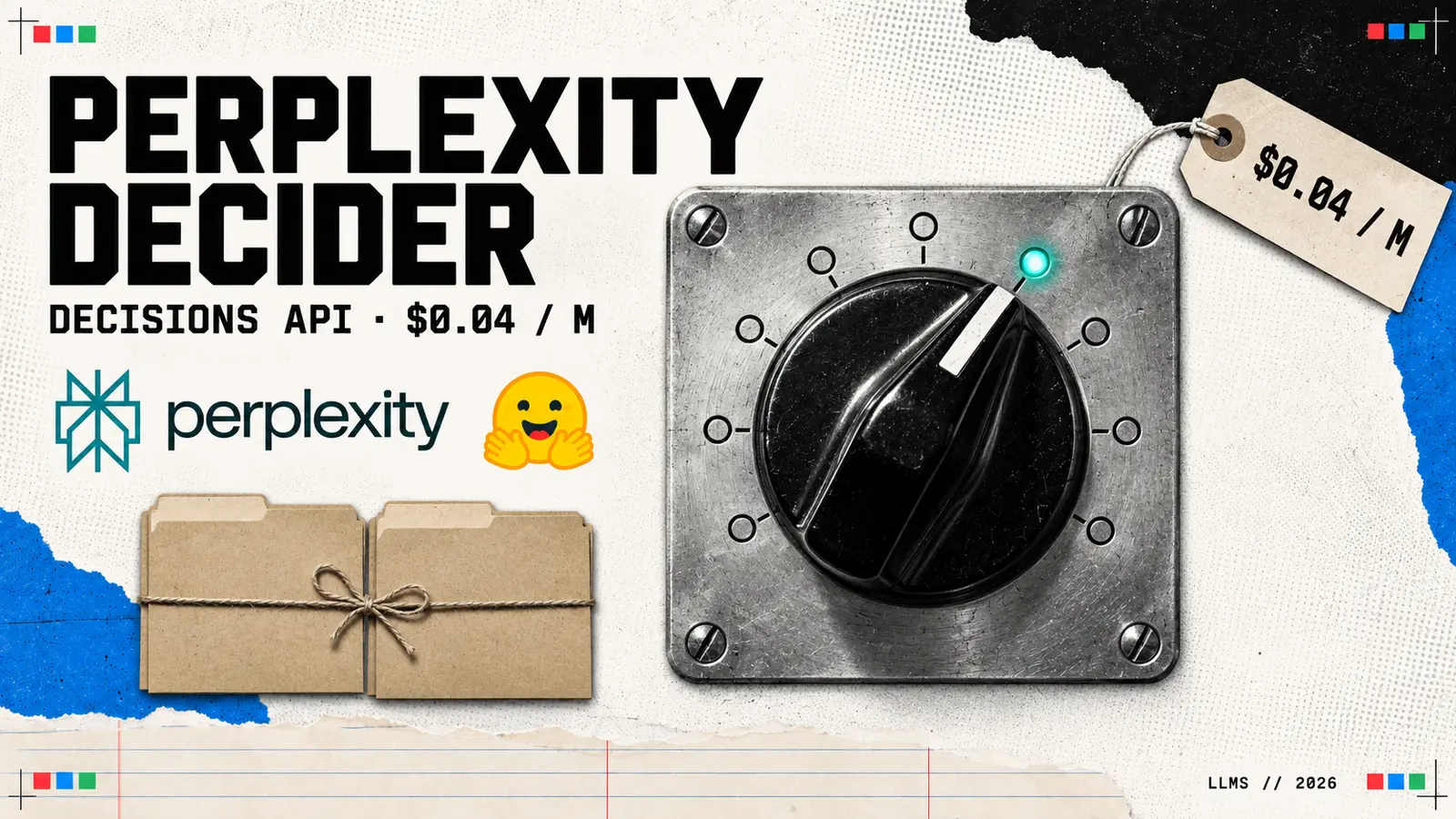
pplx-decider-v1-27b is Perplexity's decision model: it reads text and images and answers set questions with probabilities: yes or no, one of your options, or a level on your rubric. It powers the Decisions API Perplexity launched on 1 October 2026, priced at $0.04 per million input tokens with output free, and its weights are open under Apache 2.0. They are the same files as AutoJev-27B, which Denis Yarats, whose Hugging Face account sits in Perplexity's organisation, uploaded on 22 September.
pplx-decider-v1-27b is a decision model: an AI model that reads a block of text or an image and answers a set of questions with a probability for each possible answer. Perplexity, the company behind the AI answer engine of the same name, launched it on 1 October 2026 as the engine of its new Decisions API, at $0.04 per million input tokens with output free. The weights are open under Apache 2.0.
The Decisions API “answers questions about your content with probabilities”, in the words of Perplexity’s documentation, and each answer is yes or no, one of your options, or a level on your rubric. Software then acts on the numbers, to classify, route or grade content against a rubric.
You get a probability for every answer
The Decisions API takes up to 128 questions a request, each a yes-or-no question, a choice from up to 255 options or a score on up to ten levels, and returns a probability for every allowed answer. A request can carry just under 262,144 tokens of input, counting the content, any images and every question. Images go in as PNG, JPEG or WebP. Every organisation can send 10 requests a second, on every plan.
The model behind it reads natural-language text and images “the way a multimodal language model does” and “returns typed answers with probabilities”, the documentation says. Those typed answers are its whole output. Perplexity’s own timings, from its tests of 30 September 2026, run from under 2 seconds for a few hundred input tokens to 23 seconds for a request just under the input limit.
It costs $0.04 per million input tokens
Perplexity charges $0.04 per million input tokens for the Decisions API, with output tokens free and no per-request fee, according to its documentation read on 2 October 2026. That is level with TypeSafe’s Jev at $0.042 on OpenRouter. A request with 1,000 tokens of input costs $0.00004.
| Decision model | Maker | Price per million input tokens |
|---|---|---|
| pplx-decider-v1-27b | Perplexity | $0.04 |
| Jev 1.13 | TypeSafe | $0.042 |
| Clef-flash | Cloudflare | $0.09 |
| Clef | Cloudflare | $0.24 |
| Strands Decider 2B | AWS Strands Labs | Free download |
The weights are on Hugging Face under Apache 2.0, with the training and serving code under MIT. Running them takes a CUDA GPU “with room for approximately 49 GiB of weights plus working memory”, the model card says.
The same weights went up on 22 September
Every weight and configuration file in Perplexity’s release, all 19 in its manifest, matches a model called AutoJev-27B that was uploaded to Hugging Face nine days before the launch. Denis Yarats, whose Hugging Face account sits in Perplexity’s organisation, created the AutoJev-27B repository on 19 September 2026 with an earlier checkpoint, and replaced its weights with the matching files on 22 September. All 19 files listed in Perplexity’s release manifest, the eleven weight shards, the readout layer, the tokenizer and the configuration files, carry the same SHA-256 hashes in the AutoJev repository, YFarmX found on 2 October 2026.
Perplexity’s own NOTICE file titles the checkpoint “AutoJev 27B curated SFT checkpoint”, and the training code ships as a package named autojev. Both releases mark the model as checkpoint 200. The AutoJev card says it was “Built with autonomous agents, from research and data generation to training, evaluation, and deployment”, trained on one H200 GPU with 73,000 unique training examples, and calls it an “Independent implementation inspired by Jev”.
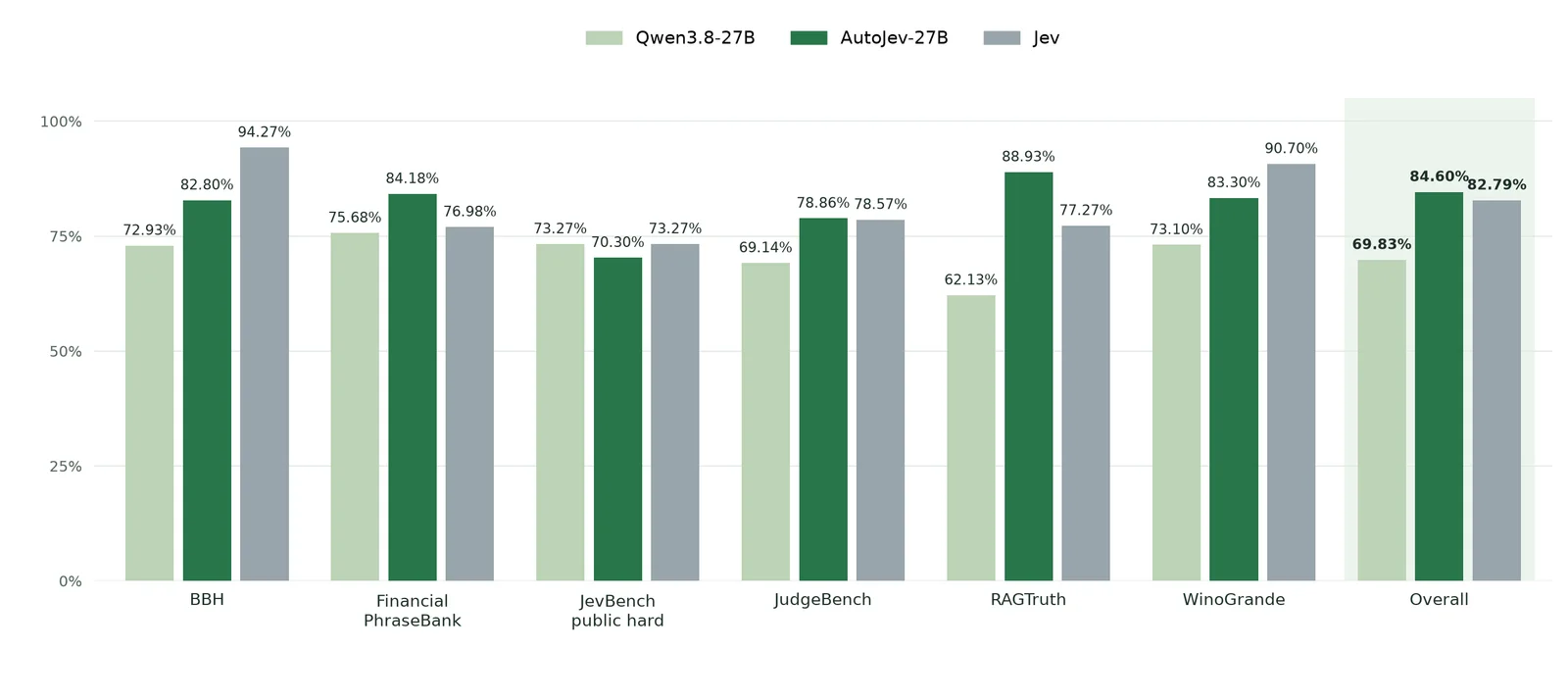
Under the hood it is Alibaba’s Qwen3.8-27B with its text-writing output layer replaced by a 255-option decision readout, and the backbone, vision and readout weights updated by supervised fine-tuning. That leaves 26.1 billion parameters.
Jev wins six of Perplexity’s eleven benchmarks
On Perplexity’s own panel of 11 decision benchmarks, pplx-decider-v1-27b scores 85.71% overall against 84.51% for TypeSafe’s Jev 1.13 and 74.76% for the base Qwen3.8-27B. The overall figure is an average weighted by each benchmark’s number of rows, 7,210 in all. Taken one benchmark at a time, Perplexity’s model leads on five and Jev on six.
| Benchmark | Rows | Jev 1.13 | pplx-decider-v1-27b |
|---|---|---|---|
| WinoGrande | 1,000 | 90.70% | 83.30% |
| FinancialPhraseBank | 999 | 76.98% | 84.18% |
| RAGTruth | 1,500 | 77.27% | 88.80% |
| JudgeBench | 350 | 78.57% | 78.29% |
| BBH | 750 | 94.27% | 82.80% |
| JevBench public hard | 101 | 73.27% | 70.30% |
| TabFact | 500 | 89.80% | 90.60% |
| ContractNLI | 510 | 77.45% | 80.78% |
| Circa | 500 | 84.60% | 89.20% |
| Belebele | 500 | 95.00% | 94.00% |
| TruthfulQA binary | 500 | 92.00% | 85.40% |
| Overall | 7,210 | 84.51% | 85.71% |
RAGTruth, which checks whether an answer is supported by its source documents, decides the overall result. It holds 1,500 of the 7,210 rows and Perplexity’s model beats Jev on it by 11.5 points; across the other ten benchmarks, weighted the same way, Jev leads 86.41% to 84.90%. Jev’s biggest leads are on BBH, a set of hard reasoning tasks, and WinoGrande. A simple average of the eleven scores puts Jev at 84.54% and Perplexity’s model at 84.33%. Both comparisons are YFarmX’s arithmetic on Perplexity’s figures, which Perplexity says “were measured through the Perplexity API”.
Where to use it
The Decisions API runs at POST https://api.perplexity.ai/v1/decisions with the model name pplx-decider-v1-27b, using the same three question types as Jev, Cloudflare’s Clef and AWS’s Strands Decider 2B. OpenAI’s Decisions API, announced at its developer day on 29 September, is a separate product. For Perplexity’s search-grounded chat models, see Sonar.
Decision models multiplied in two weeks
TypeSafe opened the category with Jev on 15 September 2026. By 2 October, OpenRouter’s decisions catalogue carried ten listings from seven makers, and Cloudflare, AWS’s Strands Labs and Perplexity had launched theirs on their own platforms on 1 October. Perplexity’s model sells at Jev’s price, and its biggest gains over Jev on its own panel are on RAGTruth, FinancialPhraseBank and Circa.
Questions people ask
- What is pplx-decider-v1-27b?
- pplx-decider-v1-27b is a decision model from Perplexity, launched on 1 October 2026 behind the Perplexity Decisions API. It reads text and images and returns typed answers with probabilities: yes or no, one of a set of options, or a level on a rubric. It does not write replies or generate code. It is fine-tuned from Alibaba's Qwen3.8-27B and has 26.1 billion parameters.
- How much does the Perplexity Decisions API cost?
- Perplexity charges $0.04 per million input tokens, with output tokens free and no per-request fee, according to its documentation read on 2 October 2026. Every organisation can send 10 requests a second. That is level with TypeSafe's Jev at $0.042 per million input tokens on OpenRouter.
- Is pplx-decider-v1-27b the same as AutoJev-27B?
- Its weights are. All 19 files in Perplexity's release manifest carry the same SHA-256 hashes as the files in the AutoJev-27B repository, which Denis Yarats uploaded to Hugging Face on 22 September 2026 and whose account sits in Perplexity's organisation. Perplexity's own NOTICE file titles the checkpoint AutoJev 27B curated SFT checkpoint, and both releases mark it as checkpoint 200.
- How does it compare with Jev?
- On Perplexity's own panel of 11 decision benchmarks and 7,210 rows, pplx-decider-v1-27b scores 85.71% overall against 84.51% for TypeSafe's Jev 1.13. The overall figure weights each benchmark by its number of rows. Benchmark by benchmark, Perplexity's model leads on five and Jev on six.
More in Large Language Models
All LLMs →- PerplexitySonarsearch-native answering
- TypeSafeJeva decision model that returns a typed answer and a confidence
- CloudflareClef and Clef-flashCloudflare's first trained models: open decision models that answer typed questions with probabilities
- AWS Strands LabsStrands Decider 2Ba small open decision model that runs on a gaming GPU or a laptop
- Google DeepMindGemini 4 Argonlonger reasoning, coding and cyber defence
- OpenAIGPT-5.6the flagship from 9 July to 3 September 2026