
StepFun
Step 5 Preview
StepFun's flagship for long agent jobs, with downloadable weights
Key facts
- 20 Sep 2026API, AI Studio, Step Plan
- Released
- 600B27B active per token
- Size
- 1M sharedinput and output combined
- Context
- $1.00 / $2.70per M tokens in / out
- Price
- 44v4.3.2, Artificial Analysis
- Intelligence Index
- 15 Oct 2026weights available
- Open weights
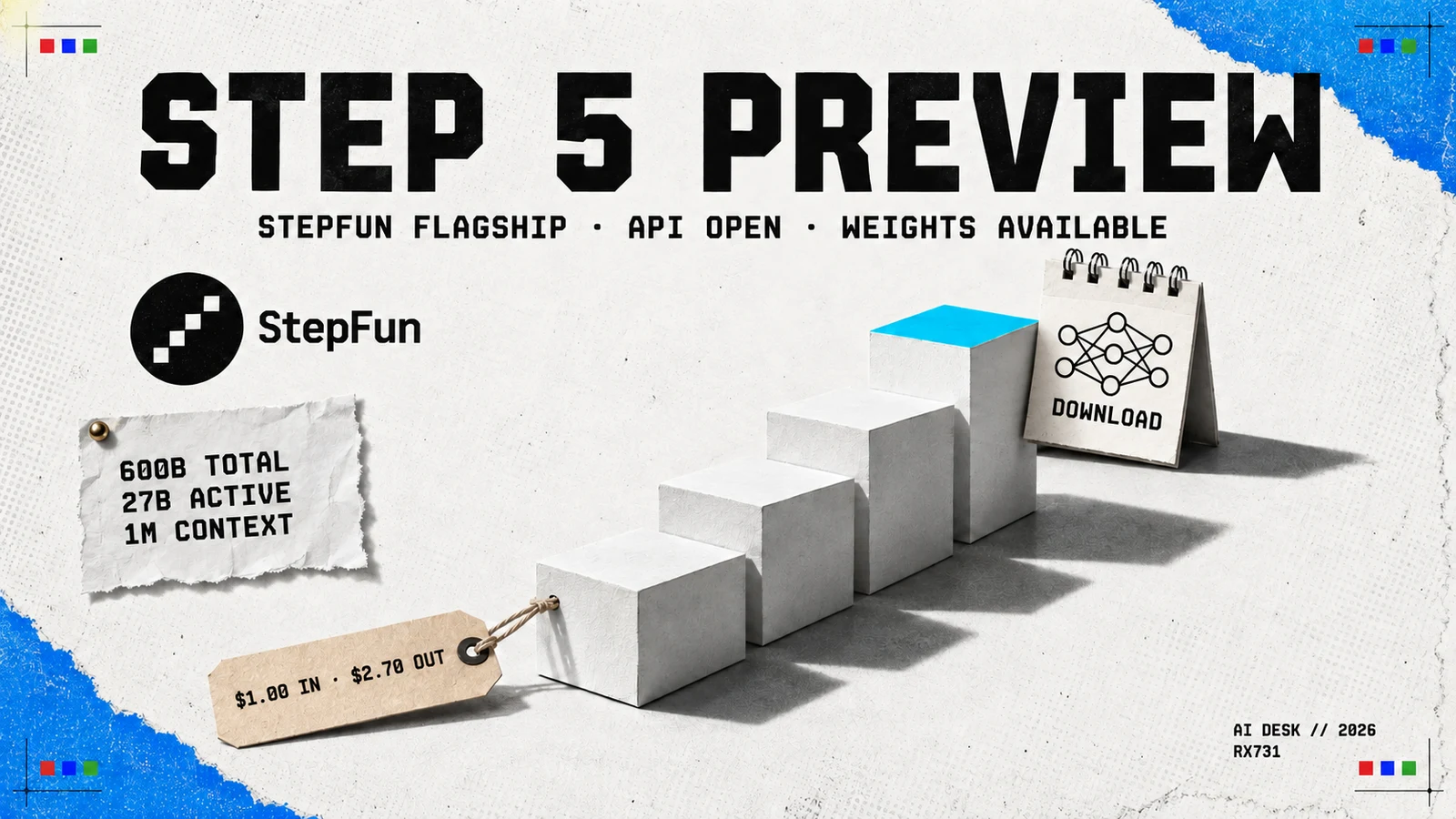
Step 5 Preview is an AI language model from StepFun, a Shanghai company, built to carry long jobs through on its own: writing and fixing code, gathering research, building financial analysis. It went on sale on 20 September 2026, reads text, images and video, holds a million tokens of context, and costs $1 for every million tokens you send it and $2.70 for every million it writes. Artificial Analysis scores it 44 on its Intelligence Index, level with Kimi K3 and Grok 4.6, and its weights are available under StepFun Model License 1.0, checked on 15 October 2026.
What Step 5 Preview is
Step 5 Preview is a large language model from StepFun, a Shanghai artificial intelligence company, built to work through long jobs on its own: writing and fixing code, gathering and checking research, and building financial analysis. StepFun announced it on 20 September 2026 in a post on X, calling it “our new flagship model for agentic work”, and its launch page says it went on sale the same day “through our products and API”. It reads text, images and video, writes text, and holds a context window of one million tokens, according to StepFun’s model documentation.
The model is a mixture of experts. It stores 600 billion parameters, the numbers it learned in training, and runs 27 billion of them for each token it reads or writes, so each request costs far less to serve than the full size suggests. StepFun gives both figures on its launch page, and Artificial Analysis, the independent benchmarking company, repeats them in its own write-up of 22 September 2026.
StepFun works from Xuhui District in Shanghai, the address on its own site. Its previous reasoning model, Step 3.7 Flash, is a 198B model with open weights on Hugging Face under Apache 2.0. Artificial Analysis dates Step 3.7 Flash to 29 May 2026 and scores it 19 on the same Intelligence Index where Step 5 Preview scores 44.
What it costs
StepFun charges $1.00 for every million tokens sent to Step 5 Preview and $2.70 for every million it writes back, on its pricing page read on 27 September 2026. Repeated input that hits the cache costs $0.05 per million, a 95% discount.
| Per million tokens | step-5-preview | step-3.7-flash |
|---|---|---|
| Input, cache miss | $1.00 | $0.20 |
| Input, cache hit | $0.05 | $0.04 |
| Output | $2.70 | $1.15 |
The cache-miss price already covers writing new content into the cache. Output tokens count the model’s reasoning as well as its final answer, which weighs on this model in particular: to run the Intelligence Index, Step 5 Preview generated 160 million output tokens against a median of 88 million for comparable models, which Artificial Analysis calls “very verbose”. Its measured cost comes to $0.72 per index task.
Pay-as-you-go accounts are rate limited by how much cash they have topped up in total. Only cash top-ups count towards a tier, and individual accounts complete identity verification first.
| Tier, by total top-up | Concurrent requests | Requests a minute | Tokens a minute |
|---|---|---|---|
| V0, under $15 | 5 | 100 | 500,000 |
| V1, $15 to $69 | 20 | 400 | 2,000,000 |
| V2, $70 to $299 | 30 | 600 | 3,000,000 |
| V3, $300 to $1,499 | 40 | 800 | 4,000,000 |
| V4, $1,500 and above | 130 | 2,600 | 13,000,000 |
You can also pay monthly through Step Plan
Step Plan, StepFun’s subscription for coding tools and agent apps, includes Step 5 Preview from $6.99 a month, according to the Step Plan overview. Each tier issues a monthly allowance of Credits, which StepFun converts at about 7 million Credits to $1 of model use, and unused Credits clear at the end of the month.
| Plan | Monthly Credits | Monthly | Yearly |
|---|---|---|---|
| Flash Mini | 400M | $6.99 | $69.99 |
| Flash Plus | 1,600M | $9.99 | $95.99 |
| Flash Pro | 8,000M | $29 | $289 |
| Flash Max | 40,000M | $99 | $989 |
Quarterly billing costs $18.99, $26.99, $79 and $269 for the four tiers. At StepFun’s conversion rate, Flash Mini’s 400 million Credits buy roughly $57 of usage for $6.99. Step Plan is exempt from the top-up rate limits, and booster packs at $6.99 for 400M Credits and $9.99 for 1,600M top up a month that runs dry. StepFun publishes setup guides for Claude Code, Cursor, Cline, OpenClaw and eleven more tools, and its Claude Code guide switches on the full one-million-token context.
Step 5 Preview ties Kimi K3 on the independent index
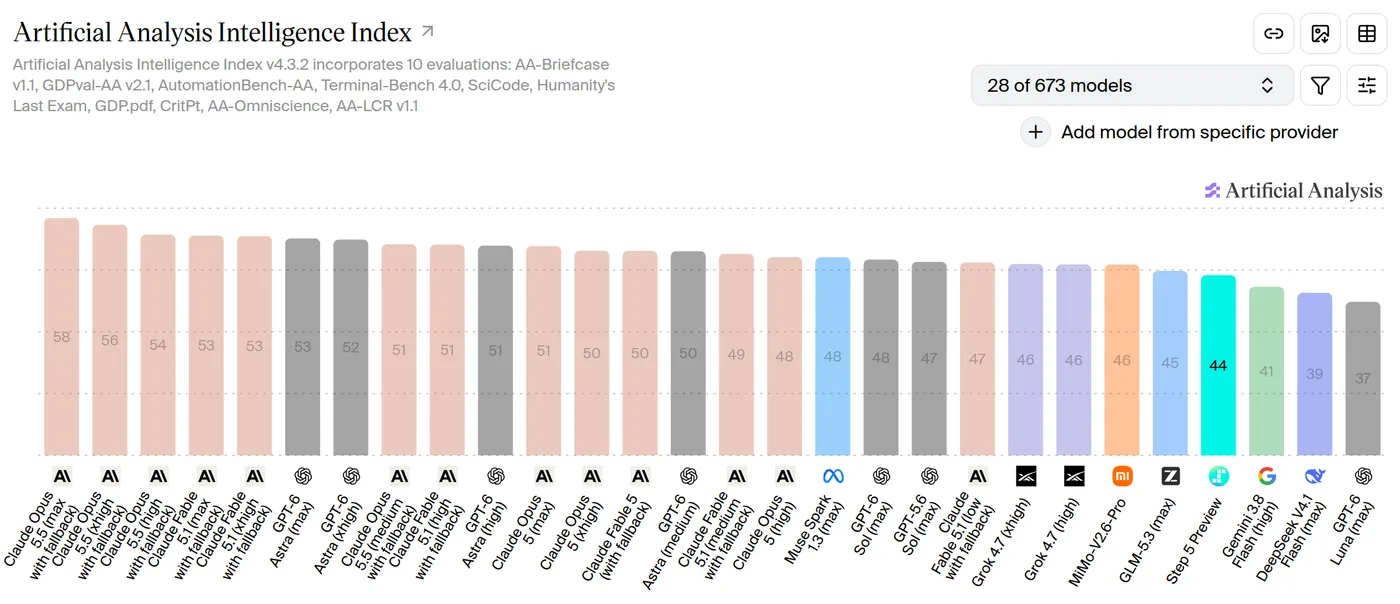
Artificial Analysis scores Step 5 Preview 44 on version 4.3.2 of its Intelligence Index, level with Kimi K3 (max) and Grok 4.6 (high), on its model pages read on 27 September 2026. The index combines ten evaluations run by Artificial Analysis itself: AA-Briefcase, GDPval-AA, AutomationBench-AA, Terminal-Bench 4.0, SciCode, Humanity’s Last Exam, GDP.pdf, CritPt, AA-Omniscience and AA-LCR.
| Artificial Analysis, 27 September 2026 | Intelligence Index v4.3.2 | Cost per index task | Input / output, per M tokens |
|---|---|---|---|
| Step 5 Preview | 44 | $0.72 | $1.00 / $2.70 |
| Kimi K3 (max) | 44 | $2.00 | $3.00 / $15.00 |
| Grok 4.6 (high) | 44 | $1.86 | $2.00 / $6.00 |
| GLM-5.3 (max) | 45 | $2.01 | $1.40 / $4.40 |
| MiMo-V2.6-Pro | 46 | $0.13 | $0.435 / $0.87 |
In its post of 22 September 2026, Artificial Analysis says Step 5 Preview is “matching Kimi K3 (max) at ~2.8x lower cost per task, but trails peers on agentic evaluations”. Against Kimi K3, Grok 4.6 and GLM-5.3, it does the index’s work at a little over a third of their cost per task, and its evaluation scores split as follows.
| Evaluation | Step 5 Preview | Best of the other three | Whose |
|---|---|---|---|
| Terminal-Bench 4.0 | 33.3% | 41.9% | GLM-5.3 (max) |
| AutomationBench-AA | 51.0% | 66.7% | Grok 4.6 (high) |
| AA-Briefcase v1.1 (Elo) | 1,432 | 1,539 | Grok 4.6 (high) |
| AA-LCR v1.1, long context | 88.3% | 88.7% | Kimi K3 (max) |
| Humanity’s Last Exam | 46.5% | 46.9% | Kimi K3 (max) |
Step 5 Preview scores lowest of the four on AutomationBench and AA-Briefcase, the two tests of multi-step business work, where Kimi K3 scores 58.3% and 1,505 and GLM-5.3 62.2% and 1,517. It handles long documents about as well as Kimi K3, and on Terminal-Bench 4.0 it clears Kimi K3’s 12.6% and Grok 4.6’s 21.2%.
On StepFun’s own API, Artificial Analysis measures 66.4 output tokens a second, slower than the average of 78 across the models it compares it with, and 2.96 seconds to the first token.
Xiaomi’s MiMo V2.6 Pro scores higher for less
Xiaomi’s MiMo V2.6 Pro, released on 21 September 2026, scores 46 on the Intelligence Index at $0.13 a task on Artificial Analysis, against Step 5 Preview’s 44 at $0.72. Among the four models scoring 44 or 45, Step 5 Preview, Kimi K3, Grok 4.6 and GLM-5.3, Step 5 Preview is the cheapest per task by a wide margin. StepFun titled its launch “Advancing the Pareto Frontier”, the line of best score for the money, and on Artificial Analysis’s per-task costs Step 5 Preview’s $0.72 is about 64% below GLM-5.3’s $2.01 and Kimi K3’s $2.00. MiMo V2.6 Pro arrived the next day with open MIT-licensed weights at 1.02 trillion parameters, and Artificial Analysis’s cost chart now draws its frontier line through MiMo, above and to the left of Step 5 Preview.
The comparison splits by what a buyer needs. Against Kimi K3, which Artificial Analysis lists at 2.8 trillion parameters and $2.00 a task, Step 5 Preview reaches the same index score at a little over a third of the cost. Against GLM-5.3 at $2.01 a task, it gives up one index point and 8.6 points of Terminal-Bench 4.0 for a similar saving. Grok 4.6 scores 44 at $1.86 a task, leads Step 5 Preview on AutomationBench and AA-Briefcase, and trails it on Terminal-Bench 4.0.
StepFun’s own tests put it level with Kimi K3 and behind Claude
On StepFun’s own runs, published on its launch page on 20 September 2026, Step 5 Preview beats GLM-5.3 (max) on 25 of 38 benchmarks, splits Kimi K3 (max) almost evenly at 18 wins, 19 losses and 3 ties across 40, and trails Claude Opus 5 (max) on 33 of 38. A selection of StepFun’s figures:
| Benchmark, StepFun’s figures | Step 5 Preview (high) | Kimi K3 (max) | Claude Opus 5 (max) |
|---|---|---|---|
| GPQA Diamond | 93.5% | 93.5% | 93.2% |
| DeepSWE v1.1 | 67.7% | 67.5% | 74.0% |
| ProgramBench, pass rate | 80.5% | 77.8% | 82.3% |
| SWE-Atlas-QnA | 63.6% | 59.5% | 66.0% |
| Toolathlon-Verified | 74.1% | 76.5% | 80.6% |
| BrowseComp | 88.7% | 91.2% | 90.2% |
| FrontierFinance | 66.4% | 62.6% | 69.7% |
| StepCodeBench, StepFun’s own test | 49.0% | 43.9% | 63.9% |
StepCodeBench is StepFun’s in-house coding test, built from 553 repositories across 9 task categories, 20 application domains and 33 programming languages, and Step 5 Preview scores 49.0% averaged over four attempts. StepFun describes it as “approaching Claude Opus 5 on low- and medium-difficulty tasks”, and says that “on the most challenging long-running tasks, a meaningful gap to the frontier remains”. DeepSWE v1.1 ran on the SWE-agent harness at a temperature of 1.0 and a top_p of 0.95.
Finance is the domain StepFun singles out. FrontierFinance is an outside benchmark of 220 expert-written questions scored against 11,543 criteria, and StepFun’s three in-house FinStepBench tests cover live financial search, company valuation and full research reports.
Step 5 Preview spent 24 hours tuning a GPU kernel
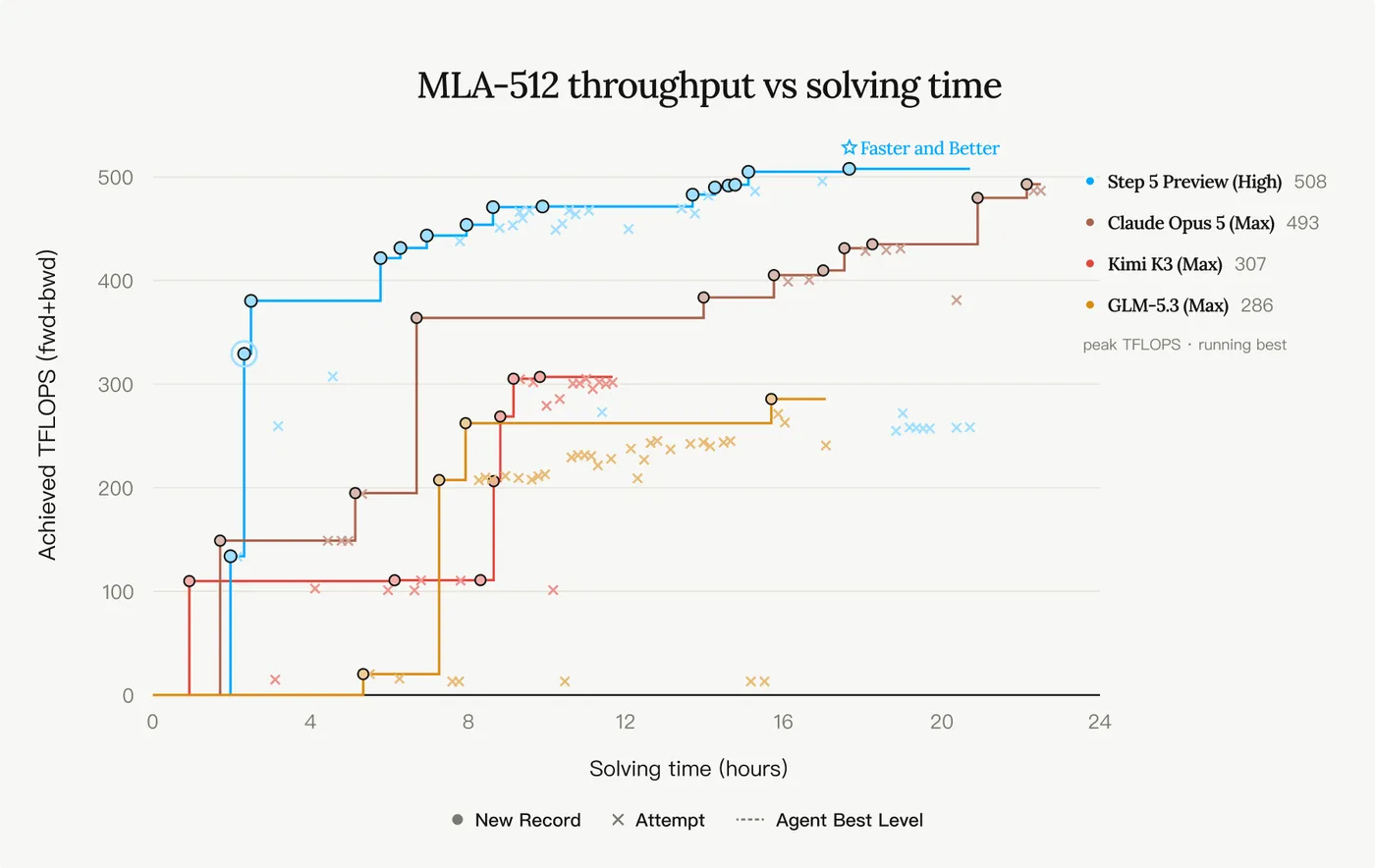
StepFun gave Step 5 Preview 24 hours to speed up an MLA attention kernel, a piece of low-level GPU code, on an NVIDIA H100, and reports that its best run reached 508 TFLOPS across the forward and backward passes, against 493 for Claude Opus 5. The kernel used a head dimension of 512 at a production shape of batch size 1, 64 heads and 8,192 tokens. Each model had four independent attempts, free to stop early, and StepFun reports the best of the four. In the same test Kimi K3 reached 307 TFLOPS and GLM-5.3 286, by StepFun’s count.
StepFun ran two more long jobs. In a second 24-hour test, Step 5 Preview ran automated post-training on a Qwen3-30B-A3B base model and lifted its AIME24 score from 53.3% to 60%, which StepFun says matched Claude Opus 5 using fewer annotator tokens. And in Pokémon Red it had played more than 3,000 turns and 6 million tokens by the time the launch page went up: by turn 3,082 it held three Gym Badges and had beaten Lt. Surge.
What you can send it
The following table describes StepFun’s hosted API, whose documentation still lists a 64K output allowance when checked on 15 October. The downloadable model card describes output up to 1M tokens within the shared input-and-output budget. Runtime and service limits determine what a deployment accepts.
StepFun’s current model card lists up to one million tokens of output within a context budget shared by input and output. The available response length therefore depends on the prompt and runtime settings.
| Item | Supported |
|---|---|
| Model ID | step-5-preview |
| Input | Text, images and video |
| Hosted API output | Text, up to 64K tokens |
| Images | JPG, PNG, WebP and static GIF, up to 60 a request, by URL or Base64, at low or high detail |
| Video | MP4, QuickTime and Matroska, by URL, Base64 or a Files API reference; MP4 files under 128 MB, under 5 minutes recommended |
| Reasoning effort | low, medium or high |
| Also supported | Streaming, tool calling, JSON Mode and JSON Schema, prompt caching |
Reasoning effort is set with reasoning_effort on the OpenAI-style Chat Completions API and with output_config.effort on the Anthropic-style Messages API. Search, code execution and other tools come from the application calling the model, which reaches your files and outside services only through them.
How to try it
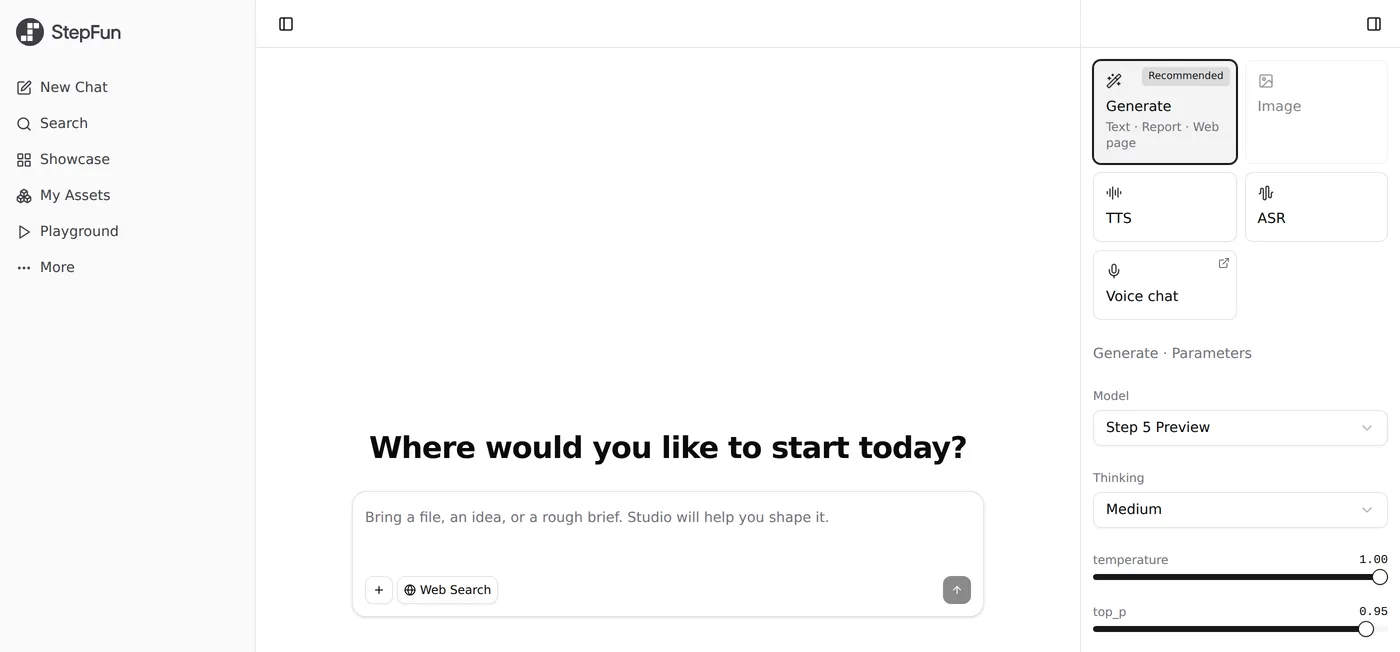
Step 5 Preview runs in three StepFun products. The API at api.stepfun.ai takes the model ID step-5-preview. Step Plan carries it into coding tools such as Claude Code and Cursor. And AI Studio, StepFun’s browser app, runs it with the thinking level and sampling settings in a side panel; on 27 September 2026 it was the model selected for Generate when the app opened.
Artificial Analysis lists one API provider for the model, StepFun itself, and its speed and latency figures come from that first-party endpoint.
StepFun publishes downloadable weights
The official repository now contains FP8 weights and links to BF16 checkpoints. Availability was verified on 15 October 2026. The original hosted release remains dated 20 September.
Step 5 uses StepFun Model License 1.0, which grants use and redistribution rights subject to additional conditions. Read those terms for a planned deployment.
What to watch
Deployment and the licence. The weights are available; hardware requirements and the licence conditions determine how another operator can serve them.
The agent scores. Artificial Analysis says Step 5 Preview trails its peers on agent evaluations, and AutomationBench and AA-Briefcase are where the gap is widest. A model named Preview leaves room for a later build that closes it.
The token bill. Step 5 Preview wrote 160 million output tokens to finish one index run, nearly twice the median, so a real bill depends as much on how long it thinks as on its price per token. Measure a real workload before committing to it.
For the models StepFun measures itself against, see Kimi K3 and GLM-5.3; for the cheaper open model that arrived a day later, MiMo V2.6.
Questions people ask
- How much does Step 5 Preview cost?
- StepFun charges $1.00 per million input tokens, $0.05 per million on a cache hit and $2.70 per million output tokens, on its pricing page read on 27 September 2026. Output tokens include the model's reasoning as well as its answer. Step Plan, StepFun's monthly subscription, includes the model from $6.99 a month.
- How big is Step 5 Preview?
- Step 5 Preview is a mixture-of-experts model with 600 billion parameters in total, of which 27 billion run for each token. StepFun gives both figures on its launch page of 20 September 2026, and Artificial Analysis repeats them in its own write-up of 22 September.
- What does Step 5 Preview score on the Artificial Analysis Intelligence Index?
- It scores 44 on version 4.3.2 of the index, level with Kimi K3 (max) and Grok 4.6 (high), as of 27 September 2026. Artificial Analysis puts its cost at $0.72 per index task, against $2.00 for Kimi K3 (max) and $1.86 for Grok 4.6 (high).
- Can I download Step 5 Preview?
- Yes. StepFun publishes FP8 and BF16 checkpoints under StepFun Model License 1.0, checked on 15 October 2026. The licence contains additional conditions and should be read before commercial deployment or redistribution.
More in Large Language Models
All LLMs →- Moonshot AIKimi K3the largest open-weight model yet released
- Z.ai / ZhipuGLM-5.3a post-training update with an emergent cyber capability
- xAIGrok 4.6xAI's flagship until Grok 4.7 replaced it, built for long-running agents
- XiaomiMiMo V2.6Flash, Pro and Pro UltraSpeed, released together
- DeepSeekDeepSeek-V4.1-Flasha 552B open-weight model built around its cache
- Google DeepMindGemini 4 Argonlonger reasoning, coding and cyber defence