
xAI
Grok 4.6
xAI's flagship until Grok 4.7 replaced it, built for long-running agents
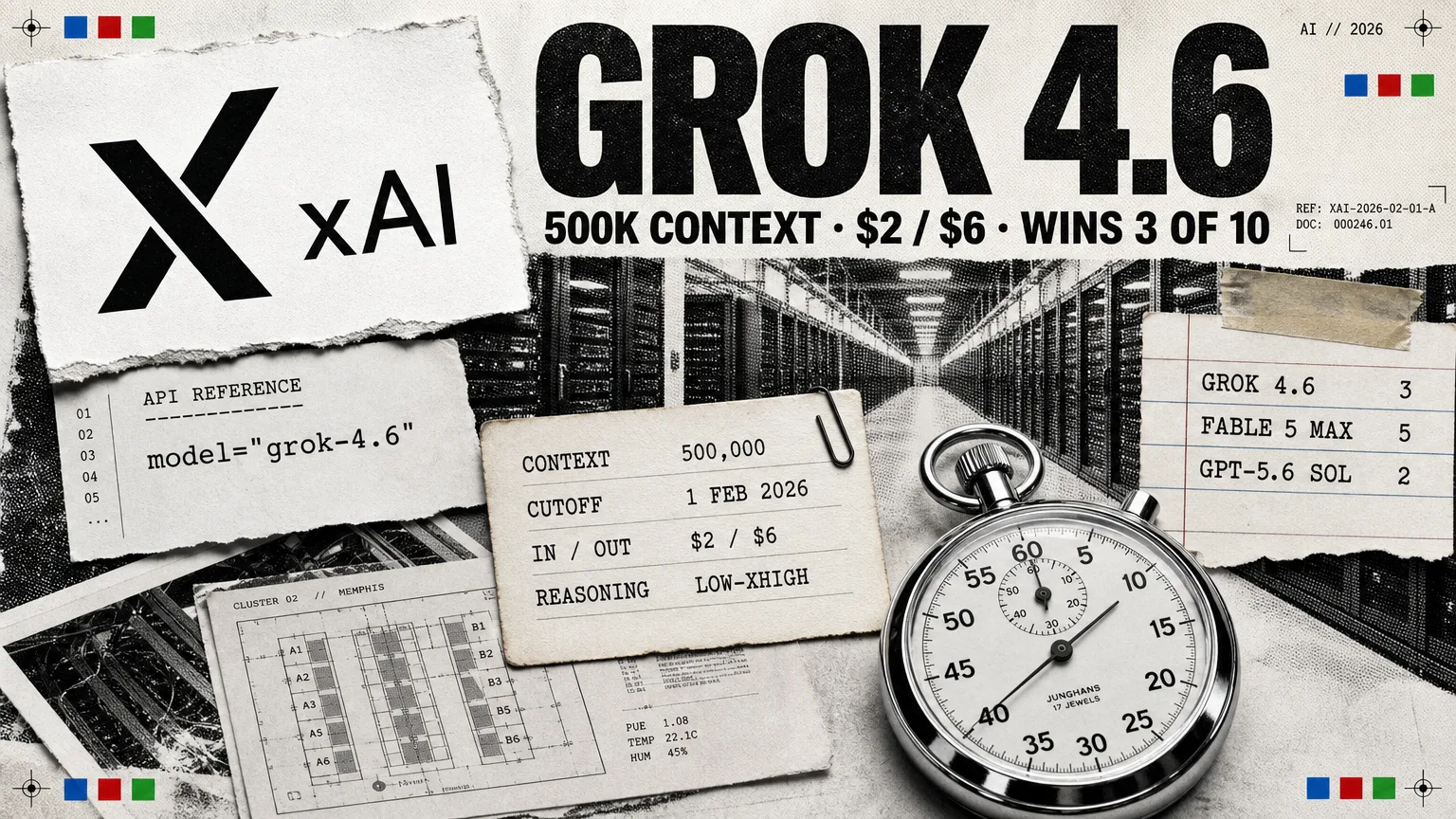
Key facts
- 12 Aug 2026flagship to 21 Sep 2026
- Released
- 500ktokens
- Context
- $2 / $6per M in / out
- Price
- $0.50up from $0.30
- Cached in
- 3on xAI's own table
- Best of 10
- 1 Feb 2026knowledge
- Cutoff
xAI's fastest-moving flagship yet, and the honest read is in its own launch table: a clear jump over Grok 4.5 on all ten benchmarks, and the best score on only three of them.
What it is
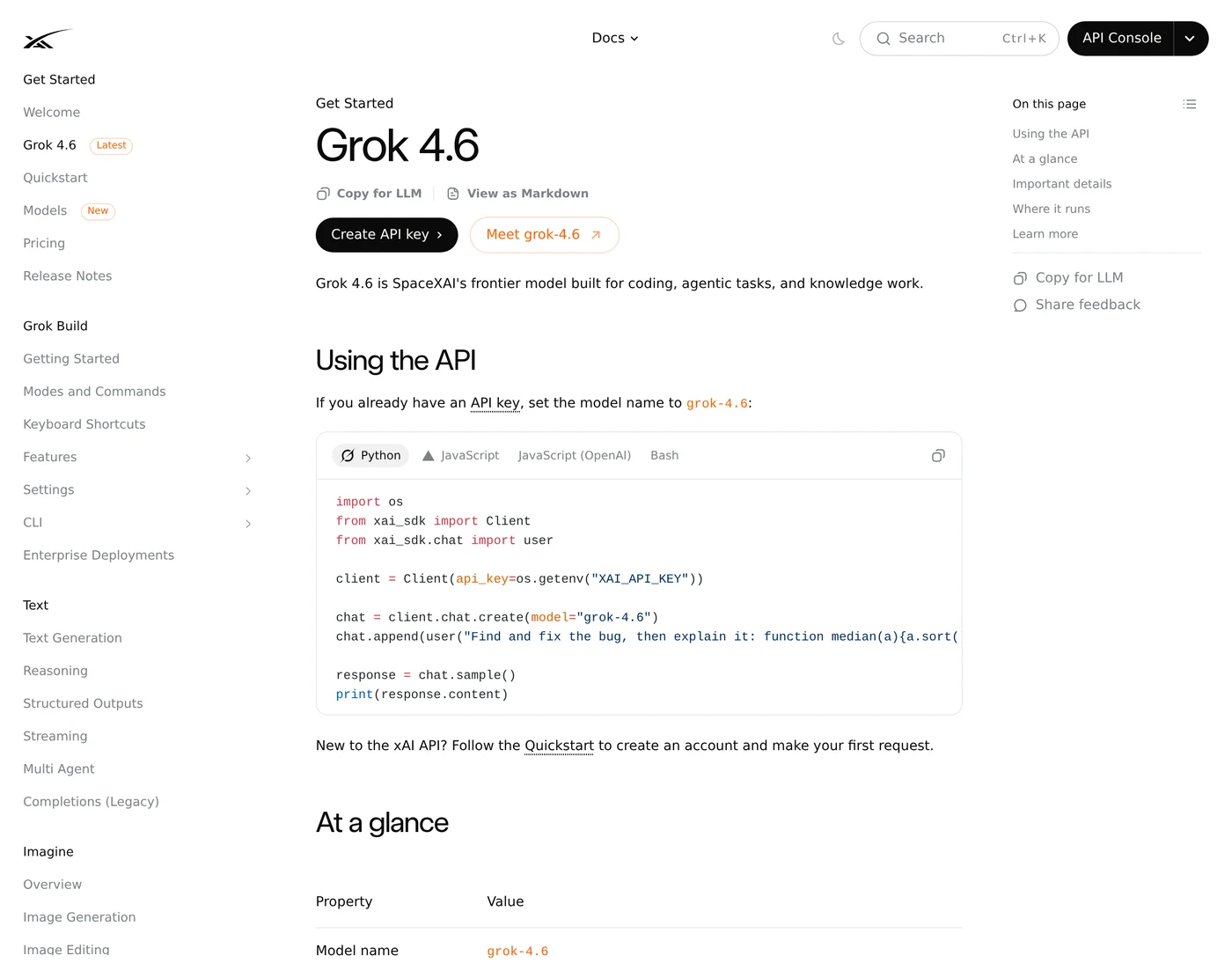
Grok 4.6 was xAI’s flagship model from 12 August 2026 until Grok 4.7 replaced it on 21 September 2026. It arrived thirty-five days after Grok 4.5. The API model name is grok-4.6, and the company’s own documentation describes it as “SpaceXAI’s frontier model built for coding, agentic tasks, and knowledge work”.
The launch announcement puts the emphasis on stamina rather than raw intelligence: Grok 4.6 “builds on Grok 4.5 with a particular focus on long-running agents and more ambitious interactive and visual work”, and “stays with complex tasks across many steps, whether researching a topic, analyzing information, working across a codebase, or turning an idea into a polished application or work artifact.”
What does xAI’s own benchmark table actually show?
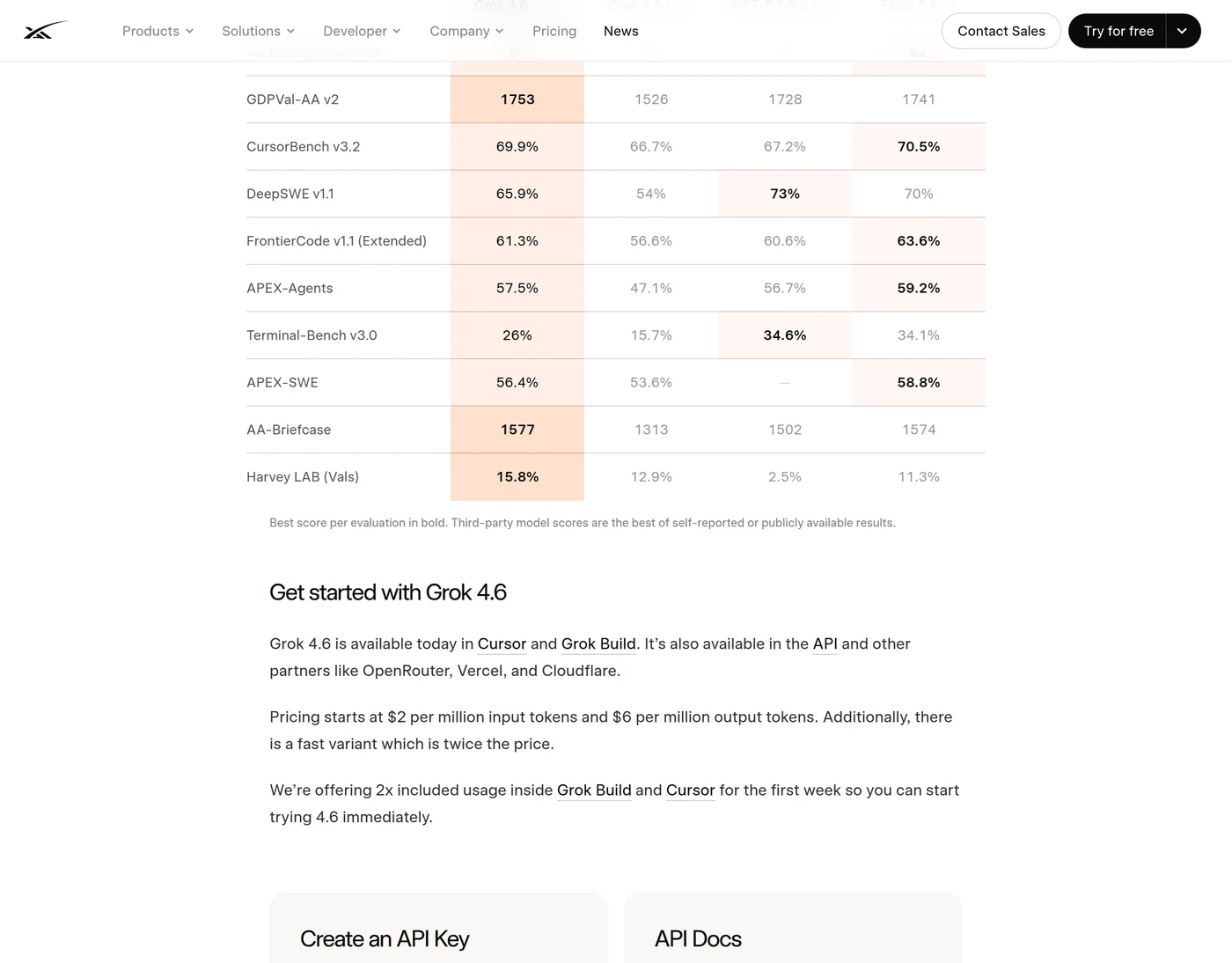
It shows Grok 4.6 taking the best score in three rows out of ten. xAI published a ten-benchmark comparison against Grok 4.5, GPT-5.6 Sol Max and Claude Fable 5 Max, with the winner of each row in bold, and its own model is not the one in bold most often.
| Benchmark | Grok 4.6 | Grok 4.5 | Leader |
|---|---|---|---|
| AA Intelligence Index | 61 | 56 | 62 Fable 5 Max |
| GDPVal-AA v2 | 1753 | 1526 | Grok 4.6 |
| CursorBench v3.2 | 69.9% | 66.7% | 70.5% Fable 5 Max |
| DeepSWE v1.1 | 65.9% | 54% | 73% GPT-5.6 Sol Max |
| FrontierCode v1.1 | 61.3% | 56.6% | 63.6% Fable 5 Max |
| APEX-Agents | 57.5% | 47.1% | 59.2% Fable 5 Max |
| Terminal-Bench v3.0 | 26% | 15.7% | 34.6% GPT-5.6 Sol Max |
| APEX-SWE | 56.4% | 53.6% | 58.8% Fable 5 Max |
| AA-Briefcase | 1577 | 1313 | Grok 4.6 |
| Harvey LAB (Vals) | 15.8% | 12.9% | Grok 4.6 |
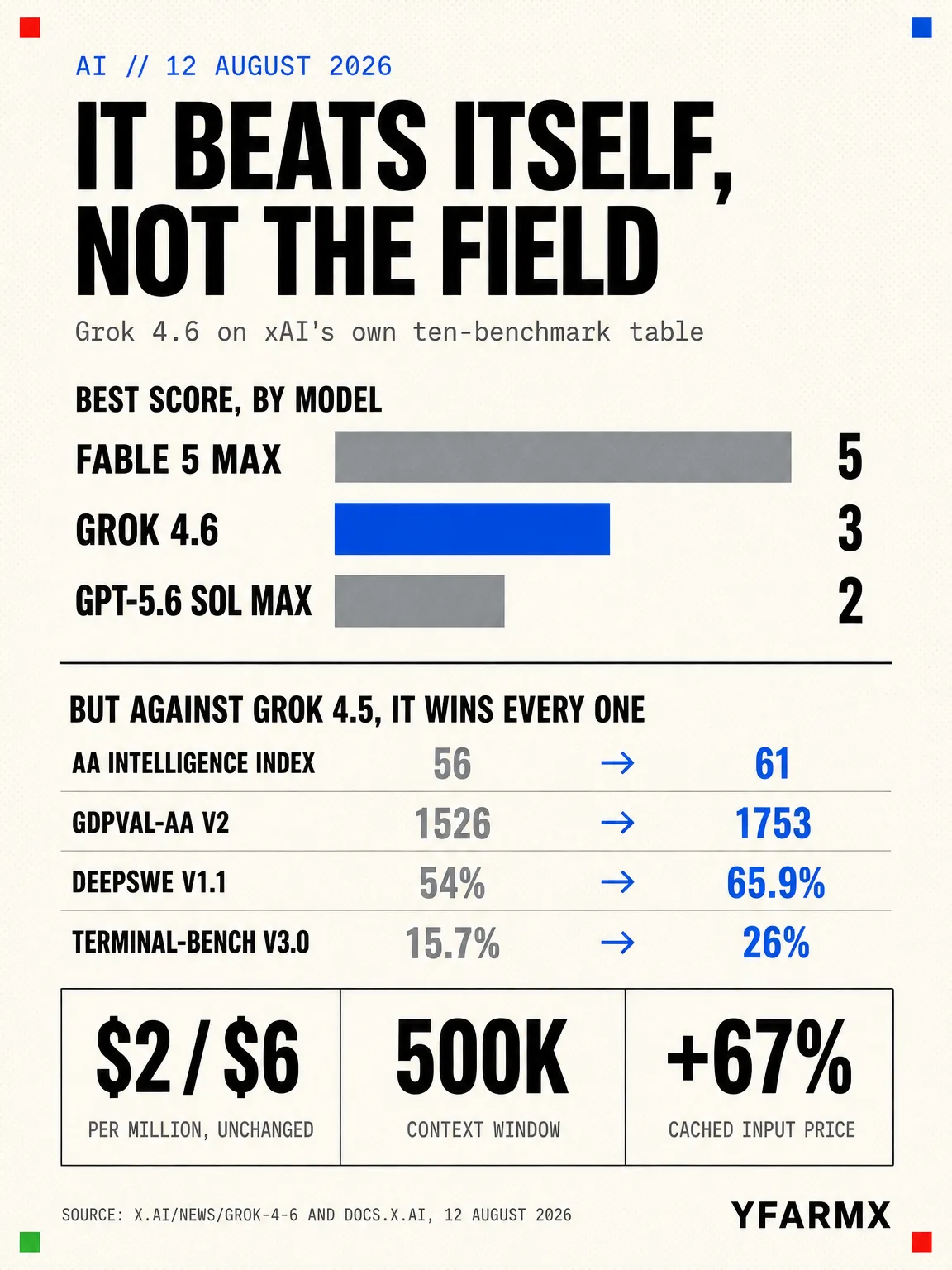
Counted up, Claude Fable 5 Max takes five rows, Grok 4.6 takes three, and GPT-5.6 Sol Max takes two. Grok’s three wins are the two economic and professional-work measures, GDPVal-AA and AA-Briefcase, plus a legal benchmark where the field is weak: Harvey LAB, where 15.8 per cent is the best score on offer and GPT-5.6 Sol manages 2.5 per cent.
The losses are not close everywhere either. On Terminal-Bench v3.0 Grok 4.6 scores 26 per cent against 34.6 for GPT-5.6 Sol, and on DeepSWE v1.1 it takes 65.9 per cent against 73. Both are agentic coding tests, which is the ground the launch is pitched on.
Publishing a table you lose is unusual enough to be worth saying out loud. The company’s own framing is careful and accurate: Grok 4.6 “achieves frontier intelligence across several agentic coding and knowledge work benchmarks” and “matches GPT-5.6 Sol on the Artificial Analysis Intelligence Index”. Both claims survive the table.
One row has moved since. The table is xAI’s own reading of 12 August 2026, and Artificial Analysis re-scores continuously: on 21 August 2026 its Intelligence Index put Claude Opus 5 at maximum effort first on 63, level with the same model at xhigh effort, then Claude Fable 5 at maximum effort on 62 and GPT-5.6 Sol at maximum on 61. The 62 xAI printed as the leading figure is no longer the top of that board.
Where it does win, decisively
Against its own predecessor. Grok 4.6 improves on Grok 4.5 in all ten rows, and several are step changes rather than increments: Terminal-Bench v3.0 goes from 15.7 to 26 per cent, DeepSWE from 54 to 65.9, GDPVal-AA from 1526 to 1753. Artificial Analysis, which runs the index independently, recorded the same jump: “Grok 4.6 gains 5 points over Grok 4.5 on the Intelligence Index just over one month after its release.”
Elon Musk marked the launch with one figure, on X, on 12 August: “Grok 4.6 reaches 1753 ELO.”
The specification
| Model name | grok-4.6 |
| Context window | 500,000 tokens |
| Knowledge cutoff | 1 February 2026 |
| Modalities | Text and image input, text output |
| Output limit | None stated |
| Reasoning effort | Low, medium, high (default), xhigh |
| APIs | Responses API, Chat Completions |
| Tools | Function calling, web search, X search, code execution |
xAI recommends setting a prompt_cache_key so a conversation’s requests route to the same server: without it, the docs warn, “you often pay full input price on a cache-cold server.”
How much does it cost to run?
The headline price has not moved from Grok 4.5: $2.00 per million input tokens and $6.00 per million output. What has changed is the cached rate, from $0.30 to $0.50 per million, an increase of about 67 per cent on the tokens an agent loop re-reads most.
The number that catches people is the long-context tier. Once a prompt reaches 200,000 tokens, every rate doubles, and xAI is explicit that this applies to the whole request: “Models with long context pricing bill the long context rates for all tokens in a request once its prompt reaches the model’s long context threshold.”
Tools are billed separately, at $5 per thousand calls each for web search, X search and code execution.
Where you can use it
Grok 4.6 shipped into Cursor and Grok Build on day one, and is also on the xAI API, OpenRouter, Vercel and Cloudflare. It is the default model of the Grok Build coding agent, on both the API and the CLI. xAI offered double the included usage inside Grok Build and Cursor for the launch week.
The announcement also mentions “a fast variant which is twice the price”. As of 12 August xAI has published no separate model ID or price line for it, so there is nothing to point an API call at yet.
How it was trained
xAI is more forthcoming than usual here. Grok 4.6 had “a longer supplemental training run than Grok 4.5”, using curated model-generated data for reasoning and technical concepts, high-quality engineering data, and what the company calls an improved optimiser and training recipe.
The step worth noticing is the next one: xAI used Grok 4.5 to regenerate the supervised fine-tuning trajectories for the new model, across reasoning efforts, agent harnesses and domains, then filtered out bad traces with model-based checks. The previous flagship became the teacher for its successor. Reinforcement learning followed on agentic tasks including kernel optimisation, web development and computer-aided design.
xAI has published no parameter count. The figure in circulation, 1.5 trillion on the same foundation as Grok 4.5, comes from a Musk post on 28 July, before release, and is his personal statement rather than anything in a model card. The same post says Grok 4.7 will be a 2.1-trillion-parameter model “released a few weeks later”.
The company changed its name and did not announce it
xAI’s own pages, including the Grok 4.6 announcement and the API documentation, now carry SpaceXAI in the masthead, while the copyright line still reads X.AI LLC. Our Grok 4.5 page recorded SpaceXAI in July as a name other coverage had started using. It is now the name on the company’s own products. We could not find a dated announcement of the rebrand itself on any xAI channel.
What is worth checking before you commit to it
The safety section of the announcement is thin by the standards of a frontier release: safeguards “improved and calibrated in line with the model’s capabilities”, the “widest-ever suite of pre-deployment testing”, and third-party testing referred to but not named or linked. No separate system card accompanied the launch, which is a change from xAI’s earlier practice and leaves the strongest claims on this page resting on the company’s own summary.
The gap this leaves is measurable elsewhere. Grok 4.6 does not yet appear on the standard SWE-bench Verified leaderboard, on ARC-AGI, or in a dated Arena placement, so the coding case rests on xAI’s own choice of benchmarks, three of which are its own or its partner’s. Artificial Analysis has confirmed the headline index score and the GDPVal figure independently, and its cost-per-task measurement of $0.84 is the most useful outside number available: it puts Grok 4.6 at roughly half the turns and a quarter of the input tokens of Claude Opus 5 on the same work.
For where this sits against the rest of the field, see our large language models hub and the wider AI section.
More in Large Language Models
All LLMs →- xAIGrok 4.5the coding pivot, superseded by Grok 4.6
- AnthropicClaude Fable 5the first model in Anthropic's Mythos class
- OpenAIGPT-5.6the flagship from 9 July to 3 September 2026
- Google DeepMindGemini 4 Argonlonger reasoning, coding and cyber defence
- OpenAIGPT-6 Astrathe new generation, rolling out from 3 September 2026
- OpenAIGPT-6.1 Solthe upgraded mid-price GPT-6 model, released 29 September 2026