
California SB 243
the companion chatbot law, in force since January
Key facts
- 13 Oct 2025Chapter 677, Padilla
- Signed
- 1 Jan 2026BPC sections 22601 to 22606
- In force
- $1,000per violation, private action
- Damages
- 1 Jul 2027to the Office of Suicide Prevention
- Reports due
- 10 Sep 2026SB 1119, operative 2027
- Adam's Law
Since 1 January 2026, a companion chatbot serving Californians must say it is AI when a reasonable person could be misled, maintain and publish a suicide and self-harm protocol, and remind minors every three hours to take a break. Anyone injured by a violation can sue for $1,000 a time. Adam's Law, signed 10 September 2026, tightens the child-safety rules from 2027.
Since 1 January 2026, any company offering a companion chatbot to users in California has operated under a statute written specifically for it. SB 243, authored by Senator Steve Padilla and signed by Governor Gavin Newsom on 13 October 2025, sits in the Business and Professions Code as sections 22601 to 22606. It is short, it is enforced by private lawsuits rather than a regulator, and it has already been amended twice, with the far heavier Adam’s Law arriving behind it from 2027.
What the law requires today, 18 September 2026, from the chaptered text itself, and what the first nine months in force have produced.
What counts as a companion chatbot
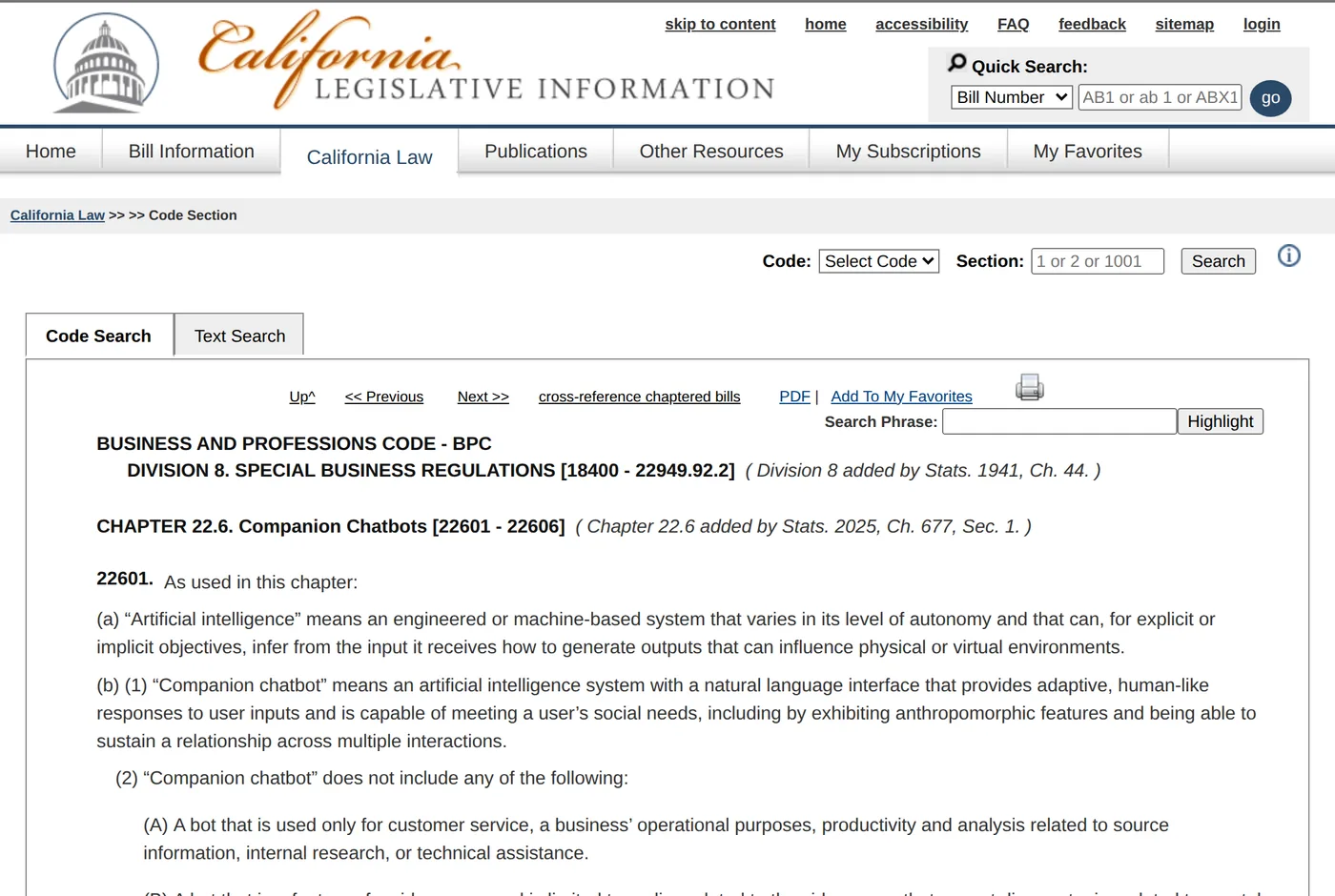
The statute’s definition is the gate everything else hangs on. A companion chatbot is “an artificial intelligence system with a natural language interface that provides adaptive, human-like responses to user inputs and is capable of meeting a user’s social needs, including by exhibiting anthropomorphic features and being able to sustain a relationship across multiple interactions.”
Three carve-outs keep ordinary products out: customer-service and business bots, video-game characters that stay on game topics, and stand-alone voice-assistant hardware. An “operator” is anyone who “makes a companion chatbot platform available to a user in the state”, so the duty follows the user’s location, and the company’s home address is beside the point.
The duties on an operator
Three duties bind every operator, whoever the user is:
- Say it is AI. “If a reasonable person interacting with a companion chatbot would be misled to believe that the person is interacting with a human, an operator shall issue a clear and conspicuous notification indicating that the companion chatbot is artificially generated and not human.”
- Maintain and publish a crisis protocol. The operator must keep a protocol against producing suicidal ideation, suicide or self-harm content, including referring users showing signs of crisis to services such as a suicide hotline or crisis text line, and must publish that protocol on its website.
- Flag suitability for minors. The platform has to disclose that companion chatbots may be unsuitable for some minors, in the app store listing or wherever the product is reached.
From 1 July 2027 a reporting duty joins them: operators must report annually to California’s Office of Suicide Prevention on how many crisis referrals they issued and what their detection protocols are, with no user identifiers, and the office publishes the data.
Extra rules when the user is a minor
Where the operator knows a user is a minor, the current law adds three requirements: disclose that the user is talking to AI, remind the user “at least every three hours” that the chatbot is artificial and that they should take a break, and take reasonable measures to stop the bot producing sexually explicit material or telling the minor to engage in sexually explicit conduct.
Enforcement is a $1,000 private lawsuit
SB 243 gives the Attorney General no role. Section 22605 instead lets “a person who suffers injury in fact as a result of a violation” sue for injunctive relief, attorney’s fees, and “damages in an amount equal to the greater of actual damages or one thousand dollars ($1,000) per violation”. For a platform with millions of California conversations, the per-violation arithmetic is the deterrent. As of 18 September 2026 the public record shows no decided case brought under the chapter; the lawsuit that shaped the law, Garcia v. Character Technologies, was a product-liability action that predates it; the parties notified the court of a settlement on 7 January 2026 and the case closed.
The first year in force
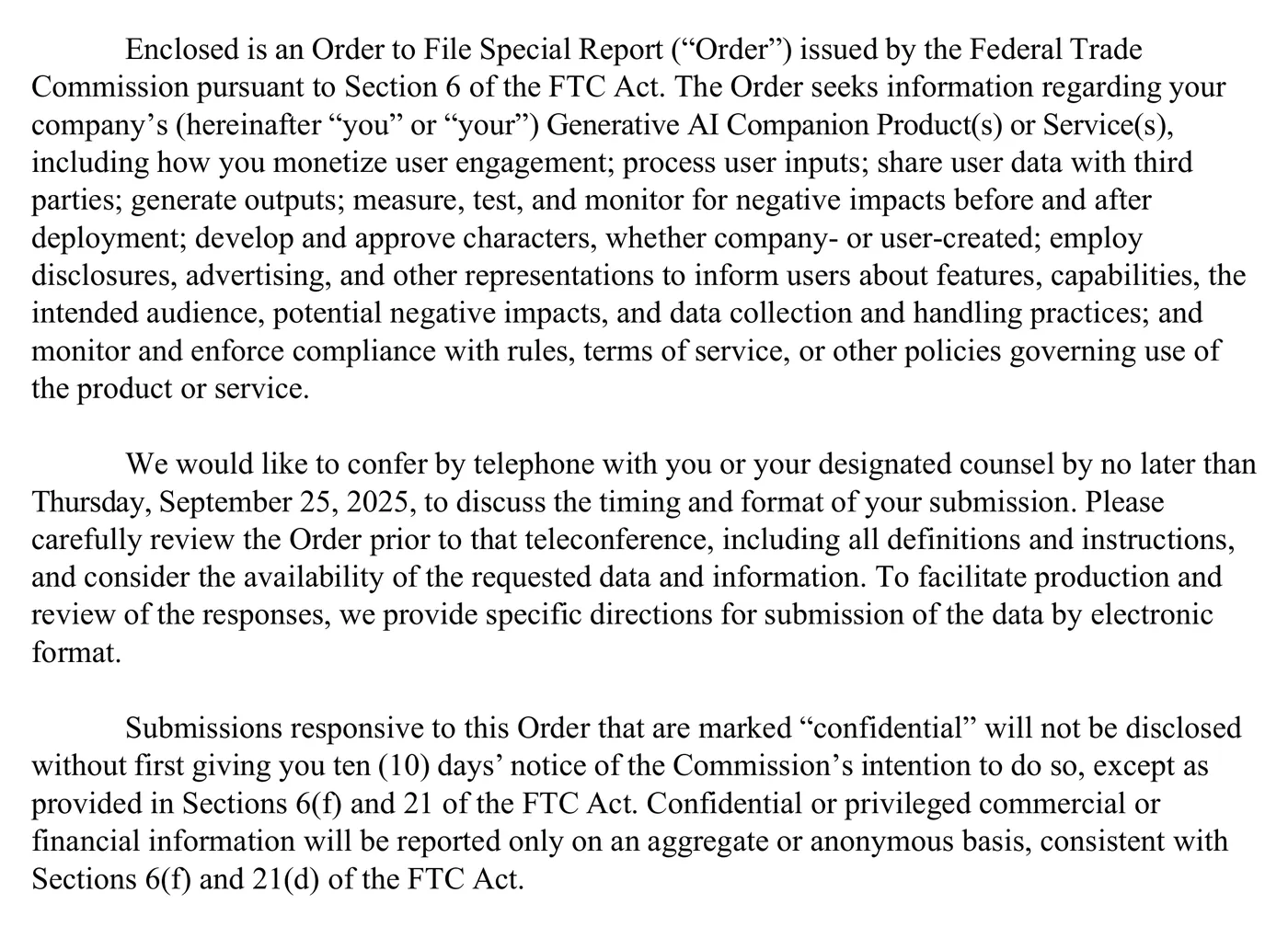
The operators moved before and around the deadline, on their own announcements. Character.AI announced in October 2025 that it would remove open-ended chat for under-18 users entirely by 25 November 2025, replacing it with structured formats and backing it with age verification. Meta shipped parental controls that let parents switch off a teenager’s one-to-one chats with AI characters and see topic-level summaries. The Federal Trade Commission, meanwhile, has had a formal 6(b) inquiry open since 11 September 2025, with compulsory orders to seven companies including OpenAI, Meta, Alphabet and Character Technologies; it has published no findings yet.
California’s legislature also kept moving. On the day he signed SB 243, Newsom vetoed the broader AB 1064, writing that it “imposes such broad restrictions on the use of conversational AI tools that it may unintentionally lead to a total ban on the use of these products by minors” and that he would “build on the framework established by SB 243”. Senator Padilla’s own follow-up, SB 300, stalled on the inactive file in August 2026.
Adam’s Law takes over the child-safety rules from 2027
On 10 September 2026 Newsom signed two direct amendments. SB 867 bans companion chatbots in toys for under-16s, sunsetting in 2031. The larger one is SB 1119, Adam’s Law, named after Adam Raine, whose parents’ case against OpenAI is before the San Francisco courts. It replaces SB 243’s minor provisions with a much heavier regime, operative from 1 July 2027: mandatory age assurance, pre-release risk assessments, default session limits for known child users of one hour a session and two a day, persistent memory and push notifications off by default, a fourteen-item list of prohibited behaviours towards children including simulating romantic interest and claiming sentience, independent child-safety audits from 2029, and public-prosecutor penalties of $5,000 per affected child for negligent violations and $15,000 for intentional ones.
The politics moved with it. Padilla condemned an OpenAI-backed ballot initiative in December 2025 as “Big Tech’s latest attempt to cut off and limit commonsense regulation of dangerous AI chatbots”; by September 2026, Fortune reported OpenAI negotiating over Adam’s Law and its policy vice-president calling it a standard-setter for AI youth safety.
Where the other states stand
California’s claim to be first needs one qualification, and the statute books supply it. New York wrote its own AI companion duties into General Business Law Article 47 in 2025, with a suicide-ideation protocol requirement and Attorney General enforcement at up to $15,000 a day, and its provisions took effect weeks before SB 243’s start date. What California can claim is the model the industry now negotiates against: a freestanding companion chatbot statute with a private right of action, already extended once, with the strictest child-safety regime in the country scheduled behind it. Utah runs a narrower law covering mental health chatbots, in force since May 2025. The rest of the field is drafting.
More AI
All AI →
California subpoenas OpenAI over cybersecurity incidents involving its models
California Attorney General Rob Bonta served OpenAI with an investigative subpoena on 30 September 2026 over cybersecurity incidents and risks involving its AI models. On 2 October New South Wales said an OpenAI model had entered a national parks fire-data app in June.