
The Bank of England's new payments objective asks for functionality, not efficiency
HM Treasury announced a secondary innovation objective for the Bank of England on 27 August. The legal text was tabled the next day, and it amends the Bank of England Act 1998 with one word changed from the objective it is said to copy.
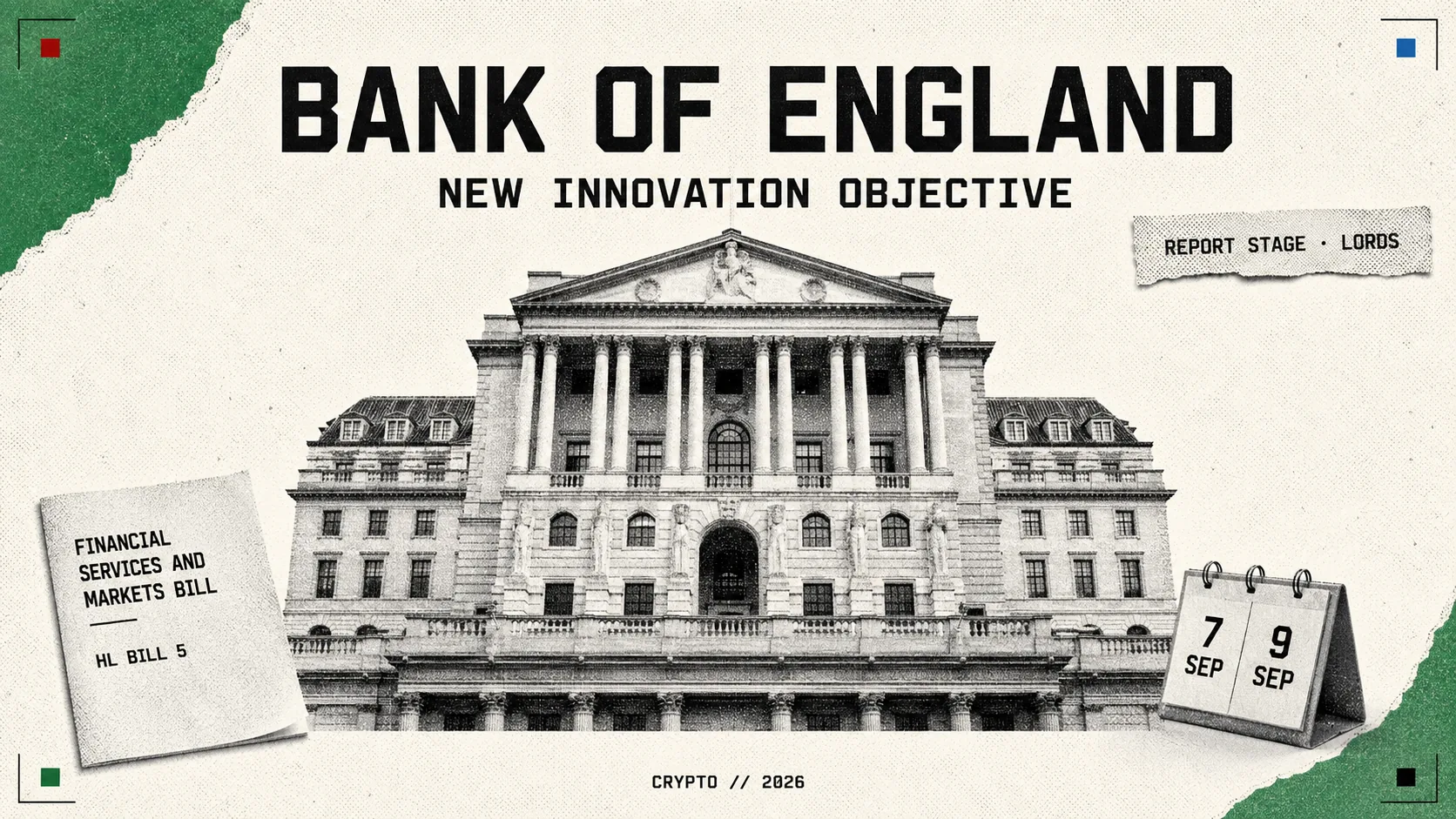
HM Treasury published its announcement at 10:04 on Thursday 27 August 2026: the Bank of England is to get a secondary objective to facilitate innovation in payments, sitting below its financial stability objective. The release said the Bank already has one of these for clearing houses and settlement depositories, and that “this reform will extend the same approach to systemic payment systems, including those using digital settlement assets”.
The legal text arrived the following day. It is close to the 2023 objective, and it is not the same approach word for word.
What was tabled, and where
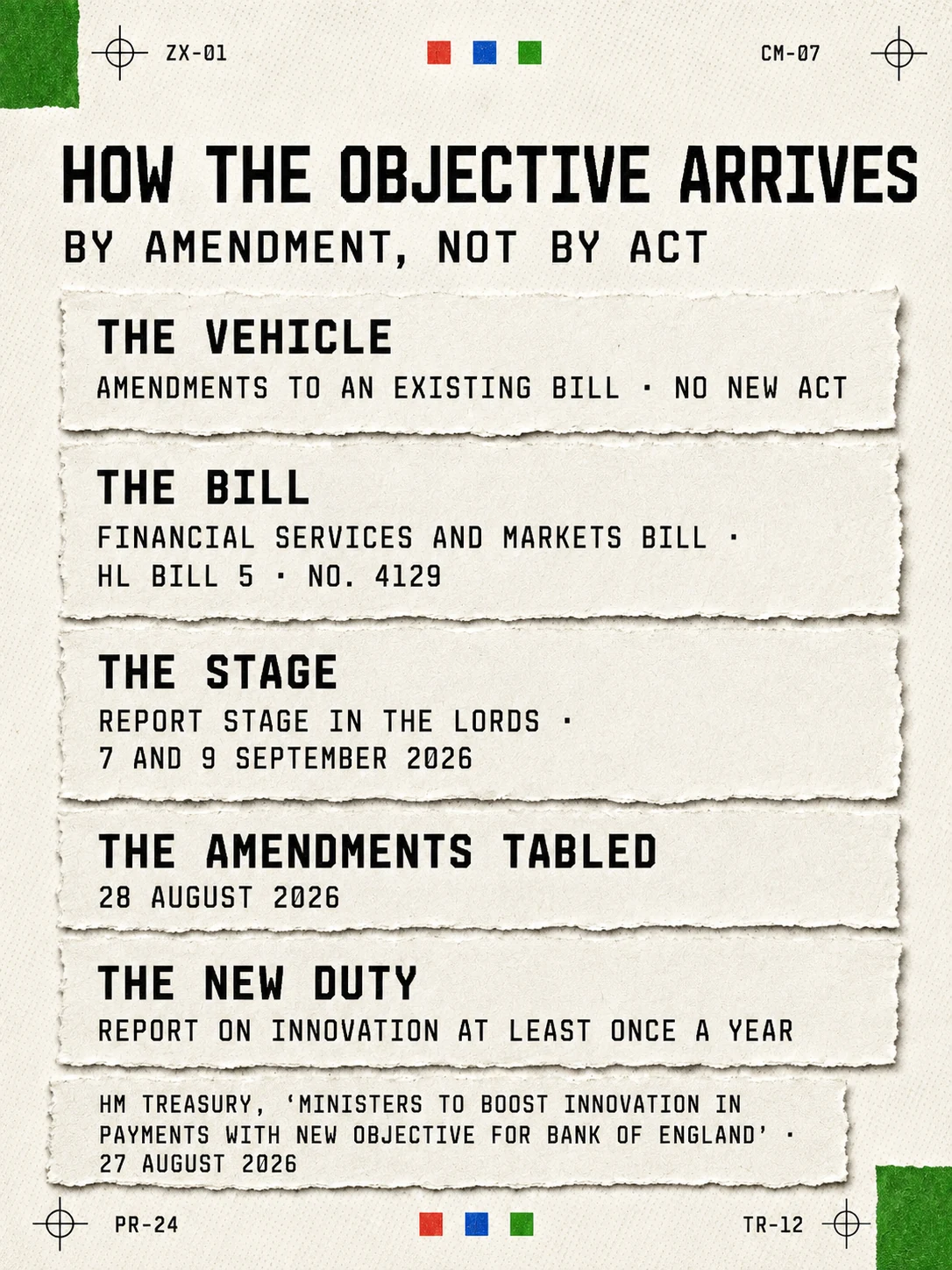
There is no new Act and no new Bill. The change is being made by amendments to the Financial Services and Markets Bill [HL], which Parliament’s own records number 4129 and print as HL Bill 5. It had its first reading in the Lords on 19 May 2026, second reading on 8 June, and six days of Grand Committee across late June and early July. Report stage is scheduled for two sittings, 7 and 9 September 2026.
The amendments appear for the first time in the Lords running list “Tabled up to and including 28 August 2026”, starred as new. They are absent from the running lists of 26 and 27 August, which dates the tabling to the day after the press release. They are grouped after Clause 22, which points at the first of the two days, though running lists print amendments unnumbered and the marshalled list that would settle both the number and the day is not out.
They also amend a different statute from the one most coverage assumes. The new clause is headed “Bank of England functions: payment systems and service providers”, and what it does is insert a new Part 3C into the Bank of England Act 1998, containing new sections 30J and 30K. Neither Financial Services and Markets Act is touched by it.
The amendments stand in the name of Lord Pitt-Watson, whom Parliament’s Members API records as Parliamentary Secretary at HM Treasury since 22 July 2026. Running lists do not label anything as a Government amendment, so nothing on the face of the paper says these are. The inference rests on three things that are documented: the Treasury said on 27 August that it expected to implement the change by amending this Bill, the amendments appeared the next day, and they are in the name of a serving Treasury minister.
The word that changed
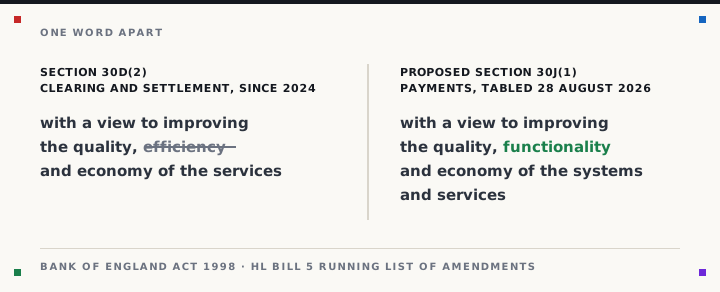
The existing objective, section 30D(2) of the Bank of England Act 1998, was inserted by section 48 of the Financial Services and Markets Act 2023 and commenced in stages from 1 January 2024. It requires the Bank to facilitate innovation in the provision of financial market infrastructure services “with a view to improving the quality, efficiency and economy of the services”.
The tabled section 30J(1) tracks that construction closely, then lands somewhere else:
In exercising its relevant payment systems functions in a way that advances the Financial Stability Objective the Bank must, so far as reasonably possible, act in a way which, as a secondary objective, facilitates innovation in the operation of recognised payment systems, the provision of services by recognised DSA service providers, and the provision of services by service providers in relation to such systems or such DSA service providers, with a view to improving the quality, functionality and economy of the systems and services.
Efficiency has been replaced by functionality, and “the services” has become “the systems and services”. Nothing else in the aim clause is different. We could not find any published explanation for the substitution: there is no impact assessment, explanatory note or policy paper for these specific amendments on the Bill’s publication list, and the member’s explanatory statement repeats the new wording without commenting on the change.
How far the duty reaches
Narrower than the announcement suggests. New section 30J(2) confines the objective to three named functions: publishing principles under section 188 of the Banking Act 2009, publishing codes of practice under section 189 of that Act, and determining the general policy and principles by reference to which the Bank performs particular functions under Part 5 of that Act.
Everything else the Bank does with payment systems sits outside it. And the duty is expressed as secondary throughout, applying only when the Bank is already exercising those functions “in a way that advances the Financial Stability Objective”, and then only “so far as reasonably possible”.
The crypto reach is in the definitions rather than the announcement. “Recognised DSA service provider” is read by reference to section 184A of the Banking Act 2009, and digital settlement assets entered Part 5 through section 22 and Schedule 6 of the Financial Services and Markets Act 2023, in force since 29 August 2023. Stablecoins are inside the objective because they were already inside the Bank’s Part 5 perimeter.
One boundary is worth naming because nothing we found addresses it. Section 184A(3) of the Banking Act 2009 says the Treasury “may not specify a DSA service provider operated solely by the Bank of England”. How the new objective interacts with the Bank’s own infrastructure, its real-time gross settlement service and CHAPS among it, is not covered in any document we located.
Who the annual report actually goes to
The press release makes a specific promise: “The Bank will report annually to Parliament on how it was advancing the innovation objective.”
The tabled text builds two reporting routes, and only one of them reaches Parliament.
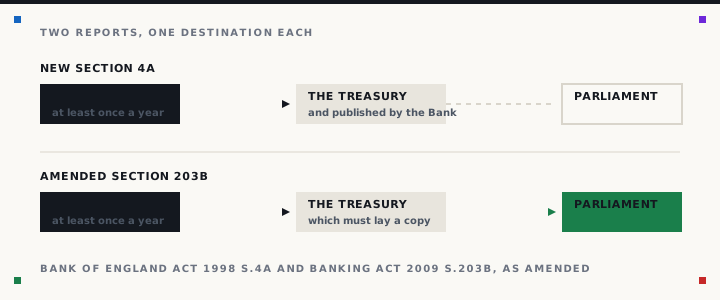
The first is a new section 4A of the Bank of England Act 1998. At least once a year the Bank must report to the Treasury on how it has complied with both innovation objectives, must explain what it has done to embed them in its “operations, processes and decision-making”, and must publish the report “in such manner as it thinks fit”. There is no duty to lay it before Parliament. There is, though, a drafting instruction that reads as a defence against burial:
A report under this section may not be combined in a single document with any other report.
The second route is the existing annual report under section 203B of the Banking Act 2009, which the same amendment rewrites. It adds the innovation objective to the report’s contents, along with the Bank’s efforts to engage with operators of recognised payment systems, recognised DSA service providers and their service providers, and the results of that engagement. Section 203B(3) has required since 2013 that the Treasury lay a copy of each such report before Parliament, so this one does get there, by an existing route rather than a new one.
So the promise is met in substance through section 203B. The standalone report the amendment creates, the one that cannot be bundled with anything else, goes to the Treasury and to publication, not to the House.
The channel that runs the other way
New section 30K would let the Treasury write to the Bank with recommendations about the Government’s economic policy that the Bank “should have regard to” when advancing both financial stability and the new objective. The Treasury must issue such recommendations at least once in each Parliament, publish the notice and lay a copy before Parliament. The Bank must respond in writing within 12 months, saying what it has done or intends to do, or why it has not, and then update annually until told it need not.
The Bank is not required to provide any information whose publication it considers would be against the public interest.
What it sits next to
The timing puts the Lords debates a fortnight before a deadline the Bank set itself. On 22 June 2026 the Bank published its policy statement and draft Code of Practice for sterling-denominated systemic stablecoins. That statement raised the permitted share of backing assets held in short-term UK government debt from the 60% proposed in 2025 to 70%, dropped the proposed per-coin holding limits of £20,000 for individuals and £10 million for businesses, and replaced them with a temporary issuance guardrail set initially at £40 billion per systemic stablecoin. Firms systemic at launch may hold up to 95% of backing assets in UK government debt securities as they scale, with a residual maturity of up to six months.
That consultation closes on 22 September 2026. The Bank intends to finalise the Code by the end of 2026, with regulated stablecoins able to operate in the UK from 2027.
The Bank has also made clear that the guardrail is not a systemic threshold: “The proposed £40 billion issuance guardrail should not be taken as an indicator of the point at which HMT may recognise a stablecoin issuer as systemic.”
The rival clause on the same order paper
The Government’s amendments are not the only digital-assets proposal down for those two days. A cross-party new clause after Clause 46, in the names of Baroness Neville-Rolfe, Lord Altrincham and Baroness Kramer, would require the Treasury within 12 months of Royal Assent to prepare, publish and consult on a strategy for the regulation and development of digital assets in the UK, covering cryptoassets, qualifying stablecoins, central bank digital currencies, tokenised securities and the de-banking of digital asset firms.
That is a demand for a plan the Government has not offered, on the same Bill, in the same week, and it comes from three peers across two parties.
The Bill’s first clause on regulators is blunter still: “The Payment Systems Regulator is abolished.” Its functions move to the Financial Conduct Authority, and Lord Holmes of Richmond told Grand Committee on 24 June that the transfer had dropped something on the way:
The intention set out in the Bill is clear that the PSR is no more and its functions are to move over to the FCA. That is a defensible and clear objective and it has been communicated. The difficulty is that it is not what the Bill currently achieves. In many ways, these amendments could be summed up by “Lost in Translation”, because key elements of the functions of the PSR, not least those critical elements around competition and innovation, have not come over and certainly have not been reproduced in the Bill to the same extent as they appear in their original statutory form.
Nine weeks later an innovation duty appears, on the Bank’s side of the perimeter rather than the FCA’s.
The Bank’s own public position on all of it, meanwhile, is a single quote inside someone else’s press release. Sarah Breeden, Deputy Governor for Financial Stability, says there that the Bank welcomes the announcement, “which will further boost our work to support innovation in financial services without compromising on financial stability”. That is one sentence of comment on a duty the Bank will be under for as long as the Act lasts.
Sources
- Ministers to boost innovation in payments with new objective for Bank of England (HM Treasury)gov.uk
- GOV.UK content API record for the same announcementgov.uk
- Financial Services and Markets Bill [HL] on the Parliament Bills APIbills-api.parliament.uk
- Every stage and sitting date for bill 4129bills-api.parliament.uk
- HL Bill 5-R running list of amendments, 28 August 2026bills-api.parliament.uk
- HL Bill 5-R running list of amendments, 27 August 2026bills-api.parliament.uk
- Financial Services and Markets Act 2023, section 48legislation.gov.uk
- Banking Act 2009, section 203Blegislation.gov.uk
- Banking Act 2009, section 184Alegislation.gov.uk
- Sterling-denominated systemic stablecoins (Bank of England policy statement)bankofengland.co.uk
- Bank of England news release on the systemic stablecoin regime, 22 June 2026bankofengland.co.uk
- Lord Pitt-Watson's biography, Parliament Members APImembers-api.parliament.uk
- House of Lords Grand Committee, 24 June 2026, full debate text (Hansard API)hansard-api.parliament.uk
- Financial Services and Markets Bill [HL] as introduced, 19 May 2026bills-api.parliament.uk