UK banks complete their first real customer payments with tokenised pound deposits, starting with two remortgages
Lloyds, NatWest and Barclays paid out two real remortgages in tokenised sterling deposits, and HSBC led a marketplace payment, UK Finance said on 24 September 2026. Seven banks share the platform, which Quant built.
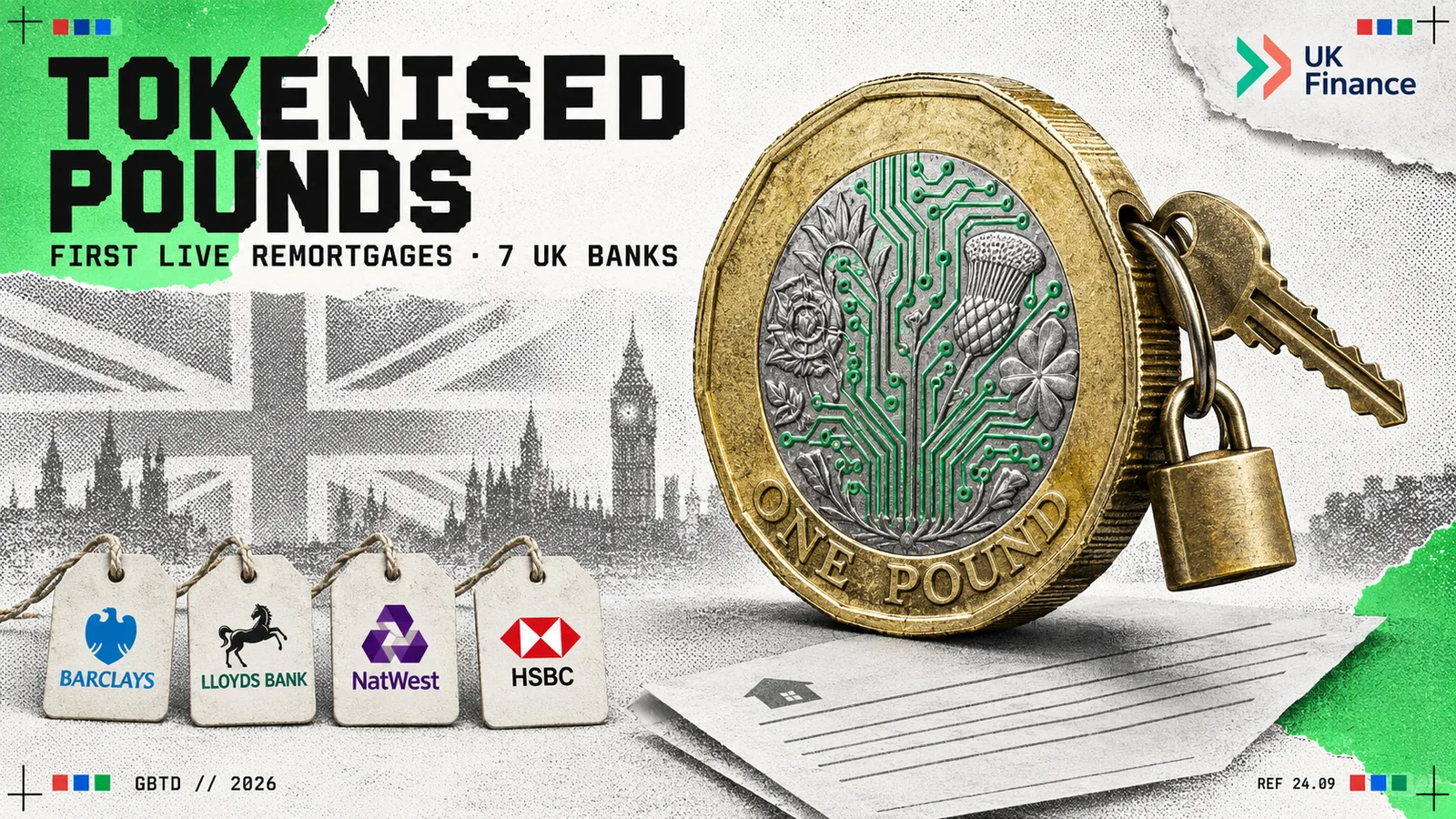
Britain’s biggest banks moved real customer money as blockchain tokens for the first time, UK Finance said on 24 September 2026. Lloyds, NatWest and Barclays completed two live remortgages paid in tokenised sterling deposits, and three banks including HSBC ran a payment between a buyer and a private seller.

The money in each remortgage sat locked in the customer’s account, still earning interest, and paid itself out automatically when the deal completed. The work runs under the Great British Tokenised Deposit project, known as GBTD, which UK Finance convenes for seven banks: Barclays, HSBC UK, Lloyds Banking Group, Monzo, Nationwide, NatWest and Santander. “These first live transactions mark a critical milestone for payments innovation in the UK,” said Lucy Rigby, Economic Secretary to the Treasury.
How did the remortgages work?
The two remortgages locked the completion money in place and released it the moment each deal completed. UK Finance’s release describes the mechanism in one line: deposit funds were “‘locked’ and then automatically released at completion, reducing manual checks and settlement delays”. Euronews, reporting the same announcement on 24 September, names the banks that ran them as Lloyds, NatWest and Barclays.
The practical gain for a borrower is the interest. With tokenised deposits, UK Finance says, “the technology can also ensure customers continue to earn interest on funds held in their accounts until completion”.
The pilots also explored how a digital connection to HM Land Registry, the register that records who owns property in England and Wales, could make future transactions more efficient. A property deal completes when the change of ownership is confirmed, so a direct link would let that confirmation trigger the payment.
HSBC’s marketplace payment held the buyer’s money until the swap
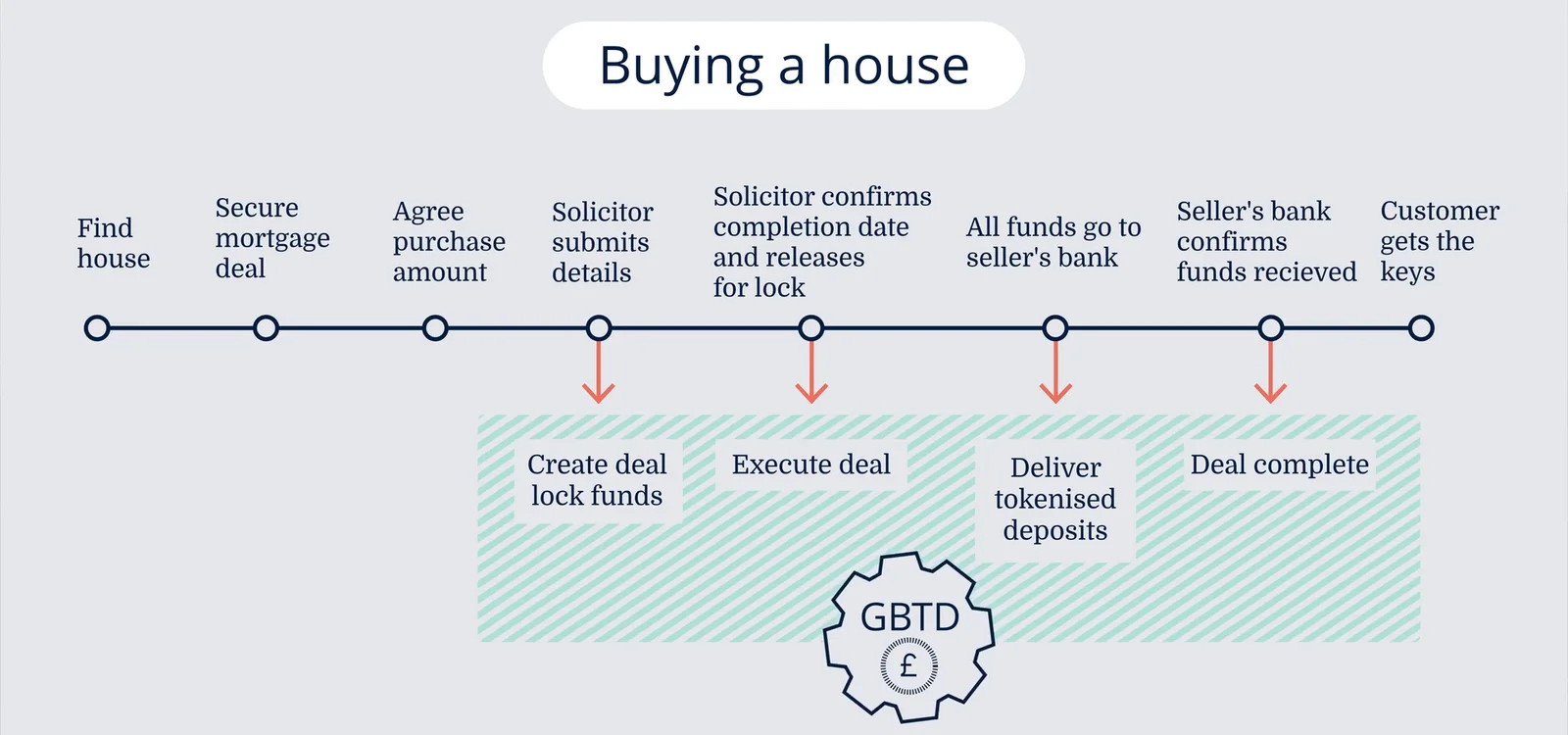
The third live payment was a purchase from a private seller, with the buyer’s money locked until the goods changed hands. UK Finance says the programmable deposits “enabled money to be ‘locked’ in the buyer’s account, with release only happening when the goods were successfully exchanged”. Three banks including HSBC ran it, Euronews reports.
This is the use case aimed at fraud on second-hand marketplaces, where one side pays and the other never delivers. The buyer’s bank holds the money on the buyer’s side, and the seller sees it committed before handing anything over. Gilbert Verdian, founder and chief executive of Quant, which built the platform, tied it to authorised push payment fraud, the scam in which a victim is talked into sending money to a criminal: conditional payments, he said, “can solve challenges the market actually has - from failed completions to authorised push payment fraud”.
A tokenised deposit is an ordinary bank deposit on a shared ledger
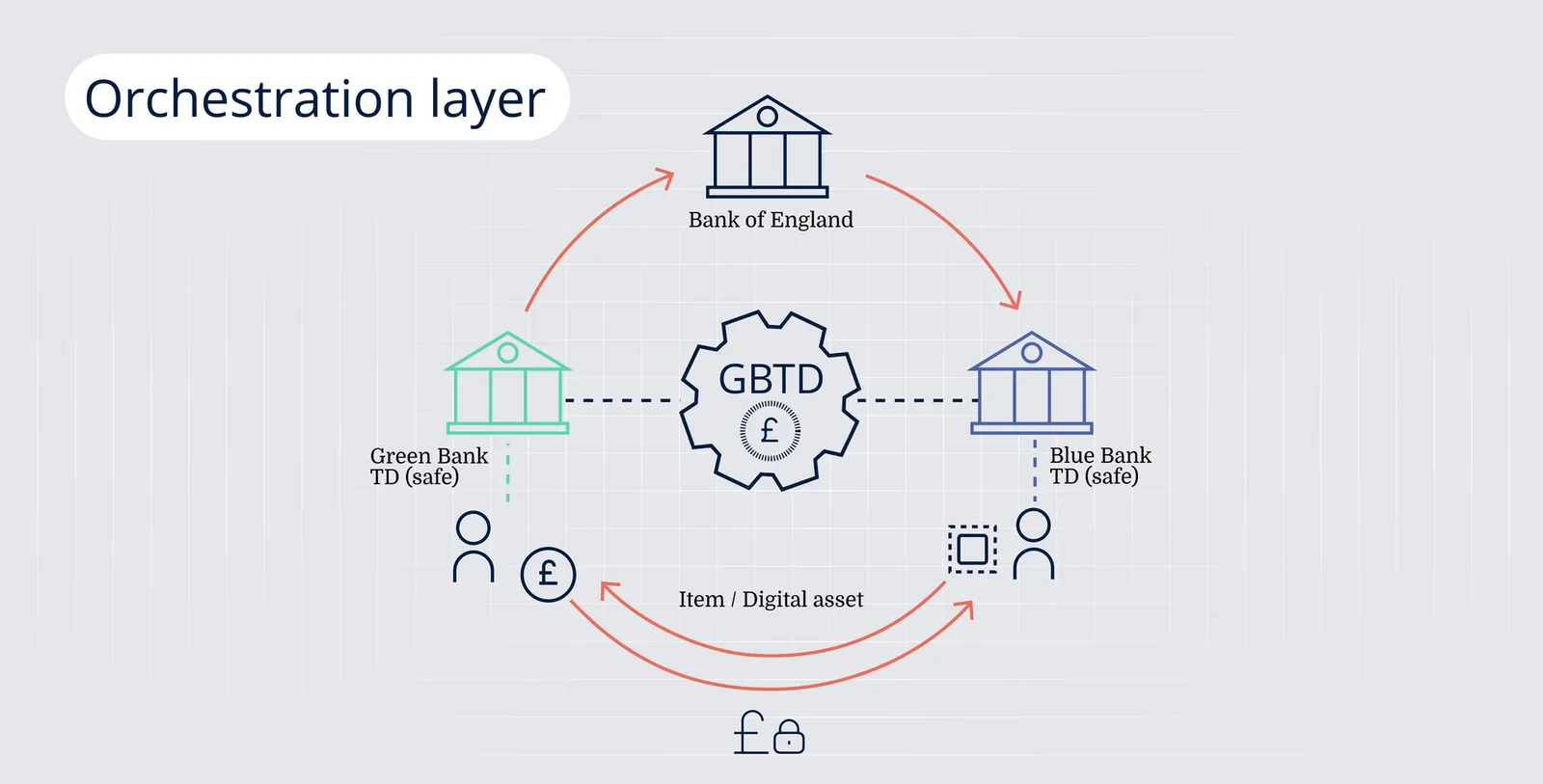
A tokenised deposit is money in a normal bank account, recorded as a token that can move between banks on shared infrastructure. It applies the same tokenisation that puts bonds and funds on a ledger to the pound in a current account. UK Finance calls it a digital representation of “traditional commercial bank money”, which keeps “the trust and regulatory protections of conventional deposits while offering benefits such as programmability, speed and efficiency”.
Programmability is the new part. A tokenised pound can carry a rule, such as paying out once the Land Registry confirms a transfer or once a buyer confirms delivery, and the ledger enforces it. The money itself stays a claim on a regulated bank, the same thing a customer holds today.
Ryan Hayward, managing director for digital assets at Barclays, put the emphasis on that continuity. Live transactions, he said, show how tokenised deposits “could help make payments more efficient, help reduce friction in processes such as remortgaging and support better experiences for customers and businesses, while maintaining the trust, security and stability of commercial bank money”.
Quant built the shared platform the seven banks use
Every GBTD bank settles on one shared platform, built by Quant as common UK infrastructure for tokenised bank money. EY provided project management, and Linklaters gave the legal advice and wrote the rulebooks. The shared build is what lets a Lloyds deposit settle against a NatWest one, the interbank step the remortgages needed.
| Role | Who |
|---|---|
| Convenor | UK Finance |
| Participating banks | Barclays, HSBC UK, Lloyds Banking Group, Monzo, Nationwide, NatWest, Santander |
| Platform | Quant |
| Project management | EY |
| Legal advice and rulebooks | Linklaters |
The project started as a pilot on 26 September 2025, with six banks and three use cases: marketplace payments, remortgaging and digital asset settlement. It built on the UK Regulated Liability Network experiments that came before it. Monzo joined as the seventh bank in January 2026, and UK Finance says GBTD was accepted into the Bank of England’s Synchronisation Lab earlier in 2026, a programme testing settlement that completes on both sides at once in central bank money.
Muneeb Shah, a partner at EY, described what the remortgages proved: “For the first time, the UK’s leading banks have shown that tokenised deposits can move seamlessly between institutions on a common, interoperable infrastructure”.
Tokenised deposits, stablecoins and a digital pound all have a place in the Bank of England’s plan
The Bank of England plans for several kinds of digital money in the UK, and tokenised deposits are one of them. Its digital pound progress update of 4 March 2026 sets the goal as payments that “operate seamlessly as part of a diverse multi-money ecosystem”, and says the Bank and HM Treasury will set out their decision on a digital pound later this year.
Stablecoins run on a separate track. The Bank’s policy statement of 22 June 2026 lets an issuer of a systemic sterling stablecoin hold up to 70 per cent of its backing in short-term UK government debt and the rest at the central bank. Its consultation closed on 22 September 2026, and the Bank intends to finalise the rules by the end of 2026.
The difference lies in who issues the money. A stablecoin is issued by a separate company holding a reserve. A tokenised deposit is issued by the bank that already holds the customer’s account, which is why the GBTD banks describe it as the existing money in a new form. The same week, the European Central Bank switched on Pontes, which settles tokenised trades in central bank money, and Euronews reads the two launches as part of one European preference for money issued by regulated banks and central banks.
Next: digital bonds that pay coupons in tokenised deposits
Digital asset settlement pilots come next, “over the next few months”, according to UK Finance. Banks in the project will issue digital debt instruments that can be traded and settled, “with coupons paid in tokenised deposits”, using a model UK Finance calls delivery-versus-payment-versus-reserves: the security, the tokenised payment and the final settlement in central bank money all complete together.
Euronews reports that the banks aim to issue three digital bonds in the first quarter of 2027 and plan to set up a company and a governing rulebook to run the service. Mark Brant, chief payments officer at NatWest Group, said the first live customer transactions are “only the beginning”.
Mike Zehetmayr of EY counted the distance travelled: “The completion of five years of collaboration across market participants, central banks, regulators and supervisors, culminating in successful real-world pilot transactions, has laid the foundations for an operational GBTD service.”
Questions people ask
- What is a tokenised deposit?
- A tokenised deposit is money in an ordinary bank account recorded as a token on a shared digital ledger rather than only in the bank's own books. UK Finance describes it as a digital representation of commercial bank money that keeps the trust and regulatory protections of a conventional deposit, while adding programmability, so a payment can be set to move only when a condition is met.
- Which banks are in the Great British Tokenised Deposit project?
- Seven: Barclays, HSBC UK, Lloyds Banking Group, Monzo, Nationwide, NatWest and Santander. Monzo joined as the seventh in January 2026. UK Finance convenes the project, Quant built the platform, EY provides project management and Linklaters gave legal advice and wrote the rulebooks.
- How is a tokenised deposit different from a stablecoin?
- A tokenised deposit is a bank's own deposit liability, issued by a regulated bank and carrying the same protections as money already in an account. A stablecoin is issued by a separate company and backed by a reserve of assets. The Bank of England regulates systemic sterling stablecoins under its own regime, published on 22 June 2026, which lets issuers hold up to 70 per cent of their backing in short-term UK government debt.
Sources
- UK Finance: UK banks complete first live customer transactions using tokenised sterling deposits, 24 September 2026ukfinance.org.uk
- UK Finance: Tokenised sterling deposits, the GBTD initiativeukfinance.org.uk
- UK Finance: UK Finance announces live pilot phase to deliver tokenised sterling deposits, 26 September 2025ukfinance.org.uk
- Euronews: Britain's largest banks make first interbank transactions using tokenised deposits, 24 September 2026euronews.com
- Bank of England: policy statement and draft rules on regulating systemic stablecoins, 22 June 2026bankofengland.co.uk
- Bank of England: progress update, digital pound design phase, 4 March 2026bankofengland.co.uk
- UK Finance: GBTD project video, June 2026player.vimeo.com