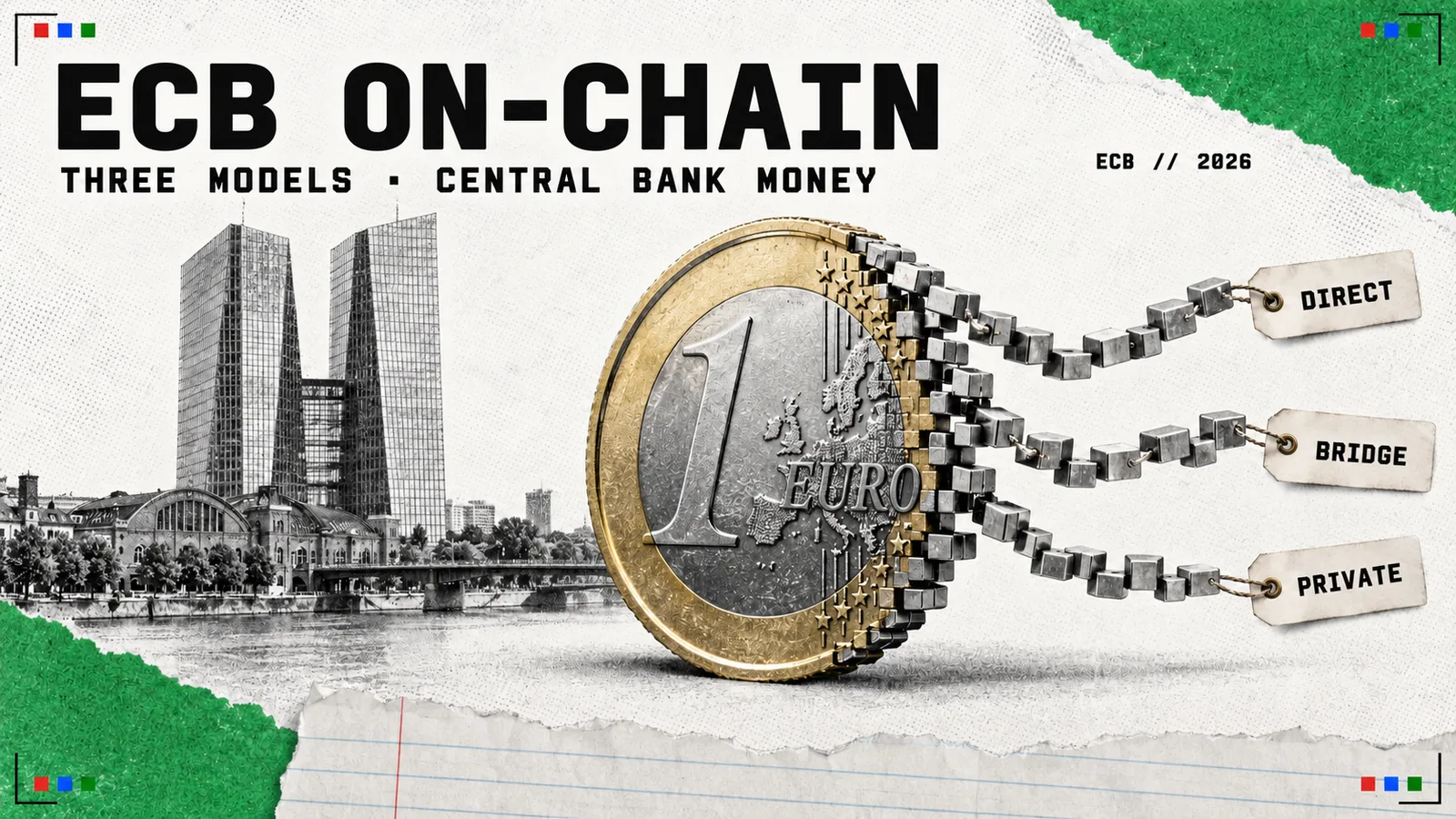
The ECB now settles blockchain trades in central bank money, with 13 banks connected on day one
The Eurosystem switched on Pontes on 21 September 2026, linking market blockchain platforms to TARGET so tokenised asset trades settle in central bank money. Thirteen banks and four DLT operators were connected on day one.
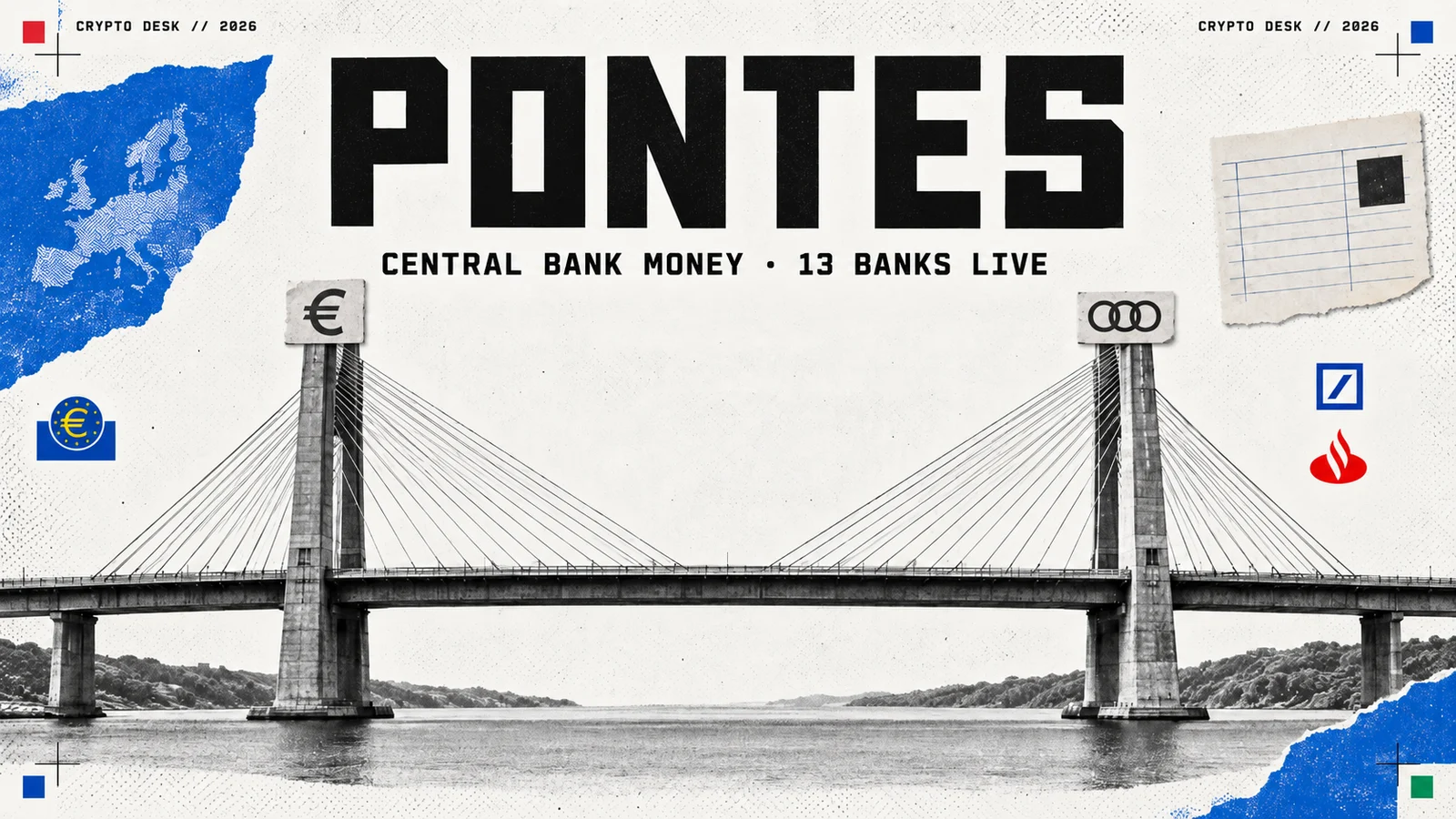
The Eurosystem switched on a service called Pontes on 21 September 2026. It lets a bank buying a tokenised bond or share pay for it with central bank money, the same money banks already hold at their national central bank, rather than with a claim on another commercial bank.
Thirteen banks and four blockchain operators were connected on the first day. The Eurosystem is the European Central Bank plus the national central banks of the 21 countries using the euro, and Pontes is the first thing it has built under a programme to make central bank money work on distributed ledgers. “The Eurosystem is working to enable a more integrated, innovative and resilient European financial market in the digital age,” said Christine Lagarde, president of the ECB.
The date had been fixed since the summer of 2025. On 1 July 2025 the Governing Council approved a two-track plan and gave Pontes an end-of-Q3-2026 deadline. It landed with nine days to spare.
How the money actually moves

A Pontes trade splits across two ledgers and a cryptographic lock holds them together. The securities stay where they already live, on the market operator’s own platform. The cash moves on a private permissioned Eurosystem ledger, where a bank holds a Dedicated Cash Wallet funded from its ordinary T2 account.
The lock is called the Hash-Link protocol, and the Service Description gives it one job: “all-or-none” settlement, so that a delivery-versus-payment or payment-versus-payment trade either completes on both sides or completes on neither. Settlement finality rests on Article 18 of Annex 1, Part I of the TARGET Guideline, Guideline (EU) 2022/912, which is the same legal footing the euro’s existing plumbing stands on.
The design decision underneath is a conservative one. The ECB’s own document records that the service “operates outside the technical perimeter of TARGET Services and requires no changes to their existing legal, regulatory, functional, or operational framework”. Pontes reaches into TARGET through a single front door, the Extended Interoperability Interface, and leaves the machine behind it untouched.
Banks reach that door two ways. A browser interface handles payments, funding and queries by hand. Everything more interesting, including every delivery-versus-payment trade, runs through the API.
Who connected on day one
Thirteen market participants and four market DLT operators had finished onboarding when the service opened, and the ECB named every one of them. The banks are ABANCA, BayernLB, Caisse des Dépôts et Consignations, Cecabank, Deutsche Bank, Deka Bank, DZ Bank, the European Investment Bank, Kreditanstalt für Wiederaufbau, Memo Bank, NRW.BANK, Santander and Société Générale. The Deutsche Bundesbank onboarded as a market participant too.
The four platform operators are Axiology, Cashlink, Clearstream and SWIAT. Clearstream, one of Europe’s two international central securities depositories, said on 17 August that it would run end-to-end tests before the launch under the ECB’s testing and certification framework.
Read the bank list and a pattern shows through it. KfW, NRW.BANK, Caisse des Dépôts and the European Investment Bank are public-sector issuers, which are among the most active names in Europe’s experimental digital bond market. Deka, DZ and BayernLB sit at the centre of the German savings-bank and cooperative networks. This is the part of the market that has been issuing DLT-based paper since 2021, and it now has somewhere safer to settle it.
More are on the way. The ECB says additional participants “are committed to connecting to Pontes in the coming months”.
The trading window is seven hours long
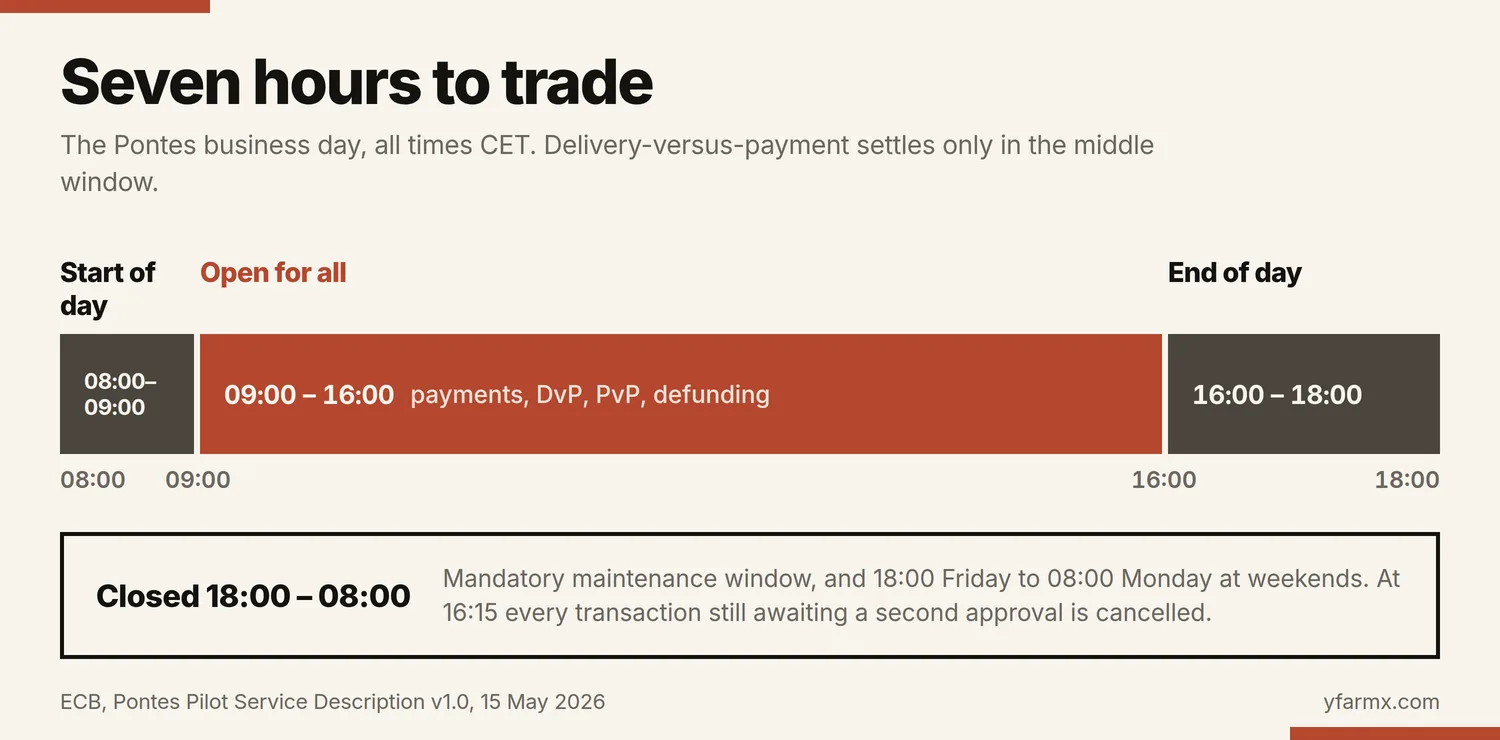
Pontes runs a four-phase business day, and the window in which a bank can actually trade is 09:00 to 16:00 CET. The Service Description sets it out phase by phase, and all times are the ECB’s own local time in Frankfurt.
| Phase | Times (CET) | What happens |
|---|---|---|
| Start of day | 08:00 to 09:00 | Business date changes, funding requests and cash token transfers process |
| Open for all | 09:00 to 16:00 | Payments, DvP, PvP, PFoD and defunding requests all process |
| End of day | 16:00 to 18:00 | Cool-down, cleanup at 16:15, automated cash token sweep |
| Closed | 18:00 to 08:00 | Mandatory maintenance window |
The calendar is the T2 calendar for the euro: Monday to Friday, closed at weekends and on 1 January, Good Friday, Easter Monday, 1 May, 25 December and 26 December. The maintenance window runs from 18:00 on Friday straight through to 08:00 on Monday.
One detail in the cleanup is worth knowing before you use the service. At 16:15 every transaction still waiting on four-eyes validation, meaning a second person’s approval, is cancelled outright. An instruction left unapproved at the bell does not carry over to the next day.
Your cash tokens go home every night
Pontes empties itself at the end of every business day. Once the 16:15 cleanup has run, an automated end-of-day cash token sweep drains every Dedicated Cash Wallet on the platform, and the matching central bank money returns to the participant’s T2 account.
The mechanism is precise about where the money sits at each step. A defunding request moves cash tokens from the participant’s wallet to the token issuance wallet, redeems them, and moves the corresponding central bank money from the token issuance account, through a technical interim account, to the participant’s T2 real-time gross settlement account. The balance on the token issuance wallet and the balance on the token issuance account mirror each other throughout, so the tokens on the ledger are always backed one-for-one by money at the central bank.
The ECB’s Information Guide explains the priority behind the sweep: the standing instruction is to avoid liquidity being “trapped” in Pontes at the end of the day and holding up T2’s own cut-off. A long-running incident is the one case in which balances might sit on the ledger overnight, and the terms and conditions cover what happens then.
For a treasurer this is the constraint that shapes the day. Money committed to Pontes is money committed until the sweep returns it, and it earns nothing while it is there, because tokenised balances do not yet count towards minimum reserves.
What arrives in 2027 and 2028
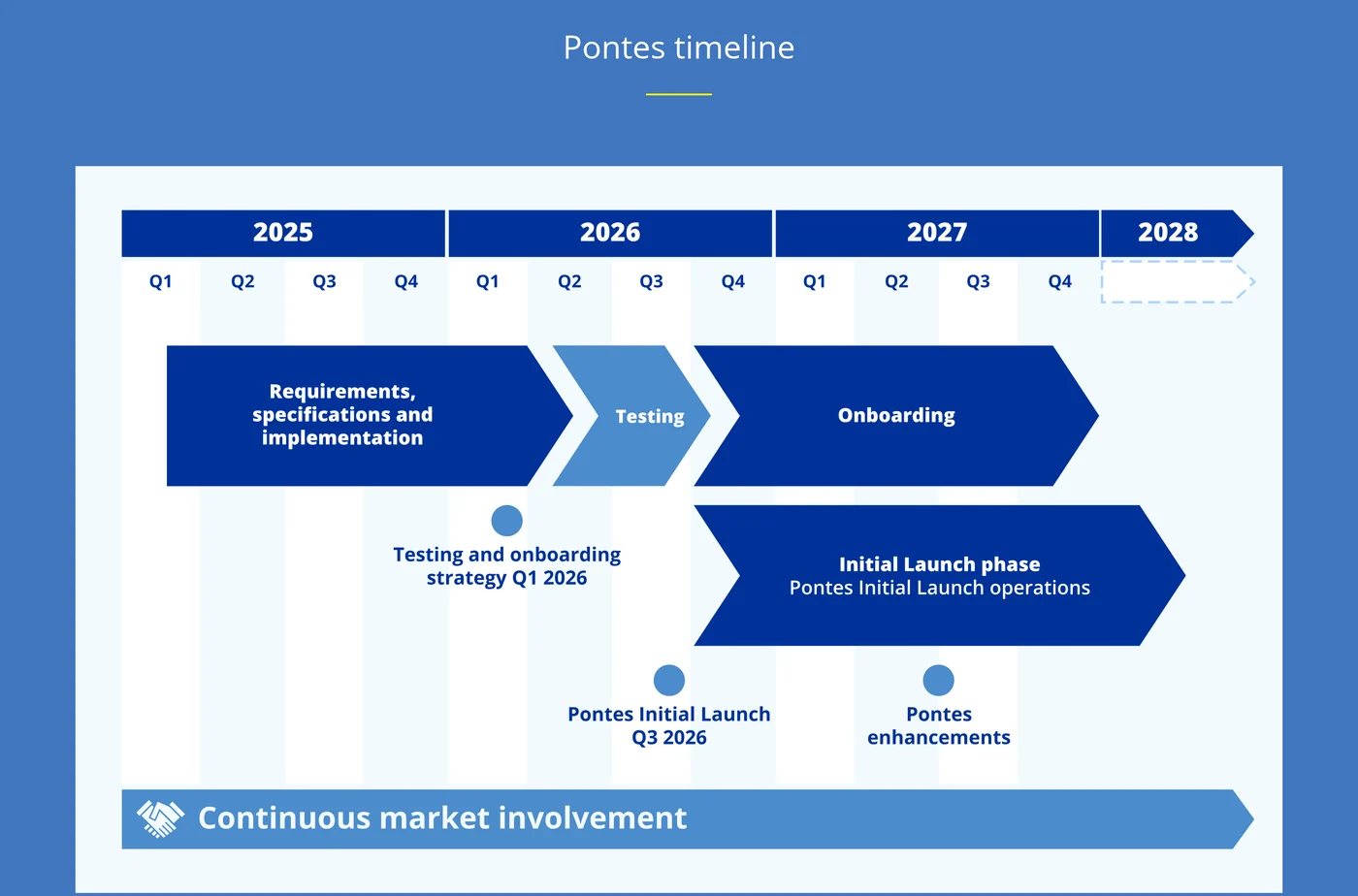
The ECB has published what it is adding and when, and the launch deck from its 22 July focus session puts the finished service in 2028. George Kalogeropoulos, deputy head of the ECB’s market infrastructure development division, put the launch on a slide in one line: “21 September 2026 is the start of the journey not the end game.”
Three things land in 2027. Settlement finality moves onto the Eurosystem ledger itself, folded into the TARGET Services legal framework rather than borrowing T2’s. Multi-currency settlement opens the service to every currency available in T2. And the operating hours stretch to match the T2 real-time gross settlement day, the ECB’s 22.5 hours a day, five days a week.
The 2028 release is the one that changes how a treasurer thinks about it. Banks will be able to hold tokenised central bank money on the ledger overnight. Those balances will count towards minimum reserve and interest calculations, which removes the cost of parking money there. And the stated target for opening hours becomes 24/7, the schedule the tokenised markets themselves already keep.
Pontes launched with a working set of use cases rather than a demonstration: primary and secondary market transactions, euro central bank money against commercial bank money, euro central bank money against e-money tokens, single euro payments, delivery-versus-payment, payment-versus-payment and wholesale payments.
Central bank money is the point
The reason the Eurosystem built any of this is a question about what a tokenised trade settles in. Europe’s issuers have placed close to €4 billion in DLT-based fixed income since 2021, according to Piero Cipollone, a member of the ECB’s Executive Board, speaking in Brussels on 23 March 2026. Every one of those trades needed a cash leg, and that cash leg has been a commercial bank deposit or a stablecoin, each of which carries the credit risk of whoever issued it.
Central bank money is a claim on the central bank itself, which makes it the safest settlement asset in the system. That is the whole of the argument, and Cipollone put it in one sentence on launch day: “Pontes brings the stability and trust of central bank money to the European tokenised finance ecosystem.” He added: “It will give an important advantage to help it scale.”
The evidence the ECB acted on came from its own trials. Between May and November 2024, 64 participants ran more than 50 trials and experiments across nine jurisdictions, moving roughly €1.6 billion, and the finding the ECB took from them was that access to a risk-free settlement asset was what the market said it needed most.
Pontes is wholesale plumbing, open to the institutions that hold a T2 account. The digital euro is the retail project, a form of central bank money for people buying things, and it runs on its own timetable under its own mandate. The two are separate programmes that happen to share a parent.
The longer project is called Appia
Appia is the second half of the plan the Governing Council approved in July 2025, and its deliverable is a blueprint in 2028. The Eurosystem published the roadmap for it on 11 March 2026. Where Pontes bridges to the machinery the euro already runs on, Appia asks what a European settlement platform designed for tokenised finance from the beginning would look like. “With Appia, we are building a road from today’s financial system to tomorrow’s tokenised markets, firmly grounded in central bank money,” said Piero Cipollone.
The roadmap organises the work into six building blocks: asset interoperability and standards; monetary policy implementation and collateral management on DLT; European tokenised central bank money infrastructure; the international dimension and cross-border links; an innovative, safe and resilient new ecosystem; and implementation strategy and the impact on existing infrastructures.
Denmark has a seat in both projects. Appia’s scope covers the euro and the other currencies whose central banks make them available in TARGET, and the ECB records that Danmarks Nationalbank participates in the work on Appia and on Pontes alike. The Eurosystem named 61 stakeholders to an Appia contact group on 19 August 2026, chosen from a call for expressions of interest issued on 1 June, and said the group would begin work in September 2026.
So the honest read of 21 September is that the euro area now has a working bridge with seven trading hours, thirteen banks, four platform operators and a 2028 date on the finished version. That is the point at which a tokenised bond trade in euros gets a settlement asset with no issuer to worry about, around the clock, on the same terms as every other euro payment.
Questions people ask
- What is Pontes?
- Pontes is a Eurosystem service, live since 21 September 2026, that links privately run blockchain platforms to the TARGET payment system so that wholesale trades in tokenised assets settle in central bank money. It is aimed at banks and market infrastructures, and it is a separate project from the digital euro, which is designed for retail payments.
- When is Pontes open?
- Pontes follows the T2 calendar for the euro, Monday to Friday. The business day starts at 08:00 CET, all transaction types can be processed between 09:00 and 16:00, end-of-day processing runs from 16:00 to 18:00, and the platform is closed from 18:00 until 08:00 the next business day.
- Which banks use Pontes?
- Thirteen market participants were onboarded at launch: ABANCA, BayernLB, Caisse des Dépôts et Consignations, Cecabank, Deutsche Bank, Deka Bank, DZ Bank, the European Investment Bank, Kreditanstalt für Wiederaufbau, Memo Bank, NRW.BANK, Santander and Société Générale. The Deutsche Bundesbank also onboarded in a market participant capacity. The four market DLT operators are Axiology, Cashlink, Clearstream and SWIAT.
- How does Pontes settle a delivery-versus-payment trade?
- The cash leg sits on a private permissioned Eurosystem ledger and the securities leg stays on the market's own platform. A cryptographic Hash-Link protocol ties the two together so that both legs complete or neither does. Settlement finality applies under Article 18 of Annex 1, Part I of the TARGET Guideline, Guideline (EU) 2022/912.
Sources
- ECB: Eurosystem brings central bank money to tokenised finance, 21 September 2026ecb.europa.eu
- ECB: Pontes, TARGET Servicesecb.europa.eu
- ECB: Pontes Pilot Service Description, version 1.0, 15 May 2026ecb.europa.eu
- ECB: Pontes Pilot Information Guide, 8 July 2026ecb.europa.eu
- ECB: Governing Council commits to DLT settlement with a dual-track strategy, 1 July 2025ecb.europa.eu
- Piero Cipollone: Building the rails for Europe's tokenised financial markets, 23 March 2026ecb.europa.eu
- Clearstream: Clearstream to test ECB's Pontes DLT solution ahead of launch, 17 August 2026clearstream.com
- ECB: Exploratory work on new technologies for wholesale central bank money settlementecb.europa.eu
- ECB: Eurosystem unveils Appia roadmap for Europe's tokenised finance, 11 March 2026ecb.europa.eu
- ECB: Appia, paving the way for Europe's tokenised financial ecosystemecb.europa.eu
- ECB: Appia contact group members selected, 19 August 2026ecb.europa.eu
- ECB: Timeline, use cases and key milestones ahead, Pontes focus session, 22 July 2026ecb.europa.eu