ECB's Schnabel weighs three ways central banks could go on-chain
Isabel Schnabel of the ECB's Executive Board weighs direct issuance, bridging and a private intermediary in slides for the Bank of England's Future of Money conference on 1 October 2026. At Jackson Hole on 28 August she argued central banks should issue tokenised reserves themselves.
Listen to this articleListen
Isabel Schnabel, a member of the European Central Bank’s Executive Board, weighs three ways for central banks to go on-chain in slides for the Bank of England’s “Future of Money” conference in London on 1 October 2026. Her 11-slide deck, published by the ECB, labels them direct issuance, bridging / synchronisation and private intermediary. The conference programme puts her on its final panel, with the IMF’s Tobias Adrian and MIT’s Neha Narula.
Schnabel’s argument, made as one member of the ECB’s Executive Board, is that central banks should issue tokenised reserves themselves. She first set out the three models, drawn from a paper by Stanford economist Darrell Duffie, at the Federal Reserve Bank of Kansas City’s Jackson Hole symposium on 28 August 2026, and made her case there: “Here I will suggest that central banks should embrace DLT and go on-chain themselves.” DLT, distributed ledger technology, is the family of shared databases that blockchains belong to. The Eurosystem’s own work runs through its Pontes settlement service, launched on 21 September 2026, and Project Appia, whose blueprint for a long-term design it aims to deliver by 2028.
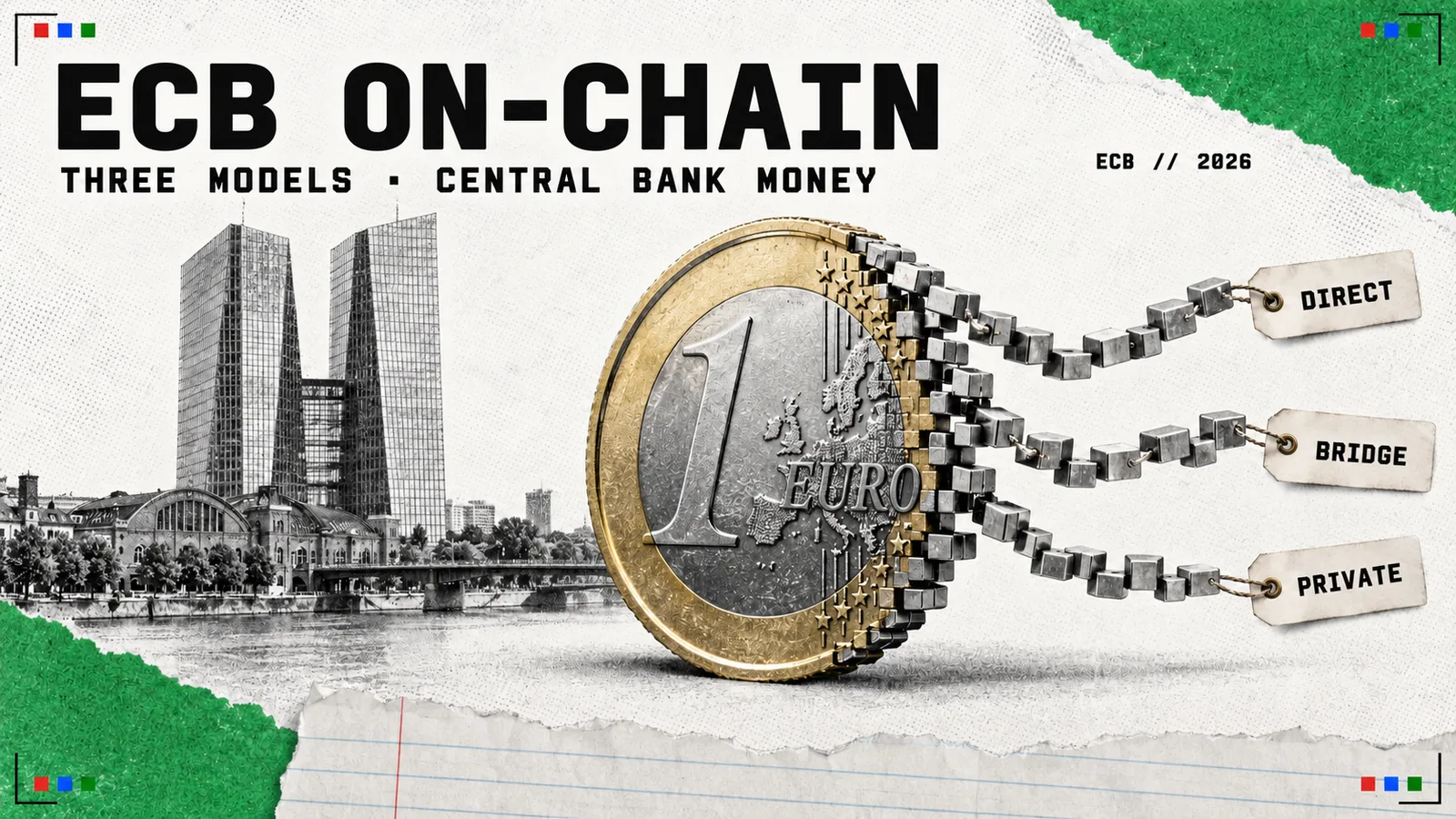
What are the three models?
Schnabel’s three models, on slide 7 of her 1 October 2026 deck and in her 28 August speech, differ in where a central bank’s reserves sit: on the ledger itself, in today’s payment system, or with a private firm that issues tokens against them. Reserves are the money commercial banks hold at the central bank, and banks use them to settle with one another. They move today through a real-time gross settlement system, or RTGS, which for the euro is T2, part of the Eurosystem’s TARGET Services.
| Model, as labelled on the slide | How it works | What pays for a trade on the ledger |
|---|---|---|
| Direct issuance | “Programmable platform with tokenised reserves”, issued by the central bank | Tokenised reserves, a direct claim on the central bank |
| Bridging / synchronisation | “Interoperability layer connects RTGS to DLT platform”, through a trigger or a hash-link, two ways of synchronising the payment with the trade on the ledger | Central bank money, settled off-chain in the RTGS |
| Private intermediary | “Private intermediary tokenises reserves” held in an omnibus account at the central bank | “Settlement tokens fully backed by central bank reserves”, a private claim |

Duffie’s paper lists four approaches. Schnabel’s slide takes his first three; the fourth, stablecoins backed by government-quality assets, she treats on its own.
Why does Schnabel back direct issuance?
Schnabel told the Jackson Hole symposium on 28 August 2026 that “only under the first option will central bank reserves be natively tokenised”, and that this would let a central bank run its own operations on the ledger. The stakes, in her words: “This choice will determine the extent to which central banks will participate in, rather than merely support, the next generation of financial market infrastructures.”
Her objection to the private intermediary is about what the token is: “the token is a private law liability backed one-for-one by central bank reserves held in the omnibus account”, so its value “depends on the continued operational, financial and legal soundness of the intermediary.” The central bank becomes “just a passive balance sheet counterparty and gatekeeper on eligibility”, she said, and the same holds for the bridge, where “the cash leg of a DLT-based transaction continues to be settled in traditional central bank money off-chain.”
Direct issuance gives the central bank tools on the ledger. Schnabel said that “if the central bank issued tokenised reserves itself, it could conduct monetary policy operations natively on the DLT platform, using smart contracts.” A repo, the central bank’s standard loan of reserves against collateral, could then settle atomically, both legs at once, with the collateral rules built into the settlement. She cited Project Pine, a study by the New York Fed and the BIS Innovation Hub, as showing smart contracts could make policy implementation “nimbler and more efficient”.
Her conclusion was “a strong case for central bank money itself becoming a native programmable asset”. In a footnote she leaves room for the private model: omnibus-account arrangements with sound governance “could coexist with on-chain central bank money”.
Why does Schnabel rate central bank money above stablecoins?
Schnabel rates central bank money above stablecoins because a central bank can expand its supply in a panic: on 28 August 2026 she set two tests for a settlement asset, that it is safe and that “its supply must be able to expand elastically in response to changes in liquidity demand”. She accepts that a carefully built stablecoin, such as Duffie’s proposed coin backed by floating-rate government securities, could pass the first test. The second is where the central bank comes in: in a panic, it can create reserves to meet demand.
In the panic of 1907, before the Federal Reserve existed, the interest rate on call money at the New York Stock Exchange reached 100 per cent a year. In the Covid-19 pandemic, the ECB’s own chart shows its total assets growing from about 40 per cent of euro area GDP in January 2020 to more than 65 per cent by autumn 2021, while the repo rate, plotted as a 7-day moving average, stayed around minus 0.5 to minus 0.6 per cent for most of that time.

Financial markets “can only scale safely if transactions settle in a risk-free asset that can be supplied elastically”, Schnabel said at Jackson Hole. “Central bank money is uniquely suited to assuming that role.” She calls stablecoins “complements to central bank money” that can widen the payment choices open to households and firms, and said Duffie “rightly recognises that stablecoins cannot replace central bank reserves” as the ultimate settlement asset.
Pontes is live, and filed under wholesale CBDC
Pontes went live on 21 September 2026, and Schnabel’s London slide now says “Launched on 21 September 2026, offering dual settlement model via TARGET2 or DLT”, where her Jackson Hole slide had “Launch: Q3 2026”. The ECB’s Governing Council approved the agreement for the initial launch on 11 August 2026, and on 11 September the Market Infrastructure Board recommended keeping the scheduled date of 21 September, according to the Council’s decisions summary of 2 October 2026.
Pontes sits between Schnabel’s models. Her slide says it “combines bridge solution with Eurosystem DLT to offer tokenised CB money”: a bridge to T2, the euro’s RTGS (the slide calls it TARGET2), as in model 2, runs alongside a Eurosystem-run ledger where trades settle in tokenised central bank money, which the ECB’s Pontes page calls “cash tokens”. She said at Jackson Hole that “although the name Pontes literally suggests a bridge, it goes far beyond synchronisation”. At launch, final settlement of the cash leg happens in T2, according to the ECB, and Schnabel said “settlement finality will ultimately be on the Eurosystem DLT platform itself.” The planned enhancements are “24/7 availability and decentralised programmability”, and Piero Cipollone, another Executive Board member, said on 26 August: “By mid-2028, we plan to offer a 24/7 service as well as greater programmability”.
In the London deck’s new map of settlement assets, the “Digital euro project” sits under retail CBDC and the “Pontes and Appia projects” under wholesale CBDC, central bank digital money for financial institutions. Tokenised deposits and stablecoins are the private settlement assets on the same map.

What comes next?
The Eurosystem’s long-term design for tokenised markets is the work of Project Appia, whose blueprint the Eurosystem aims to deliver by 2028, according to the Appia paper of March 2026. Appia asks a second question, separate from the three models: how many ledgers, and who runs them. Appia explores a range of architectures, which Schnabel’s London deck draws as a “Single unified ledger”, “Interconnected networks” and “Multiple shared ledgers”. On that choice Schnabel said in August that “it remains an open question which architecture is best suited to maximise the benefits of tokenisation”, while leaning towards well-linked ledgers over a single one.
The Eurosystem selected 61 market stakeholders and public institutions for an Appia contact group on 19 August 2026, and the group was due to begin work in September 2026. The Bank of England, the conference host, is building model 2 for sterling: it committed in May 2026 to a live synchronisation service targeted for 2028.
| Date | What happens |
|---|---|
| 11 August 2026 | Governing Council approves the Pontes launch agreement |
| 28 August 2026 | Schnabel sets out the three models at Jackson Hole |
| 21 September 2026 | Pontes launches |
| 1 October 2026 | Schnabel’s London slides mark Pontes as launched |
| By mid-2028 | Pontes plans a 24/7 service |
| By 2028 | The Eurosystem aims to deliver Project Appia’s blueprint |
Schnabel steps down from the ECB on 3 January 2027, the bank announced on 24 September 2026. The same day, IMF Managing Director Kristalina Georgieva announced her intention to appoint Schnabel as the Fund’s Financial Counsellor and Director of its Monetary and Capital Markets Department, effective 4 January 2027. Schnabel ended her Jackson Hole speech by calling for central bank money to be brought “into the tokenised environment”, adding: “This is precisely where the ECB is heading with its Pontes and Appia projects, paving Europe’s path towards a tokenised financial system.”
Questions people ask
- What are the three models for central bank money on-chain?
- Isabel Schnabel's slide of 1 October 2026 names three. Direct issuance puts tokenised central bank reserves on a programmable platform, so the reserves themselves live on the ledger. Bridging or synchronisation links the central bank's existing payment system to a programmable platform, and the reserves stay in that system. A private intermediary holds reserves at the central bank and issues settlement tokens backed by them, so each token is a private claim. The options come from Darrell Duffie's Jackson Hole paper.
- Which model does the ECB use today?
- The ECB's Pontes service, launched on 21 September 2026, combines a bridge to T2, the Eurosystem's real-time gross settlement system, with a Eurosystem ledger carrying tokenised central bank money, according to Schnabel's slides of 1 October 2026. Her Jackson Hole speech of 28 August 2026 argues for direct issuance, under which reserves are natively tokenised. The Eurosystem's long-term design is being worked out under Project Appia, whose blueprint it aims to deliver by 2028.
- Who is Isabel Schnabel?
- Isabel Schnabel is a member of the European Central Bank's Executive Board and Governing Council. The ECB announced on 24 September 2026 that she will step down on 3 January 2027, and the IMF intends to appoint her Financial Counsellor and Director of its Monetary and Capital Markets Department from 4 January 2027. She set out her case for central banks going on-chain at Jackson Hole on 28 August 2026 and in slides for a Bank of England conference on 1 October 2026.
Sources
- ECB: Central banks on-chain, slides by Isabel Schnabel for the Bank of England's Future of Money conference, 1 October 2026ecb.europa.eu
- ECB: Central banks on-chain, speech by Isabel Schnabel at the Jackson Hole Economic Policy Symposium, 28 August 2026ecb.europa.eu
- ECB: Central banks on-chain, slides for the Jackson Hole speech, 28 August 2026ecb.europa.eu
- Federal Reserve Bank of Kansas City: Darrell Duffie, Tokenized Finance and The Perimeter of Central Bankingkansascityfed.org
- Bank of England: Future of Money conference in celebration of Charles Goodhart, 1 October 2026bankofengland.co.uk
- Bank of England: The Future of Money 2026, conference programmebankofengland.co.uk
- ECB: Eurosystem brings central bank money to tokenised finance, 21 September 2026ecb.europa.eu
- ECB: Pontes, TARGET Servicesecb.europa.eu
- ECB: Decisions taken by the Governing Council (in addition to decisions setting interest rates), 2 October 2026ecb.europa.eu
- ECB: Piero Cipollone, speech of 26 August 2026ecb.europa.eu
- ECB: Appia, paving the way for a future-ready, integrated financial ecosystem, March 2026ecb.europa.eu
- ECB: Eurosystem selects members for the Appia contact group, 19 August 2026ecb.europa.eu
- ECB: Executive Board member Isabel Schnabel to resign to take senior role at IMF, 24 September 2026ecb.europa.eu
- Bank of England: FCA and Bank of England set out shared vision for tokenisation in UK wholesale markets, May 2026bankofengland.co.uk
- ECB: press photos, Pontes go-live event, 21 September 2026ecb.europa.eu